The budget line
What survives at this price, and what quietly disappears
Spend less than $100 on a knife set and three things are normally the first to go: forged construction, full tang handles and an itemized contents list. Manufacturers cut whichever of the three costs them the most to keep, and most cut all three at once — you get a stamped blade, a handle that is glued or pinned rather than riveted through the full length of the steel, and a listing that tells you a piece count and nothing else. That is not automatically a bad knife. A thin stamped blade sharpens easily and plenty of home cooks are perfectly happy with one for years. But it is a different product from what the box implies, and under $100 you have to read past the headline number to tell which one you are getting.
The three sets below are the exception worth noticing, not because they are expensive-feeling imitations, but because each one publishes at least one of the three details that usually disappear at this price. Amazon Basics states full tang construction outright. Martha Stewart's Lockton line and the Cuisinart C77WTR-15P both state forged blades — genuinely unusual under $100, where stamped is the default. None of them pretend to be something costing three times as much. They just don't hide what they are.
What a $100 budget still buys
Real steel, real tang, real published specs
High-carbon stainless is standard even at the low end, because the raw material cost difference between it and a lower grade is small. What costs money is the labor: hammering a blade instead of stamping it, riveting a handle through a full tang instead of molding plastic around a stub. Two of the three sets here absorb that labor cost at $84.99 and $85.49 — a genuine signal that corners were cut elsewhere, likely in marketing spend or handle materials, rather than in the blade itself.
What it usually can't
Matched sets, warranties, and itemized boxes
What you typically give up under $100 is consistency across the set — every knife ground to the same angle by the same process — and the kind of lifetime warranty a $300 German set carries. You also often lose the manufacturer's own itemized breakdown of the box. A "14-piece" or "16-piece" claim on its own tells you nothing about how many of those pieces are knives you will use weekly versus steak knives you will use twice a year.
Construction
Full tang at this price: why it matters, and how to check
The tang is the part of the blade's steel that extends back into the handle. On a full-tang knife, that steel runs the entire length of the handle, usually visible as a thin steel line along the top and bottom edge, held in place by rivets you can see and feel. On a partial-tang knife, the steel stops a few centimeters in and the rest of the handle is molded plastic or a glued-on cap. The practical difference is balance and durability: a full tang puts weight behind the blade so the knife doesn't feel front-heavy, and because there is no glued joint to fail, there is nothing inside the handle to crack, loosen or let water in over years of washing.
Amazon Basics states full tang construction directly in its listing title for its 14-piece set, which at $24.99 is the cheapest of the three sets here and the clearest example that full tang does not require a large budget — it requires the manufacturer to spend the extra step in assembly rather than skip it. The Martha Stewart Lockton 16-piece set goes further, pairing full tang with forged blades and triple-riveted handles, for $84.99. Between those two, full tang is confirmed in writing for both.
The Cuisinart C77WTR-15P is the instructive exception. Its listing states forged, triple-rivet construction, which in general is a strong indicator of full tang — you don't usually triple-rivet a handle onto a stub of steel, because there is nothing structural to rivet into. But the listing title does not use the words "full tang" outright, and we won't assert a spec that isn't published. If full tang construction specifically matters to your decision, confirm it on the Cuisinart listing or product photos before buying rather than assuming it from the rivet count alone. That single check — read the listing instead of inferring from adjacent details — is the habit worth building for every knife set you look at, at any price.
To check it yourself on any listing: look for the words "full tang" explicitly, or for product photos that show the blade's steel visibly running the full length of the handle with two or three rivets along it. A smooth, uninterrupted plastic handle with no visible metal is almost always partial tang, whatever the marketing copy around it claims.
Construction
Forged under $100 is unusual — here, it's the rule, not the exception
A forged blade starts as a single bar of steel that is heated and hammered into shape, which is why forged knives are typically heavier and carry a bolster — a thick collar of steel where the blade meets the handle. A stamped blade is cut from a flat sheet of steel the way a cookie cutter cuts dough: faster, cheaper, and lighter in the hand. Forging is labor-intensive, and that labor cost is usually the first thing a budget set removes. Most knife sets under $100 are stamped, and there is nothing wrong with that on its own — a stamped blade sharpens easily and does the job for most home cooks.
What's unusual here is that two of the three sets we're recommending are forged anyway. The Martha Stewart Lockton 16-piece set states forged, full-tang construction at $84.99, and the Cuisinart C77WTR-15P states forged, triple-rivet construction at $85.49. Both sit just under the $100 line and both carry the weight and bolster that forging implies, which is normally the first casualty of a budget set, not an afterthought. The Amazon Basics 14-piece set, at $24.99, does not make a forged claim in its listing, and we won't assume one — at that price, high-carbon stainless with full tang construction and a published sharpener is already a complete, honestly specified kitchen, and it should be judged on those terms rather than compared against a forged blade it never claimed to be.
The practical takeaway: if a forged blade matters to you and your budget tops out near $100, check the listing title and bullet points for the word "forged" explicitly, the way you would check for "full tang." Absence of the word is itself information. Sets that have gone to the expense of forging almost always say so, because it's the one detail in this price range that justifies charging more than a stamped competitor.
What's actually in the box
Read the contents list, not the piece count
"14-piece," "15-piece" and "16-piece" are the three numbers on the sets in this guide, and on their own they tell you almost nothing. A piece count bundles knives, a block, a sharpener and sometimes shears and steak knives into one headline figure, and two sets with the same number can split that very differently — one might give you seven knives and a block, another five knives, six steak knives and a pair of shears. The number sells the box. The list sells the knife.
This is where piece count becomes actively misleading rather than just vague: a 16-piece set is not necessarily "more knife" than a 14-piece set, because the extra two pieces could be anything from a genuinely useful boning knife to a second sharpening slot you'll never touch. Before comparing two sets on their headline number alone, open both listings and read the itemized contents — most manufacturers list exactly what's included further down the page or in the product images, even when the title only gives a total. If a listing doesn't break the count down anywhere, treat that as a mark against it, the same way you'd treat a missing ingredients list on food packaging.
Of the three sets here, each publishes a specific total — 14, 15 and 16 pieces respectively — but the honest next step before buying any of them is the same: open the Amazon listing and check the exact breakdown of knives versus block versus extras for your specific needs, rather than assuming more pieces means a better set. A cook who only reaches for a chef's knife, a paring knife and a bread knife gets no extra value from a sixteenth piece that happens to be a steak knife they already own six of.
The picks
Three sets under $100 that publish what they're made of
01Forged & full tang
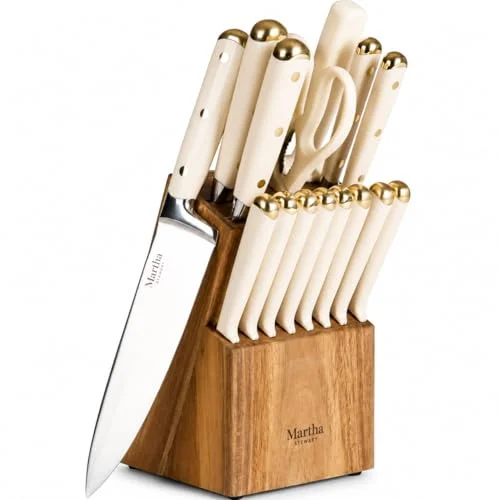
Martha Stewart Knife Block Set, 16-Piece
Best for forged steel closest to the $100 ceiling
16 pieces·Forged, full tang·Triple-riveted handles·Acacia wood block
The Lockton line from Martha Stewart states forged, full-tang chef's knives with triple-riveted handles, housed in an acacia wood block finished in linen white and gold. At $84.99, it combines the two details — forged and full tang — that most often disappear together once a set drops under $100, and states both outright rather than leaving them to be inferred from photos.
The set to buy if forged weight and a true full tang both matter to you, and $85 is still inside budget.
02Forged value
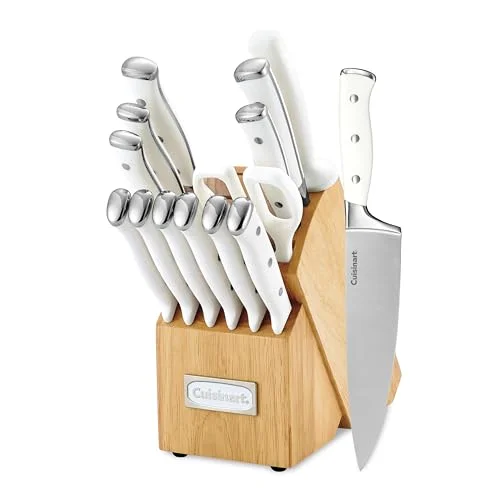
Cuisinart C77WTR-15P Forged Triple Rivet
Best value from a known name, if you confirm tang yourself
15 pieces·Forged, triple rivet·High-carbon stainless
Cuisinart's C77WTR-15P states forged, triple-rivet construction in high-carbon stainless for $85.49 — forged blades at this price are the exception, and Cuisinart is a name you don't have to take on faith. What the listing title doesn't state outright is full tang; the triple rivets are a strong hint of it, but not a published confirmation, so if that specific detail is the deciding factor, check the listing photos before buying rather than assuming it.
The set to buy for forged steel from a known brand — just verify full tang on the listing if that detail is non-negotiable for you.
03Lowest entry price
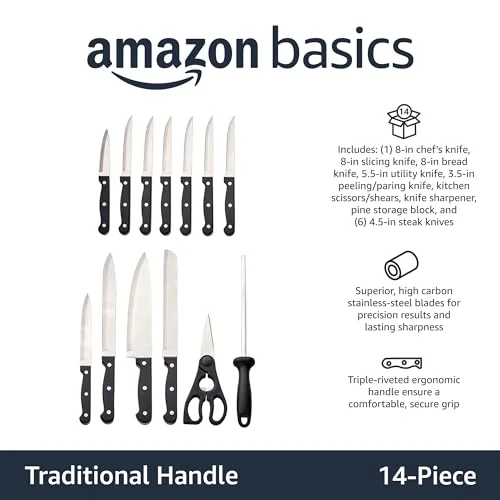
Amazon Basics 14-Piece Knife Set
Best for full tang at the lowest price on this page
14 pieces·Full tang·High-carbon stainless·Sharpener & pinewood block included
At $24.99, this is a quarter of the budget this guide allows, and it still states full tang construction and ergonomic handles in high-carbon stainless, with a built-in sharpener and a pinewood block included. It does not claim forged blades, and we take it at its word on that rather than assume one; what it does claim, it claims plainly. For a first kitchen, a second home or a backup set, that is a complete, honestly specified knife block for less than the cost of one premium chef's knife alone.
The set to buy if full tang matters more to you than forging, and the rest of your budget is going elsewhere.
Side by side
The three, compared
| Set | Best for | Pieces | Construction | Price | Get it |
|---|
 Martha Stewart Lockton 16-Piece Martha Stewart Lockton 16-Piece |
Forged + full tang together |
16 |
Forged, full tang |
$84.99 |
Get it |
 Cuisinart C77WTR-15P Cuisinart C77WTR-15P |
Forged value, known brand |
15 |
Forged, triple rivet |
$85.49 |
Get it |
 Amazon Basics 14-Piece Amazon Basics 14-Piece |
Lowest price, full tang |
14 |
Full tang, high carbon |
$24.99 |
Get it |
Prices change. We refresh them, but Amazon is the authority at the moment you buy. See the full six-set roundup if your budget stretches past $100.
The counter-argument
When to buy three good knives instead of a block
Everything above assumes you want a block set, and for most kitchens that's the right assumption — a block is tidy, a sharpener in the slot gets used precisely because it's already there, and the price per knife drops the more pieces are in the box. But it's worth asking honestly what you actually reach for. In nearly every home kitchen, the answer is three knives: an 8-inch chef's knife for almost everything, a small paring knife for the jobs the chef's knife is too big for, and a serrated bread knife, because a straight edge crushes a loaf rather than slicing it. Everything else in a 14-, 15- or 16-piece set — the santoku, the slicer, the six steak knives, the shears — is either a duplicate of one of those three or an occasion you'll reach for a handful of times a year.
If that describes your cooking, the math changes. Spreading $100 across three knives you'll actually use every week buys meaningfully better steel per knife than spreading the same $100 across fifteen pieces, most of which sit in the block untouched. None of the three sets in this guide are sold as a three-piece set, so we won't recommend a specific one for this path — that would mean asserting a product we haven't verified. What we can say is the decision rule: if you can name the three knives you used last week and they're the same three you used last month, a smaller, better-made set of exactly those three is worth pricing out separately before you buy a block built around a number instead of your actual habits.
The reverse is also true. If you cook for a household that bakes, carves roasts, and occasionally needs a boning knife or kitchen shears, the block earns its keep, and the sets above are a genuinely good way to get full tang or forged steel into that box without spending past $100.
Our method
How we picked — and what we can't tell you
What we did
Specs, prices and published listings
We compared published specifications and current Amazon prices for kitchen knife sets sold in the US under $100, then narrowed the list to sets whose listings explicitly state something checkable — full tang, forged construction, or a specific piece count — rather than relying on adjectives like "razor-sharp" or "professional-grade" that no listing can substantiate on its own.
What we didn't
We don't run a testing lab
We do not physically test these knives, we do not own them, and we do not publish invented scores or star ratings. We have no verified review data for these specific products, so we don't paraphrase owner sentiment either. What we can do honestly is read every published specification, compare them against each other, and tell you plainly which claims are checkable and which are marketing.
FAQ
Common questions
What does "full tang" mean, and how do I check it before buying?
The tang is the part of the blade's steel that extends into the handle. On a full-tang knife, that steel runs the entire length of the handle and is usually riveted in place, visible as a thin metal line along the top and bottom edge. To check before buying, look for the exact phrase "full tang" in the listing, or for product photos that show steel running the full length of the handle. A smooth plastic handle with no visible metal is almost always partial tang, whatever the surrounding copy claims.
Why is a forged blade unusual under $100?
Forging means hammering a blade from a single bar of steel, which is labor-intensive compared with stamping a blade from a flat sheet. That extra labor cost is usually the first thing a budget set removes, which is why most sets under $100 are stamped. The Martha Stewart Lockton set ($84.99) and the Cuisinart C77WTR-15P ($85.49) are the exception here — both state forged construction in writing, just under the $100 line.
Does a bigger piece count mean a better set?
Not on its own. A "16-piece" set and a "14-piece" set can both bundle knives, a block, a sharpener and extras very differently, and a higher number sometimes just means more steak knives rather than more useful knives. Before comparing two sets on their headline total, open both listings and check the itemized breakdown of what's actually included, rather than assuming more pieces automatically means more value.
Should I just buy three good knives instead of a full block set?
If you can name the three knives you reached for last week — almost always a chef's knife, a paring knife and a bread knife — and they're the same three you reach for every week, then spreading your budget across three well-made knives instead of fifteen mixed pieces can buy better steel per knife you'll actually use. If your cooking regularly needs a boning knife, shears or steak knives too, a block set earns its piece count.
Keep reading
Related on Best Knife Sets