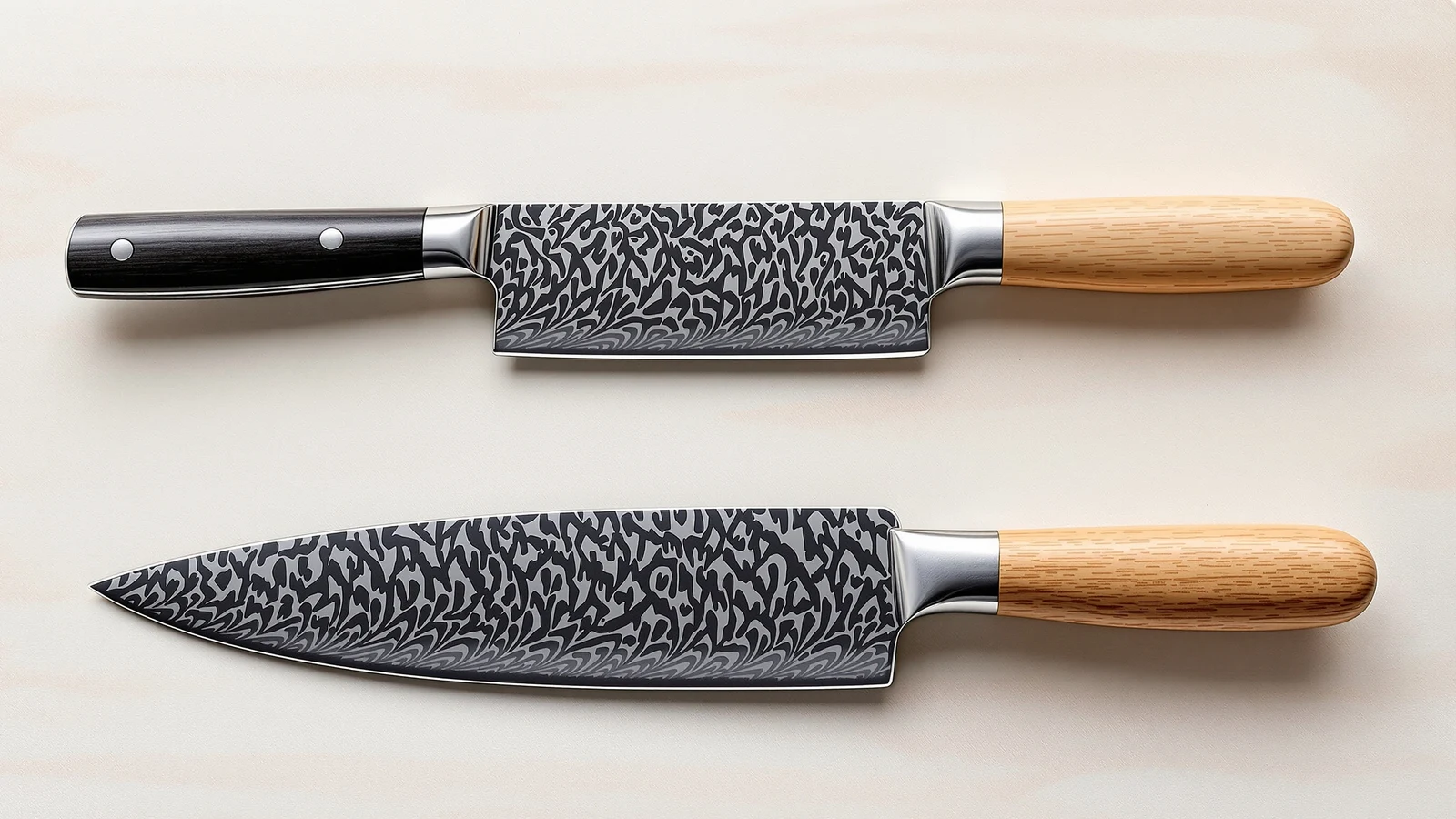
The two listings
Two listings, the exact same price, and one variable between them
Yatoshi Knives Magnetic Kitchen Knife Block Set exists as two separate Amazon listings, and the strange part isn’t that they’re similar — it’s that they’re priced identically. Both are $189.99. Both are six pieces. Both state a VG-10 cutting core enveloped by 67 layers of stainless-steel Damascus cladding, both state a Rockwell hardness of 60-61, and both describe a meticulously hand-shaped Japanese double bevel at 16 degrees on each side. Read the “High-Quality Blades” bullet on either listing and the wording is close to identical. That is, by itself, worth noticing: brands frequently charge a premium for a wood handle over a composite one, or vice versa, and Yatoshi charges neither set a cent more than the other.
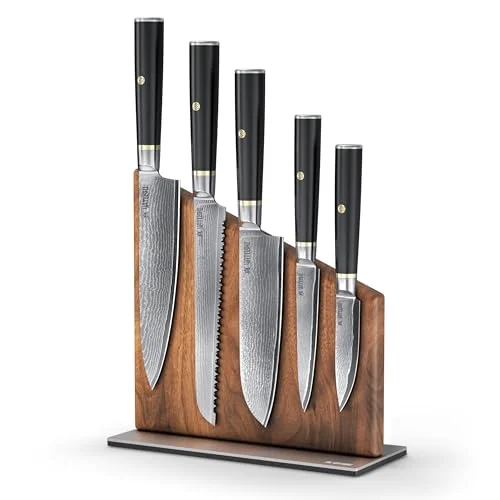
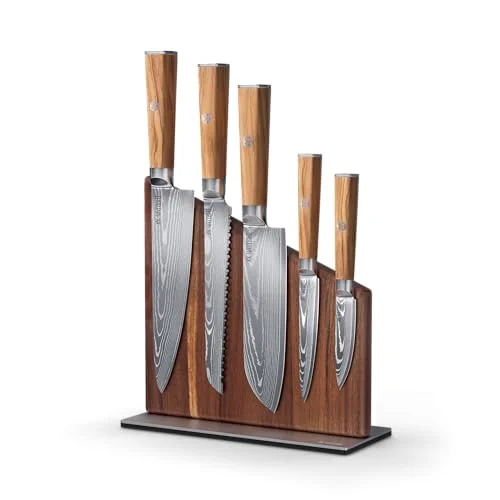
What does change is the handle, and what comes bundled with it. One listing is built around a G10 handle in a black-and-gold finish and ships with a walnut wood magnetic block. The other swaps in an olive wood handle and ships with an acacia wood magnetic block instead. Both blocks are described the same way otherwise — double-sided and magnetic, with an anti-skid pad to keep the block steady on a countertop. Both handles are built with what Yatoshi calls a concealed-tang design, meaning the steel that runs back from the blade into the handle is hidden inside the material rather than exposed as a visible full-tang strip with through-rivets. Neither listing publishes a star rating or a review count we can verify, so we won’t paraphrase owner sentiment that doesn’t exist on either page — this comparison runs entirely on what both listings state in writing.
What's identical across both
The blade, the price, and the construction method
VG-10 core, 67-layer Damascus cladding, 60-61 Rockwell, a 16° double bevel per side, a concealed-tang handle, a double-sided magnetic block with an anti-skid pad, and a $189.99 price. Every one of those lines reads the same on both listings.
What actually changes
The handle material, and the wood it's paired with
One set: a G10 fiberglass composite handle in black and gold, with a walnut block. The other: an olive wood handle, with an acacia block. That's the entire list of stated differences between a $189.99 purchase and the other $189.99 purchase.
Option one
The G10 handle, paired with a walnut block
G10 is a laminated fiberglass composite built by layering woven glass cloth with epoxy resin under heat and pressure, and it has been a standard handle material on working knives for decades precisely because it is not wood — it does not have grain, it does not absorb water, and it cannot swell, crack or warp the way a natural material can. Yatoshi's listing calls it a “textured fiberglass composite” and pairs it with the black-and-gold color option, finished with the concealed-tang construction described above. The texture is molded into the material itself rather than carved or sanded, which is the usual way G10 handles stay grippy when wet without needing a raised pattern cut into the surface afterward.
On grip, G10's main advantage over a polished wood handle is consistency: the same molded texture is there in a dry kitchen in January and a humid one in July, because the material itself doesn't respond to moisture the way wood does. On maintenance, that same inertness is the whole case for it — a composite handle doesn't need periodic oiling, doesn't need to be kept out of standing water for its own sake, and won't develop the fine surface checking that dry wood sometimes does over years. Yatoshi's own listing describes the result as “low-maintenance,” which is a fair characterization of the material in general, even though it's a marketing adjective rather than a figure we can independently check. On look, G10 reads as deliberately modern and workshop-grade: flat black with the gold accenting named in the listing's color field, no grain, no two handles subtly different from each other the way a natural material produces.
The block that ships with this set is walnut — a dense, tight-grained hardwood commonly used in knife blocks and cutting boards for its dark, even color and its resistance to the day-to-day dings a block takes on a countertop. Yatoshi describes it as double-sided and magnetic, with an anti-skid pad built in, matching the description given for the acacia block on the olive-wood set. The pairing itself is a small but deliberate styling choice: a composite black handle set against a dark walnut block, rather than against the lighter wood the other listing uses.
Option two
The olive wood handle, paired with an acacia block
The second listing swaps the G10 handle for one made from olive wood, keeping the same concealed-tang construction underneath. Olive wood is a dense hardwood long used for kitchenware and knife handles, prized mainly for how it looks: a warm, honey-to-brown base color running through with darker swirling grain lines, and because it's a natural material, no two handles carry exactly the same pattern. Yatoshi's listing names the color simply as “Olive” and, like the G10 set, describes the handle as low-maintenance and built for a secure grip — again, a characterization we can't independently verify, though it's consistent with how dense hardwood handles generally behave in a kitchen.
On grip, a wood handle like olive doesn't rely on a molded texture; it relies on the handle's shape and the natural slight tooth of the wood grain itself, and most owners of wood-handled knives find that grip perfectly secure as long as the handle is dry. On maintenance, that's the real trade-off against G10: wood handles, olive included, generally do better hand-washed and dried immediately rather than left wet in a sink, and most woodworking and cutlery guidance recommends an occasional light oiling to keep a wood handle from drying out over years of washing — a step a composite handle simply doesn't need. On look, this is the handle to choose if the warm, grain-forward aesthetic of real wood is part of why you want a set like this in the first place; it's a different visual language from G10's flat, modern black entirely.
The block paired with this handle is acacia wood rather than walnut — another dense hardwood, generally lighter in tone than walnut and known for prominent, often two-toned grain, commonly used in cutting boards and knife blocks for the same reasons: durability on a countertop and a warm, natural look. Like the walnut block, Yatoshi describes it as double-sided, magnetic, and fitted with an anti-skid pad. The styling logic here mirrors the G10 set in reverse: a natural wood handle set against a natural wood block, both in warmer tones than the composite-and-walnut pairing.
Under the handle
What doesn't change, no matter which handle you pick
Strip the handle and the block out of the comparison and what's left is, on paper, one knife sold twice. Both listings state a VG-10 cutting core — a Japanese stainless steel widely used in higher-end kitchen cutlery for its ability to take and hold a fine edge — wrapped in 67 layers of stainless-steel Damascus cladding. The cladding's job is mostly structural and visual rather than functional: it's softer, more flexible steel folded around the harder VG-10 core, which protects that core from chipping on side impact and produces the wavy Damascus pattern visible on the blade face. Both listings state the same layer count, so neither handle option is paired with a different grade of cladding or a thinner wrap.
Both also state a Rockwell hardness of 60-61 for the core. That number sits toward the harder end of what's common in kitchen cutlery — harder than the mid-fifties range typical of many Western-style stamped knives, which generally trades some edge retention for easier sharpening and a bit more forgiveness against a bone or a frozen edge. A core in the 60-61 range should, in principle, hold a sharpened edge longer between touch-ups, in exchange for being less forgiving of the kind of lateral stress a thin edge takes when it meets something hard it shouldn't. That trade-off applies equally to both sets, since the stated hardness doesn't change with the handle.
And both state the same edge geometry: a Japanese double bevel ground to 16 degrees on each side, described on both listings as meticulously hand-shaped. A double bevel means the edge is ground symmetrically on both faces of the blade, as opposed to a single-bevel edge ground almost entirely on one side, which is more common on traditional single-edge Japanese blades like a yanagiba. Sixteen degrees per side is a narrow angle by Western standards — many German-style kitchen knives sit closer to 20 degrees per side — and a narrower angle generally means a finer, sharper-feeling edge that's also less forgiving of hard contact than a wider one. That geometry is the one part of either knife that no handle choice touches at all; it's ground into the steel itself before either handle is ever attached.
The actual decision
The pick, by which material survives your sink habits
Because the blade, the price and the block mechanism are identical, this comparison reduces to one honest question: how do you actually treat a knife handle day to day? If knives in your kitchen routinely sit in a sink full of water for a while before they get washed, or your kitchen runs humid, or you'd rather not think about oiling a handle on any kind of schedule, the G10 set is the more forgiving choice. A fiberglass composite handle doesn't care how long it sits wet, because there's no grain for water to work into and nothing to dry out over time the way a natural material can.
If you hand-wash and dry your knives promptly as a matter of habit, and the warm, grain-forward look of real wood is part of why you're drawn to a set like this at all, the olive wood handle gives you that look without asking for much in return — just the ordinary care any wood-handled knife benefits from, and an occasional light oiling if you want to keep the finish looking fresh for years rather than just months. Neither choice is the objectively better knife, because under the handle there isn't a knife to choose between — VG-10 core, 67-layer cladding, 60-61 Rockwell and a 16-degree double bevel are the same spec sheet twice. This is a decision about maintenance habits and countertop aesthetics, priced by Yatoshi as if that decision were worth exactly nothing either way.
The picks
Both Yatoshi six-piece sets, by who each one actually suits
01Low-maintenance composite
Yatoshi Knives Magnetic 6-Piece Set, G10 Handle, Black Damascus
Best for a kitchen where handles sit wet or humid conditions are routine
VG-10 core·67-layer cladding·60-61 HRC·G10 handle · Walnut block
The same stated core steel, cladding and edge geometry as the olive wood set, in a textured black-and-gold G10 handle that doesn't need oiling and isn't affected by sitting wet the way a natural material can be. Ships with a double-sided magnetic walnut block and an anti-skid pad, at the identical $189.99 price as the alternative handle.
The set to buy if you want one less thing to maintain and don't mind trading wood's warmth for a flat, modern finish.
02Warm, natural finish
Yatoshi Knives Magnetic 6-Piece Set, Olive Wood Handles
Best for the grain-forward wood look, if you hand-wash and dry promptly
VG-10 core·67-layer cladding·60-61 HRC·Olive wood handle · Acacia block
The identical stated core steel, cladding and edge geometry as the G10 set, finished instead with a natural olive wood handle, each one carrying its own grain pattern, and a double-sided magnetic acacia block with the same anti-skid pad. Also $189.99 — Yatoshi charges nothing extra for the wood.
The set to buy if the warmth and grain of real wood is the point, and you're already in the habit of drying knives promptly.
Side by side
The two Yatoshi sets, compared
| Set | Best for | Core & edge | Handle | Block | Price | Get it |
|---|
 G10 Handle, Black Damascus |
Low-maintenance, humid kitchens |
VG-10, 67-layer, 60-61 HRC, 16° double bevel |
G10 composite |
Walnut |
$189.99 |
Get it |
 Olive Wood Handle |
Warm natural finish, careful drying |
VG-10, 67-layer, 60-61 HRC, 16° double bevel |
Olive wood |
Acacia |
$189.99 |
Get it |
Prices change. We refresh them, but Amazon is the authority at the moment you buy. Our McCook sets compared guide covers a different brand facing the same question — two listings, one price, specs that don't explain a gap because there mostly isn't one.
Our method
How we compared — and what we can't tell you
What we did
Both listings, line by line, against each other
We compared the published titles, feature bullets and current Amazon prices for both Yatoshi six-piece magnetic sets, matching each stated spec — core steel, cladding layer count, Rockwell hardness, bevel angle, handle material, block wood — against its counterpart on the other listing. Where both listings state the same figure, we treated it as genuinely identical. Where a listing used a subjective word like “low-maintenance” without a checkable figure behind it, we said so rather than treating it as a verified fact.
What we didn't
We don't run a testing lab, and neither listing has review data
We do not physically test these knives, we do not own them, and we do not publish invented scores or star ratings. Neither Yatoshi listing carries a public star rating or review count we could verify at the time of writing, so we have no owner sentiment to paraphrase for either set and we haven't invented any. What we can do honestly is read every published word on both listings, set them against each other, and tell you plainly which lines are identical and which ones actually differ.
FAQ
Common questions
Is one Yatoshi six-piece set more expensive than the other?
No. Both the G10-handle set and the olive wood-handle set are listed at $189.99. Yatoshi doesn't charge a premium for either handle material over the other, which is unusual — wood handles and composite handles often carry different prices on comparable sets from other brands.
What's the actual difference between the two sets?
The handle material and the wood of the magnetic block it ships with. One set has a G10 fiberglass composite handle in black and gold with a walnut block; the other has an olive wood handle with an acacia block. Both listings state the identical VG-10 core, 67-layer Damascus cladding, 60-61 Rockwell hardness and 16-degree double bevel per side.
Is G10 or olive wood the better choice if I'm not careful about drying knives right away?
G10 is the more forgiving material if knives in your kitchen sometimes sit wet for a while before washing, since it's a fiberglass composite that doesn't absorb moisture or need periodic oiling the way a natural wood handle generally does. Olive wood looks warmer and more grain-forward, but it rewards being hand-washed and dried promptly, like most wood-handled kitchen knives.
What does "concealed-tang design" mean on these listings?
The tang is the part of the blade's steel that extends back into the handle. A concealed-tang design hides that steel inside the handle material rather than leaving it visible as a full-tang strip with through-rivets along the top and bottom edge. Both Yatoshi listings use this construction, so it's identical on the G10 set and the olive wood set — it isn't something that changes with the handle choice.
Keep reading
Related on Best Knife Sets
- See both Yatoshi sets side by sideCore steel, bevel, handle, block and price, in one table.
- Jump straight to the pick by sink habitsWhich handle material actually suits how you treat a knife day to day.
- McCook Knife Sets Compared: Same Price, Different ListingsA different brand, the same pattern of two listings priced identically with specs that barely diverge.
- SHAN ZU Damascus Knife Sets Compared: 3 Pieces, 7 Pieces and a $120 GapAnother single-brand Damascus lineup, but one where the price gap is real and the core claim stays constant.
- HOSHANHO Knife Sets Compared: 5, 7 and 16 Pieces From $199 to $429A brand that does price its sizes apart, and the hardness figures behind that gap.
- Henckels Statement Knife Sets Compared: 12, 15 and 20 PiecesA German brand's own lineup, and what a bigger set actually costs per knife.
- Browse every guide on the siteThe full library of comparisons and buying guides, updated as prices change.
- Why trust this site's picksWho writes these guides and how we handle Amazon affiliate links.