The two processes
How a stamped blade and a forged blade actually get made
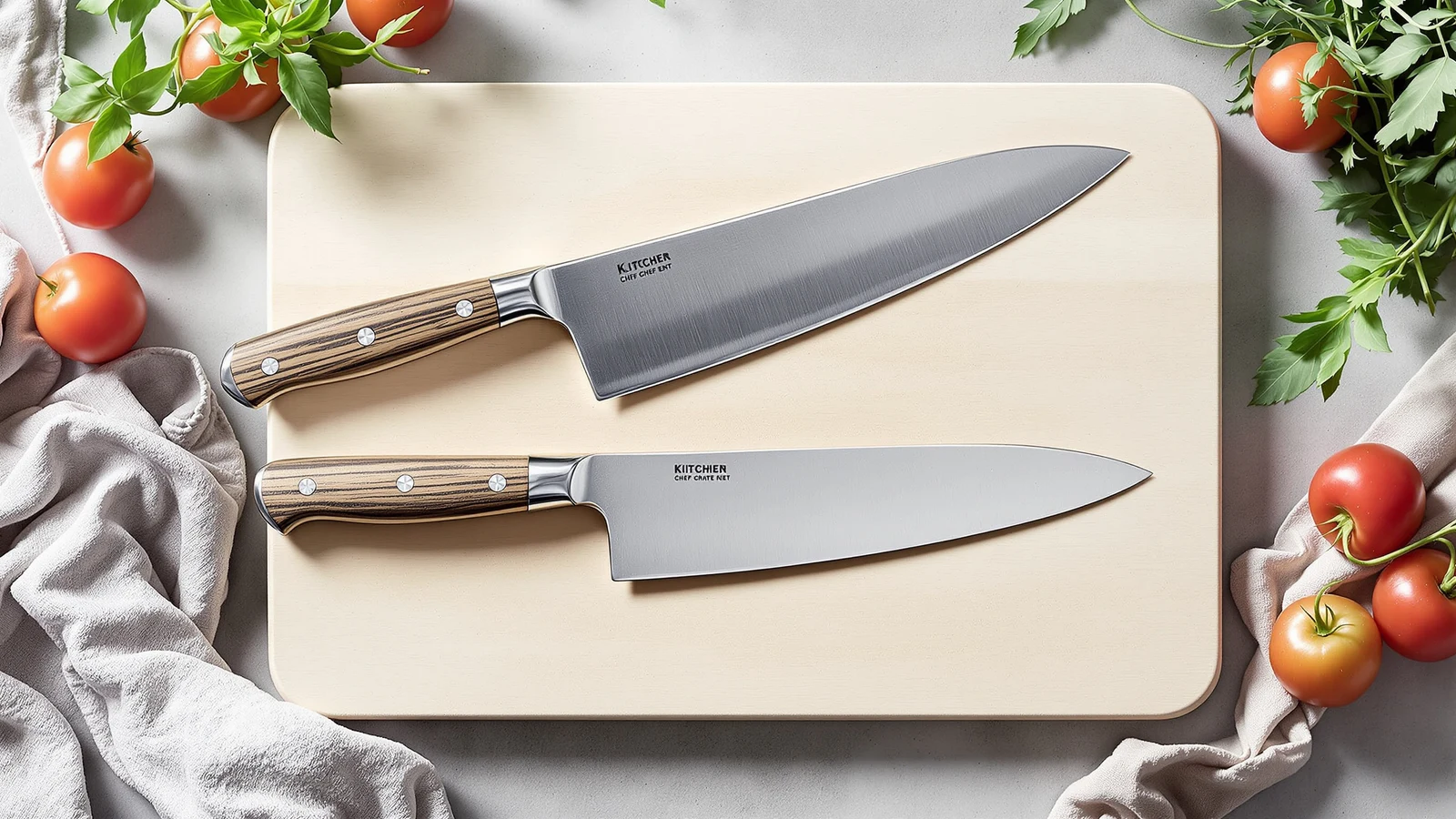
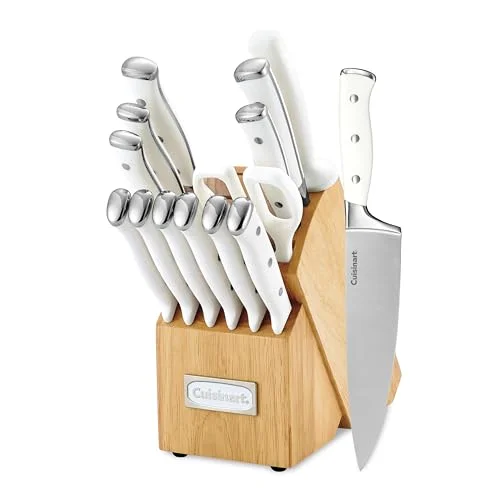
A forged blade starts as a bar of steel, heated until it glows and then hammered or pressed, under enormous force, into roughly the shape of a knife. That single bar becomes the blade, the bolster and part of the tang all at once — nothing is added or joined. From there it is ground to its final profile, heat-treated to set the hardness, tempered to remove brittleness, and sharpened. It is a slow process with a lot of manual steps, which is exactly why it costs more. The Cuisinart C77WTR-15P states this construction directly: forged high-carbon stainless steel with a triple-riveted handle, the kind of build that only makes sense once you understand where the bolster came from in the first place.
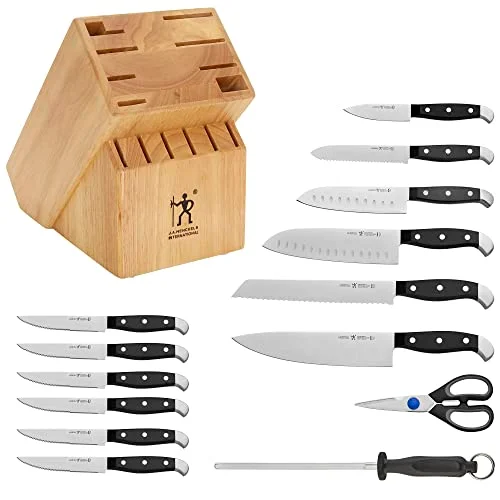
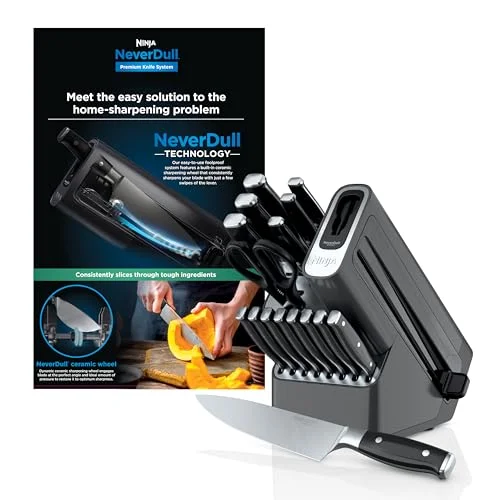
A stamped blade starts life as a flat sheet of steel, and the blade shape is cut out of it the way a cookie cutter cuts dough — a die comes down, and a knife-shaped piece of steel comes out. From there the process converges with forging: the blank is ground, beveled, heat-treated and sharpened. The difference is entirely upstream, in how the rough shape was produced, not in what happens to the edge afterward. Henckels' Statement 15-piece set and Ninja's NeverDull 17-piece set are both stamped blades, and both go through the same grinding and heat-treating steps as the forged Cuisinart once the rough blank exists.
This is the part that gets lost in knife marketing: stamping is not a shortcut taken on the edge. It is a shortcut taken on how the piece of steel was shaped before anyone ever touched a grinding wheel. Everything that actually determines sharpness — the steel's composition, the heat treatment, the final bevel — happens after the fork in the road, not before it. We get back to that in detail further down, because it is the single most misunderstood part of this whole comparison.
Construction detail
The bolster, and what it actually does
A bolster is the thick collar of steel where the blade meets the handle, and on a forged knife it is not a separate part — it is simply the section of the original steel bar that was hammered thicker instead of thinner. That is why a true bolster is almost always a feature of forged construction: it comes from having extra material in that spot to begin with, rather than from attaching something afterward. Cuisinart's C77WTR-15P specifically calls out an extra-wide bolster, which is consistent with its forged, triple-rivet build.
What the bolster is for is less obvious than what it looks like. It adds weight at the point where your hand meets the blade, which shifts the knife's balance point back toward the handle instead of out toward the tip. For a lot of cooks that makes a knife feel more stable and controlled during heavier work, like breaking down a squash or cutting through a chicken joint. It also acts as a knuckle guard, keeping your fingers from sliding down onto the sharpened edge when you choke up on the blade, and it gives a full-tang handle something substantial to be riveted into.
Stamped blades generally do not have a true bolster, because there is no extra steel sitting at that junction to begin with — the blank came off the sheet at a uniform thickness. Some stamped knives are given a bolster-shaped piece that is welded or pressed on separately, which looks similar but is not structurally the same thing; neither Henckels' Statement set nor Ninja's NeverDull set publishes a bolster claim, so we are not asserting one exists on either. What that means in practice is a straighter transition from blade to handle, less weight concentrated at that one point, and a knife that is easier to choke up close to the edge for fine work, because there is no raised guard in the way.
Ergonomics
Weight: why heavier is not better for everyone
A forged blade is, almost without exception, heavier than a stamped blade of the same size, because it carries more steel through the bolster and often through a thicker spine. Knife marketing treats that weight as an unambiguous upgrade — more steel, more substance, more "quality." For some kitchens and some hands, it genuinely is an advantage: a heavier chef's knife carries its own momentum through a stroke, so you can let gravity and inertia do some of the work when you are breaking down a large squash, splitting a chicken, or working through a long pile of vegetables. You push less, because the knife is doing more of the pushing.
For other hands, the same weight is simply fatigue. If you have smaller hands, a wrist that tires over a long prep session, or you are standing at the counter chopping for twenty minutes rather than two, a lighter blade lets you control speed and direction with less effort per cut. This is precisely the appeal Henckels leans on with its stamped Statement set: a lighter blade that stays easy to maneuver through a long session, at the cost of the heft a forged knife carries. Ninja's NeverDull set is stamped for the same reason — it is built to be used daily without becoming a chore, and a lighter blade supports that.
There is no universal answer here, and that is the honest point: "heavier means better built" is a marketing shorthand, not a rule that applies to every cook. A professional butcher breaking down whole animals for hours wants the weight. A home cook doing fifteen minutes of dinner prep most nights usually does not need it, and may find it actively tiring. The only way to know which side of that line you are on is to notice how your wrist feels after using whichever knife you currently own for a full meal's worth of chopping — not to assume the heavier set is automatically the better buy.
Pricing
What forging costs, and where that money goes
Forging is slower than stamping at every step. Heating a bar of steel, hammering or pressing it into shape, and then grinding away the irregular surface that process leaves behind all take more labor time per blade than cutting a flat shape out of sheet steel. That labor is the real cost, not the raw steel itself — the price of the metal in a forged blade and a stamped blade of similar size is close enough to be a rounding error next to the difference in machine time and hand-finishing. Cuisinart's forged C77WTR-15P sells for $91.37, which is a genuinely unusual price for forged construction; most sets that absorb that labor cost sell well above $100.
But price in this category does not track construction method cleanly, and the other two sets here prove it. Henckels' Statement set is stamped, not forged, and still costs $149.95 — more than the forged Cuisinart. That premium is not paying for a hammered bar of steel; it is paying for a century-old German engineering name, the warranty standing behind it, and the brand's own quality control on the grinding and heat-treating steps that happen after the blank is stamped out. Ninja's NeverDull set, also stamped, costs $375.00, and almost none of that price difference is about the blades at all — it is paying for the sharpening mechanism built into the block itself, a genuinely separate piece of engineering from the knives it holds.
The practical lesson: forging cost is real, and it is one of the reasons a knife set costs what it costs, but it is not the only lever manufacturers pull on price. A brand name, a warranty, a built-in sharpener, or simply a company's own quality-control standards on an otherwise ordinary stamped blank can move the price further than the forging process itself does. If you are deciding between a stamped set and a forged set on price alone, check what else that price is buying before assuming the more expensive one is the better-made blade.
What doesn't change
Edge quality: the thing that is not different
This is the claim worth being precise about, because it is the one marketing copy gets backwards most often: a forged blade is not inherently sharper than a stamped blade. Sharpness and edge retention come from the steel's composition, how it was heat-treated, and the final angle it was ground to — three things that happen after the blank exists, whether that blank was hammered out of a bar or cut from a sheet. A stamped blank and a forged blank can both be heat-treated to the same hardness and ground to the same bevel, and when that happens, they cut comparably well straight out of the box.
All three sets here support that point rather than contradict it. Cuisinart's forged C77WTR-15P is built from high-carbon stainless steel. Henckels describes the Statement set's stamped blades as razor-sharp and German engineered. Ninja states its stamped NeverDull blades use an optimised edge angle, and builds a sharpener into the block to keep that edge maintained over time. None of these three manufacturers is claiming their construction method alone is what makes the knife sharp — the sharpness claim in every case rests on the steel and the grind, not on whether the blank started as a bar or a sheet.
What forging does change, and what we have covered above, is weight, the presence of a true bolster, and usually price. What it does not reliably change is how the edge performs the day you unbox it. If sharpness is the deciding factor in your purchase, the construction method printed on the listing is not the detail to weigh most heavily — the steel type, the stated hardness where a manufacturer publishes one, and whether the set includes any way to maintain that edge over time, like Ninja's built-in sharpener, matter more.
The picks
The picks, by how a knife should feel in your hand
01Best forged feel
Cuisinart C77WTR-15P Forged Triple Rivet
Best for hands that want weight and a bolster
15 pieces·Forged, triple rivet·Extra-wide bolster·High carbon stainless steel
If what you want from a knife is the substantial, balanced feeling that comes from a forged bar of steel, this is the set that gives it to you without paying a premium for it. The triple-riveted handle and the extra-wide bolster are both direct results of the forging process covered above, and at $91.37 it is an unusually affordable way to get that construction. Choose this one if your hand likes to feel the knife's weight do some of the cutting work for you.
The set to buy if a heavier, bolstered knife feels more controlled in your hand than a light one does.
02Best stamped balance
Henckels Statement 15-Piece Block Set
Best for a lighter, all-day prep feel
15 pieces·German engineered·Stamped blades·Razor-sharp edge
Stamped construction means this set is noticeably lighter in the hand than the forged Cuisinart, which is exactly the point for anyone who finds a heavy knife tiring over a long prep session. Henckels is a German house with a century behind it, and that name is a large part of why a stamped set carries a $149.95 price — you are paying for the engineering standards and the warranty, not for a hammered bar of steel. Choose this one if your hand prefers to move quickly and lightly through a chopping board.
The set to buy if you want a name you can trust behind a blade that never feels like a burden to hold.
03Best stamped + maintained
Ninja NeverDull 17-Piece Knife Block Set
Best for a light blade you never have to sharpen yourself
17 pieces·German stainless, stamped·Sharpener built into the block·Optimised edge angle
This is the other side of the stamped-is-lighter argument taken to its logical end: a set that is light in the hand like the Henckels, but pairs that with a sharpener built into every slot, so the edge gets touched up each time the knife goes back into the block. At $375.00 it is the most expensive set here, and the price is paying for that mechanism as much as for the blades themselves. Choose this one if you want a light, easy-to-maneuver knife and never want to think about sharpening it separately.
The set to buy if a light blade appeals to you but keeping it sharp on your own does not.
All three are stamped except the Cuisinart. If forged construction and a tighter budget both matter to you, see our roundup of knife sets under $100, where forged blades at this price are the exception rather than the rule.
Side by side
The three, compared
| Set | Best for | Construction | Bolster | Pieces | Price | Get it |
|---|
 Cuisinart C77WTR-15P Cuisinart C77WTR-15P |
Weight and a bolster |
Forged, triple rivet |
Extra-wide |
15 |
$91.37 |
Get it |
 Henckels Statement Henckels Statement |
Light, all-day prep |
Stamped, German engineered |
Not stated |
15 |
$149.95 |
Get it |
 Ninja NeverDull K32017 Ninja NeverDull K32017 |
Light + self-sharpening |
Stamped, German stainless |
Not stated |
17 |
$375.00 |
Get it |
Prices change. We refresh them, but Amazon is the authority at the moment you buy. See the full six-set roundup for sets we haven't covered on this page.
Our method
How we compared — and what we can't tell you
What we did
Published construction, specs and prices
We compared the construction method, published specifications and current Amazon prices for these three kitchen knife sets, then checked each manufacturer's own claims against what forging and stamping actually involve as manufacturing processes. Where a listing states something checkable — forged, stamped, a bolster, a sharpener — we treated that as the spec. Where it doesn't state something, like a bolster on the stamped sets, we did not assume it anyway. Every set we track across the network sits in our guide index, updated as prices and listings change.
What we didn't
We don't run a testing lab
We do not physically test these knives, we do not own them, and we have no verified review data for these specific products, so we don't paraphrase owner sentiment or publish star ratings either — inventing sentiment would be the same offense as inventing a score. What we can do honestly is explain what forging and stamping actually change about a blade, and what they don't, and let that explain the price and feel differences rather than a manufactured opinion. See how we handle affiliate links and picks for more on that policy.
FAQ
Common questions
Is a forged knife always sharper than a stamped one?
No. Sharpness and edge retention come from the steel's composition, the heat treatment, and the final bevel the edge is ground to — all of which happen after the blank exists, whether that blank was hammered from a bar or cut from a sheet. Cuisinart's forged C77WTR-15P and the stamped Henckels and Ninja sets can all be ground to a comparably sharp edge; forging changes weight and the bolster, not the sharpness you get out of the box.
What does the bolster on a forged knife actually do?
It is the thick collar of steel where the blade meets the handle, formed from the same bar of steel as the rest of a forged blade rather than attached separately. It shifts the knife's balance back toward the handle, acts as a guard that keeps your fingers from sliding onto the edge, and gives a full-tang handle solid steel to be riveted into. Stamped blades, cut from a uniform sheet, generally don't have a true bolster.
Is a heavier knife better than a lighter one?
It depends on your hand and how you cook, not on which one is "better built." A heavier forged blade carries momentum through tougher cuts, like breaking down a squash or a chicken, which can mean less effort per stroke. A lighter stamped blade is easier to control through a long prep session without tiring your wrist. Neither is objectively correct; it's worth noticing how your wrist feels after a full meal's prep with whatever you currently use before assuming heavier means better.
Why does a stamped Henckels set cost more than a forged Cuisinart set?
Because price in this category doesn't track construction method alone. Forging adds real labor cost, which is part of why the forged Cuisinart C77WTR-15P costs $91.37. But the stamped Henckels Statement set costs $149.95 largely for the brand name, engineering standards and warranty behind it, and the stamped Ninja NeverDull set costs $375.00 mostly for the sharpening mechanism built into its block — not for the blades' construction method.
Keep reading
Related on Best Knife Sets