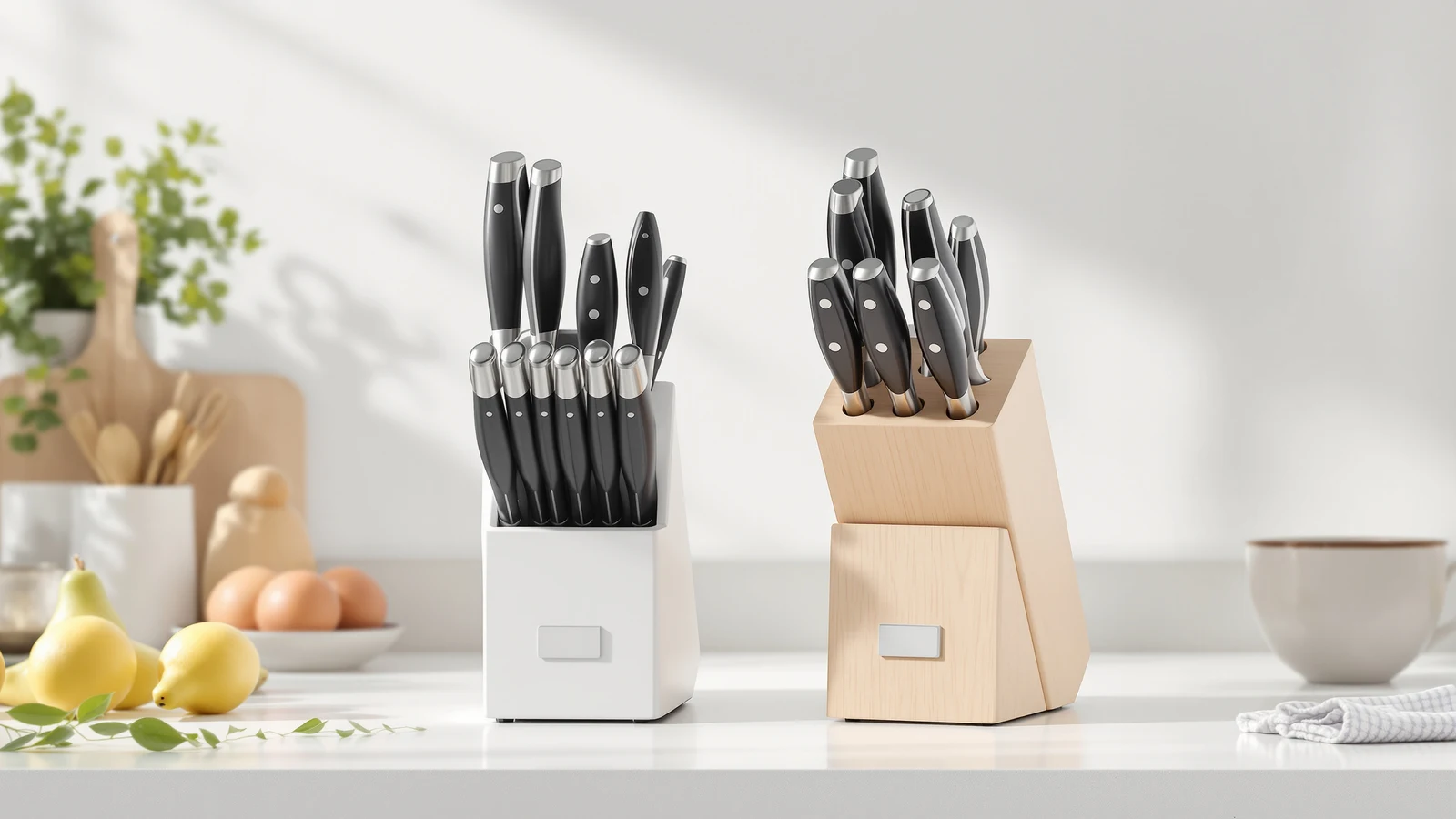
One set, two listings
One 15-piece knife set, sold twice, in two colors
The Umite Chef 15 Piece Premium Chef High Carbon Stainless Steel Kitchen Knife Block Set (White) (ASIN B0FQ4YPVKC) lists at $32.99. The Umite Chef 15 Piece Premium Kitchen Knife Block Set, Black Sharp Knife Set for Kitchen (ASIN B0FQ4XCPXS) lists at $35.99 — $3.00 more. Both titles describe the same thing in the same order: a 15-piece set, high-carbon stainless steel, razor-sharp, an ergonomic forged triple-rivet handle, built for the kitchen, dishwasher safe. Both listings give the size as Large, with no smaller or larger option published on either page. Strip the color word out of each title and you are reading the same sentence twice.
That is not automatically suspicious. Plenty of knife brands sell a single design in more than one handle or block color, and charging slightly different prices for different finishes is routine retail practice — a black coating or dye step can cost a few cents more per unit to apply than leaving the steel or handle in its lighter finish, and $3.00 across a fifteen-piece set is well within that kind of margin. What makes these two listings worth lining up side by side is that neither one tells you why the gap exists. Nothing on either page explains the $3.00 difference. What follows is what both listings actually state, word for word, and what is left for a shopper to guess at.
Reading the listings
White at $32.99, black at $35.99: reading the only stated difference
Put the two titles next to each other and the only words that change are the color and the price. The white listing's title ends “Dishwasher Safe(White)”, with the color sitting in parentheses almost as an afterthought. The black listing works the color into the sentence itself — “Black Sharp Knife Set for Kitchen” — which reads as a small copywriting choice rather than a different product description. Beyond that, every claim on both pages matches: 15 pieces, high-carbon stainless steel, razor-sharp, ergonomic forged triple-rivet handle, professional knife set for kitchen, dishwasher safe, size Large. There is no bullet on either listing that says the steel grade differs, that the edge angle differs, or that the block differs. The color of the handle and the block appears to be the entire stated distinction between a $32.99 product and a $35.99 one.
We say “appears to be” deliberately. Neither listing publishes an itemized breakdown of the fifteen pieces — no line telling you how many are knives, how many are steak knives, or whether a block and a sharpener are included in that count. That is a gap in both listings equally, not a point of difference between them, but it matters for the same reason it always does in this category: a “15-piece” headline number tells you almost nothing about what you are actually unboxing until you open the product photos and count for yourself. If the exact contents matter to your decision, that is the one thing worth confirming on the live listing before buying either color, because neither title does the counting for you.
What both listings claim
The 15-degree edge and the triple-rivet handle: word for word on both listings
Two specific construction claims appear identically on both the white and the black listing: a razor-sharp edge described at 15 degrees, and an ergonomic, forged, triple-rivet handle. Both are real, checkable construction choices, and both are worth understanding on their own terms before deciding whether either color is worth the money.
A 15-degree edge refers to the angle ground into each side of the blade, measured from the centerline. That is a narrower, more acute angle than the roughly 20-degree-per-side grind typical of a traditional Western chef's knife, and it is the angle most associated with Japanese-style blades. A narrower edge bites into food with less resistance and can feel noticeably sharper straight out of the box, which is exactly the kind of claim a budget set benefits from making prominently. The trade-off is durability: a thinner edge is also a more delicate one, more easily rolled or chipped by a cutting board edge, a bone, or a frozen block of food, and it typically needs more frequent, gentler sharpening to stay at that angle than a wider-ground Western edge does. Stating the number at all is a point in the listing's favor — it is a figure a buyer can at least hold the manufacturer to, rather than an adjective like “professional-grade” that means nothing on its own.
The triple-rivet handle claim is a construction detail, not a marketing word. A rivet is the metal pin that physically pins the handle scales to the tang — the extension of the blade's steel that runs back into the handle. Three rivets, evenly spaced along the handle, is the traditional signature of a handle built to stay fixed to the blade under years of use rather than loosen at the joint. “Forged” in the same phrase typically implies the blade itself was shaped from a heated bar of steel rather than stamped from a flat sheet, which usually brings more weight and a thicker spine. Both listings state “ergonomic forged triple rivet handle” in the identical phrase, which means whatever is true of that construction, it is equally true — or equally unverified beyond the listing's own words — of both colors. Neither page offers a Rockwell hardness figure or a named steel alloy beyond “high carbon stainless steel,” so those two specific claims, the edge angle and the rivet count, are the most concrete details either listing gives you to evaluate.
The actual question
What three dollars actually buys, if anything
Here is the honest answer, based on what the two listings actually publish: there is no stated reason for the $3.00 gap. Every checkable claim — piece count, steel type, edge angle, handle construction, size, dishwasher safety — is identical between the two pages. The only concrete difference in the product itself is the color of the handles and, presumably, the block they sit in, since product photography on both listings shows a matching block finish to the handle color. We say “presumably” because neither listing states the block's material or finish explicitly beyond what is visible in the photos, so if the block itself matters to your decision, confirm it from the images on the specific listing you are buying rather than assuming it from the title.
There are a few unverifiable but plausible explanations for a gap this small. A black coating or black-anodized finish can cost marginally more to apply in manufacturing than leaving steel or a handle material in a lighter, uncoated state, and that cost can be passed straight through to the listing price. It is also possible the gap reflects nothing about manufacturing cost at all and is simply a pricing choice — sellers frequently price color variants a few dollars apart to see which one converts better, independent of any real cost difference. Amazon listing prices also fluctuate day to day for reasons that have nothing to do with the product itself, including promotions, inventory levels, and algorithmic repricing. We cannot confirm which of these explains this specific $3.00 gap, and neither listing offers a reason, so the fair statement is the narrow one: the gap is real and current, but nothing on either page tells you what it is buying.
What that means practically is that color preference, not product quality, is the only defensible reason to pick one over the other at these prices. If you would be equally happy with either handle color, the white listing is the one to buy, because it is the same stated product for three dollars less. If you specifically want a black-handled set in your kitchen, that preference is worth three dollars to plenty of buyers, and there is nothing wrong with paying for the look you want — just don't expect a sharper edge, a tougher handle, or a different steel for the extra money, because neither listing claims one.
The bigger picture
Why near-identical listings are common at this price tier
Umite Chef is far from the only brand doing this, and it is not unique to knife sets. In budget kitchenware generally, manufacturers commonly produce one core design and release it under two or three color or finish variants as separate Amazon listings, each with its own ASIN, its own price, and its own copy that is identical except for the color word. It is a low-cost way to capture shoppers with different aesthetic preferences without designing, tooling, or testing a second product. The knife itself, the steel, and the construction process are typically shared across every color variant; only the coating, dye, or handle material applied at the final manufacturing step changes.
We have seen the same pattern elsewhere in this category. Astercook sells near-identical 15-piece sharpener blocks across three listings that differ mainly in block wood and color rather than steel or construction, with a price gap that tracks the finish, not the blade. Lesser-known brands like Amorston and Klaus Meyer lean on a bigger piece-count number across otherwise similar listings to differentiate themselves without an established name to sell on. The pattern worth recognizing is the same every time: when two listings from the same brand share nearly every word in their bullet points, the piece count and the price are the wrong details to compare them on. The right move is to read past the title and check whether any claim actually differs — in Umite Chef's case here, none does, beyond the color itself.
None of this makes either Umite Chef listing a bad buy. A 15-piece high-carbon stainless block set with a stated 15-degree edge and a triple-riveted handle for $32.99 to $35.99 sits at a reasonable price for this category, and the specificity of the edge-angle claim is more than plenty of listings at this price bother to state. The lesson is narrower and more useful than “avoid this brand”: when a manufacturer runs two color variants of the same product, assume the specs are identical until a listing states otherwise, and spend your three dollars on the color you actually want rather than on a performance difference that isn't there.
The pick
Which color to buy, and the one reason to pick the other
01The pick
Umite Chef 15-Piece Set, White
Best for most buyers — the same set for three dollars less
15 pieces·High-carbon stainless·15° edge·Triple-rivet handle
At $32.99, this listing states every construction claim the black version does — 15 pieces, high-carbon stainless steel, a razor-sharp 15-degree edge, and an ergonomic forged triple-rivet handle — for three dollars less. Unless the black finish specifically matters to how your kitchen looks, there is no stated reason on either page to pay more for the same set.
The default pick on the published specs alone: identical claims, lower price.
02If you want black
Umite Chef 15-Piece Set, Black
Best if the black finish is worth three dollars to you
15 pieces·High-carbon stainless·15° edge·Triple-rivet handle
At $35.99, the listing states the identical piece count, steel, edge angle and handle construction as the white version. The one reason to choose this over its cheaper sibling is the color itself — a black handle and block may simply suit your kitchen better, and that preference is a legitimate reason to spend the extra three dollars. It is not, on the published specs, a sharper or sturdier knife.
Buy this one for the color, with the explicit knowledge that it isn't buying anything else.
Side by side
The two, compared
| Set | Color | Pieces | Edge | Handle | Price | Get it |
|---|
 Umite Chef 15-Piece |
White |
15 |
15°, razor-sharp |
Forged, triple rivet |
$32.99 |
Get it |
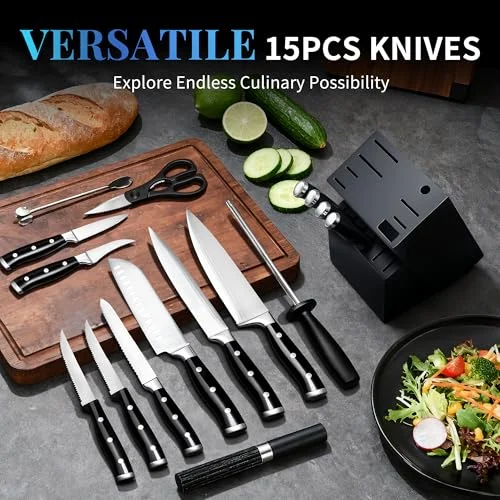 Umite Chef 15-Piece |
Black |
15 |
15°, razor-sharp |
Forged, triple rivet |
$35.99 |
Get it |
Prices change. We refresh them, but Amazon is the authority at the moment you buy. See our broader look at Cuisinart's hollow-handle tiers if you want sets with a published, itemized contents list.
Our method
How we compared — and what we can't tell you
What we did
Titles, bullet points and current prices
We read the published titles and current Amazon prices for both listings (B0FQ4YPVKC and B0FQ4XCPXS) line by line, specifically checking whether each stated claim — piece count, steel, edge angle, handle construction, size, dishwasher safety — appeared on one listing, the other, or both, rather than assuming the two color variants were identical without checking.
What we didn't
We don't run a testing lab
We do not physically test these knives, we do not own them, and we have no verified rating or review-count data for either listing, so we don't paraphrase owner sentiment we haven't confirmed. What we can do honestly is compare what each listing states against the other and tell you plainly where the claims match, where they don't, and where neither one tells you enough to be sure.
FAQ
Common questions
Are the white and black Umite Chef knife sets actually the same knives?
On the published specs, yes. Both the white listing (B0FQ4YPVKC, $32.99) and the black listing (B0FQ4XCPXS, $35.99) state 15 pieces, high-carbon stainless steel, a razor-sharp 15-degree edge, and an ergonomic forged triple-rivet handle, in the same wording. The only stated difference between the two pages is the handle and block color, and the $3.00 price.
Why does the black version cost three dollars more?
Neither listing says. A black coating or finish can cost marginally more to apply during manufacturing than a lighter finish, which is one plausible explanation, but it's also common for sellers to price color variants a few dollars apart for reasons unrelated to production cost. We can confirm the gap exists and that no listed spec explains it; we can't confirm which cause is the real one.
What does the 15-degree edge and triple-rivet handle actually mean?
A 15-degree edge refers to the angle ground into each side of the blade, a narrower, Japanese-style angle that cuts with less resistance but is more delicate than the wider roughly-20-degree grind typical of Western chef's knives. A triple-rivet handle means three metal pins fix the handle to the blade's tang, the traditional signature of a handle built to stay attached over years of use. Both claims appear identically on both the white and black listings.
Which one should I buy?
If you'd be equally happy with either color, buy the white set: it states the same construction for three dollars less. If you specifically want a black handle and block in your kitchen, that's a legitimate reason to pay the extra $3.00 — just don't expect a sharper edge or sturdier build for the difference, because neither listing claims one.
Keep reading
Related on Best Knife Sets