The short answer
The three knives that do nearly everything
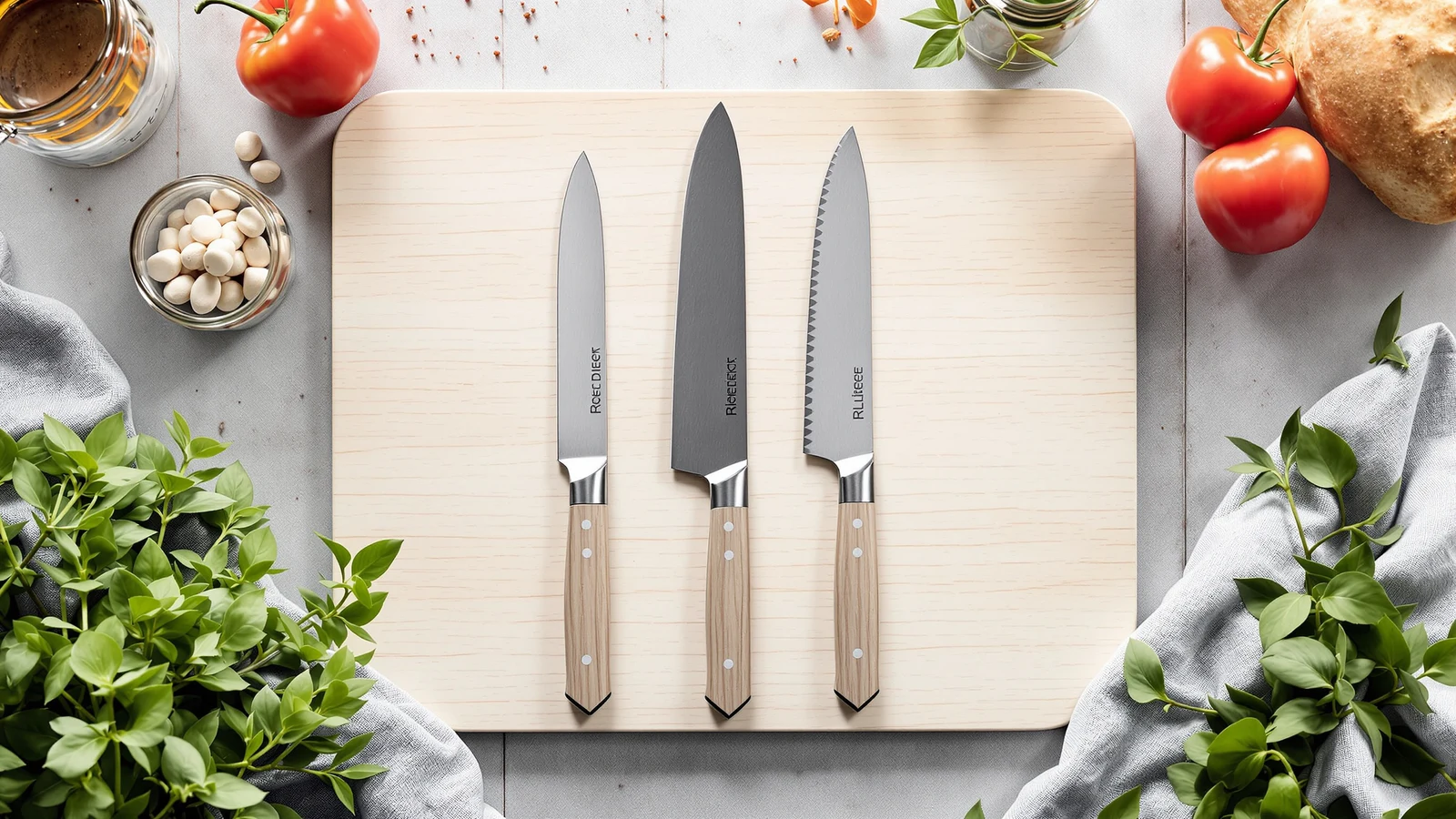
Watch anyone cook for a week and the pattern is the same regardless of how many knives live in their kitchen. They reach for an 8-inch chef’s knife for almost everything that needs chopping, slicing or mincing — onions, garlic, chicken breast, a block of cheese, a melon. They reach for a small paring knife for the jobs where the chef’s knife is simply too big: hulling a strawberry, deveining shrimp, peeling an apple in one hand. And they reach for a serrated bread knife for the one job neither of the first two can do cleanly, because a straight edge crushes the crust of a loaf and tears the crumb instead of slicing through it. Three knives, three distinct jobs, almost no overlap between them.
The third knife is the one worth arguing about, which is exactly why we said it’s arguable. If you rarely bake or buy bread that needs slicing at home, the bread knife sits in a drawer for weeks at a time and the honest list shrinks to two. If you cook fish or do a lot of fine trimming, a lot of people add a smaller utility knife before they’d add a bread knife. The chef’s knife and the paring knife are not really up for debate — between them they cover the overwhelming majority of cutting board time in a home kitchen. Everything past those two is a personal call, not a universal rule, and that’s the detail a 15-piece block is specifically designed to obscure.
This matters because of how knife sets are marketed. A box that says “15 pieces” is implicitly selling you on volume: more knives, more value, more kitchen. But if the actual job a knife does only comes up a handful of times a year, having a dedicated blade for it isn’t fifteen times the value of three knives — it’s three knives you use constantly, plus twelve you store. Our guide to knife sets under $100 makes the same point from the budget side: piece count and usefulness are two different axes, and manufacturers have every incentive to make you compare sets on the one that's easiest to inflate.
What's in the box
What a 15-piece block actually contains
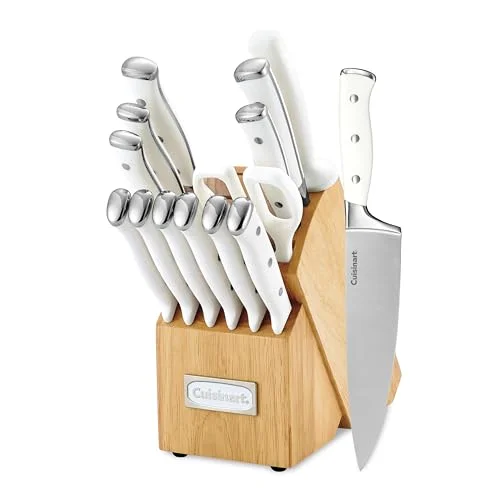
“15-piece” is a count of everything in the box, not a count of knives you’ll use. Take the Cuisinart C77WTR-15P, a forged, triple-rivet set we’ve covered before on this site: its own listing itemizes an 8-inch chef’s knife, an 8-inch slicer, a 7-inch santoku, a 5.5-inch utility knife and two parers. That’s six individual knives. Add the wooden block itself as a seventh item, and you’ve accounted for seven of the fifteen pieces using Cuisinart’s own published breakdown. The remaining eight pieces, by simple subtraction, are steak knives.
That split — roughly half the box as steak knives, a handful of overlapping all-purpose blades, and the block as a single line item — is close to the norm across this category, not an outlier. It's why, as a general pattern across the sets we've researched, a “15-piece” set tends to work out to somewhere around eight knives, six or more steak knives, and the block, while a “14-piece” set might instead swap a couple of steak knives for a sharpener and a pair of kitchen shears. The headline number hides which of those two boxes you're actually buying, and the two boxes are not equivalent purchases even when the number on the front is identical.
None of this makes a 15-piece set a bad buy. A block is a tidy, single piece of counter furniture that organizes knives safely, and if you genuinely host steak dinners for six people twice a month, those eight steak knives are doing real work. The problem isn’t the set — it’s using the piece count as a proxy for value when comparing two different sets. Our stamped vs. forged comparison covers the other half of that same mistake: people comparing two 15-piece sets on the number alone, when one is forged steel and the other is stamped, which is a far bigger difference than three extra steak knives.
The maths
Steak knives, and how often you actually use them
Steak knives are the single largest line item in most blocks by piece count, and the easiest to run an honest estimate against. Picture a household that cooks steak, or any meal firm enough to need a dedicated serrated edge, once every couple of weeks, and seats four people when they do. That's roughly 26 occasions a year, needing four knives at a time. A set of six or eight steak knives covers every one of those occasions with knives to spare for when a couple of friends come over — and sits completely idle the other 339 days of the year, because a chef's knife or a utility knife handles the rest of the week's cutting board work just fine.
Run the same estimate for a single person or a couple who mostly cook stir-fries, pasta and sheet-pan dinners, and the honest number of steak-knife occasions in a year might be in the single digits — a holiday dinner, a dinner party, a handful of weekend grills. Eight dedicated steak knives for eight uses a year is not a disaster; the knives don't wear out from sitting in a block. But it is eight pieces of the fifteen you paid for that are doing almost no work relative to the three knives doing nearly all of it, which is the entire point of this page: the piece count rewards the part of the set you'll touch least.
The honest middle ground, if steak knives matter to your household, is to actually count your own occasions rather than accept the manufacturer's default of six or eight. A family that grills weekly and regularly has guests over gets real value from a full set. A household that eats steak a few times a year would get more out of two or three good steak knives bought separately, or none at all, with that money going toward a better chef's knife instead — which is the knife actually doing the work on the other 51 weeks.
Overlap
Duplicates: the slicer, the santoku, and the chef's knife
The two knives most likely to duplicate a chef's knife's job are a slicer and a santoku, and they duplicate it in different ways. A slicer is long, narrow and usually has a rounded tip, built to make long, even strokes through a single piece of cooked meat — a roast, a ham, a turkey breast — without sawing back and forth and tearing the fibers. A chef's knife can do this too, and for a weeknight chicken breast or a smaller cut, most home cooks genuinely can't tell the difference in the result. The slicer earns its keep specifically on large roasts carved at the table, where a longer blade in one continuous motion produces cleaner slices. If that's not a dish your household makes more than a few times a year, the slicer in the block is functionally a spare chef's knife with a narrower profile.
A santoku overlaps with both of the other two. It's shorter and flatter along the edge than a Western chef's knife, with a blunter, less pointed tip — a shape built around a rocking chop through vegetables rather than the piercing or fine-tip work a chef's knife also handles. That flat edge is also part of why a santoku can stand in for some of what a slicer does: on boneless cuts, a flat profile lets it push straight down through the full length of a slice rather than rocking through it. For someone who does a lot of vegetable prep, a santoku is a genuinely different tool worth having alongside a chef's knife. For someone who mostly cooks proteins and uses the chef's knife for vegetables too, it's the third or fourth knife in the block doing a version of a job the first one already does.
None of this is a case against owning a slicer or a santoku — plenty of cooks have a strong preference for one shape over another and use it daily. It's a case for noticing that a set which bundles a chef's knife, a slicer and a santoku together is giving you three tools for jobs that overlap substantially for most home cooking, not three tools for three unrelated tasks the way the chef's knife, paring knife and bread knife are.
The case for the block
Where a block still earns its place
Everything above is a case for buying fewer knives, and for some kitchens that's the wrong conclusion. A block earns its keep in a few specific situations. The first is a household with more than one person cooking, or guests who help in the kitchen regularly — a block keeps a dozen blades organized and visibly accounted for, which matters more with more hands reaching into the drawer. Loose knives in a drawer are also a real safety issue: reaching into a drawer full of unsheathed blades is a worse daily risk than a set of knives standing edge-up in slots built for them.
The second is a built-in sharpener. Several sets, including the Cuisinart Essentials set covered below, build a sharpener into the block itself, so the knife gets drawn through it on the way back into the slot. That's a genuine, ongoing convenience for anyone who would otherwise never sharpen a blade, and it's a feature a loose three-knife set generally doesn't offer. If you already own a whetstone and sharpen deliberately, a built-in sharpener adds little. If you don't, it's one of the strongest reasons to choose a block over three unassisted knives.
The third is simply that a block is tidy counter or drawer furniture with a fixed home, which matters in a kitchen where cutting boards, knives and every other tool compete for the same two drawers. And the fourth is genuine, repeated use of the pieces past the first three — a household that regularly carves roasts wants the slicer, one that does heavy vegetable prep wants the santoku, one that grills for a crowd wants the steak knives. A block isn't wasteful if you can name the occasions each extra piece is for. It becomes wasteful only when nobody in the house can.
The picks
The picks, by how much furniture you want
01No furniture
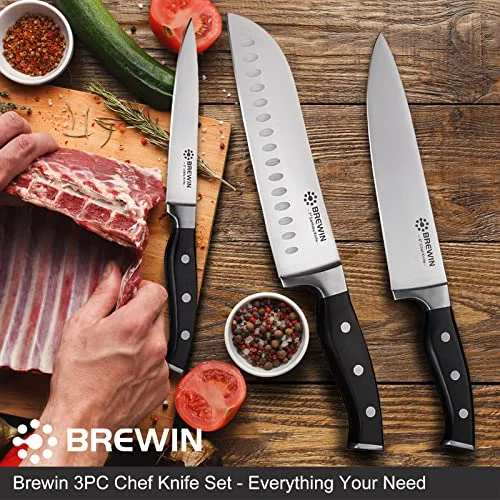
Brewin Professional 3-Piece Chef Knife Set
Best if you only want the three knives that do nearly everything
Chef, santoku, utility·56+ Rockwell·Full tang, triple riveted·Gift box, no block
This is the literal answer to the question in the title: three knives, nothing else. High-carbon stainless, full tang, triple-riveted handles, and a Rockwell hardness Brewin states as 56 or above — the mid-fifties range that's the sensible middle ground for a kitchen blade. It ships in a gift box rather than a block, which means no counter furniture, no steak knives you'll use twice a year, and no built-in sharpener either. You're buying blades, not a box, and at $53.99 you're paying almost entirely for steel rather than packaging.
The honest purchase if your own weekly habits already match the three-knife answer above.
02A small footprint
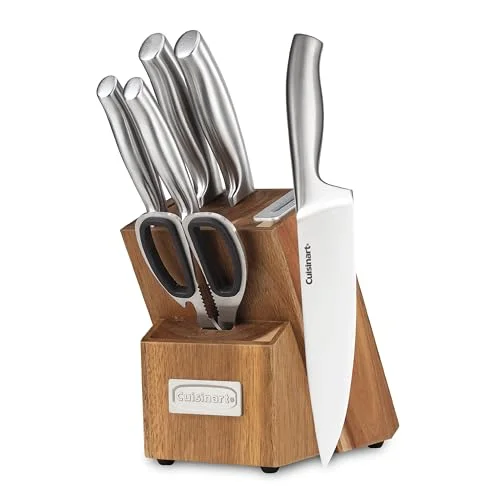
Cuisinart 7 Pc Essentials Cutlery Block Set
Best for a compact block with a sharpener built in
7 pieces·Stainless steel·Built-in sharpener·Small block
The middle ground between a loose three-piece set and a full fifteen-piece block. Cuisinart's listing doesn't itemize exactly which seven pieces are in the box, so we won't guess at the breakdown beyond what it states — but the name tells you the shape of the thing: a stainless-steel set built around a block with a sharpener worked into it, at roughly a third of the piece count of the brand's larger set. That's enough pieces to cover the core knives plus a couple of extras, with a sharpener doing the maintenance you'd otherwise have to remember to do yourself, without the full run of steak knives taking up the rest of the box.
Worth it specifically for the built-in sharpener, if you want a block but not a full fifteen pieces of one.
03The full block
Cuisinart C77WTR-15P Forged Triple Rivet
Best if you genuinely use steak knives and want everything in one box
15 pieces·Forged, triple rivet·High-carbon stainless·Full-size block
The set this entire article has been measuring against. Chef's knife, slicer, santoku, utility knife and two parers published by name, plus the block, plus — by our own count of the remaining pieces — eight steak knives. It's genuinely forged rather than stamped, which at $88.79 is unusual for this price and covered in more depth in our stamped vs. forged comparison. The honest case for choosing it over the two sets above is simple: you host, you carve, you want a dedicated slicer and a drawer full of steak knives ready without a separate purchase, and you're willing to store a full-size block to get it.
The right choice if you can name the occasions for the extra eight pieces. The wrong one if you can't.
Side by side
The three, by furniture and price
| Set | Furniture | Pieces | Construction | Price | Get it |
|---|
 Brewin 3-Piece Brewin 3-Piece |
None — gift box |
3 |
Full tang, 56+ HRC |
$53.99 |
Get it |
 Cuisinart Essentials 7-Piece Cuisinart Essentials 7-Piece |
Small block |
7 |
Stainless, built-in sharpener |
$79.95 |
Get it |
 Cuisinart C77WTR-15P Cuisinart C77WTR-15P |
Full-size block |
15 |
Forged, triple rivet |
$88.79 |
Get it |
Prices change. We refresh them, but Amazon is the authority at the moment you buy. See the full six-set roundup if you want every option this network has researched, not just these three.
Our method
How we worked this out — and what we can't tell you
What we did
Published contents, prices, and arithmetic
We read the published contents lists, current Amazon prices and construction details for these three sets, then did the plain subtraction a piece count invites: if a listing names seven items out of fifteen, the other eight are whatever's left in the box. The usage estimates in this piece — how often a household might actually reach for steak knives or a slicer — are presented as a reasoning exercise with stated assumptions, not as a measured statistic, because no one has that data for your kitchen but you.
What we didn't
We don't run a testing lab
We do not physically test these knives, we do not own them, and we do not publish invented scores or star ratings. We have no verified review data for these specific products, so we don't paraphrase owner sentiment either. What we can do honestly is read every published specification, run the arithmetic the piece count obscures, and tell you plainly which numbers are stated and which are our own estimate.
FAQ
Common questions
So how many knives do I actually need?
Three, and the third is arguable: a chef's knife for almost everything, a paring knife for what the chef's knife is too big for, and a serrated bread knife for the one job neither handles cleanly. If you rarely slice bread at home, the honest list is two. Everything past that is a personal preference, not a universal requirement — which is exactly what a piece count on a box can't tell you.
What's the point of steak knives if I barely use them?
For a household that hosts steak dinners regularly, they're doing real work on real occasions. For a household that eats steak a few times a year, six or eight dedicated steak knives are mostly sitting in the block as unused piece count. The fix isn't to avoid steak knives entirely; it's to count your own occasions honestly and size the set — or buy a few separately — to match, rather than accepting whatever default a 15-piece box ships with.
Do I need both a slicer and a chef's knife?
Only if you regularly carve large roasts, hams or turkeys at the table. For smaller cuts and weeknight cooking, a chef's knife does the slicer's job well enough that most people can't tell the difference in the result. The slicer's long, narrow, rounded-tip blade earns its place specifically on big, single pieces of cooked meat carved in long, even strokes — a job that comes up a handful of times a year in most homes, not weekly.
Should I buy a block set or just the three knives?
Buy the three knives alone if you can name them and they're the same three you reach for every week, and you don't need the organization, safety or built-in sharpener a block provides. Buy a block if more than one person cooks in your kitchen, if a built-in sharpener would actually get used, or if you can name real, repeated occasions for the extra pieces — carved roasts, heavy vegetable prep, steak dinners for a crowd. The block isn't wrong; the piece count is just the wrong way to decide between two of them.
Keep reading
Related on Best Knife Sets