The vocabulary
Gyutou, santoku, and what the words actually mean
Gyutou translates roughly to "beef knife," and despite the name it is the Japanese equivalent of a Western chef's knife — a long, slightly curved, double-bevel blade meant to do most of the cutting board's work: slicing, chopping, mincing, breaking down a chicken. The curve near the tip is usually gentler than a German chef's knife, which changes the cutting motion slightly toward a push-and-draw stroke rather than a full rock. Two of the three sets in this guide use "gyutou" directly in their listing titles, which is the clearest signal a manufacturer can give that the blade profile follows that Japanese convention rather than a European one.
Santoku means "three virtues," a reference to the three jobs it is traditionally built to handle well: slicing, dicing and mincing. The blade is shorter and flatter than a gyutou, with far less curve toward the tip, which trades the rocking motion of a chef's knife for a straighter push cut — useful on a cutting board, less useful if you like to rock through a pile of herbs. It's worth knowing the term because it shows up constantly in searches for this category, but none of the three sets below are sold as a santoku; all three are built around a gyutou-style or general chef's-knife profile, so we won't stretch the santoku name onto a blade that isn't marketed as one. If you're trying to work out how many of either shape you actually need in a block, our breakdown of how many kitchen knives you actually need covers that regardless of which country's grinding convention the blade follows.
The geometry
15 degrees against 20: what a narrower edge changes
Every double-bevel knife is ground at some angle on each side of the blade, and that angle is the single biggest factor in how a knife feels in use. Western, German-style blades are conventionally finished nearer 20 degrees per side — a thicker, more obtuse edge that trades some bite for durability. Japanese-style edges are typically ground narrower, often closer to 15 degrees per side, which is a meaningfully thinner wedge of steel meeting the food. The imarku set with ASIN B0G5GGC7FP states this directly in its own listing, describing an "ultra-sharp 10–15° edge" on its gyutou blades — a figure we're repeating because the manufacturer published it, not because we measured it ourselves.
What that narrower angle changes in practice: less force is needed to start a cut, because a thinner wedge separates fibers with less resistance. On a tomato, a fillet of fish, or a stack of herbs, the difference is obvious the first time you feel a blade fall through with almost no downward push. The trade is durability at the very edge. A 20-degree bevel has more steel supporting the cutting line, so it tolerates a bit of lateral stress — a twist, a scrape against a bone — before it deforms. A 15-degree bevel has less steel there, so the same lateral stress is more likely to roll or chip the edge rather than just dull it. Neither angle is objectively better; they're suited to different habits, and the next two sections are about exactly where that trade pays off and where it doesn't.
The steel
Hardness and chipping: the trade you're accepting
Edge angle is only half the story; the other half is how hard the steel itself is, usually expressed as a Rockwell hardness number. Harder steel holds a fine edge longer between sharpenings, because the metal resists the slow rolling and flattening that dulls a blade over weeks of normal use. The cost of that hardness is brittleness: harder steel is also more prone to chipping at the very edge when it meets something unexpectedly hard or gets twisted mid-cut, and a chip in a narrow 15-degree edge is both more likely to happen and more noticeable than the same impact on a thicker, softer 20-degree edge. That's the real trade a Japanese-style set asks you to accept — a finer edge that cuts more easily and needs a bit more care to keep that way.
None of the three sets in this guide publish a specific Rockwell figure in their current listings, so we won't attach a number to any of them that the manufacturer hasn't stated — the same rule we apply to every spec on this site. What all three do share, by virtue of being high-carbon stainless kitchen knives, is the general shape of that trade-off described above. If you want to see how a published hardness number reads on a set that does state one, and how that compares with a forged construction's own durability trade-offs, our stamped-versus-forged comparison walks through the construction side of that same durability question.
The honest limit
What a Japanese-style edge does not suit
A narrower edge is a specialist's tool, and being honest about its limits matters more than listing its strengths. It is a poor choice for cutting through bone or frozen food, where the blade meets hard, unyielding material head-on rather than slicing through soft fibers; that kind of contact is exactly the lateral stress a thin bevel tolerates worst, and it's how a fine edge chips rather than simply dulls. It's also a poor choice for anyone who twists the blade while cutting — prying apart a stuck lid, levering a stubborn squash in half, or using the tip as a makeshift screwdriver. None of that is specific to any one set here; it's true of the geometry itself, regardless of brand or price.
It's also worth being plain about what we can and can't say for each set in this guide. The imarku B0G5GGC7FP listing states its handles are ergonomic, non-slip and dishwasher safe; we have no dishwasher-safe claim on file for the other two sets reviewed below, so we're not extending that claim to them. A dishwasher is hard on any edge regardless of what the listing says — detergent is abrasive, the heat stresses handles, and knives knocking against other items in the rack roll edges that a narrower Japanese-style grind can least afford to lose. Hand washing and drying immediately remains the safer habit for any of the three sets below, dishwasher-safe claim or not. And if your kitchen regularly needs a knife for bone-in cuts or frozen packages, keeping one separate, sturdier blade for that job — rather than reaching for the gyutou — is the simplest way to keep a fine edge fine. For the full range of what's available across both styles, our complete six-set roundup covers German-style sets built for exactly that kind of heavier-duty work.
The picks
Three Japanese-style sets worth the attention
01Best overall
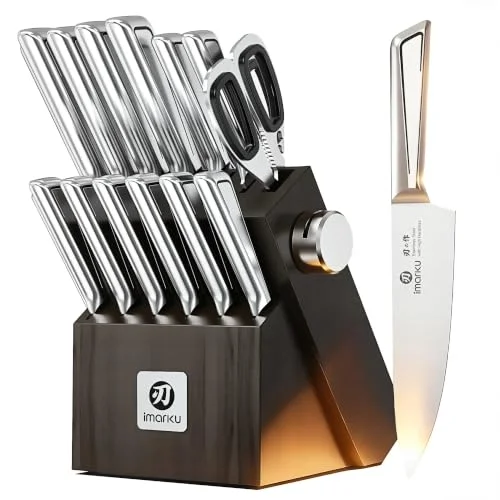
imarku Japanese High Carbon Stainless Steel Knife Set with Block
Best for a dedicated Japanese-style edge with a sharpener built in
14 pieces·10–15° edge·Precision-forged·Built-in sharpener
This is the most explicit Japanese-style set of the three: the listing states precision-forged gyutou blades ground to an ultra-sharp 10 to 15 degree edge, ergonomic non-slip handles, and a sharpener built into the block itself. It's also stated as dishwasher safe, which is unusual for a set leaning this hard into a narrow Japanese grind — we'd still hand wash it given what a thin edge risks in a rack full of other dishware, but the manufacturer's own claim is on record. At $169.99 for 14 pieces, it's the set to reach for if you specifically want the narrower angle discussed above and a convenient way to maintain it.
Buy it if you want the 15-degree edge on purpose, with a sharpener that's already in the slot for the days you skip a proper touch-up.
028-inch gyutou
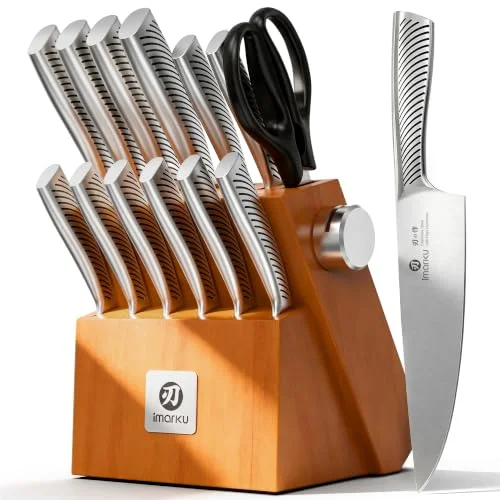
imarku 14-Piece Japanese Gyutou Stainless Steel Kitchen Knife Set
Best if an 8-inch gyutou is specifically what you're after
14 pieces·8-inch gyutou·Stainless steel
A second imarku line at the same $169.99 price, built around an 8-inch gyutou rather than the sharpener-equipped block above. The listing doesn't publish a specific edge angle or a Rockwell figure the way the first set does, so we're not assigning this one a number it hasn't claimed — what we can say is that it shares the same gyutou profile and 14-piece count, with the main difference being the 8-inch blade size stated in its own listing. If the 8-inch length is the detail you're shopping for specifically, this is the set that states it; if you want the published edge angle and the in-block sharpener instead, pick 01 above does both.
Buy it for the 8-inch gyutou specifically. For a stated edge angle, the sharpener-equipped set above gives you that detail in writing.
03Full block, no style bet
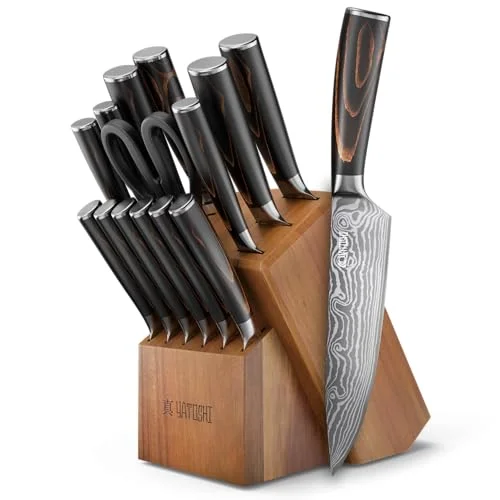
Yatoshi Professional Kitchen Knife Set, 15 Pieces
Best if you want block volume without committing every blade to one grind
15 pieces·High carbon stainless·Ergonomic handle
Unlike the two imarku sets above, the Yatoshi's own listing doesn't use the words "Japanese" or "gyutou" anywhere in its title — it's described plainly as a professional 15-piece high-carbon stainless set with an ergonomic handle, and we're not dressing it up as something its listing doesn't claim. We're including it here precisely because it's the honest counterpoint to everything above: if you want the piece count of a full block — more knives for more occasional jobs — without betting your whole drawer on a narrower edge that chips on bone and twisting cuts, a general-purpose high-carbon set like this one, at $199.99 for 15 pieces, is the more forgiving everyday choice.
Buy it if the narrower edge appeals in theory but you don't want every knife in the block to be that specialized.
Side by side
The three, compared
| Set | Best for | Pieces | Edge / style | Price | Get it |
|---|
 imarku Gyutou + Block imarku Gyutou + Block |
A published 15° edge, sharpener included |
14 |
Gyutou, 10–15° stated |
$169.99 |
Get it |
 imarku 8" Gyutou imarku 8" Gyutou |
A specific 8-inch gyutou |
14 |
Gyutou, 8" stated |
$169.99 |
Get it |
 Yatoshi 15-Piece Yatoshi 15-Piece |
Block volume, no style claim |
15 |
General-purpose chef's profile |
$199.99 |
Get it |
Prices change. We refresh them, but Amazon is the authority at the moment you buy. Want a sturdier, German-style edge instead? See the full six-set roundup.
Upkeep
Caring for a finer edge without a whetstone
A whetstone is the proper tool for resetting a narrow edge, but it has a learning curve, and plenty of people who'd benefit from a Japanese-style grind will never own one. There are still several habits that keep a 15-degree edge usable without a stone in the house. A honing rod — ceramic rather than the ridged steel rods bundled with some Western sets — realigns a slightly rolled edge between uses rather than removing metal, which suits a thinner bevel better than an aggressive steel rod would. Drawing the blade through at a shallow, consistent angle a few times before you start cutting is often enough to bring back the bite you felt when the knife was new.
A built-in sharpener, like the one in the imarku B0G5GGC7FP block, is a real convenience for exactly this problem: drawing the knife out of its slot touches up the edge automatically, with no separate tool to buy or learn. It is a blunt instrument compared with a stone — it removes material in a fixed way and can't fully recover a chipped or badly rolled edge — but for routine upkeep on a narrower edge, it's genuinely useful. Be cautious with generic pull-through V-notch sharpeners sold separately for Western knives; many are set to a wider angle than a Japanese-style edge is ground to, and pulling a 15-degree blade through a 20-degree slot grinds away more steel than necessary and gradually changes the edge geometry you bought the knife for.
Beyond sharpening, the basics matter more on a finer edge, not less. Cut on wood or soft plastic, never on glass, stone or a plate — those surfaces are harder than the steel and dull a narrow bevel within a handful of strokes. Hand wash and dry immediately rather than letting a blade sit wet in a sink, where it knocks against other dishes and rolls its edge. Store it in the block, a sheath or a blade guard rather than loose in a drawer, where the edge meets everything else sharing that space. None of this requires owning a stone; it requires treating a narrower edge as the more specialized tool it actually is.
Our method
How we picked — and what we can't tell you
What we did
Specs, prices and published listings
We compared published specifications and current Amazon prices for Japanese-style and gyutou-labeled knife sets sold in the US, and kept the ones whose listings state something checkable — an edge angle, a blade length, a piece count — rather than relying on adjectives like "razor-sharp" that no listing can substantiate on its own.
What we didn't
We don't run a testing lab
We do not physically test these knives, we do not own them, and we do not publish invented scores or star ratings. We have no verified review data for these specific products, so we don't paraphrase owner sentiment either. What we can do honestly is read every published specification and tell you plainly which claims are checkable and which aren't stated at all.
FAQ
Common questions
What's the difference between a gyutou and a regular chef's knife?
They do the same job — slicing, chopping, mincing — but a gyutou is the Japanese version of that shape, typically with a gentler curve near the tip and, as a style, often finished at a narrower edge angle than a German-style chef's knife. The imarku B0G5GGC7FP states a 10 to 15 degree edge directly in its listing, compared with the roughly 20 degrees per side common on Western double-bevel blades. The practical result is a gyutou that bites more easily into food and asks for a bit more care around bones, twists and the dishwasher.
Is a narrower edge actually sharper?
It's thinner, which usually means it needs less force to start a cut, and that's often what people mean by "sharper" in everyday use. But sharpness also depends on how fine the final polish is and how well the edge is maintained, not the angle alone. A well-maintained 20-degree edge can out-cut a neglected 15-degree one. The angle changes how the knife feels and how it needs to be cared for; it doesn't guarantee a better result on its own.
Can these go in the dishwasher?
Only one of the three sets here, the imarku B0G5GGC7FP, states dishwasher-safe construction in its own listing; we have no such claim on file for the other two, so we don't extend it to them. Even where it's stated, we'd still recommend hand washing: detergent is abrasive, the heat stresses handles, and knives knocking against other items in the rack can roll an edge that a narrower Japanese-style grind can least afford to lose.
Do I need a whetstone to keep a Japanese-style edge sharp?
Not for routine upkeep. A ceramic honing rod realigns a slightly rolled edge between uses without removing metal, and a built-in sharpener like the one in the imarku B0G5GGC7FP block handles basic touch-ups automatically. A whetstone is still the right tool for fully resetting a damaged or badly dulled edge, but you can keep a finer edge usable for a long stretch without owning one — just be cautious with generic pull-through sharpeners built for wider Western angles.
Keep reading
Related on Best Knife Sets