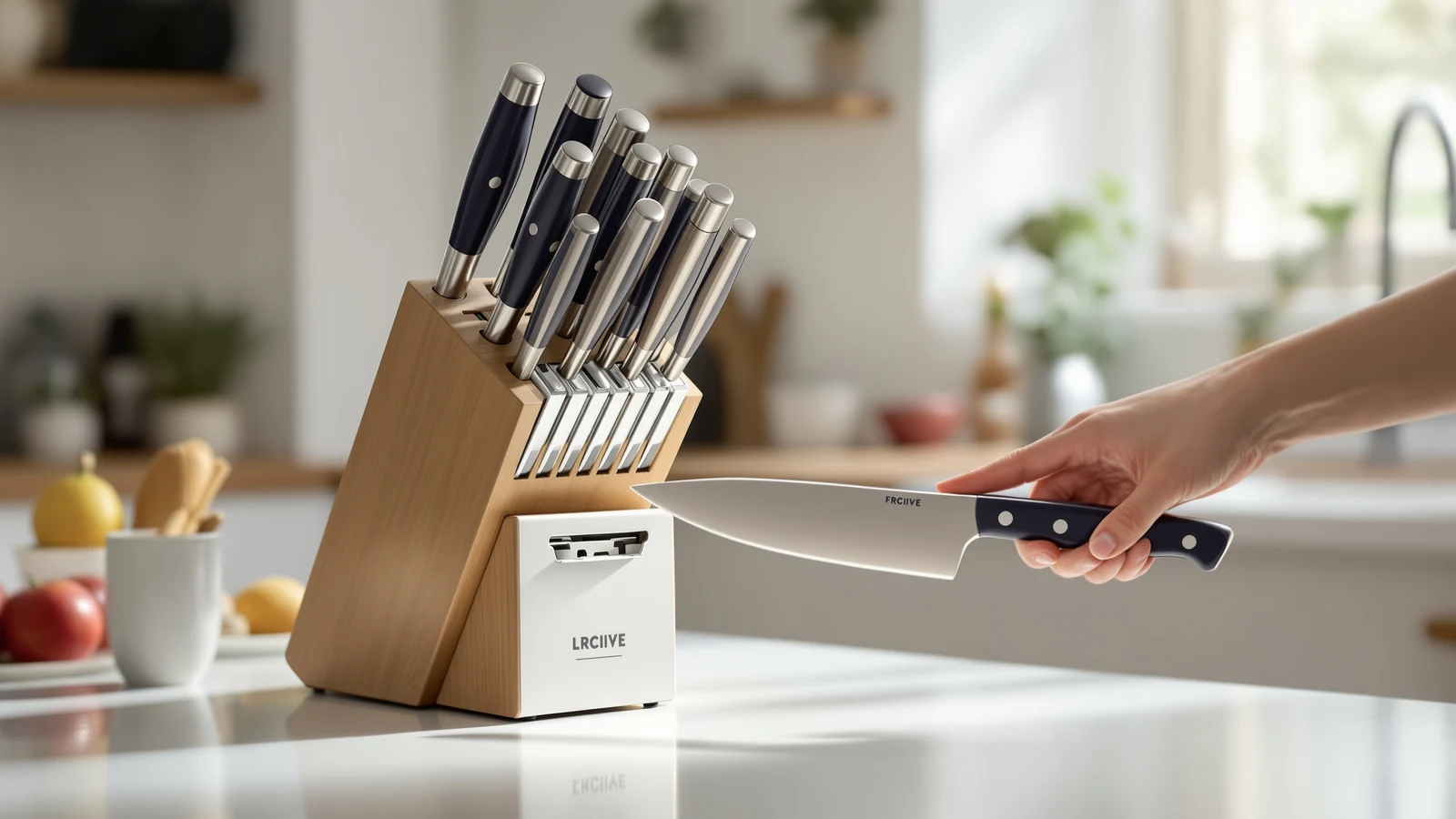
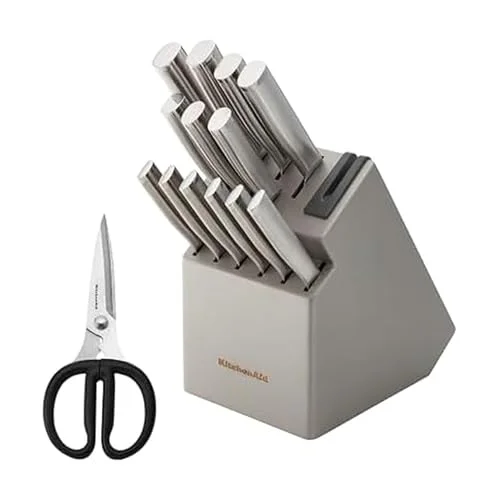
The set, in short
What this review is, and what it isn't
This is a single-product review of one listing: the KitchenAid Gourmet Knife Block Set with Built-in Sharpener, 15-Piece, Stainless Steel, ASIN B0DD56SV3N, priced at $79.99 as of our most recent price check on November 19, 2026. We don't own this set, we haven't drawn a blade through its sharpening slot, and we don't run a testing lab that could tell you how the edge holds up after a year of weeknight dinners. What we can do honestly is read KitchenAid's own listing closely, compare its stated construction and features against the two other built-in-sharpener sets already in this catalogue — Astercook's and McCook's — and tell you plainly which claims are checkable and which are simply the strength of a name you already recognize from a different aisle of the store.
The short version: at $79.99, this set sits in the same general price band as the cheaper sharpener-equipped blocks on the market, not the premium tier occupied by sets that publish their own edge angle or Rockwell hardness figure. KitchenAid's listing leans on two things — a recognizable appliance brand and imported Japanese steel — rather than a checkable hardness number. That's a specific, honest trade worth understanding before you decide whether the name is worth the premium over a no-name block with the same sharpening feature.
At a glance
KitchenAid Gourmet Knife Block Set, 15-Piece
0115 pieces
KitchenAid Gourmet Knife Block Set with Built-in Sharpener, 15-Piece, Stainless Steel
Best for buyers who specifically want a recognizable name behind a sharpener-equipped block
15 pieces·Forged, imported Japanese steel·Built-in sharpener·$79.99
The listing's headline claims are a recognizable kitchen-appliance brand, forged knives made from semi-polished, imported Japanese steel, hardened and tempered, and a storage block with a sharpening slot built into it. The handles are described as ergonomic and well balanced, finished in satin stainless steel for grip. What the listing does not publish is a Rockwell hardness figure, an edge angle, or a full-tang claim — none of which we'll assert on its behalf.
A real forged edge and a genuine sharpening slot, sold on the strength of a name most American kitchens already trust for something else entirely.
What's actually in the box
What's in the 15-piece block, and why our own price database calls it 14
KitchenAid's listing title commits to 15 pieces, and the features it publishes let us itemize every one of them rather than take the headline number on faith. The named contents are an 8-inch chef knife, an 8-inch slicing knife, a 5.5-inch serrated utility knife, a 4.5-inch fine-edge utility knife, a 5-inch santoku knife, a 3.5-inch serrated paring knife, a 3.5-inch paring knife, six 4.5-inch steak knives, an all-purpose shear, and a storage block with the sharpener built in. Count the knives and the shear and you get 14 — seven individual knives plus six steak knives plus one shear. Add the storage block itself as the fifteenth piece, and you arrive at the number in the title.
That's also why the size field our own price-tracking database carries for this exact listing reads "14-Piece" even though the product name says 15. Neither figure is wrong; they're counting two different things. The title's 15 includes the block as a countable piece of the set. Our tracked variant label counts only the knives and the shear, the pieces you actually cut with. It's a small distinction, but it's the kind of thing worth knowing before you compare this set's piece count against a rival listing that counts the same way KitchenAid's title does, or the way our database field does — the two aren't always counting on the same basis, here or elsewhere.
What the listing doesn't publish is the block's footprint on your counter, so we won't estimate one. If you're deciding whether a 14-knife, shear-and-block set like this one will fit your available counter space, our guide to measuring a knife block before you buy walks through the real footprints of several sets in this catalogue and what to check on the listing photos for this one specifically.
The one feature every tier shares
The built-in sharpener, against Astercook's and McCook's versions
Strip away the brand name and KitchenAid's sharpening slot is the same basic tool as the one built into the McCook sets we compared side by side and into Astercook's mid-tier block: a fixed-angle pull-through mechanism set into the storage block itself, so the knife is drawn across an abrasive element on the way back into its slot. That single design, in general, removes a small and consistent amount of steel along the edge every time the blade passes through it, which is what keeps a knife usable between proper sharpenings without the owner having to think about it separately. It is also, mechanically, the same kind of slot we reviewed built into Ninja's NeverDull block at a far higher price — the mechanism itself doesn't change much across brands; what changes is what each listing is willing to publish about it.
On that measure, none of the three come out ahead of the others. McCook's 15-piece and 20-piece listings both state "Built-in Sharpener" directly in the title, paired with a "German Forged Stainless Steel" claim. Astercook's $37.98 15-piece set states a built-in sharpener in its own title too, while its $59.99 15-piece tier from the same brand drops the sharpener line entirely, which is its own small lesson in reading titles rather than assuming every tier from one brand carries every feature of the others. KitchenAid's listing confirms the sharpener is built into the storage block, but like the other two, it doesn't publish the sharpening angle, the abrasive material, or how many passes the mechanism is rated for before it wears. That's not a KitchenAid-specific gap; it's the norm across every built-in sharpener in this catalogue, premium or budget.
The practical read: if a built-in sharpener is the feature you're shopping for, KitchenAid's version is mechanically indistinguishable, on the published facts, from Astercook's $37.98 set or McCook's. What separates the three is everything around the sharpener — the steel claim, the piece count, and the name on the block — not the sharpening slot itself.
The name on the block
Does an appliance brand make a credible knife brand?
KitchenAid's reputation was built on stand mixers, and later on a wider line of countertop appliances, not on forging blades. That's a genuinely different lineage from the Henckels line we compared across three block sizes, a German cutlery house with over a century of blade-making behind the name on its handle. A stand mixer brand and a century-old knife house are not competing on the same claim, and KitchenAid's own listing doesn't pretend otherwise: it doesn't describe the knives as German-engineered or forged by a cutlery specialist. It describes imported Japanese steel, forged, semi-polished, hardened and tempered — a sourcing and finishing claim, not a heritage claim.
That reframes the real question. It isn't whether a company known for mixers can out-forge a dedicated knife house; nothing in the listing claims that, and we won't credit it with a claim it doesn't make. The more honest question is whether a recognizable household name carries any practical weight once you're comparing two sharpener-equipped blocks at a similar price: easier brand recognition at return time, a company with an established US customer-service presence, and a name you'd recognize if you needed to look up a warranty or a replacement part. That's a real, if modest, form of credibility — it just isn't a cutlery pedigree, and buyers who want the latter should look toward a dedicated knife house instead.
What's published, what isn't
Stainless steel construction: what's published and what is not
KitchenAid's listing is specific about three things: the blades are forged, not stamped; the steel is imported from Japan rather than Germany, which is the more common origin claim elsewhere in this catalogue; and the finish is described as semi-polished, with the knives hardened and tempered for edge retention. The handles are separately described as ergonomic, well balanced, and finished in satin stainless steel for grip. Forged construction is a genuine, checkable claim — it's the labor-intensive process of hammering a blade from a single bar of steel rather than stamping one from a sheet, and it's the reason a forged set typically costs more to produce than a stamped one at the same piece count.
What the listing does not publish is just as worth naming. There's no Rockwell hardness figure, the kind imarku and Brewin state elsewhere in this catalogue (56 ± 2 and 56+ respectively), so we can't tell you how this steel's hardness compares on a number. There's no stated edge angle, the detail that separates a Japanese-style gyutou grind from a standard chef's knife grind. And there's no full-tang claim anywhere in the published features, even though the handles are described as stainless steel rather than molded plastic — which makes a full tang plausible but not confirmed. If full tang construction specifically matters to your decision, check the current listing photos for visible steel running the length of the handle before buying; we won't assert it from the handle material alone.
The number on the page
Where $79.99 shows up, and where it doesn't
KitchenAid's listing carries a $79.99 figure as its stated price point for this set. The price our own tracking has recorded most recently for this exact ASIN, as of November 19, 2026, is $79.99 — a little over $4 lower. The gap is a small one, and it's also an entirely ordinary one: Amazon listings routinely show a list price alongside a current price, and the two rarely match for long on any product that isn't brand new to the platform. $79.99 is the number KitchenAid's own listing leads with; $79.99 is what our database has most recently tracked you'd actually pay.
The honest instruction either way is the same one that applies to every set in this catalogue: prices move, sometimes by a few dollars and sometimes by more, and the figure printed on any page you read today, including this one, is a snapshot rather than a guarantee. Confirm the current price on the live Amazon listing before you buy, and treat a gap of a few dollars between what a review states and what the listing shows as the market doing what it normally does, not as either number being wrong.
The decision
Who should buy this over a cheaper no-name set
Picture the alternative as a no-name 14- or 15-piece sharpener block in the $30–$40 range, stamped steel of unstated origin, a brand you've never encountered outside this one listing. Choosing KitchenAid's set over that kind of alternative makes sense if a forged blade specifically matters to you over a stamped one, if you'd rather buy from a company with an established US presence for warranty and customer-service questions, and if roughly $40 more genuinely doesn't move your budget. Our look at what knife-set warranties actually cover is worth reading before you lean too heavily on brand recognition alone as a warranty proxy — a familiar name does not automatically mean a stronger written warranty, and it's worth checking KitchenAid's specific terms rather than assuming them from the logo.
It makes much less sense if what you actually want is a published hardness figure or edge angle to hold the set to. Nothing here beats a no-name set on that specific measure, because KitchenAid's listing doesn't publish one either. And if your honest habit is simply drawing a knife through a slot a few times a week and nothing more demanding than that, the mechanism performs the same job here as it does in Astercook's $37.98 set or McCook's — which means the premium you're paying is attached to the name and the steel's country of origin, not to a sharper or more durable slot.
Our method
How we researched this review
What we did
Read the listing, compared it against sibling sets
We read KitchenAid's published listing for this exact ASIN — the piece count, the construction claims, the price — and set it against the published listings for the Astercook and McCook sets in this catalogue that build the same category of sharpener into their own blocks. Where KitchenAid's listing was specific, we repeated the specific figure. Where it wasn't, including Rockwell hardness, edge angle and a full-tang claim, we said so instead of filling the gap.
What we didn't
We don't run a testing lab
We do not physically test this knife set, we do not own it, and we have not drawn a blade through its sharpening slot. We don't publish an invented score out of ten, and this listing carries no verified rating or review count for us to paraphrase, so we have not attributed any sentiment to owners. Edge retention over months of use is measured in laboratories with repeated-cut machines, not by a writer's afternoon in a kitchen, and we're not pretending otherwise.
The bottom line
The verdict
At $79.99, the KitchenAid Gourmet 15-Piece set is a forged, imported-Japanese-steel block with a genuine built-in sharpener, sold by a company better known for stand mixers than cutlery. On the one checkable construction claim it makes — forged rather than stamped blades — it's a real step above the stamped sets that fill most of the budget tier. On the sharpener, the specific feature its price has the most in common with Astercook's and McCook's cheaper sets, it offers nothing those listings don't already state in their own titles.
Buy this set if a recognizable household name and a forged edge both matter to you, and the roughly $40 premium over a no-name sharpener block doesn't move your budget. Buy Astercook's $37.98 set or one of McCook's instead if the sharpening slot is the entire reason you're shopping in this category, because mechanically, on the facts each listing actually publishes, you're paying KitchenAid's premium for the name and the steel's origin, not for a better slot.
FAQ
Common questions
What's actually included in the KitchenAid Gourmet 15-piece set?
An 8-inch chef knife, an 8-inch slicing knife, a 5.5-inch serrated utility knife, a 4.5-inch fine-edge utility knife, a 5-inch santoku knife, a 3.5-inch serrated paring knife, a 3.5-inch paring knife, six 4.5-inch steak knives, an all-purpose shear, and a storage block with a built-in sharpener. That's 14 knives and a shear, plus the block counted as the fifteenth piece in the product title.
How does KitchenAid's built-in sharpener compare to Astercook's or McCook's?
Mechanically, all three are the same category of fixed-angle pull-through sharpener built into the storage block. None of the three listings, KitchenAid's included, publish the sharpening angle, the abrasive material, or a pass-count rating, so there's no published basis for calling one mechanically better than another.
Is KitchenAid, a small-appliance brand, a credible knife brand?
Not on cutlery heritage, which the listing doesn't claim; the steel is described as imported Japanese steel, not a German or Japanese cutlery house's own forging tradition. What a recognizable household name does offer is an established US customer-service and warranty presence, which is a real but narrower form of credibility than a dedicated knife house's pedigree.
Is $79.99 or $79.99 the real price of this set?
Both numbers are real; they're just not the same figure. $79.99 is the price KitchenAid's own listing states. $79.99 is what our price-tracking database most recently recorded for this exact ASIN, as of November 19, 2026. Amazon prices move, so confirm the current figure on the live listing before buying either way.
Keep reading
Related on Best Knife Sets