The fine print
What a "limited lifetime warranty" usually excludes
The word doing the real work in that phrase is not "lifetime." It is "limited." A lifetime warranty on a knife set almost never means the company will replace the knife for any reason, forever. It means the company will replace a knife that fails under what it considers normal kitchen use, for as long as it still makes that model and still exists as a company — two conditions that sound trivial until you actually need them. Read enough of these clauses across the category and the same exclusions turn up again and again: damage from a dishwasher cycle, even on a set the box also calls "dishwasher safe"; a blade that chipped doing something the company classifies as abuse, like cutting through bone or frozen food; rust or discoloration, which manufacturers routinely attribute to the owner's care rather than the steel; commercial or restaurant use on a knife sold for a home kitchen; and cosmetic wear — scratches, a handle that has dulled in color — which is treated as expected aging rather than a defect.
None of that makes the warranty worthless. A genuine manufacturing defect — a blade that was never properly tempered, a handle that separates from the tang on its own, a rivet that was never seated — is exactly the kind of failure these warranties exist to cover, and a company with a real claims process will usually honor it without much argument. What the exclusions mean is narrower and more useful: a warranty is not an insurance policy against your own kitchen habits. It is a promise about the manufacturing process, with a specific and fairly short list of failures it will actually pay out on. The gap between what the word "lifetime" implies and what the clause actually covers is where most of the disappointment in this category lives.
Who's on the other end
Established brand versus no-name: who answers the email
A warranty clause is a promise, and a promise is only as good as whoever is still around to keep it. That is the entire difference between buying from a company with decades of retail history and buying from a brand name that exists mainly as an Amazon storefront. Farberware, for instance, is a licensed houseware name that has been sold through major US retailers for generations and is manufactured under license by an established cookware group — which does not guarantee a flawless claims experience, but it does mean there is a real company, with a real customer service department and a public retail footprint, on the other end of a warranty claim. That matters independently of whether any single knife is actually better steel. A warranty from a brand with that kind of standing is a line item you can reasonably expect someone to honor, because the company has a retail reputation worth protecting.
Set that against a brand name that exists only as a listing title on a marketplace — the kind of name attached to a single product category, with no separate retail presence, no obvious US-based support operation, and a company history you cannot find outside the listing itself. That describes a large share of the budget knife sets sold today, including some in our own catalogue. It does not automatically mean the knife is bad, and it does not mean a warranty claim will be refused. It means the honest answer to "who do I email if this breaks" is "we don't know, and neither does the listing," which is a materially different risk than buying the same price point from a name like Cuisinart or a licensed brand like Martha Stewart, both of which carry a retail history a reader can actually verify before clicking buy.
Reading the clause
Reading the fine print on blade versus handle coverage
Where a warranty clause exists at all, it rarely treats the whole knife as one object. The blade and the handle tend to be covered under different logic, because they fail for different reasons and a manufacturer prices its risk accordingly. Blade coverage usually centers on manufacturing defects in the steel itself — a crack that appears without impact, a blade that will not hold any edge at all rather than one that simply dulls with normal use, delamination on a layered or Damascus-style blade. What it does not cover, almost universally, is a chip or crack caused by hitting bone, a frozen block of food, or a hard surface like granite or ceramic, because the manufacturer treats that as a use decision made by the owner, not a flaw in the steel.
Handle coverage is a separate conversation and often the more generous one, because handle failures are easier for a manufacturer to classify cleanly as defects: a rivet that works loose on its own, a handle scale that separates from the tang, a seam that opens up after normal washing. A loose handle with visible movement where the steel meets the grip is one of the clearer, more defensible warranty claims in this entire category, precisely because there is very little a reasonable owner could have done to cause it through normal use. The practical lesson is to read a warranty clause as two separate promises rather than one: what it says about the edge, and what it says about the handle, because a set can be generous on one and silent on the other.
Before you notice
What voids a warranty before you even notice
Several of the most common ways to void a knife warranty happen in the first week of ownership, long before anything actually breaks. The dishwasher is the biggest one: plenty of knife sets are marketed as dishwasher safe on the box, and the same manufacturer's warranty terms can still exclude damage caused by dishwasher use, because the two claims are written by different parts of the company for different purposes — marketing wants a convenience feature, legal wants a narrow liability. The practical result is that a knife can be technically fine to put in a dishwasher and still lose warranty coverage for whatever that cycle does to it over time, which is not a contradiction the box copy is going to flag for you.
Sharpening is the second trap, and it cuts in both directions depending on the set. A set sold with a built-in pull-through sharpener expects you to use it; a set with no sharpener at all can sometimes treat an aggressive, incorrect angle from an owner's own sharpening stone as the cause of a chip rather than a defect. Using the knife for something the listing never claimed it could do — prying open a can, cutting through a frozen roast, using it as a letter opener — voids coverage the instant it happens, whether or not the knife shows damage yet. And registering a warranty, where the manufacturer requires it, is the step most owners skip entirely: a defect discovered two years in is far easier to resolve if there is already a registered proof of purchase on file than if you are trying to produce an Amazon order history from memory.
Doing the math
When a lower price with no warranty is still the better deal
A warranty is worth something specific: the expected cost of the failure it covers, multiplied by how likely that failure actually is, multiplied by how much friction there is in collecting on it. For an eight-piece set bought for $18.98, all three numbers are small. The knives are cheap enough that replacing the whole set out of pocket costs less than most people's hourly rate for the time a warranty claim actually takes — photographing the defect, finding the order, emailing support, waiting for a response, possibly returning the item. At that price, a published warranty is a nice-to-have, not a reason to pay more, because the alternative to filing a claim is simply buying another $18.98 set.
That math flips hard once the price climbs. A premium set costing several hundred dollars is exactly where a real, honored warranty stops being a footnote and starts being part of what you are actually paying for — the cost of a single replacement knife is high enough that the friction of a claim is worth absorbing, and a brand with a track record of honoring claims is protecting a much larger investment. The honest rule of thumb: at a low enough price, no warranty is a fair trade for the lower cost, because you are effectively self-insuring with cash you'd have spent on the premium anyway. At a high enough price, a vague or absent warranty is a red flag precisely because the company is asking you to take on all the risk of an expensive purchase with none of the backstop a price that size should include.
Three listings, read closely
The three sets, and what we'd ask a seller before buying
01Budget pick
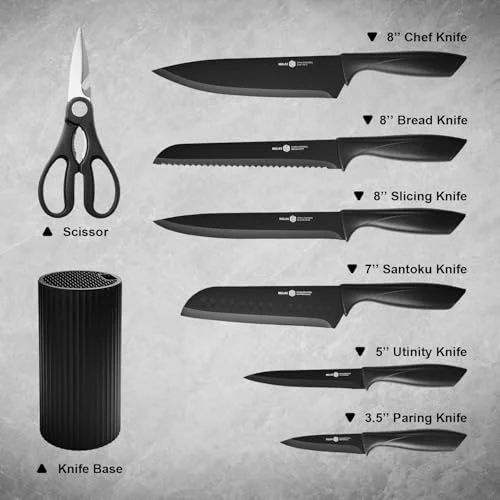
NULAS 8-Piece Knife Set with Universal Block
Best for testing whether you need a warranty at all
8 pieces·Universal block·Dishwasher safe·$18.98
NULAS is a marketplace brand name without a separate retail history we can point to outside this listing, and the listing itself leads with anti-rust blades and dishwasher-safe construction rather than any named warranty program. At $18.98, that is consistent with the broader pattern: budget sets rarely spell out a warranty process in the title or bullets the way a legacy brand does. Before buying, we'd open the listing's warranty or guarantee section specifically (not just the bullet points) and look for a stated duration and a named contact — if neither exists, Amazon's own A-to-z Guarantee on a marketplace purchase becomes your real fallback, not a manufacturer promise.
The question worth asking a seller like this: if a rivet works loose in year one, is there a documented process, or is a return within Amazon's own window the only real recourse?
02Established name
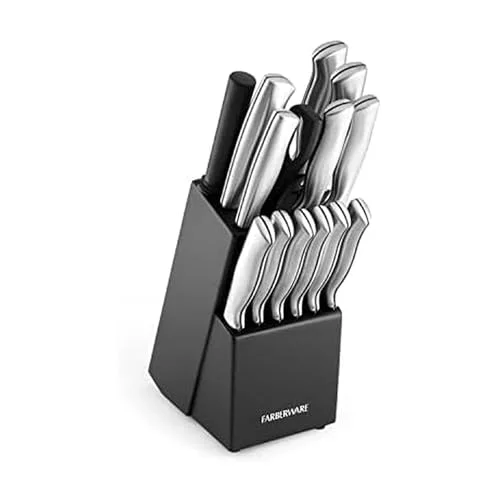
Farberware 15-Piece Knife Set
Best for a recognizable name at a budget price
15 pieces·High-carbon stainless·Sharpening tool & shears included·$35.18
Farberware is the clearer case for "established brand" in this group: it is a licensed houseware name with a long US retail history, sold under license by a cookware manufacturer with a public customer service operation — a materially different starting point from a name that exists only inside one Amazon listing. That history does not tell us the specific warranty terms printed on this particular set's packaging, and we have not seen that paperwork, so we won't invent its duration or exclusions here. What it does mean is that if a claim is needed, there is a real support channel to find, independent of the listing itself. At $35.18 for 15 pieces including shears and a sharpening tool, that brand recognition is arguably worth more than the extra pieces.
The question worth asking: does the warranty live on the packaging insert, on the brand's own site, or only in Amazon's return window — and which of those three did you actually check before buying?
03Built-in sharpener
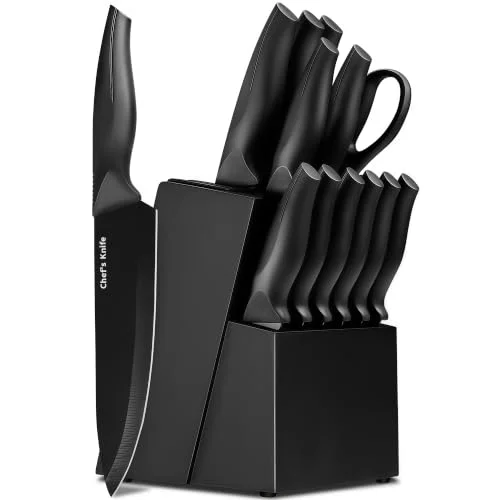
LINHAO 14-Piece Knife Block Set
Best for understanding where a mechanism voids coverage
14 pieces·Built-in sharpener·Black block·$23.74
LINHAO, like NULAS, is a marketplace-first brand name rather than one with an independent retail footprint we can verify. What makes this set a useful case specifically is the built-in sharpener in the block: a mechanism like that is itself a common source of the voids discussed above, because a manufacturer can reasonably argue that a dulled or damaged edge is the result of the sharpener being used (or misused), not a manufacturing defect in the blade. See our guide to what's actually in a knife block for how shears, guards and built-in sharpeners each carry their own, separate coverage questions rather than falling under one blanket warranty for "the set."
The question worth asking: does the listing's warranty language, if any, explicitly mention the sharpening mechanism, or does it only describe coverage for "the knives" — leaving the one moving part in the box unaddressed?
Side by side
The three, compared on price and brand standing
| Set | Best for | Pieces | Brand standing | Price | Get it |
|---|
 NULAS 8-Piece |
Budget pick, self-insure instead |
8 |
Marketplace-only name |
$18.98 |
Get it |
 Farberware 15-Piece |
Recognizable name, real support channel |
15 |
Licensed, established houseware brand |
$35.18 |
Get it |
 LINHAO 14-Piece |
Built-in sharpener, check mechanism coverage |
14 |
Marketplace-only name |
$23.74 |
Get it |
Prices change. We refresh them, but Amazon is the authority at the moment you buy. Warranty terms and claims processes can also change without the listing being updated — always check the current listing and packaging insert, not this page, before relying on a specific clause.
Our method
How we compared — and what we can't tell you
What we did
Listings, brand history and published policy patterns
We compared the published listing details, current Amazon prices and verifiable brand history — retail presence, licensing, how long a name has been sold in US stores — for the sets in this guide, and set that against the general pattern of exclusions that recur across published "limited lifetime warranty" terms in this product category.
What we didn't
We don't have the warranty paperwork for every ASIN
We do not physically test these knives and we do not own them, and we have not obtained the specific printed warranty card or claims-process documentation for every individual listing in our database. Where we have not seen the actual terms for a specific product, we say so and tell you to check the current listing, rather than inventing a duration or exclusion we can't verify.
FAQ
Common questions
Does "limited lifetime warranty" mean the company will replace my knife for any reason?
No. "Limited" is the operative word. It typically means the manufacturer will replace a knife found to have a genuine manufacturing defect, for as long as it still makes that model and still exists as a company. It almost never covers damage from dishwasher use, chips from cutting bone or frozen food, rust attributed to care, commercial use, or ordinary cosmetic wear. Treat it as a promise about manufacturing defects, not a blanket insurance policy against your own kitchen habits.
Does it matter if the brand is well-known versus a marketplace-only name?
Yes, independently of the knife's actual quality. A warranty is a promise, and a promise is only as useful as the company that stands behind it. An established, licensed brand with a public retail history generally has a real customer service channel you can find outside the listing itself. A brand that exists only as a product title on a marketplace may still honor a claim, but there is often no verifiable support channel beyond the listing, and Amazon's own A-to-z Guarantee becomes the practical fallback instead of a manufacturer warranty.
Are the blade and the handle covered by the same warranty terms?
Usually not in practice, even when they're covered by the same clause on paper. Blade coverage tends to focus narrowly on defects in the steel itself — cracking without impact, a blade that won't hold any edge — and excludes chips from bone, frozen food or hard surfaces. Handle coverage is often more straightforward, because a loose rivet or a separated handle scale is easier for a manufacturer to classify cleanly as a defect rather than a use issue. Read what the clause says about each part separately.
Is it ever fine to buy a knife set with no stated warranty at all?
Often, yes, at a low enough price. A warranty is worth the cost of the failure it covers, multiplied by how likely that failure is, multiplied by how much friction there is in actually filing a claim. On a $18.98 set, replacing it outright usually costs less time and money than pursuing a claim would. That math reverses at higher price points, where a vague or absent warranty on an expensive set is a legitimate reason for caution rather than something to shrug off.
Keep reading
Related on Best Knife Sets