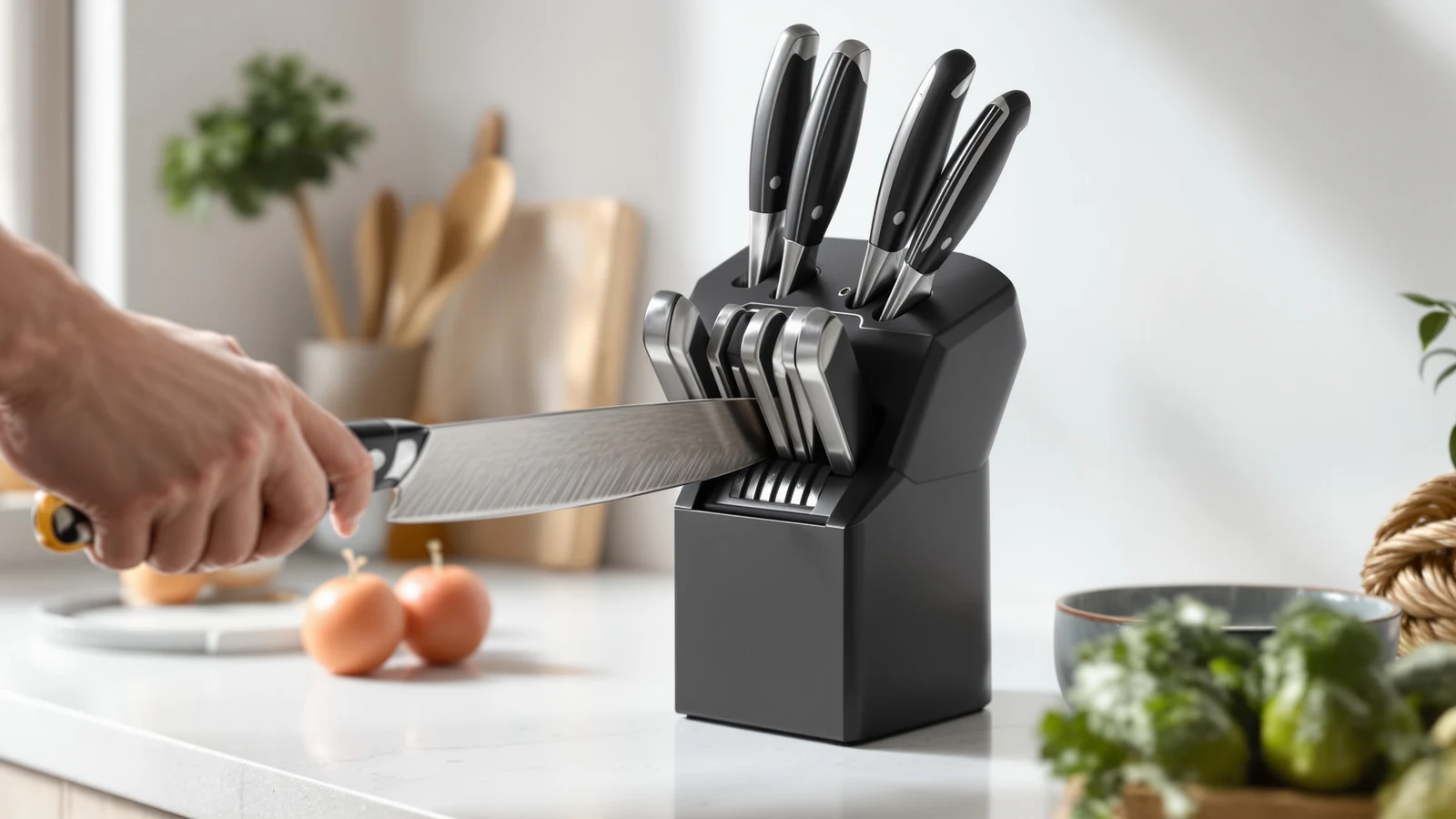
The slot sharpener
What a pull-through slot actually removes from the edge
A pull-through or built-in slot sharpener does its job the way its name describes: you draw the blade through a fixed abrasive channel, and the abrasive removes a thin layer of steel along both faces of the edge until a new, sharper line meets in the middle. That is a real sharpening action, not a cosmetic one — it can bring back a knife that has gone properly dull, which a honing steel cannot do. The trade is that every pass removes metal permanently. A knife is thinnest at the edge and gets thicker toward the spine, so each pass through the slot is, in effect, grinding the blade a fraction closer to the spine. Do it once a week for a decade and the blade is measurably narrower than it started.
The second cost is the angle. A slot is cut at whatever angle the manufacturer chose when they built it, and it sharpens every knife drawn through it at that same angle regardless of how the blade was originally ground. For a mid-range kitchen knife that is rarely a problem you would notice by eye. For a narrower, more deliberately ground edge — the kind our piece on high-carbon stainless covers in more depth — a slot built for a generic 20-degree edge can widen an edge that was meant to be narrower, trading some of the knife's original bite for the convenience of a one-second pass through the block.
None of that makes a built-in sharpener a bad feature. It means what it is doing is closer to a vending-machine version of sharpening on a stone: fast, consistent, available every time you reach for the block, and coarser than a deliberate hand-sharpening session would be. For someone who would otherwise never sharpen a knife at all, a slot that does something automatically every time the blade goes back into the block is a genuine upgrade over a knife that just gets duller and duller with no intervention.
The honing steel
What a honing steel does, and does not do
A honing steel is not a sharpener in the sense the word usually implies. Drawing a blade across a steel at a shallow angle does not remove meaningful metal and does not cut a new edge; what it does is realign the very edge of the blade, which bends microscopically out of true every time it meets a cutting board, a bone, or anything harder than the food it was built for. That bent edge is what you feel as dullness long before the knife is actually dull in the sense of having lost its geometry. A few seconds on a steel straightens it back into line, and the knife feels sharp again because, structurally, most of the edge still is — it was just folded sideways by a fraction of a degree.
What a steel cannot do is bring back an edge that has genuinely worn away. Once the metal itself is gone — rounded off by months of cutting, or chipped against something it shouldn't have met — no amount of time on a steel restores it, because there is no new edge being formed, only the existing one being straightened. At that point the knife needs an actual sharpening: a stone, a slot sharpener, or a professional service. A steel used religiously after every few uses can push that point much further into the future by keeping the existing edge aligned instead of letting it degrade gradually. A steel used occasionally, or not at all, does very little, because the realignment effect fades the longer a bent edge is left to work-harden in its bent position.
The other honest caveat is technique. A slot sharpener works the same way regardless of who uses it, which is most of its appeal. A honing steel rewards a consistent angle and a light touch, and punishes a heavy hand or an inconsistent angle with an edge that gets no better, or occasionally slightly worse. It is the more skill-dependent of the two tools, and also the one that does the least long-term damage to the blade if used correctly, since it removes essentially no steel at all.
The missing piece
Sets that include neither, and what that means for year one
The Martha Stewart Knife Block Set, 16-Piece — the Lockton line in forged, full-tang, high-carbon stainless steel, housed in an acacia wood block for $68.39 — does not name a sharpener or a honing steel anywhere in its published title or specifications. That is not unusual; plenty of sets in this price range spend their budget on the knives and the block and simply do not include a maintenance tool at all, leaving it to the buyer to decide how and when to maintain the edge.
What that means concretely is that year one looks different from a set with a slot built in. There is no automatic touch-up happening every time the knife goes back into the block, and no steel sitting in a slot reminding you it exists. A forged, full-tang blade like this one starts out with a genuine edge, and for the first weeks of ordinary use the difference is unlikely to be noticeable. The gap shows up later — typically somewhere in the first few months of regular cooking, depending on how often the knife meets a cutting board versus a plate, a bone, or the sink. Without either tool in the box, that gradual dulling has nothing arresting it until the owner does something deliberate about it: buy a honing steel, buy a sharpener, or take the knife to be sharpened.
None of this is a defect in the set. A set that doesn't claim a maintenance tool it doesn't include is simply more honest than a listing that bundles an unspecified “sharpening tool” without saying which kind, a case our piece on the extra pieces hiding in a knife block covers for a different set in this catalogue. The practical takeaway for a set like this one is to treat the honing steel or sharpener as a second purchase you are making at the same time as the knives, not as an optional extra for later — because by the time a knife feels noticeably dull, the maintenance habit that would have prevented it has already been skipped for months.
The actual question
Which one actually extends the time between real sharpenings
These two tools do different jobs, which means the honest answer depends on what “extends the interval” is actually asking. If the question is which tool delays the day you need a genuine resharpening — a stone, a professional service, or a slot that removes real metal — the honing steel wins, and it is not close. Used consistently, a steel keeps the existing edge aligned instead of letting it roll over and work-harden in a bent position, which is the mechanism that turns a merely misaligned edge into a genuinely worn one. A blade maintained on a steel after every few uses can go considerably longer before it needs an actual sharpening than the same blade left alone.
A pull-through slot does the opposite kind of work. It does not extend the interval before a real sharpening — it is a real sharpening, just a coarse and automatic one. Every pass through the slot resets the clock by cutting a fresh edge, which is why a knife drawn through one feels sharp again even after being badly neglected. The cost, covered above, is that this “resetting the clock” is the thing that is permanently thinning the blade. A knife maintained exclusively on a slot sharpener will rarely feel properly dull, because the slot keeps re-cutting it, but it is also spending down its usable steel faster than a knife maintained on a steel and sharpened properly only when it is actually needed.
The sets in this catalogue that build a sharpener into the block are making that trade on the owner's behalf: convenience and a knife that rarely feels dull, in exchange for a blade that is slowly ground thinner over the years. The honest middle path, achievable with either kind of set, is to use a steel for routine maintenance between real sharpenings and reserve an actual sharpening — slot, stone, or professional — for the point where the steel genuinely stops helping. That is a maintenance habit, not a product feature, and it works whether the set in the block is a honing steel, a sharpener, or neither.
If the set doesn't include one
Buying the missing tool separately, and what it costs
A basic honing steel is one of the least expensive tools in a kitchen drawer, generally the cheapest single item you could add to complete a set that doesn't include one. A pull-through sharpener sold on its own typically costs somewhat more than a steel, since it is a small mechanical device rather than a plain steel or ceramic rod, though it still sits well below the price of any knife in a set like the ones compared here. Either is a modest, one-time addition next to the cost of the knives themselves.
Framed against the sets in this guide, that math is straightforward. The Martha Stewart 16-piece set at $68.39 plus a separately bought honing steel still comes in well under the McCook 15-piece set at $49.99, which bundles a sharpener into the block already. Buying the Martha Stewart set and a steel separately is the cheaper route to owning both a forged, full-tang knife set and a maintenance tool — it just requires remembering to make the second purchase, rather than having it arrive already in the box. The McCook set is the opposite trade: paying more up front so the maintenance tool is already there and nothing further needs to be decided or bought.
The one thing worth checking before buying a sharpener or steel separately is that it is sized and shaped to sit in whatever storage you already have — a loose steel next to a block built for a fixed set of slots is a drawer item, not a block item, and that is a minor but real difference in whether the maintenance habit actually sticks. A tool you have to go looking for gets used far less often than one already standing in the block next to the knives.
The picks
The picks, by how much maintenance you will realistically do
01Do the least
McCook Kitchen Knife Set 15PC with Built-In Sharpener
Best if you know you will never pick up a steel on your own
15 pieces·Built-in sharpener·Knife block set·$49.99
McCook names the built-in sharpener directly in the title, which puts the maintenance decision inside the block itself rather than leaving it to a separate purchase or a separate habit. Every time a knife goes back into its slot, it passes through the sharpener, which means the edge gets touched up automatically whether or not the owner ever thinks about maintenance at all. That convenience is the entire point of this set, and the earlier section on what a slot removes from the edge applies here in full — this is the fast, coarse, always-available version of sharpening, not the precise one.
Buy this one if the honest answer is that a honing steel would sit untouched in a drawer. A sharpener you walk past every day gets used; one you have to remember to buy and then remember to pick up usually doesn't.
02Confirm before buying
Farberware 15-Piece Kitchen Knife Set
Best budget pick, if you confirm the tool type first
15 pieces·Sharpening tool included·Steak knives & shears·$35.18
Farberware's title lists a “Sharpening Tool” among the fifteen pieces, alongside the wood block, the steak knives and the all-purpose shears, without stating whether that tool is a honing steel or a pull-through sharpener. Those are genuinely different objects doing genuinely different jobs, as the sections above lay out, and at $35.18 this is by far the least expensive set in this comparison. If which mechanism is in the box matters to your maintenance plans, check the listing photos for a visible abrasive slot versus a plain rod before buying — we have the name of the piece, not its mechanism, so we won't guess on your behalf.
A reasonable buy at this price either way. Just don't assume which of the two tools you're getting until you've looked at the photos yourself.
03Bring your own routine
Martha Stewart Knife Block Set, 16-Piece
Best if you already have, or already plan to buy, a maintenance tool
16 pieces·Forged, full tang·Triple-riveted handles·$68.39
This Lockton set states forged, full-tang construction with triple-riveted handles in an acacia wood block, and names no sharpener or steel anywhere in its listing. For a set this deliberately specified on the blade and handle, that omission reads as a choice of priorities rather than an oversight — the money went into the steel and the construction, not into a maintenance accessory. Pair it with a honing steel bought at the same time, and the two together, as the cost section above works out, still land well under the price of a set with a sharpener already built in.
The set to buy if you'd rather control the maintenance tool yourself than inherit whichever one, or none, came in the box.
Side by side
The three, compared on what maintains the edge
| Set | Maintenance tool | Mechanism | Price | Get it |
|---|
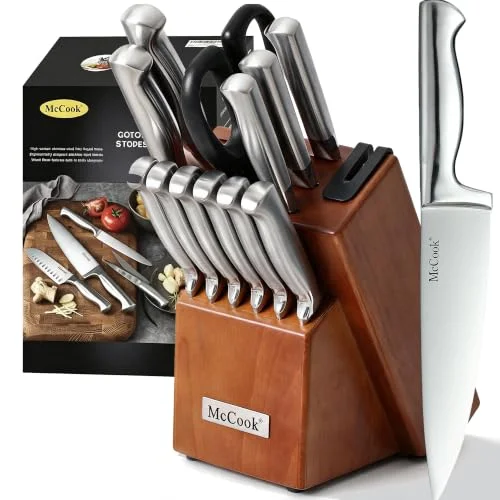 McCook 15PC |
Built-in sharpener |
Abrasive slot — cuts a new edge |
$49.99 |
Get it |
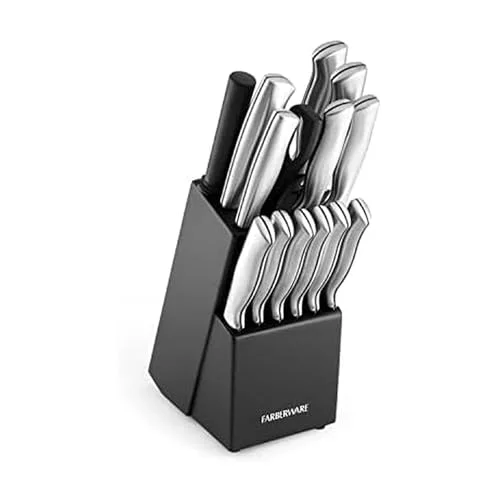 Farberware 15-Piece |
Sharpening tool (unspecified) |
Not stated — check listing photos |
$35.18 |
Get it |
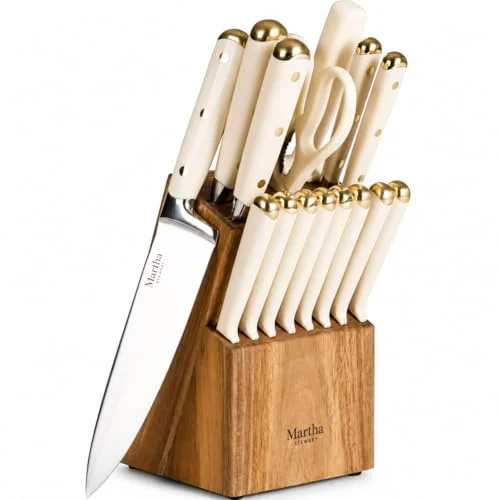 Martha Stewart 16-Piece |
None included |
— |
$68.39 |
Get it |
Prices change. We refresh them, but Amazon is the authority at the moment you buy. See the sets between $100 and $200 for more options that bundle a sharpening mechanism into the block.
Our method
How we compared — and what we can’t tell you
What we did
Read what each listing names, and only that
We compared the published titles and specifications for three sets that sit on different points of the maintenance question: one names a built-in sharpener outright, one names an unspecified “sharpening tool,” and one names neither. What each tool mechanically does and does not do is explained from general, checkable facts about how pull-through sharpeners and honing steels work, not from anything specific to these three listings beyond what they state.
What we didn’t
We don’t run a testing lab
We do not physically test these sets, we do not own them, and we have no verified owner review data to paraphrase for any of the three. Where a listing doesn’t specify a mechanism — Farberware’s “sharpening tool” is the clear example — we say so plainly rather than guessing which kind it is.
FAQ
Common questions
What does a pull-through sharpener actually remove from the blade?
It removes a thin layer of steel from both faces of the edge every time the blade is drawn through the slot, cutting a genuinely new edge rather than just realigning the existing one. Done repeatedly over years, that permanently thins the blade and sharpens it at whatever fixed angle the slot was built for, not necessarily the angle the knife was originally ground at.
Does a honing steel sharpen a dull knife?
Not in the sense of cutting a new edge. A steel realigns a microscopically bent edge back into true without removing meaningful metal, which is why a knife feels sharper right after using one. It cannot restore an edge that has genuinely worn away; once the steel itself is gone from the edge, only an actual sharpening — a stone, a slot sharpener, or a professional service — brings it back.
What happens in year one if a set includes neither tool?
Nothing dramatic at first. The edge dulls gradually with ordinary use, and because there's no steel or slot automatically maintaining it, the decline becomes noticeable sooner than it would with either tool in the mix — typically somewhere in the first few months of regular cooking. The fix is to treat a honing steel or sharpener as a second purchase made at the same time as the knives, rather than an afterthought bought once the knife already feels dull.
Is it worth buying a honing steel or pull-through sharpener separately?
Usually yes, and the cost is modest next to the price of the knives themselves. A honing steel is typically the less expensive of the two, and a pull-through sharpener costs somewhat more but still far less than any knife in a set like the ones compared here. Buying the tool separately alongside a set that doesn't include one is often cheaper overall than upgrading to a pricier set that bundles a sharpener into the block.
Keep reading
Related on Best Knife Sets