The headline number
What actually counts as a “piece,” and what shouldn’t
Nothing in retail law or kitchenware convention says a “piece” on a knife set box has to be a knife. A block counts as a piece. A honing steel counts as a piece. In at least one listing we looked at for this guide, the manufacturer counts a blade cover — a slip of plastic that sits over a blade in a drawer and does nothing else — as a piece, right next to the knife it protects. None of that is illegal, and most of it is disclosed if you read past the title. The problem is that “12-piece” and “15-piece” read, at a glance, like a count of knives, and the whole point of a bigger number on the box is to be read at a glance.
The honest version of a piece count is one the manufacturer itemizes: so many knives, by name and size, plus a named block, plus named extras. Cuisinart does this for its 12-piece Advantage set, right down to the color coding. Farberware does it partially for its 15-piece set, naming most but not quite all of the fifteen. The least honest version is a bare number with no breakdown at all — not because the manufacturer is necessarily hiding something, but because you have no way to check, and a number you can’t check is an adjective wearing a digit.
Should count
Anything you’d miss if it were gone
A chef’s knife, a paring knife, a bread knife, a block to store them in, a sharpener you’d otherwise have to buy separately — all of these are things a kitchen is worse off without. They belong in a piece count because losing one of them changes what you can actually do at the cutting board.
Shouldn’t inflate the number
Anything that exists only because a knife does
A blade guard exists because a knife exists; it has no function on its own. Packaging foam, a warranty card and a cardboard insert aren’t pieces either, for the same reason. If you removed it and the knife underneath still works exactly the same, it’s packaging, not a piece worth paying attention to on the box.
Shears
Kitchen shears: genuinely useful, or a box-filler?
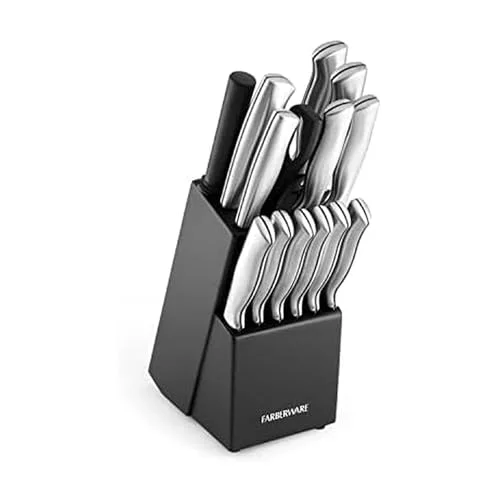
Farberware’s 15-piece set names “All-Purpose Shears” directly in its title, alongside the block, the steak knives and the sharpening tool. That phrasing — all-purpose, not poultry shears or herb shears — tells you what kind of tool it is before you even open the listing: a general kitchen scissor meant for the jobs a knife handles badly, not a specialized blade for a narrow task.
Whether that earns its place on the piece count depends entirely on what you already own. If there is no pair of scissors in your kitchen drawer, a pair bundled into a knife set is a genuine convenience — snipping the corner off a bag, cutting kitchen twine, trimming fat off a cut of meat, opening stubborn packaging. None of that requires a knife at all, and doing it with one is usually worse: a chef’s knife dulls faster against twine and plastic than a scissor built for exactly that resistance. Shears used this way aren’t filler; they’re a second tool doing a second tool’s job.
If you already own kitchen shears, the calculation flips. A second pair, bundled into a set you bought for the knives, is dead weight on the piece count — and the price you paid for the set is spread a little thinner over the knives you actually wanted. Farberware’s listing also leans on language like “razor sharp” and “ultra-sharp precision cutting” to describe the whole set, which is worth reading the way we cover in our piece on knife-set marketing words: a sharpness claim on the box is not a measurement, and it applies to the knives, not the shears, which are a separate mechanism entirely — two blades that scissor past each other rather than one edge that slices.
Blade guards
Blade guards: six pieces that are not knives
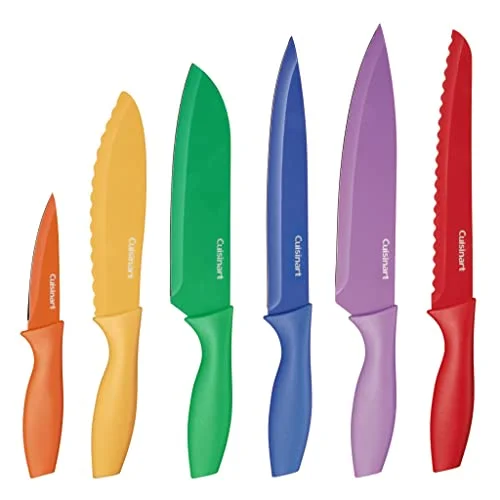
Cuisinart’s own listing for the C55-01-12PCKS Advantage set states the split plainly: “features 6 knives and 6 covers,” including an 8-inch chef knife, an 8-inch slicing knife, an 8-inch serrated bread knife, a 7-inch santoku, a 6.5-inch utility knife and a 3.5-inch paring knife. Six knives. Six covers. Call that a “12-piece” set and the arithmetic is true — six plus six is twelve — and the number still tells you almost nothing about how many of those twelve pieces will actually cut something. The covers are the color-coded sleeves that correspond to the color-coded handles, meant to help you remember which knife touched raw chicken versus which one touched bread. That is a real, if narrow, convenience. It is not a knife.
At $19.51, the Cuisinart set is the cheapest of the three we looked at for this guide, and it is also the clearest example of what a fully itemized piece count looks like when a manufacturer bothers to publish one. You don’t have to guess what the other six pieces are, because Cuisinart told you. That transparency is worth something on its own, separate from whether six plastic covers are worth paying for.
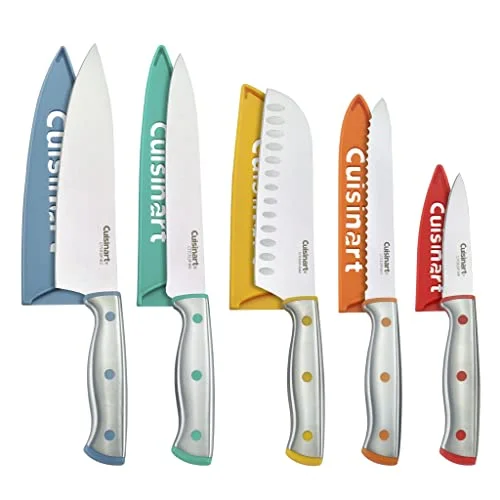
Cuisinart’s own C77CR-10P ColorCore set follows the same basic idea — a “10pc” set that the title says comes “with Blade Guards” — without the same arithmetic. The published features for that set list “high-quality stainless steel blades,” an ergonomic handle and a lifetime warranty, but nothing that states how many of the ten pieces are knives and how many are guards. The one dimension Cuisinart does publish for it is 3.9 inches, which in blade-length terms sits closer to a paring or utility knife than a chef’s knife — useful context if you assumed the guards in the name were protecting a full-size blade. If the knife-to-guard ratio specifically matters to your decision, that is a case for opening the listing photos before buying rather than assuming the same 1-to-1 split Cuisinart uses on its other set; we don’t have the number, so we won’t assert one.
Either way, the practical use of a blade guard is real and modest: it keeps an edge from nicking other items in a drawer, and it keeps a hand from finding an edge by accident while reaching past it. That is worth something in a crowded drawer. It is not worth counting as equal to a knife when you’re deciding between two sets on price.
The sharpening tool
The sharpening tool: a sharpener, or a steel?
Farberware’s title names a “Sharpening Tool” as one of the fifteen pieces in its set, separate from the block, the steak knives and the shears. What the listing does not specify is which of two genuinely different tools that phrase refers to, and the difference matters more than the shared name suggests.
A honing steel — the long rod many knife blocks include a slot for — does not sharpen a blade in the sense of removing metal to create a new edge. It realigns a microscopically bent edge back into true, which is why a knife drawn across one feels sharper immediately: the edge was already there, just folded slightly out of alignment from use, and the steel straightens it. A pull-through or built-in sharpener, by contrast, uses an abrasive slot to actually grind away a small amount of metal and cut a new edge, which does restore genuine sharpness to a dull blade but also wears the knife down a little more each time, and does it at whatever angle the slot is fixed to, not necessarily the angle the blade was originally ground at.
Because Farberware’s listing doesn’t say which mechanism its “sharpening tool” uses, we won’t guess. What we can tell you is what to check before you buy if the distinction matters to you: product photos that show a built-in abrasive slot in the block usually mean a true sharpener; a separate rod with no visible grit along the handle is almost always a honing steel. Either is a legitimate thing to include in a set — a steel is genuinely useful for anyone who uses their knives daily and wants the edge to stay true between real sharpenings, and a built-in sharpener is useful for anyone who would otherwise never sharpen anything at all. What neither of them is, is a knife, and “sharpening tool” sitting in the same list as “8-inch chef knife” makes it easy to read the set as having one more usable blade than it actually does.
Doing the math again
Totaling the knives alone — and comparing again
Divide a set’s price by its advertised piece count and you get a per-piece price that makes every set in this guide look inexpensive. Divide the same price by the number of pieces that actually cut something, and the comparison changes — sometimes a lot, depending on how much of the box is covers, a block and a sharpening tool rather than blades.
$3.00
Cuisinart 12-Piece
$19.51 ÷ 6 knives Cuisinart names by size. The other six pieces are the color-coded covers, which don’t cut anything.
$3.91
Farberware 15-Piece
$35.18 ÷ 9 knives named in the listing (an 8-inch chef, a bread knife, a santoku and six steak knives). Three of the fifteen pieces aren’t itemized anywhere we can check.
$3.80
Cuisinart C77CR-10P
$24.95 ÷ 10 pieces, since Cuisinart doesn’t publish how many of them are knives versus blade guards for this particular set.
Two things are worth noticing in that math. First, the Cuisinart 12-piece set, which looks like the cheapest option at $1.50 per piece on the headline number, is priced in the middle once you count knives only — the covers were quietly doing a third of the work of making it look like a bargain. Second, Farberware’s per-knife price is the highest of the three even though its per-piece price looks lowest, because nine real knives absorb the full $35.18 once the block, the shears and the sharpening tool stop being credited as blades. None of this makes any of the three a bad buy — a block, a sharpener and a pair of shears are genuinely useful things to own. It means the number on the box isn’t the number that determines value, and the only way to find the real one is to total the knives yourself, by name. Our comparison of Astercook’s tiers runs the same exercise on sets thirty to forty-five dollars apart.
The picks
Three sets that name their extras — and who each one is actually for
01Clearest arithmetic
Cuisinart C55-01-12PCKS 12-Piece Advantage Set
Best for seeing exactly where the piece count comes from
6 knives, by size·6 color-coded covers·Nonstick blade coating·$19.51
Cuisinart states the split outright: an 8-inch chef knife, an 8-inch slicer, an 8-inch serrated bread knife, a 7-inch santoku, a 6.5-inch utility knife and a 3.5-inch paring knife, each with a matching color-coded cover meant to flag which blade touched which food. The covers are the six non-knife pieces, named as such, which makes this the set to point to when you want to see the mechanics of piece inflation laid out in the manufacturer’s own words rather than inferred from a vague bullet list.
Eighteen dollars for six real, correctly sized knives is a fair deal. Eighteen dollars for “twelve pieces” is a different sentence describing the same box.
02Shears & sharpener bundled
Farberware 15-Piece Kitchen Knife Set
Best if you’ll genuinely use the shears and the sharpening tool
8” chef, bread & santoku·Six steak knives·Shears + sharpening tool named·$35.18
Farberware’s title names a wood block, steak knives, a sharpening tool and all-purpose shears alongside the core knives, and the bullet copy itemizes nine blades: an 8-inch high-carbon stainless chef knife, a bread knife, a santoku and six steak knives, each with an ergonomic handle. That accounts for twelve of the fifteen claimed pieces once you add the block, the sharpening tool and the shears; the remaining three aren’t itemized anywhere in the data we have, so we won’t guess what they are — check the listing images if the exact count matters to you.
Buy this one for the shears and the sharpening slot specifically, not on the belief that fifteen separate useful objects are sitting in the block.
03Guards are the point
Cuisinart C77CR-10P ColorCore 10-Piece Set
Best if blade guards, not extra knives, are what you’re actually shopping for
ColorCore color rivets·Blade guards included·Lifetime warranty·$24.95
Cuisinart’s own title leads with the guards, not a knife count, and the published specs confirm stainless steel blades and a lifetime warranty without stating how many of the ten pieces are knives versus covers. The one number we have is a 3.9-inch blade size, which points toward a smaller, paring-scale knife rather than a full chef’s set. If you already own knives and specifically want guards sized to Cuisinart’s own ColorCore line, that specificity is the honest reason to buy this over a bigger set you don’t need.
The guards are the product here. If what you want is covers that actually fit, this is a more honest purchase than hoping a bigger block includes the right size.
Side by side
The three, compared on knives instead of pieces
| Set | Claimed pieces | Named knives | Named extras | Price | Per knife | Get it |
|---|
 Cuisinart 12-Piece |
12 |
6 |
6 color-coded covers |
$19.51 |
$3.00 |
Get it |
 Farberware 15-Piece |
15 |
9 |
Block, sharpening tool, shears |
$35.18 |
$3.91 |
Get it |
 Cuisinart C77CR-10P |
10 |
Not published |
Blade guards |
$24.95 |
— |
Get it |
Prices change. We refresh them, but Amazon is the authority at the moment you buy. See the sets between $100 and $200 if your budget stretches further than any of the three above.
Our method
How we compared — and what we can’t tell you
What we did
Read every itemized claim, and only those
We compared the published titles, bullet features and current Amazon prices for three sets that specifically name shears, blade guards or a sharpening tool among their pieces, then counted the knives each manufacturer actually itemizes by name or size, separately from the total piece count on the box.
What we didn’t
We don’t run a testing lab
We do not physically test these sets, we do not own them, and we have no verified owner review data to paraphrase for any of the three. Where a listing doesn’t state a detail — which knives make up the untitled pieces, or which mechanism a “sharpening tool” uses — we say so plainly instead of inferring one.
FAQ
Common questions
Do blade covers really count as pieces on the box?
Manufacturers count them, and Cuisinart's own listing for its 12-piece Advantage set says so directly: six knives and six covers. That arithmetic is accurate — six plus six is twelve — but it means half the advertised pieces don't cut anything. Before comparing two sets on their headline number, check whether the breakdown is a knife count or a knives-plus-covers count.
Are kitchen shears in a knife set actually useful, or just filler?
It depends on whether you already own a pair. If you don't, bundled shears handle jobs a knife does badly — cutting twine, opening packaging, trimming fat — and are a genuine convenience. If you already have kitchen scissors, a second pair bundled into a set is dead weight that dilutes the price you're really paying for the knives.
Is the sharpening tool in a knife block a real sharpener?
It can be either a honing steel, which realigns an edge without removing metal, or a true pull-through sharpener, which grinds a new edge and wears the blade down slightly each use. Listings that just say "sharpening tool" often don't specify which, and the two do different jobs — check product photos for a built-in abrasive slot versus a plain rod if the distinction matters to your decision.
How many of the knives in a 12- or 15-piece set will I actually use?
Usually far fewer than the total. A chef's knife, a paring knife and a bread knife cover most kitchen tasks; the rest of a block — steak knives, a santoku, a slicer, plus any guards or a sharpener — are either occasional-use or not knives at all. Totaling the price against the knives you'll actually reach for, rather than the full piece count, gives a more honest per-knife cost than the number on the box.
Keep reading
Related on Best Knife Sets