On Amazon
What it means on an Amazon listing, which is less
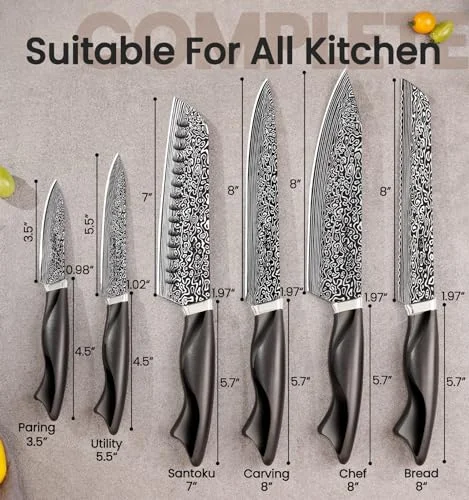
On a product title, “high carbon stainless steel” usually is the entire metallurgical claim, full stop. The 15-Piece Knife Set with Built-In Sharpener states “High Carbon German Stainless Steel” in its title and adds nothing more specific anywhere in the listing — no grade, no hardness figure, no heat-treatment description. “German” functions the way “Japanese” does elsewhere in this category: a heritage adjective borrowing the reputation of a steelmaking tradition, with no number behind it.
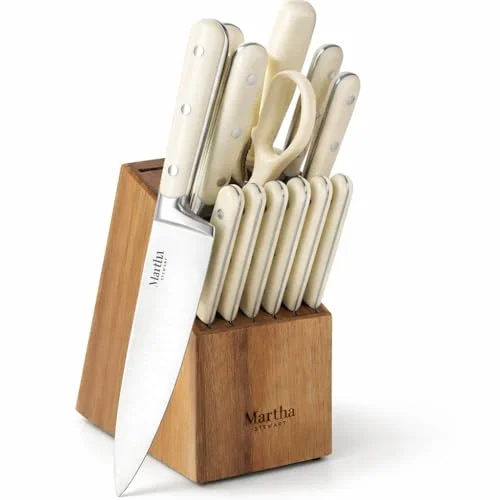
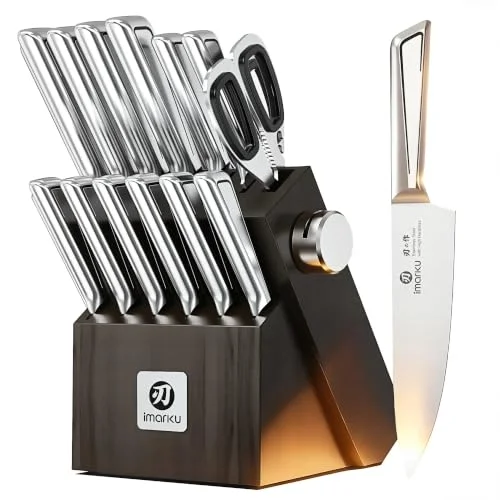
The MARTHA STEWART Eastwalk 14-Piece set states the same base claim — “High Carbon Stainless Steel” — but pairs it with something checkable: forged construction and triple-riveted handles, confirmable by looking at the knife, though it still doesn’t state the hardness the steel actually reached. The imarku Japanese 14-Piece set goes further: alongside “Japanese High Carbon Stainless Steel,” its listing states a specific edge angle, 10–15° per side — the only number among the three sets that ties directly to the blade’s performance rather than to construction or origin.
None of the three publishes a Rockwell hardness figure, which is close to the norm for this category. For all three, “high carbon stainless steel” reassures you about the steel family while leaving the one number that would tell you how hard that steel actually ended up unstated. We won’t invent that number for any of the three. If a hardness figure matters to your decision, check the current listing yourself or contact the seller before buying, rather than assuming a number from the phrase.
Reading the claim
The brands that add a number, and the ones that add an adjective
Line the three listings up and a pattern appears that generalizes past this guide: some brands follow “high carbon stainless steel” with a number, and some follow it with an adjective, and the two are not interchangeable even when they sit in the same sentence. An adjective — “German,” “Japanese,” “professional,” “ultra-sharp” — borrows credibility from a tradition or an impression without creating anything you could be wrong about. A number — an edge angle in degrees, a Rockwell hardness figure, a specific steel designation — is a claim a brand can be held to. That distinction is the same one we laid out for “ultra-sharp” and “razor-sharp”, and “high carbon stainless steel” is exposed to the same dynamic: close enough to a technical term to borrow its authority, while usually carrying none of the specificity a real spec would.
Here, imarku is the one that adds a number — the 10–15° edge angle — though it’s worth being precise about what that number covers. An edge angle is a geometry spec, not a metallurgy spec: it tells you how the blade was ground, not how hard the steel underneath that grind is. A narrower angle generally produces a thinner, keener-feeling edge, a real and checkable property, but a narrow edge on soft steel behaves differently from a narrow edge on hard steel, and this still isn’t a hardness figure. Martha Stewart’s Eastwalk set adds a construction detail instead — forged, triple riveted — genuinely informative about how the knife was built, without saying anything about the hardness the steel reached. The 15-Piece Knife Set with Built-In Sharpener adds only the heritage adjective, “German,” with no number attached at all.
None of this ranks the three sets against each other on steel quality; we don’t have the data to do that honestly. What it shows is a hierarchy worth carrying into any listing in this category: a specific number beats a construction detail, a construction detail beats a heritage adjective, and a heritage adjective beats nothing — but only the number is something you could independently verify.
Why it's everywhere
Why almost every set in this category uses the phrase
“High carbon stainless steel” is close to a universal claim in kitchen knife sets for a simple reason: the raw material cost difference between a high-carbon stainless alloy and a plainer, lower-carbon one is small. It is one of the cheapest upgrades a manufacturer can legitimately claim, which is why a $37.99 set, a $59.99 set and a $123.49 set in this guide can all use some version of the phrase without lying. The real cost differences between a budget set and a premium one show up elsewhere — heat treatment, grind precision, consistency, handle construction — none of which appear in a four-word material claim.
That is also why the phrase carries so little signal about where a set sits in quality or price. It functions less like a nutrition label and more like a minimum bar the entire category has already cleared, the same way “dishwasher safe” appears on sets at every price point regardless of how well they survive a cycle. A manufacturer who stops at the phrase isn’t necessarily cutting a corner on the steel; they’re simply not spending listing space on a number competitors also aren’t publishing. The honest reading: the phrase tells you the set probably isn’t using the cheapest possible stainless alloy, not how that alloy was treated, ground or finished — where the real differences in a knife’s working life get decided.
What actually matters
What actually correlates with edge retention
If the carbon-stainless family alone doesn’t decide how long an edge lasts, three other things do more of the work, and all three are things a listing could state and usually doesn’t. The first is heat treatment: the same alloy taken to a higher achieved hardness generally holds an edge longer before resharpening, at the cost of more chipping on hard contact. A published Rockwell number is the only way to know where a knife landed on that trade-off, and none of the three sets here state one.
The second is edge geometry — the angle the blade is ground to, the one number imarku publishes for its Japanese 14-Piece set. A narrower edge, in the 10 to 15 degree range imarku states, bites into food more easily and feels sharper immediately, but is inherently less durable against lateral stress: a bone, a frozen surface, a cutting board dragged sideways under the blade. A wider edge, more typical of German-style grinds like the 15-Piece Knife Set with Built-In Sharpener, trades initial bite for everyday forgiveness. Neither geometry is simply better; the angle number, where it’s published, is useful information “high carbon stainless steel” alone does not convey.
The third is maintenance, the variable most within your control regardless of which set you buy. High carbon stainless resists rust better than plain carbon steel but is not immune to it, and dishwasher heat, alkaline detergent and other utensils knocking against the blade accelerate edge dulling on virtually any kitchen steel. Hand washing, drying immediately, and storing the knife in a block rather than a drawer does more for a set’s working life than the gap between two listings that both say “high carbon stainless steel” and stop there.
The picks
The picks, and what we would check first instead of the phrase
01Lowest entry price
Knife Set, 15 Pieces with Built-In Sharpener
Best for a complete block at the lowest price here, checked on piece count rather than the steel claim
15 pieces·High carbon German stainless·Built-in sharpener·Dishwasher safe
At $37.99 this is the cheapest of the three sets here, and “High Carbon German Stainless Steel” is the entirety of its metallurgical claim — no hardness figure, no edge angle, just the alloy family and a heritage adjective. What it does state plainly is a 15-piece count with a built-in sharpener, a genuine convenience if you’d otherwise never touch up an edge, and dishwasher-safe blades, though hand washing still extends any knife’s working edge further than a cycle will.
The set to buy if you want a complete 15-piece block for under $50 and are judging it on the sharpener and the piece count, not on a steel claim this listing never quantifies.
02Construction detail, not a number
MARTHA STEWART Eastwalk 14-Piece Knife Block Set
Best for a checkable construction claim alongside the steel claim
14 pieces·High carbon stainless·Forged, triple riveted·Acacia wood block, linen white
The Eastwalk set states “High Carbon Stainless Steel” the same way the other two sets here do, but it pairs the material claim with a construction detail you can verify by looking at the knife: forged blades with ABS triple-riveted handles, in an acacia wood block finished in linen white. At $59.99, that forged construction is a step up in specificity over an alloy name alone, even though the achieved hardness stays unstated. Acacia is one of three block materials worth comparing on its own merits if that factors into your decision.
The set to buy if a stated construction method matters more to you than a steel claim with nothing to check it against.
03Only one with a geometry number
imarku Japanese High Carbon Stainless Steel Knife Set, 14 Pcs
Best for the one published number in this trio, with a clear eye on what that number does and doesn't cover
14 pieces·Japanese high carbon stainless·10–15° edge·Precision-forged, built-in sharpener
At $123.49, this is the most expensive set in the guide, and the only one of the three that attaches an actual number to its steel-adjacent claim: a 10–15° edge angle, alongside precision-forged construction and a built-in sharpener. That is more than either of the other two sets publishes — but it is a geometry number, not a hardness number, and it answers a different question than full tang or heat treatment would. A narrower edge like this trades some durability against bone and frozen food for a thinner, easier-biting cut, fitting a gyutou-style Japanese grind.
The set to buy if you want the one number this category rarely publishes — just keep in mind it describes the grind, not the hardness the steel was heat-treated to.
Side by side
The three, compared on what they actually state
| Set | Best for | Pieces | Steel claim | Number published | Price | Get it |
|---|
 15-Piece Built-In Sharpener Set |
Lowest entry price |
15 |
High carbon German stainless |
None stated |
$37.99 |
Get it |
 MARTHA STEWART Eastwalk 14-Piece |
Checkable construction detail |
14 |
High carbon stainless |
None stated (forged, triple rivet) |
$59.99 |
Get it |
 imarku Japanese 14-Piece |
Only published edge-angle number |
14 |
Japanese high carbon stainless |
10–15° edge angle |
$123.49 |
Get it |
Prices change. We refresh them, but Amazon is the authority at the moment you buy. For sets specifically in the $100–$200 range where imarku’s set sits, see the best knife sets between $100 and $200; for the cheaper end of this category, see the best knife sets under $30.
The checklist
What we would check first instead of the phrase
Checkable
Facts a listing can state in writing
A Rockwell hardness figure, an edge angle in degrees, whether the blade is forged or stamped, whether the handle is full tang, the block material per our block material guide, and an itemized piece count. Each is a claim the manufacturer commits to in writing, verifiable against the knife that arrives.
Not checkable on its own
A material family name with nothing attached
“High carbon stainless steel” alone, with no hardness number, no edge angle and no heat-treatment detail, is close to the floor this category already clears. Treat it as confirmation the set isn’t using the cheapest possible alloy, not as evidence about how it was treated, ground or finished — and look for a number attached before paying a premium on the phrase alone.
Our method
How we researched this — and what we can't tell you
What we did
Specs, listing language and general metallurgy
We compared the published titles, bullet points and current Amazon prices for the three sets in this guide, noting which pair “high carbon stainless steel” with a checkable number or construction detail and which stop at the phrase, then set that against widely documented metallurgical facts about carbon content, heat treatment and edge geometry.
What we didn’t
We don’t run a testing lab
We do not physically test these knives, we do not own them, and we have not measured the hardness or edge retention of any specific unit. We have no verified review data for these products, so we don’t paraphrase owner sentiment either. Every claim above is anchored to a published spec, a price, or a general domain fact about steel and heat treatment, not an invented score.
FAQ
Common questions
Does "high carbon stainless steel" guarantee a sharp or durable knife?
Not by itself. It names a real alloy family capable of good edge retention, but how hard the steel actually ended up depends on the heat treatment it received, which almost no listing states. None of the three sets in this guide publishes a Rockwell hardness figure; only imarku's Japanese 14-Piece set adds any number at all, and that number is an edge angle, not a hardness measurement.
What's the difference between a stated edge angle and just saying "high carbon stainless steel"?
An edge angle, like the 10–15° imarku states, is a geometry claim about how the blade was ground — checkable because it describes a specific grind. "High carbon stainless steel" on its own is an alloy family name with no attached number. Only the angle tells you something specific about how that knife will cut and wear.
Why do almost all knife sets use the same "high carbon stainless steel" phrase?
Because the raw material cost difference between a high-carbon stainless alloy and a plainer one is small, so nearly every manufacturer at nearly every price point can make the claim honestly. The real quality differences show up in heat treatment, grinding precision and construction, none of which the phrase discloses.
What should I check before buying, if the listing only says "high carbon stainless steel"?
Look for a Rockwell hardness number, a stated edge angle, whether the blade is forged or stamped, whether the handle is full tang, and an itemized piece count. If none of these are published beyond the base material phrase, treat that as the floor this category already clears, not evidence of anything above it.
Keep reading
Related on Best Knife Sets