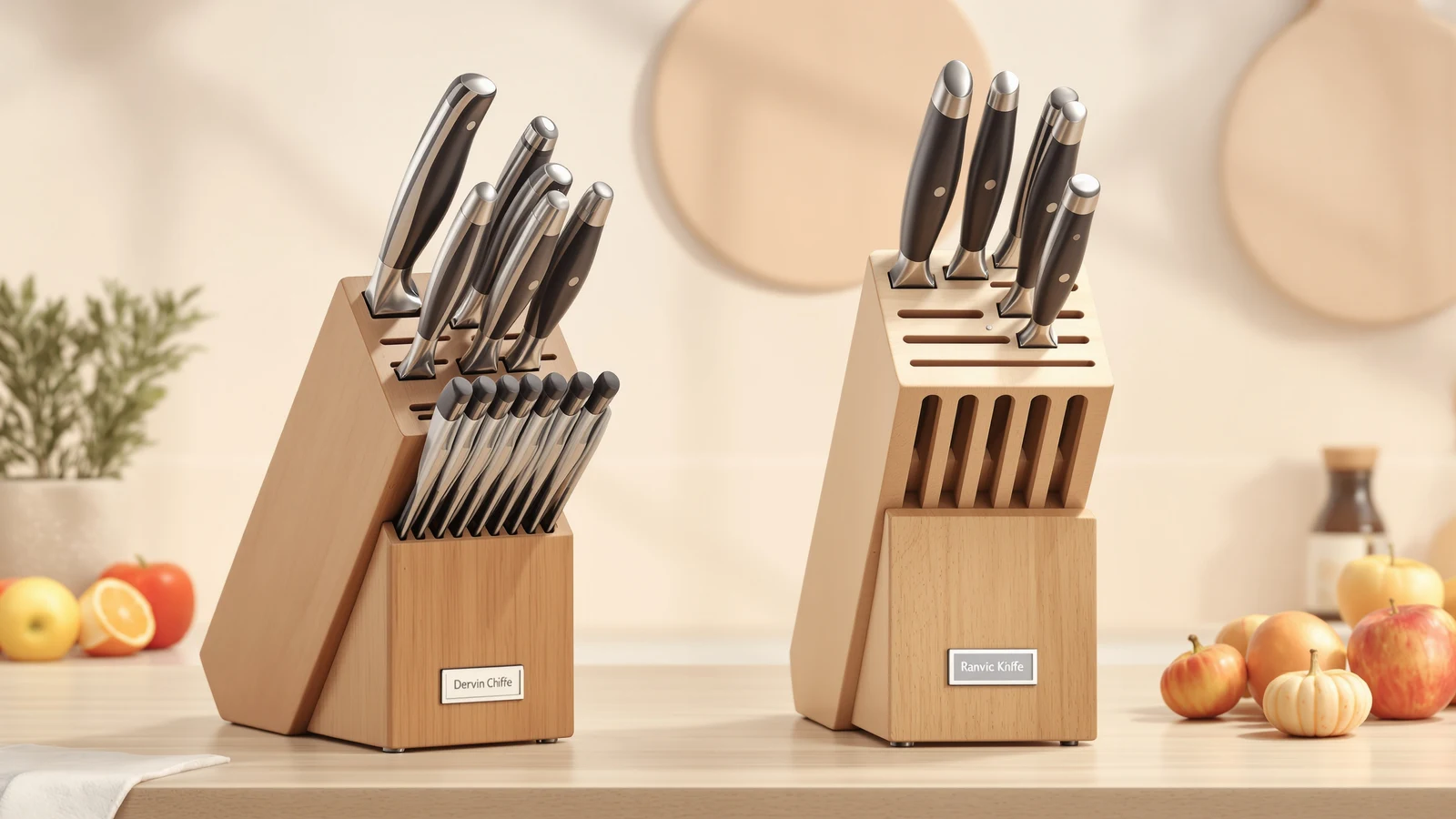
How it works
How a universal block actually holds a blade
A fixed-slot block is a hole cut to a shape. A universal block is a mechanism, and the mechanism is almost always the same idea wearing different clothes: instead of one rigid opening sized for one knife, the block is filled with something that can move — stiff plastic bristles, a ring of flexible pins, or a bed of small rods set close together. Push a blade down between them and they part to let it through, then close back in around whatever width of steel just passed. The knife is held by friction and spring-back pressure from dozens of small contact points rather than by a slot machined to its exact outline. That is the entire trick, and it is also the entire limitation: the block has no idea what shape of knife it is holding, which is precisely the point.
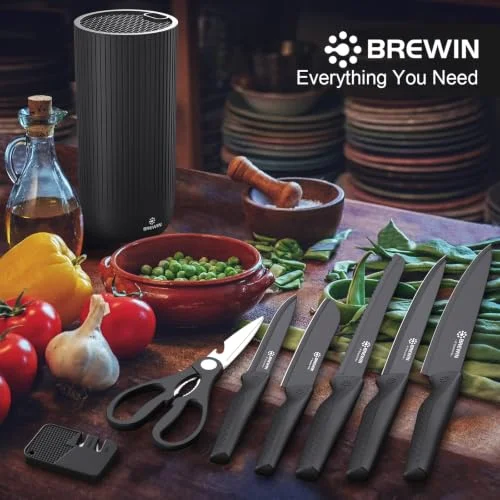
Brewin's set is the plainest example in this comparison — its listing calls the block a "universal knife block" outright, built in high-density polypropylene with drainage holes through the base, and it is designed to seat an 8-inch chef's knife, an 8-inch slicing knife, an 8-inch bread knife, a 5-inch utility knife and a 5-inch santoku side by side along with kitchen scissors and a separate sharpener, none of which need to be the same width to fit. The listing does not spell out whether the gripping surface is bristle, pin or rod, and we won't guess at a mechanical detail it doesn't publish — if the exact gripping method matters to you, the product photos on the listing are the place to check before buying, not a review page.
What a universal design is actually solving for is the gap between what a block ships with and what ends up living in it. Kitchens accumulate knives that were never part of a matched set — a gift, a replacement for one that chipped, a specialty blade bought for one recipe. A fixed slot has no answer for any of those. A universal block, by construction, does.
How it works
How a fixed-slot block is cut, and for which knife
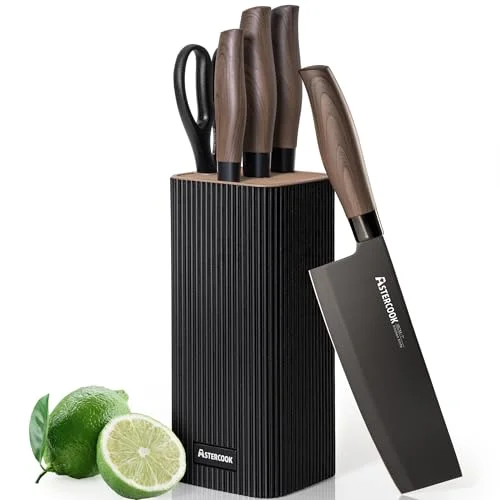
A fixed-slot block starts from the opposite direction. The manufacturer knows exactly which knives are going in the box, so the block is bored or routed to those specific outlines before the knives are ever packaged with it. Astercook's 6-piece set is built this way: a square block with what the listing describes as a "4-hole" design, drilled with drainage holes so the block dries out rather than trapping moisture the way a solid wood block can, sitting on a non-slip base. Four holes for a 6-piece set is not a mismatch — the remaining pieces are the scissors and sharpener that don't need a bored slot at all. Every hole in that block was sized at the factory for the knife that ships next to it, not for knives in general.
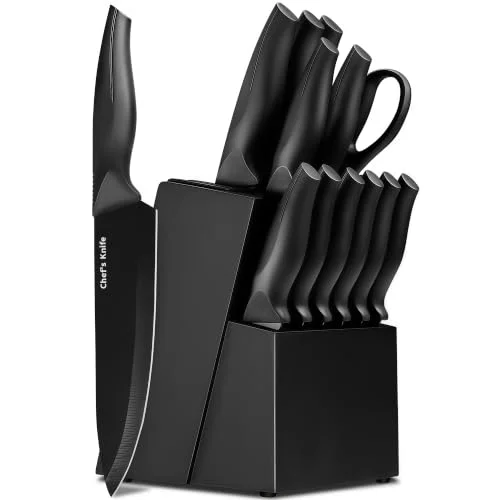
LINHAO's 14-piece set is a fixed-slot design for a more specific reason: the block has a built-in sharpener. The listing states the blades are precision laser-cut to an optimal angle and that each knife is precision forged from a solid block of stainless steel with a full tang and an extra-wide forged handle for balance. A built-in sharpener only works if the knife meets the sharpening wheels or rods at a consistent angle every single time the blade is drawn out and back in — which is only possible when the slot and the blade geometry are matched to each other. That is the trade a sharpening slot makes: it gives up the flexibility of a universal block in exchange for a sharpening step that happens automatically, for the knives it was built around.
Neither Astercook's nor LINHAO's listing claims the block will accept a knife from outside its own set, and we won't claim it for them. See our full tang explainer for how LINHAO's "extra-wide forged handle" claim fits into the broader construction picture a listing like this is making.
The failure case
What happens when a knife does not match its slot
With a universal block, a knife that is narrower or thinner than the ones it was designed around still goes in — it just has less of the gripping surface in contact with it. The bristles or pins that would normally close tightly around a standard chef's-knife blade have less steel to grip on a thin paring knife or a boning knife with an unusually slim spine, so the blade sits with more play: a visible lean to one side, or a knife that can be rocked slightly front to back by hand. It will not fall out, but it is not seated as firmly as the knife the block was designed and marketed around.
A blade that is wider than intended runs into the opposite problem — more resistance going in and out, and more force needed each time, which over months of daily use is exactly the kind of repeated stress that loosens a mechanism built from many small moving parts.
With a fixed-slot block, the failure mode is blunter: the knife either fits the hole that was cut for it, or it does not go in at all. There is no partial fit to speak of. A chef's knife from a different brand, with a different blade width or a thicker spine, may not seat past the top of the hole, or may drop in loosely with no support along the sides — the slot was never shaped around it, so there is nothing to grip it correctly either way. This is the direct cost of the design LINHAO and Astercook both chose: precision for the knives in the box, and no promise whatsoever for any knife that didn't ship with it.
Practically, this means the two designs are answering different questions before you even open the box. A fixed-slot set assumes you will use exactly the knives it ships with, for as long as you own the block. A universal block assumes you will not — that something will eventually need to go into that block which wasn't there on day one.
The honest trade-off
Grip and wobble: the universal block's real weakness
The flexibility of a universal block is also where it gives something up, and it is worth being plain about what that something is. A fixed slot, cut to the exact outline of a specific blade, supports that blade along a continuous surface — the full length of the hole is in contact with the knife. A bristle or pin mechanism supports a blade at dozens of individual contact points instead of one continuous surface, and individual points of contact, however many there are, provide less total resistance to sideways movement than a single matched slot does. That is simple mechanics, not a flaw unique to any one product: it is the structural cost of building a mechanism that has to fit many different shapes instead of one.
In day-to-day terms, this shows up as a small amount of side-to-side play when a knife is seated in a universal block, more noticeable on a lighter or thinner blade than on a full-size 8-inch chef's knife. It is rarely enough to be a safety concern — the knife is still held, still won't tip out on its own — but it is a genuine difference from the snug, no-wiggle fit of a blade dropped into a hole cut specifically for it. Brewin's listing does not make a claim about how firmly its universal block grips any particular knife width, and we are not going to invent one; this is a general mechanical trade-off of the bristle/pin category of block, not a specific defect we're assigning to that product.
None of this makes a universal block the wrong choice. It makes it a choice with a specific cost attached: you trade a small amount of fit and firmness for the ability to put almost anything into the slot. If your knife drawer never changes, that trade buys you nothing. If it does, it is the entire reason the design exists.
Upkeep
Cleaning a universal block versus a fixed one
A fixed-slot block is, geometrically, a simple shape: a handful of holes bored straight through a solid piece of material. There is very little surface area inside each hole, which means there is very little surface area for crumbs, oil or moisture to collect on beyond the hole itself. Astercook's block is built around this directly, with drainage holes in its own design specifically so the block dries out rather than holding water the way a solid block can, and the listing states both the knives and the block set are dishwasher safe.
A universal block's gripping mechanism is the opposite shape, by necessity: many small bristles, pins or rods set close together, which is exactly the kind of geometry that creates more total surface area and more narrow gaps for debris to lodge in than a single bored hole does. More individual parts also means more places for moisture to sit after a knife is wiped and put away wet. Brewin's listing addresses this directly for its own set — it states the block is high-density polypropylene with drainage holes in the base, and that both the knives and the block are dishwasher safe, which at least puts the cleaning question in the dishwasher's hands rather than requiring individual bristles to be wiped by hand. That is a meaningful mitigation for a mechanism that otherwise has more nooks than a bored slot.
LINHAO's listing is the one gap here worth flagging plainly: it does not state that the knife set or its block is dishwasher safe anywhere in the published details we have, so we are not going to claim it is. If you buy that set, treat it as hand-wash unless you confirm otherwise on the current listing, which is also good general practice — see our piece on what "dishwasher safe" actually means on a knife set for why that label is worth reading closely rather than assuming either way.
The picks
The picks, by how often you buy a knife that does not fit
01Rarely, if ever
Astercook 6-Piece Knife Set with Block
Best if the knives you own today are the knives you'll own in five years
6 pieces·4-hole fixed block·High carbon stainless·Dishwasher safe
At $18.98, this is the simplest set in this comparison: a square, wood-grain-handled block drilled with four holes sized for its own knives, with a drainage design and non-slip base so the block doesn't trap moisture the way a solid wood block can. There is no flexibility built in here and no need for any — if you are not someone who buys individual knives outside a set, a fixed slot costs you nothing, and not paying for a mechanism you'd never use is a reward in itself.
The set to buy if your knife drawer has never changed and you don't expect it to.
02Occasionally
LINHAO 14-Piece Block Set with Built-In Sharpener
Best if you want sharpening built in and can commit to the matched set
14 pieces·Fixed sharpening slot·Full tang, forged·Extra-wide handles
At $23.74, this is the largest set here by piece count, and the fixed slot is doing real work: the built-in sharpener needs the blade to pass through at a consistent angle, which the listing supports with precision laser-cut blades forged from a solid block of stainless steel with a full tang and an extra-wide handle for balance. The trade is the one every fixed-slot block makes — this block was never designed to accept a knife from outside the set, so treat it as a complete, closed system rather than a block you'll add to later.
The set to buy if automatic touch-up sharpening matters more to you than flexibility.
03Regularly
Brewin Universal Knife Block Set
Best if your knife drawer keeps gaining knives the block wasn't built for
8 pieces·Universal block·1.4116 stainless·Scissors & sharpener included
At $18.98, this is the least expensive of the three and the only one built around flexibility on purpose. The listing describes a complete set — an 8-inch chef's knife, 8-inch slicing knife, 8-inch bread knife, 5-inch utility knife, 5-inch santoku, kitchen scissors and a separate sharpener, all made from 1.4116 stainless steel — seated in what the listing itself calls a universal knife block, built in high-density polypropylene with drainage holes and stated as dishwasher safe along with the knives. You pay for the mechanism that lets you drop in a replacement or a gift knife later, not just for the knives in the box today.
The set to buy if you already know you'll eventually own a knife this block was never designed for.
Side by side
The three, compared
| Set | Block type | Pieces | Price | Dishwasher safe | Get it |
|---|
 Astercook 6-Piece |
Fixed, 4-hole |
6 |
$18.98 |
Yes, stated |
Get it |
 LINHAO 14-Piece |
Fixed, built-in sharpener |
14 |
$23.74 |
Not stated |
Get it |
 Brewin Universal |
Universal |
8 |
$18.98 |
Yes, stated |
Get it |
Prices change. We refresh them, but Amazon is the authority at the moment you buy. See our knife block material guide for how the block itself — wood, pine or magnetic — changes this decision further.
Our method
How we compared — and what we can't tell you
What we did
Listing construction details, side by side
We compared the published construction details, current Amazon prices and listing copy for three current knife block sets, choosing one described explicitly as a universal block and two built around fixed slots for different reasons — a basic drainage design and a built-in sharpener. Where a listing used a marketing word like "ultra sharp" or "razor sharp" without a checkable spec behind it, we treated that as a claim to flag, not a fact to repeat; see our piece on what "ultra-sharp" and "razor-sharp" actually tell you for how we handle that pattern network-wide.
What we didn't
We don't run a testing lab
We did not physically fit a mismatched knife into any of these blocks and measure the wobble, and we are not going to describe a feel we haven't verified. The mechanical reasoning in this piece — why a bristle grip gives less total resistance than a cut slot, why a sharpening slot has to be fixed — is general engineering logic about how each design works, not a claim about any specific product's performance. We have no rating or review data for any of these three sets, so we have not paraphrased owner sentiment anywhere on this page.
FAQ
Common questions
Can I put any knife into a universal block?
Almost any knife will physically go into a universal block, because the bristle, pin or rod mechanism is built to part around whatever width of blade is pushed into it. What changes is how firmly it's held — a knife noticeably thinner or wider than the ones the block was designed around will sit with more play than a knife that matches the intended range, since fewer contact points end up gripping it.
Will a fixed-slot block ever accept a different brand's knife?
Sometimes, by accident, if the blade happens to share a similar width and spine shape with the knife the slot was cut for — but the manufacturer never designed or tested for that, and there's no way to know in advance. A slot that's too narrow won't accept the blade at all; one that's too wide will hold it loosely with no support along the sides. Treat a fixed-slot block as built for its own knives only.
Why does a built-in sharpener need a fixed slot instead of a universal one?
A built-in sharpener works by drawing the blade past sharpening wheels or rods set at a specific angle every time the knife goes in or out. That only functions correctly if the blade meets those wheels at a consistent position and angle, which requires the slot and the blade geometry to be matched to each other at the factory. A universal block's flexible gripping mechanism has no fixed position to align a sharpener against, which is why sets built around automatic sharpening use fixed slots, not universal ones.
Is a universal block harder to clean than a fixed-slot block?
Structurally, yes, in most cases. A fixed slot is a single bored hole with minimal surface area for debris to collect on. A universal block's gripping mechanism is made of many small bristles, pins or rods set close together, which creates more total surface area and more narrow gaps for crumbs and moisture to lodge in. Whether that's a real problem for a specific set depends on whether the manufacturer addresses it — check the listing for drainage holes and a stated dishwasher-safe block before assuming either way.
Keep reading
Related on Best Knife Sets