The budget line
What disappears below thirty dollars
At under $100, a set can still be forged, still carry a full tang, and still come with an itemized contents list. Drop the ceiling to $30 and more than price falls away. None of the three sets in this guide states forged construction or full tang in its listing, and we won't assume either — at this price, stamped, unspecified-tang blades are simply the default, the same way stainless was the default assumption a decade ago and is no longer safe to make without reading the listing. The honest way to shop here is to stop expecting the constructions that defined the $100 tier and start checking which of the cheaper tier's own claims are actually written down.
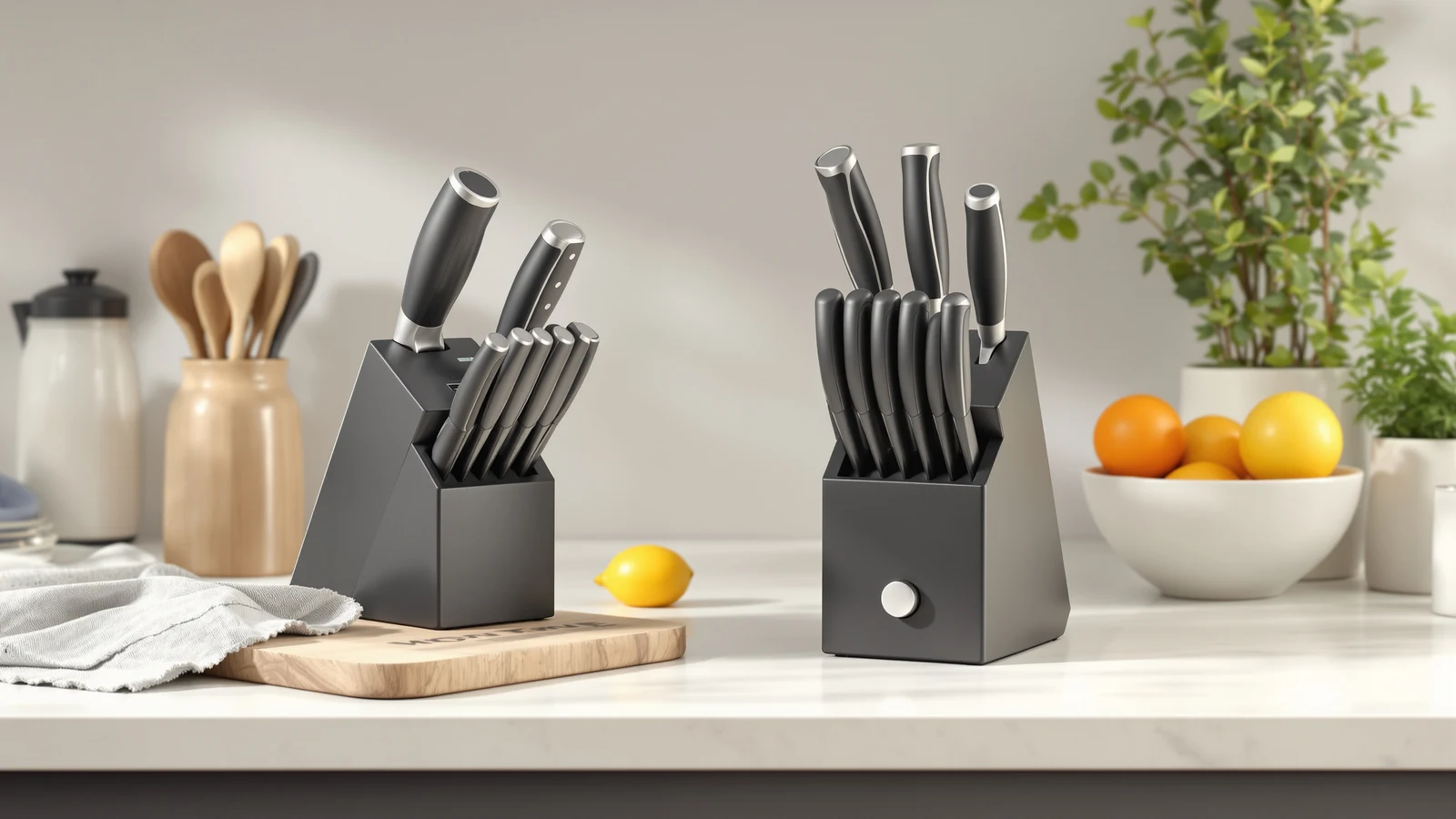
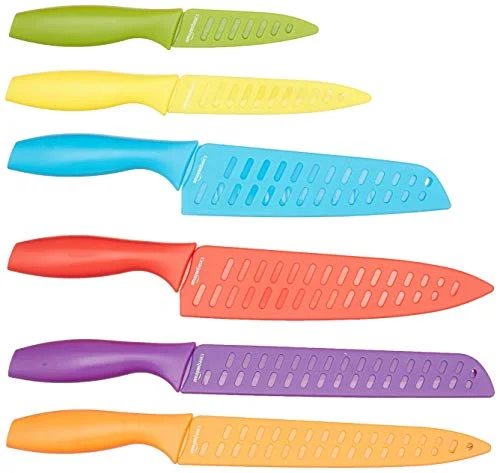
The block is usually the first visible casualty. A $100 set almost always ships with a wood or acacia block with slots cut for each knife. Under $30, that block is frequently replaced by something cheaper to mold: a compact plastic holder, a "universal" block with wide slots sized to fit several blade widths rather than one shape each, or — in the case of the Amazon Basics set in this guide — no block at all, just a plastic guard snapped over each blade. A blade guard does the one job a block exists for, which is keeping an edge from meeting another edge in a drawer, but it does it without the counter presence or the single motion of pulling a knife from a slot. Neither is wrong for a first kitchen; they are simply different products wearing the same category name.
The second casualty is precision in the copy itself. A $100 listing will often specify a Rockwell hardness figure or a blade angle, because the manufacturer is trying to justify the price against cheaper stamped competitors. At $30 and under, that incentive disappears — there's nothing to justify against — and the listings in this tier tend to describe handles, dishwasher compatibility and finish, not steel grade. The NULAS 8-Piece and LINHAO 14-Piece sets here both specify piece count and basic construction type; neither publishes a hardness number or a blade angle, and we treat that absence as information rather than fill it in with an assumption.
What does survive, consistently, is the piece count and a stated material finish — "anti-rust," "non-stick," "high carbon" — even when the underlying steel grade is not named. That is the shape of the budget tier: you can usually tell what the set claims to resist (rust, dulling, staining) without being told what alloy is doing the resisting. The three sections below work through exactly that gap, because it's the one most worth understanding before you add any of these to a cart.
The feature that sells itself
The built-in sharpener at this price: does it work?
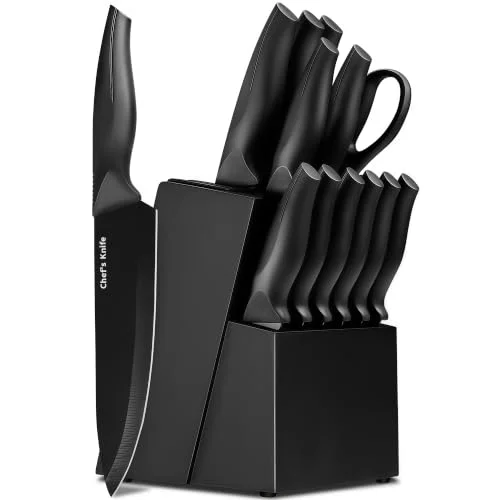
Of the three sets here, only the LINHAO 14-Piece Block Set states a built-in sharpener, and it's the single feature in this guide most likely to change how long a budget set stays usable. The mechanism in sets like this is almost always the same idea: a slot in the block holds two small abrasive elements at a fixed angle, and drawing the blade in and back out as you return the knife to its slot scrapes a thin layer of metal off the edge at that angle. It asks nothing of you beyond putting the knife away the way you were going to anyway.
What it can genuinely do: keep a working edge working. A knife that's merely gone a little dull from normal cutting — not damaged, not chipped, just blunted — gets measurably sharper after a few passes through a built-in slot sharpener. That is a real, checkable mechanical effect, not a marketing adjective, and it is the reason this feature shows up again and again across every price tier we've covered on this site, from LINHAO's $23.74 set up to sharpeners built into sets costing ten times as much.
What it can't do is the part the listing won't volunteer. A fixed-slot sharpener grinds at one angle, set by the block, with no ability to reset a bevel that's been rolled over or chipped against a bone. It is maintenance, not repair, and it is cruder than a whetstone used by someone who knows the knife's actual edge angle. If you already own a sharpening stone and use it, LINHAO's built-in slot adds nothing you don't already have. If you don't — and most people who buy a $30-to-$40 starter set don't — it is close to the only mechanism standing between "sharp on day one" and "dull by month three," because neither the NULAS nor the Amazon Basics set in this guide includes any sharpening feature at all.
The honest conclusion: it works for what it is, and what it is matters more at this price than at any other. A $300 set's owner can afford to also own a whetstone. A $30 set's owner is statistically less likely to, which is exactly the audience a built-in sharpener is built for.
Read the material claim
Anti-rust coating versus genuine stainless steel
NULAS markets its 8-Piece set explicitly as "Anti-Rust Chef Knives," and Amazon Basics describes its 12-piece set as having "Non-stick Sharp Blades." Both phrases describe something real, and both describe something different from a blade that resists rust because of what it's made of rather than what's been applied to it. The distinction is worth understanding before either listing's wording does the deciding for you.
Genuine stainless steel resists rust because of chromium content baked into the alloy itself — typically at least 13% by the conventional definition — which forms a thin, self-renewing oxide layer across the entire blade, including any part exposed by a chip or a deep scratch. It doesn't wear off, because it isn't a layer sitting on top of the steel; it's the steel. A coating, by contrast, is a separate material — a non-stick finish, a rust-inhibiting film — applied over a base metal that may or may not be stainless on its own. A coating can do real work while it's intact, and both non-stick and anti-rust finishes do: they reduce food sticking to the blade and slow surface oxidation respectively. The difference shows up specifically at the edge and at any scratch, where a coating is thinnest and first worn through by the one thing a knife does constantly, which is cut against something.
Neither NULAS nor Amazon Basics states a specific steel grade or a stainless percentage in its listing, and we won't assume either. What we can say plainly: "anti-rust" and "non-stick" are both claims about a treatment or finish, not confirmations that the base metal is stainless steel in the chromium-content sense. That doesn't make either set a bad buy — a coating genuinely protects a blade under normal kitchen use, including through the dishwasher cycles both sets claim to tolerate — but it's a different promise than "stainless all the way through," and the listings here make the first promise, not the second.
The practical check, on any budget listing: look for the word "stainless" used as a material, not just a benefit. "Anti-rust" and "rust-resistant" describe an outcome a manufacturer wants you to expect. "Stainless steel blade" describes what the blade is. When a listing gives you only the outcome, treat the material itself as unconfirmed and dry the blade promptly regardless of what the handle or the box promises.
What you'll actually reach for
How many of these pieces you will use in year one
Piece count inflation gets worse, not better, as price drops, because a bigger number is one of the few ways a budget listing can compete on the page without touching the steel. The Amazon Basics set is 12 pieces — six knives and six matching blade guards, counted as a pair each. The NULAS set is 8 pieces including its universal block. LINHAO's set is 14. None of those totals is dishonest, but none of them tells you how many of those pieces will see a cutting board more than once.
Our buying guide walks through the general rule that applies at every price tier: most home cooks reach for a chef's knife, a paring knife and something serrated, and use everything else occasionally or never. At this price, that rule gets sharper rather than softer, because a $30 set's "extra" pieces are more likely to be the pieces a manufacturer added to hit a round number than pieces chosen for genuine variety. Six color-coded knives with six blade guards, as in the Amazon Basics set, is really six tools you decide how to use — the color-coding is a food-safety habit, not six distinct blade shapes, and our guide to color-coded sets covers what that system does and doesn't guarantee on its own.
A useful way to estimate year-one use before buying: count the knife shapes, not the piece total. NULAS's 8 pieces include a stated set of chef knives plus its block, which suggests fewer distinct shapes doing more of the daily work. LINHAO's 14 pieces, with a block and built-in sharpener included in that count, likely spread across more shapes, some of which — steak knives, a smaller parer — are realistically annual-occasion tools rather than weekly ones. Neither listing itemizes its exact contents piece by piece the way some sets above $80 do, so the honest step before buying any of them is opening the Amazon listing's own images, which typically show every piece laid out, and counting which ones you can picture using inside a normal week.
None of this is an argument against buying a 12- or 14-piece set at this price. It's an argument for knowing, going in, that roughly a third to half of what arrives in the box is there to round out the count rather than to earn its place on the counter — and for not judging the set's value by the number on the front of the listing.
The picks
Two sets under $30 that publish what they're made of
01Lowest entry price
Amazon Basics Color-Coded 12-Piece Knife Set
Best for a first kitchen on the smallest budget here
12 pieces·6 knives, 6 blade guards·Non-stick blades·Dishwasher safe
At $13.67, this is the cheapest complete set in this guide, and it skips the block entirely in favor of a color-coded blade guard for each of its six knives — a trade that keeps the price down without leaving the edges exposed in a drawer. The listing states ergonomic handles and non-stick blades; it does not state a steel grade or full tang construction, and we won't assume either. Amazon Basics lists the set's size as 8 inches, almost certainly the chef's knife, the piece you'll reach for most.
The set to buy if color-coded handles and the lowest possible price matter more than a block on the counter.
02Closest to a real block
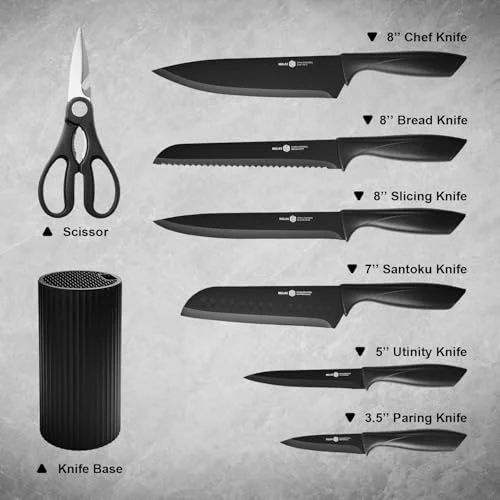
NULAS 8-Piece Knife Set with Universal Block
Best for a block set that still fits under $30
8 pieces·Universal block·Anti-rust chef knives·Dishwasher safe, black
NULAS is the set in this guide that still looks and functions like a proper block set, at a fraction of what the sets in our splurge-tier roundup cost: a universal block with wide slots sized to hold several blade widths, rather than the blade guards the Amazon Basics set uses instead. The listing markets the knives as anti-rust and ergonomic; it stops short of naming a specific stainless grade, so treat the anti-rust claim as a finish, not a confirmed alloy, and dry the blades promptly regardless.
The set to buy if a block on the counter matters to you and $18.98 is the ceiling.
Side by side
The three, compared
| Set | Best for | Pieces | Block / storage | Sharpener | Price | Get it |
|---|
 Amazon Basics 12-Piece |
Lowest price |
12 |
Blade guards, no block |
None |
$13.67 |
Get it |
 NULAS 8-Piece |
A real block under $30 |
8 |
Universal block |
None |
$18.98 |
Get it |
 LINHAO 14-Piece |
The upgrade, if $18 more works |
14 |
Block included |
Built in |
$23.74 |
Get it |
Prices change. We refresh them, but Amazon is the authority at the moment you buy. See our buying guide for how to weigh these trade-offs at any budget.
Worth the extra eighteen dollars
The one upgrade worth making first
Strictly, the LINHAO 14-Piece Black Kitchen Knife Block Set is not under $30 — at $23.74 it sits just above the line this guide is built around. We're including it anyway, as the upgrade to consider before any other, because it's the one set in this comparison that adds a genuinely new capability rather than just more pieces or a cheaper finish: a built-in sharpener in the block itself, covered in detail above.
Here's the actual trade you're making for that extra eighteen dollars against the NULAS set: you give up nothing on piece count — 14 against NULAS's 8 — and you gain a mechanism that keeps the knives you already own cutting well past the point most $30-tier sets go dull and get replaced rather than maintained. If you've read the sharpener section above and recognized yourself as someone who will never separately buy a whetstone, that built-in slot is realistically worth more to the set's lifespan than any other five dollars you could spend on it.
This isn't a recommendation to always spend more. If $30 is a hard ceiling, NULAS's block and Amazon Basics's rock-bottom price both remain honest, specified choices, and our guide to full-tang construction and our dishwasher-safe guide cover the other two details worth checking on any set at this tier before you commit. But if the budget has even eighteen dollars of flex in it, a built-in sharpener is the single upgrade in this price range most likely to still be paying off a year from now, which is more than can be said for most of what separates a 12-piece set from a 14-piece one.
Our method
How we picked — and what we can't tell you
What we did
Specs, prices and published listings
We compared published specifications and current Amazon prices for kitchen knife sets sold in the US under $30 (and the nearest set just above that line), then narrowed the list to sets whose listings explicitly state something checkable — piece count, block type, a named finish like anti-rust or non-stick, or a specific feature like a built-in sharpener — rather than relying on adjectives like "professional-grade" that no listing at this price can substantiate.
What we didn't
We don't run a testing lab
We do not physically test these knives, we do not own them, and we do not publish invented scores or star ratings. We have no verified review data for these specific products, so we don't paraphrase owner sentiment either. What we can do honestly is read every published specification, compare them against each other, and tell you plainly which claims are checkable and which are marketing — especially at a price where the marketing has to work harder.
FAQ
Common questions
What's the real difference between "anti-rust" and genuine stainless steel?
Genuine stainless steel resists rust because of chromium content built into the alloy itself, which forms a self-renewing protective layer across the entire blade, including at a chip or scratch. "Anti-rust" as a marketing term more often describes a coating or finish applied over a base metal, which can wear through at the edge or at a deep scratch over time. Neither NULAS nor Amazon Basics states a specific stainless grade in its listing, so treat the anti-rust and non-stick claims as finishes rather than confirmed base-metal properties, and dry the blades promptly either way.
Does a built-in sharpener actually keep a cheap knife sharp?
Yes, for the specific job it's built for: maintaining an edge that's gone a little dull from ordinary use. Drawing the blade through the slot at a fixed angle every time you put it away genuinely restores a working edge. What it can't do is fix a chipped or rolled edge, or change the blade's angle — that requires a whetstone and more attention than most budget-set buyers are looking to give. LINHAO's 14-piece set is the only one of the three sets here that includes this feature.
Why doesn't the Amazon Basics set come with a block?
At $13.67, it replaces the block with individual blade guards — plastic sleeves that snap over each knife's edge. This does the same core job a block does, which is keeping an exposed edge from meeting anything else in a drawer, at a lower manufacturing cost than molding or cutting a full block. You lose the counter presence and the single-motion draw of a block set; you don't lose the safety function.
Should I buy the $23.74 set instead, even though this guide is about sets under $30?
If your budget has any flexibility, it's worth considering. The LINHAO 14-Piece set costs eighteen dollars more than NULAS's $18.98 set but adds a built-in sharpener, which is the single feature in this price range most likely to extend how long the knives stay genuinely useful. If $30 is a hard ceiling, NULAS and Amazon Basics remain honest, fully specified choices on their own terms.
Keep reading
Related on Best Knife Sets