Question one
How much do you actually cook?
This is the question that should be answered before any other, because it decides whether a bigger box is a bargain or a drawer full of unused steel. If you cook most nights — prepping vegetables, breaking down proteins, slicing bread — a set with more knives earns its keep: a dedicated utility knife and a santoku both get picked up in the same week, and the sharpener or extra parer stops being filler and starts being used. If cooking is a weeknight-pasta-and-weekend-eggs routine, the same fifteen-piece box is mostly storage for knives that will sit untouched for years.
Our guide to what's actually in a 15-piece knife set breaks this down piece by piece: a typical fifteen-count box is roughly eight knives, six steak knives and a block, or seven knives plus a sharpener, shears and a block. Either way, most of that count is duplication or occasion-only tools. Before comparing two sets on their headline number, ask how many distinct knife-shaped tasks your week actually contains. For most home cooks the honest answer is three: a chef's knife, a paring knife, and something serrated for bread. Everyone above that baseline is buying convenience; everyone below it is buying storage.
If your cooking is light and occasional — a first kitchen, a studio, a kitchen you share with roommates — a compact set with a handful of knives and no six-piece steak-knife tail is the more honest match, a point we go into further in our guide to knife sets for a first apartment. A heavier cooking schedule is where a larger block starts to make sense, and where the next five questions start to matter more than the piece count ever did.
Question two
Do you want weight in the hand?
A forged blade is hammered from a single bar of steel, which is why forged knives are typically heavier and carry a bolster — a thick collar of steel where the blade meets the handle. A stamped blade is cut from a flat sheet, the way a cookie cutter cuts dough: lighter, thinner, and usually cheaper to produce. Neither is simply better. People who like a knife to feel substantial, almost like an extension of the arm, tend to prefer forged. People who do a lot of continuous prep — chopping for twenty minutes at a stretch — often find a lighter stamped blade less tiring over the course of a session.
This is also where a brand's country of manufacture becomes a genuine clue, which is the subject of our comparison of German versus Japanese kitchen knives: German sets tend toward a thicker, more forgiving edge geometry, while Japanese-style blades are typically ground thinner for a sharper bite. The Henckels Statement 15-Piece Block Set states its blades are stamped rather than forged — exactly why a fifteen-piece German-engineered set can still sit on the lighter end of the scale, not the heavy, bolstered end the brand's reputation might suggest.
Not every listing answers this question outright. If blade weight is high on your list and a set's description doesn't use the words "forged" or "stamped" explicitly, that is itself useful information: check the listing photos for a visible bolster before you assume either way. We won't state a construction method a manufacturer hasn't published, and you shouldn't buy on the assumption of one either.
Question three
Will you ever sharpen them?
Be honest here, because the answer changes what you should be shopping for more than almost anything else on this page. Some knife blocks build a sharpener directly into the slot, so the blade gets drawn through it every time it's put away — a real convenience for someone who would otherwise never touch a whetstone, and worth looking for explicitly in a listing if that describes you. It is also, by design, a crude tool compared with sharpening by hand: it maintains an edge rather than resetting one that's badly damaged.
None of the three sets we recommend later ship with a sharpener built into the block or box, a detail worth knowing up front rather than discovering after the knives have gone dull. That doesn't make any of them a worse purchase — it means sharpening, whenever it becomes necessary, is a separate task, whether that's a whetstone, a pull-through sharpener, or a professional service. Our guide on how to keep a knife set sharp for years covers how infrequently that needs to happen if you also avoid the two habits that dull a blade fastest: the dishwasher, and a cutting board the knife has to fight rather than glide across.
Hardness also plays into this. The Brewin 3-Piece set in this guide publishes a Rockwell hardness figure of 56 or higher, a range we unpack in full in our explainer on what Rockwell hardness tells you about a knife. In short: harder steel holds an edge longer between sharpenings but chips more readily and takes more effort to bring back; softer steel dulls sooner but comes back quickly on a stone. Mid-fifties, where Brewin sits, is the sensible range for a knife that will meet bones, frozen edges, and the occasional moment of carelessness. A published number is also a small but real sign that a manufacturer expects its claim to be checked.
Question four
How much counter space is the block allowed?
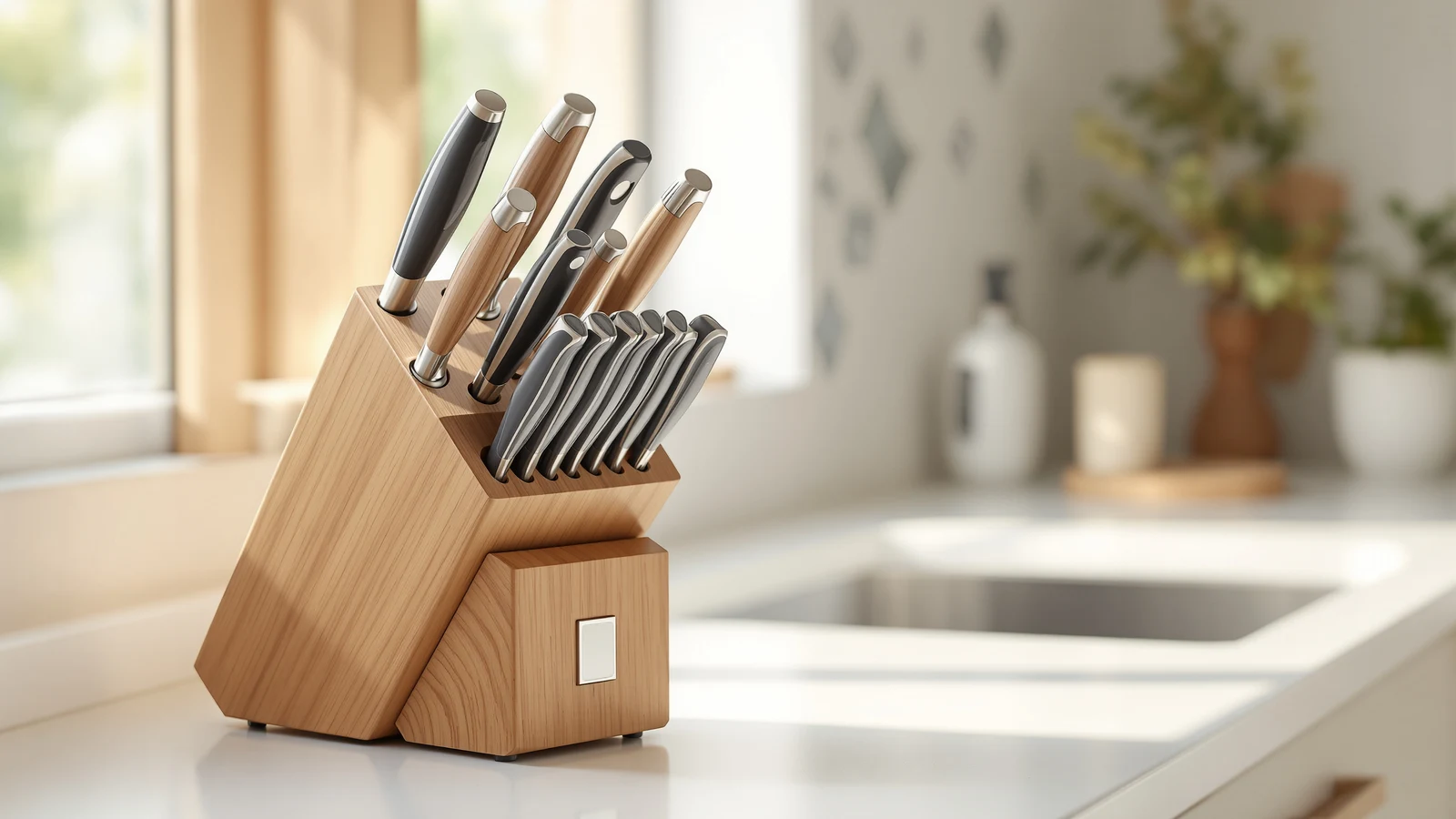
A block is furniture. It sits on the counter permanently, takes up roughly the footprint of a toaster, and announces itself every time you walk into the kitchen. For a lot of households that's a fair trade: knives are visible, within reach, and sorted by size without you having to think about it. For a galley kitchen, a studio, or a counter that's already crowded with a coffee maker and a drying rack, a block is the first thing to go when you're deciding what earns a permanent spot.
Of the three sets in this guide, two come with a wood block included and one does not. The CAROTE 14-Piece set and the Henckels Statement 15-Piece set both include a block as part of the package, so factor that footprint into your decision before you buy either. The Brewin 3-Piece set ships in a gift box instead, with no block at all — the knives go into a drawer, a knife roll, or an in-drawer tray you supply yourself. If your counter space is genuinely tight, that absence is a feature, not a missing accessory, and we cover the broader category in our roundup of the best knife sets without a block.
There's a secondary cost worth naming: open block slots mean exposed edges, which matters if small children move through the kitchen. A drawer tray or knife roll keeps blades fully enclosed between uses — a direct trade of visibility and convenience against counter space and exposure.
Question five
Are you buying for one person or a household?
A single cook who handles all their own prep rarely needs more than three knives in rotation, no matter how large the collection sitting in the block. A household of four, especially one where more than one person cooks, puts more knives into simultaneous use, misplaces them more often, and benefits from having a few duplicates and a wider range of sizes on hand. The right piece count genuinely scales with the number of people reaching into the kitchen, which is the one case where a bigger box is a legitimate answer rather than a marketing one.
Of the three sets here, the Brewin 3-Piece set is sized for exactly one kind of household: someone who wants a chef's knife, a santoku and a utility knife and nothing else, with no block and no extras to store or account for. It's a deliberately minimal answer, and we go into when that minimalism is the right call versus a liability in our guide to knife sets for a first apartment. The CAROTE 14-Piece and Henckels Statement 15-Piece sets both scale up for a household that cooks more, entertains occasionally, or simply wants more knives in rotation so nobody's waiting for the one chef's knife to free up.
If your household regularly sets a table for more than two and wants knives at each place setting, none of the three sets in this guide publish steak knives as part of their contents, so don't assume they're included based on piece count alone — our separate roundup of the best steak knife sets covers that need directly, since it's common enough to deserve its own list rather than a guess about what's packed into someone else's box.
Question six
What are you willing to pay for a brand with a warranty?
Price in this category buys more than steel. It also buys a name that's been making knives long enough to stand behind them, and the paperwork that comes with it. Henckels is the accessible line of a German knife house with more than a century behind it, and the Statement 15-Piece set carries that brand's name and warranty support into a price well under what the company's higher-end forged lines cost. That institutional backing is a real part of what the extra money buys, separate from the blades themselves.
The CAROTE and Brewin sets in this guide are priced well below the Henckels set, at $47.47 and $28.21 against $118.73, and both are newer, less established names without the same century of brand history to point to. That doesn't make either one a worse knife — price and brand pedigree are a different axis from blade quality, and a newer company can make a perfectly good set. It does mean the warranty conversation is different: a long-established brand has more incentive to make a claim painless. With a newer brand, read the listing's warranty terms directly rather than assuming they match an older company's.
This question matters even more if the set is a gift rather than a purchase for your own kitchen, since a recipient who's never heard of the brand has no independent way to judge it beyond the box itself — a scenario we address directly in our guide to the best knife sets to give as a gift. A known name does some of the reassuring for you; an unfamiliar one asks the recipient to take the listing on faith.
Put together
Three shortlists, by the answers
None of these three is "the best knife set" in the abstract. Each is the right answer to a specific combination of the six questions above.
ACompact & affordable
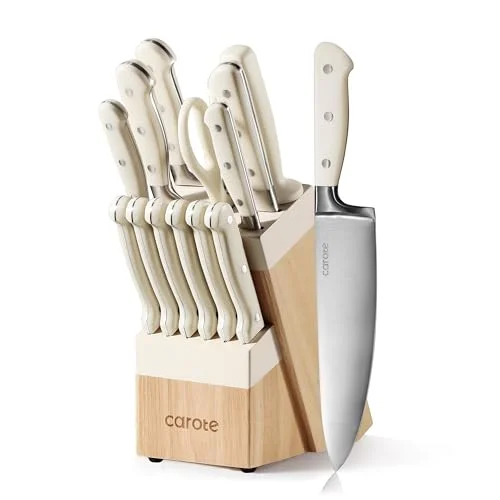
CAROTE 14-Piece Knife Set with Wood Block
For: moderate cooking, a household of two or three, a block that fits a normal counter
14 pieces·Wood block included·Rust-resistant·Cream finish
CAROTE's 14-piece set pairs a full wood block with rust-resistant blades at $47.47, which answers questions one, four and six together: enough pieces for regular weeknight cooking, a block that announces itself on the counter rather than disappearing into a drawer, and a price that doesn't ask you to weigh brand pedigree too heavily. The listing doesn't state a forged-versus-stamped construction or a built-in sharpener, so if either of those specifically matters to you, check the current listing before buying rather than assuming either way.
The answer if you cook several nights a week, want a block, and don't mind spending a little past fifty dollars to get one.
BMinimal & no block
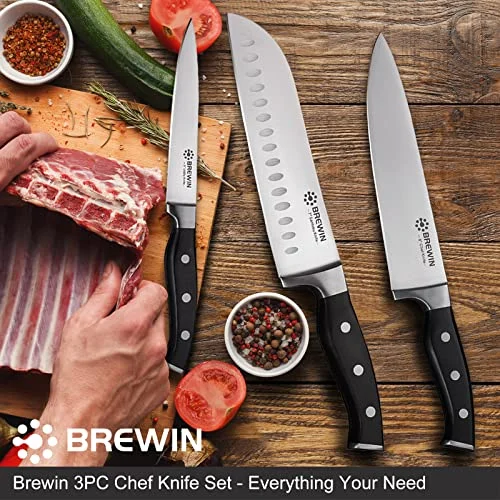
Brewin 3-Piece Chef Knife Set
For: light or solo cooking, tight counter space, no interest in sharpening maintenance beyond the basics
3 pieces·High carbon stainless·Japanese-style blades·Gift box, no block
Three knives, no block, no steak-knife tail: Brewin's set is the direct counter-argument to buying by piece count. It answers question one honestly for anyone whose real weekly rotation is a chef's knife, a santoku and a utility knife, question four by taking up zero counter space since it ships in a gift box rather than a block, and question five by being sized for one person's kitchen rather than a household's. High carbon stainless steel with Japanese-style grinding gives it a lighter, sharper-biting edge than a typical German-style blade of the same price.
The answer if you already know your real rotation is three knives, and you don't want to pay for, or find a home for, twelve more.
CHousehold & warranty
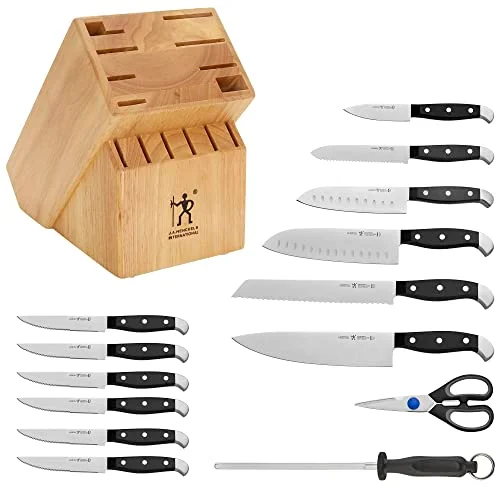
Henckels Statement 15-Piece Knife Block Set
For: a busier household, a lighter stamped blade, and a century-old brand's name behind the warranty
15 pieces·German engineered·Stamped blades·Block included
Henckels answers question six most directly of the three: it's the only set here backed by a knife house with more than a hundred years of history and the warranty infrastructure that comes with it. Fifteen pieces and a block make it the pick for a household where more than one person cooks and more knives genuinely get used rather than stored. The blades are stamped rather than forged, so despite the brand's German pedigree, this is a lighter knife in the hand than the "heavy German steel" stereotype suggests — a detail worth knowing if question two mattered to you.
The answer if more than one person cooks in your kitchen, and you're willing to pay for a name with a warranty behind it.
Side by side
The three, compared
| Set | Best for | Pieces | Block | Price | Get it |
|---|
 CAROTE 14-Piece |
Regular cooking, modest budget |
14 |
Wood block included |
$47.47 |
Get it |
 Brewin 3-Piece |
Solo cooks, tight counters |
3 |
None (gift box) |
$28.21 |
Get it |
 Henckels Statement 15-Piece |
Households, brand warranty |
15 |
Block included |
$118.73 |
Get it |
Prices change. We refresh them, but Amazon is the authority at the moment you buy.
Our method
How we put this guide together
What we did
Specs, prices and the six questions
We compared published specifications and current Amazon prices for kitchen knife sets sold in the US, then organized the decision around six questions that determine satisfaction with a set more reliably than piece count does: cooking frequency, blade weight, sharpening habits, counter space, household size, and brand warranty. Each of the three sets we recommend answers a different combination of those six well.
What we didn't
We don't run a testing lab
We do not physically test these knives, we do not own them, and we do not publish invented scores or star ratings. We have no verified review data for these specific products, so we don't paraphrase owner sentiment either. What we can do honestly is read every published specification, compare them against each other, and say plainly which claims are checkable and which aren't published at all.
FAQ
Common questions
Is a bigger piece count always a better knife set?
No. A piece count bundles knives, a block, and sometimes a sharpener, shears or steak knives into one headline number, and two sets with the same number can split that very differently. The six questions in this guide — how much you cook, whether you want weight in the hand, whether you'll sharpen the knives, how much counter space you have, who's cooking, and what you're willing to pay for a warranty — predict satisfaction with a set far better than the number on the box.
Do any of these three sets come with a sharpener?
No. None of the CAROTE 14-Piece, Brewin 3-Piece, or Henckels Statement 15-Piece sets ship with a sharpener built into the block or box. Sharpening, whenever it becomes necessary, is a separate task for all three — typically a whetstone or a pull-through sharpener bought on its own. See our guide on how to keep a knife set sharp for years for what that upkeep actually involves.
Should I buy a set with a block, or knives without one?
It depends mainly on your counter space and how many people use the kitchen. A block keeps knives visible and sorted but takes up a permanent footprint and leaves edges exposed between uses. A no-block option, like the Brewin 3-Piece set here, stores flat in a drawer or knife roll and takes no counter space, but you supply the storage yourself. Neither is objectively correct — it's a direct trade between visibility and convenience versus counter space and exposure.
Does a more expensive brand actually mean a better knife?
Not necessarily in terms of the blade itself, but it often means more in terms of warranty support and institutional history. Henckels' Statement set costs significantly more than the CAROTE or Brewin sets in this guide cost, and a meaningful part of that difference is the backing of a German knife house with more than a century of history behind its warranty. A newer brand can make a perfectly good knife; what it usually can't yet offer is the same track record standing behind a claim.
Keep reading
Related on Best Knife Sets