The trade-off
What a block actually costs you in counter space
A typical knife block sized for a 14- or 15-piece set runs roughly 8 to 10 inches wide and 8 to 9 inches deep, and it needs clearance behind it to pull the longest blade straight up without the tip catching the counter edge below a cabinet. On a small kitchen counter, that is not a trivial footprint — it is often the same square footage as a stand mixer or a two-slice toaster, occupied permanently by something that, unlike either of those, you use for about ninety seconds at a time. The block does not fold away, does not stack, and does not move easily once it is full, because a loaded block is heavier than it looks.
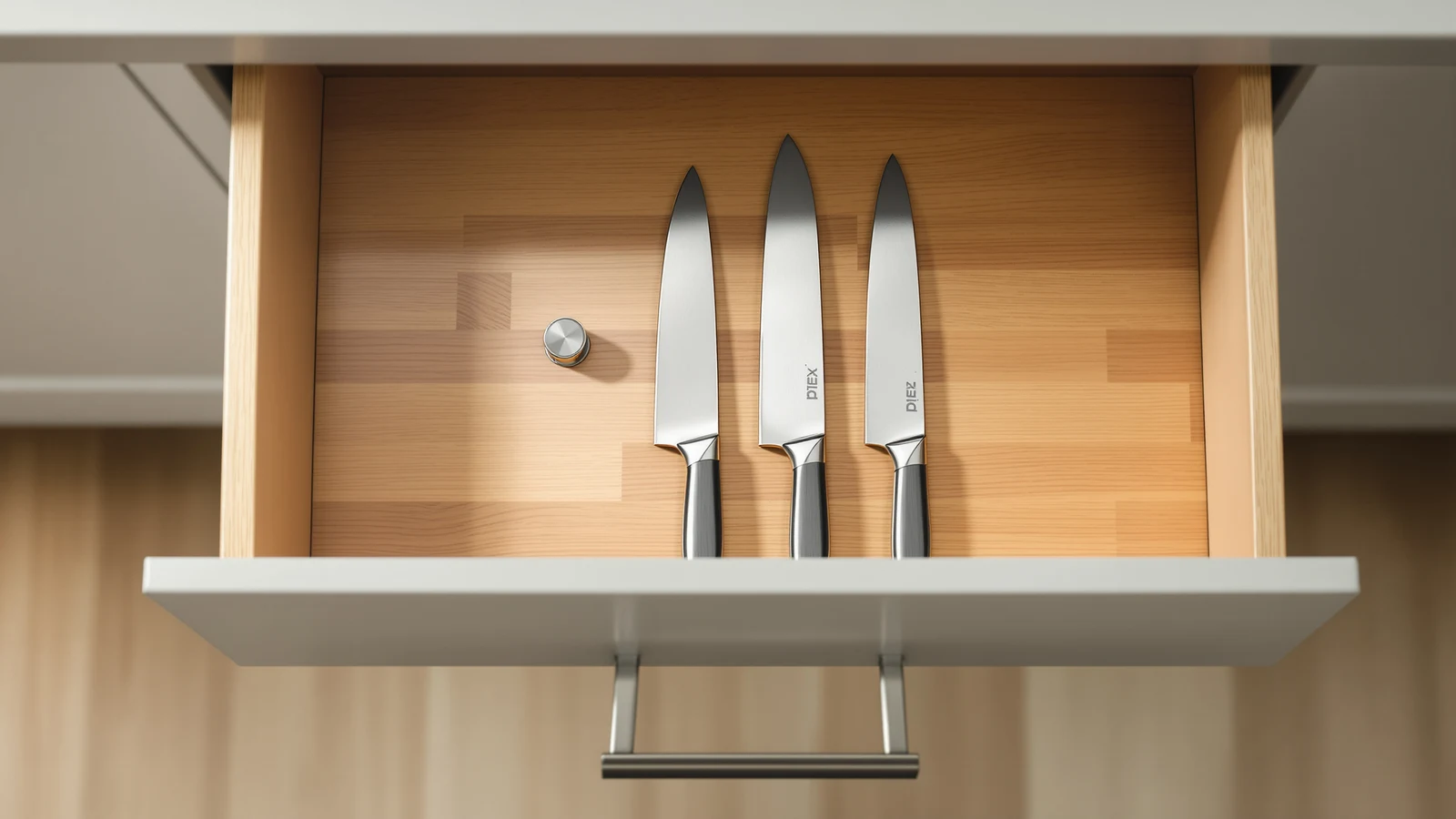
The sets in this guide replace that footprint with something flat: a case, a tray, or individual blade guards that let the knives lie in a drawer. None of them are block sets, and none of them are trying to be. The Amazon Basics 12-piece set and the Cuisinart C77CR-10P both ship with blade guards instead of a block, and the Brewin 3-piece set ships in a gift box rather than a stand of any kind. What you give up is the one-motion draw of pulling a knife from a slot at eye level. What you get back is a counter, or a drawer, that does not have a permanent resident.
This matters most in exactly the two situations named in the brief for this guide: a short counter, where every inch between the stove and the sink is already claimed by a cutting board or a dish rack, and a deep drawer, where a flat tray of guarded knives fits naturally in space that a block could never use. If neither describes your kitchen, a block is still a perfectly reasonable piece of furniture. If one of them does, the rest of this guide is about doing without it safely.
Storage
Drawer storage, done safely
A bare knife loose in a drawer is a genuine hazard, not a dramatic one: a blade with nothing covering its edge will cut whatever reaches in after it, including a hand that is not expecting to find it there. The fix is not to avoid the drawer, it is to never put an uncovered blade into one. Every set worth considering for drawer storage either includes a guard for every knife or is sold with a dedicated in-drawer tray that keeps each blade in its own slot, edge down and separated from its neighbors.
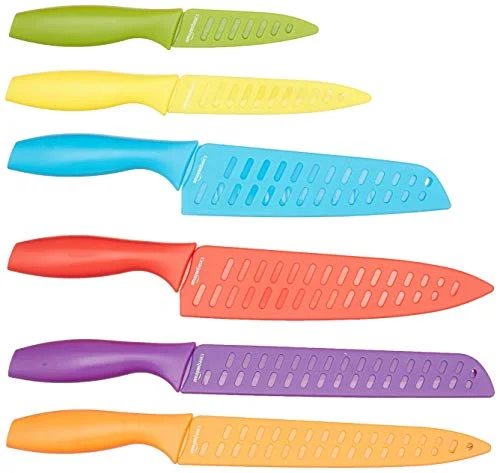
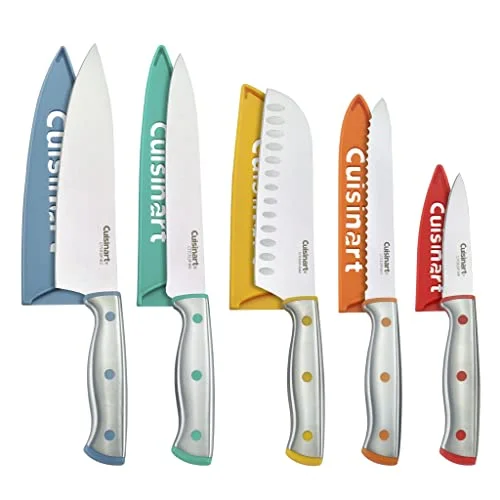
The Amazon Basics 12-piece set states exactly this approach in its own name: six knives, six blade guards, one guard per knife, no exceptions. The Cuisinart C77CR-10P pairs its color-coded knives with blade guards as well. Both are built around the assumption that the knife is going into a drawer rather than a slot, and both answer the safety question before you have to ask it — a guard that fits over the edge and locks or clips in place, not a loose sleeve that can slide off in transit.
What neither listing specifies is the depth or layout of your particular drawer, so that part is on you to check: lay the knives out, guards on, before you buy a tray or commit a drawer to them, and make sure the longest blade in the set — typically the chef's knife — actually fits the drawer's width with the guard on, not just the blade alone. A guard adds real length and width to a knife's footprint, and that is the dimension drawer buyers most often forget to measure.
Wall mounted
Magnetic strips, and the wall you need
A magnetic knife strip is the other common way to go without a block: a bar mounted to a wall or backsplash that holds knives by their steel, blades exposed, handles pointing out. It is the most counter-space-efficient option of all, because it uses vertical wall space that nothing else in a kitchen competes for. None of the three sets in this guide are sold with a magnetic strip included, and that omission is worth stating plainly rather than papering over: a strip is a separate purchase, and whether any of these knives will sit securely on one depends on the knife's own steel content, which none of the listings for these three sets specify.
What we can tell you without guessing is the general rule a magnetic strip buyer needs regardless of which knives they own. The strip itself needs a wall or backsplash it can be anchored into — tile, drywall with anchors rated for the combined weight of the knives, or a magnetic surface like some stainless backsplashes that a strip can simply stick to directly. It also needs clearance: enough wall space at a safe height, away from a stove's open flame and away from a doorway swing, with the blades mounted edge-up or handle-out depending on the strip's design, so a hand reaching past it does not meet an edge by accident.
If a magnetic strip is the direction you want to go, the honest next step is to confirm two things before buying any knife set for it: that the specific blades are magnetic stainless steel capable of holding to a strip (check the listing or ask the seller directly, since none of the three sets here publish that spec), and that your kitchen has a wall section that meets the clearance and anchoring needs above. A set bought for a strip that can't hold it, mounted on a wall that can't support it, solves nothing that the drawer-and-guard approach wouldn't have solved more simply.
Food safety
Colour-coded sets and cross-contamination
Color-coding is a restaurant-kitchen practice built around one simple rule: one color, one food category, every time, so a knife that touched raw chicken is never mistaken for the one you are about to use on bread. The Amazon Basics 12-piece set is multicolor by design, with six knives in six distinct colors and matching guards, which makes the system usable at a glance — the color is on the handle and the guard, so it is visible whether the knife is in your hand or sitting in the drawer. The Cuisinart C77CR-10P takes the same idea further with its ColorCore line, where the color runs through the rivet itself rather than just the handle shell, a detail Cuisinart states directly in the product name.
The practical system most households and many commercial kitchens use assigns colors roughly as follows: red for raw meat, yellow for raw poultry, blue for raw fish, green for fruits and vegetables, and a neutral color like white or black for bread and dairy. Neither Amazon Basics nor Cuisinart publishes a required color-to-food mapping for their specific sets, so you are free to assign your own scheme — what matters is that you pick one, write it down or tape a small card inside the drawer, and actually keep to it, since a color system only prevents cross-contamination if everyone using the kitchen follows the same assignment.
The underlying food-safety logic color-coding supports is widely recommended by public health guidance: wash cutting boards and knives with hot soapy water between uses on different raw food categories, and avoid letting raw meat juices contact a surface that will later touch food eaten without further cooking. A dedicated knife per category reduces how often that cleaning step gets skipped under pressure, which is the real value color-coding offers over a single all-purpose knife — not a claim about sharper cuts, just one about fewer missed washes.
The picks
Three sets that skip the block on purpose
01Best for a drawer
Amazon Basics Color-Coded 12-Piece Set
Best for drawer storage and cross-contamination control at a low price
12 pieces·6 knives, 6 blade guards·Dishwasher safe·Ergonomic handles, multicolor
Six knives, six color-matched blade guards, no block, no pretense of one. Amazon states dishwasher-safe, non-stick blades with ergonomic handles across the 12-piece set, and the multicolor scheme is built in rather than optional — each knife and its guard share a color, so the system works whether the knife is in your hand or sitting flat in a drawer. At $13.67, it is the cheapest path in this guide to a complete, guard-covered set with no furniture required.
The set to buy if a drawer is your only storage option and you want the color system handled for you out of the box.
02Best color-through build
Cuisinart C77CR-10P ColorCore™ 10-Piece Set
Best for a color system built into the rivet, not just the handle
10 pieces·Stainless steel·Color rivet construction·Blade guards included
Cuisinart's ColorCore line runs the color through the rivet itself rather than molding a colored shell over a plain handle, which is a more durable way to keep the coding visible after years of washing and handling — a shell can wear or discolor at the edges; a colored rivet is the fastener itself. The set ships with blade guards in place of a block, and the stainless steel construction is stated directly in the listing name. At $24.95, it sits between the Amazon Basics set and the Brewin set on price.
The set to buy if you want the color-coding system to survive years of dishwasher cycles, not just the first few months.
03Fewest knives, no stand
Brewin Professional 3-Piece Chef Knife Set
Best for a small kitchen that wants three knives and nothing else
3 pieces·High carbon stainless steel·Japanese-style·Gift box, no block
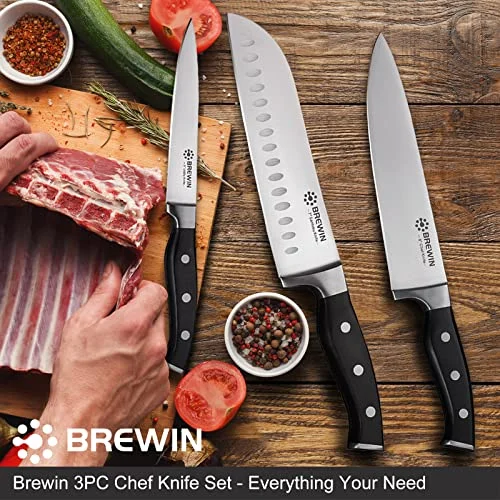
The counter-argument to owning six or twelve knives at all. Brewin's 3-piece set states high carbon stainless steel construction and ships in a gift box, not a stand of any kind, which means there is nothing to find counter space for in the first place — store the three knives in a drawer with guards you add yourself, or in the box they arrive in. At $28.21 it is the most expensive set here, priced for fewer, more deliberately chosen knives rather than more pieces.
The set to buy if you have already decided three knives is the right number and do not want to pay for a case you will never use.
Side by side
The three, compared
| Set | Best for | Pieces | Storage | Price | Get it |
|---|
 Amazon Basics 12-Piece |
Drawer storage, low price |
12 |
6 blade guards, no block |
$13.67 |
Get it |
 Cuisinart C77CR-10P |
Durable color coding |
10 |
Blade guards, no block |
$24.95 |
Get it |
 Brewin 3-Piece |
Minimal, no stand at all |
3 |
Gift box, no block |
$28.21 |
Get it |
Prices change. We refresh them, but Amazon is the authority at the moment you buy. If piece count and forged steel under $100 matter more than skipping a block, see our under-$100 roundup instead.
What's in the box
The sheaths and guards that come in the box
A blade guard is a rigid or semi-rigid cover, usually plastic, shaped to slide over the cutting edge and sometimes the point of a knife, held on by friction or a small clip. It is not a sheath in the leather-goods sense and it is not meant to be worn — it exists purely so the knife can sit in a drawer, a bag, or a box without its edge exposed. The Amazon Basics 12-piece set includes one guard per knife across all six blades, matched to the knife's own color, which is as close to a complete safety system as a guarded set gets: nothing in the box is ever uncovered once you take the shrink wrap off.
The Cuisinart C77CR-10P is specified the same way — ColorCore knives with blade guards rather than a block — though its listing does not break down the exact guard-to-knife count the way Amazon Basics does, so if you are counting on a guard for every single blade in the set, confirm the full contents list on the Cuisinart listing before buying rather than assuming a 1:1 ratio. The Brewin 3-piece set is the outlier here: its listing states a gift box, and does not specify blade guards for the three knives inside. If you buy the Brewin set intending to store the knives loose in a drawer, budget for a small set of universal guards or knife sleeves separately — they are inexpensive and widely sold on their own, but they are not confirmed to be included with this particular set.
One habit worth carrying into any guarded set, regardless of brand: check that the guard is seated fully before the knife goes anywhere near a drawer, bag, or dish rack. A guard that is only half-on defeats its own purpose, and it is the single most common way a "safe" blade guard system still ends in a cut.
Our method
How we picked — and what we can't tell you
What we did
Specs, prices and published listings
We compared published specifications and current Amazon prices for kitchen knife sets sold in the US that ship without a block — guarded sets, color-coded sets and boxed sets — then kept the ones whose listings explicitly state something checkable: guard counts, construction material, or color-coding design, rather than adjectives alone.
What we didn't
We don't run a testing lab
We do not physically test these knives, we do not own them, and we do not publish invented scores or star ratings. We have no verified review data for these specific products, so we don't paraphrase owner sentiment either. What we can do honestly is read every published specification, compare them against each other, and tell you plainly which claims are checkable and which are marketing.
FAQ
Common questions
Is it actually safe to store knives loose in a drawer?
Not without covering the edge. A bare blade in a drawer will cut whatever reaches in after it. It becomes safe once every knife has a blade guard fitted and fully seated, or sits in a dedicated in-drawer tray that separates each blade into its own slot. The Amazon Basics 12-piece set ships with a guard for every one of its six knives for exactly this reason.
Do I need special knives for a magnetic strip?
You need knives whose blades are magnetic stainless steel, and none of the three sets in this guide publish that spec, so we can't confirm any of them will hold securely on a strip. If a magnetic strip is your plan, confirm the blade's magnetic properties on the listing or with the seller before buying, and separately confirm your wall has a surface the strip can anchor to with enough clearance and weight support.
What's the point of color-coded knives if I cook alone?
The same point as in a shared kitchen: consistency. Color-coding works by assigning one color to one food category — raw meat, poultry, fish, produce — so you never have to remember which knife touched what. Cooking alone makes it easier to keep to a system, not unnecessary to have one, since the real risk is skipping a wash between raw meat and a food that won't be cooked afterward.
Does a blade guard replace sharpening maintenance?
No. A blade guard is a storage cover, not a sharpening tool — some knife block slots build in a sharpener that touches up the edge on the way in, but a flat plastic guard does nothing to the edge itself. None of the three sets in this guide state a built-in sharpener, so maintaining the edge is on you regardless of which one you choose.
Keep reading
Related on Best Knife Sets