Starting from nothing
Equipping a kitchen from zero
The honest version of a first apartment is that nothing is already there. No knife block left behind by a roommate, no hand-me-down chef’s knife from a parent’s kitchen, nothing in the drawer but the cardboard liner. That changes the calculation entirely from the one most buying guides assume, which is a reader replacing or upgrading a single tired knife. Here the problem is coverage: you need something that cuts a tomato, something that cuts a loaf of bread, and something that gets through a chicken breast, and you need all three by the time you want to cook your first real meal in the new place.
That is a smaller list than a fifteen-piece block implies, and it is worth saying plainly before comparing any sets: most kitchens use three knives regularly, not eight or fourteen. The case for a starter set is not that you need every piece in the box. It is that, for a first kitchen specifically, having the block, the sharpener and the extra pieces already assembled and shipped as one purchase is worth more than the marginal cost of the pieces you’ll rarely touch — because the alternative is making four or five separate purchasing decisions during a month when you’re already making forty.
The three sets below share a trait that matters more than any single spec: each one costs less than $50, and each one tells you, in writing, what construction you’re buying. None of them claim to be a knife you’ll own for twenty years. All three are a complete, working kitchen for the first one to five years of living somewhere, at a price that doesn’t compete with your deposit, your first grocery run or your couch.
Construction
What full tang means, and why it still matters at $25
The tang is the part of a knife’s steel that continues back into the handle. On a full-tang knife, that steel runs the entire length of the handle, visible as a thin metal line along the top and bottom edge and usually held with rivets you can see and feel. On a partial-tang knife, the steel stops a short way in and the rest of the handle is molded plastic or a glued cap. It is one of the few construction details a budget manufacturer can either keep or cut, and at the very low end of the market, most cut it, because a full-tang handle takes an extra assembly step that a molded one skips.
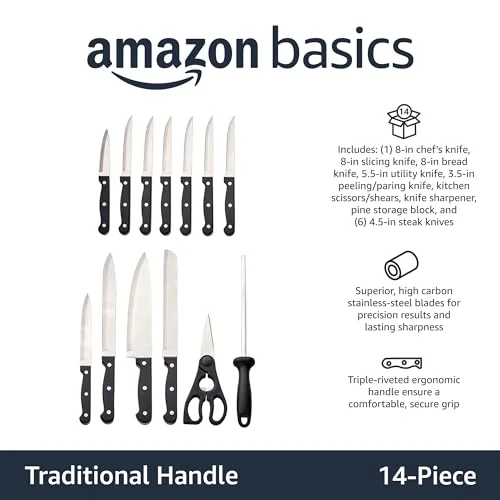
At $25, full tang is not a small thing to find in writing. The Amazon Basics 14-Piece set states full tang construction directly in its listing, which is the detail that separates it from a knife that merely looks similar in a thumbnail. A full tang puts the knife’s weight behind the blade rather than in a hollow plastic grip, which matters for balance during the kind of repetitive cutting a first apartment kitchen does a lot of — onions, chicken, the vegetables for a meal you’re cooking for one. It also means there is no glued seam inside the handle to loosen or let water in after months of hand washing, which is the failure mode that ends a cheap knife’s life early.
None of this means full tang is the only construction worth buying. Stamped and forged blades trade off weight and price in their own way, and almost everything at this budget is stamped rather than forged — that is simply what $25 to $50 buys, and it is not a flaw. The point of checking for full tang specifically, at this price, is narrower: it is the cheapest-to-verify signal that a manufacturer didn’t cut every corner available to them. A listing that states it outright, the way Amazon Basics does, is telling you something true and checkable, which in a category full of adjectives is worth noticing.
Where it lives
The block, the counter space, and the drawer alternative
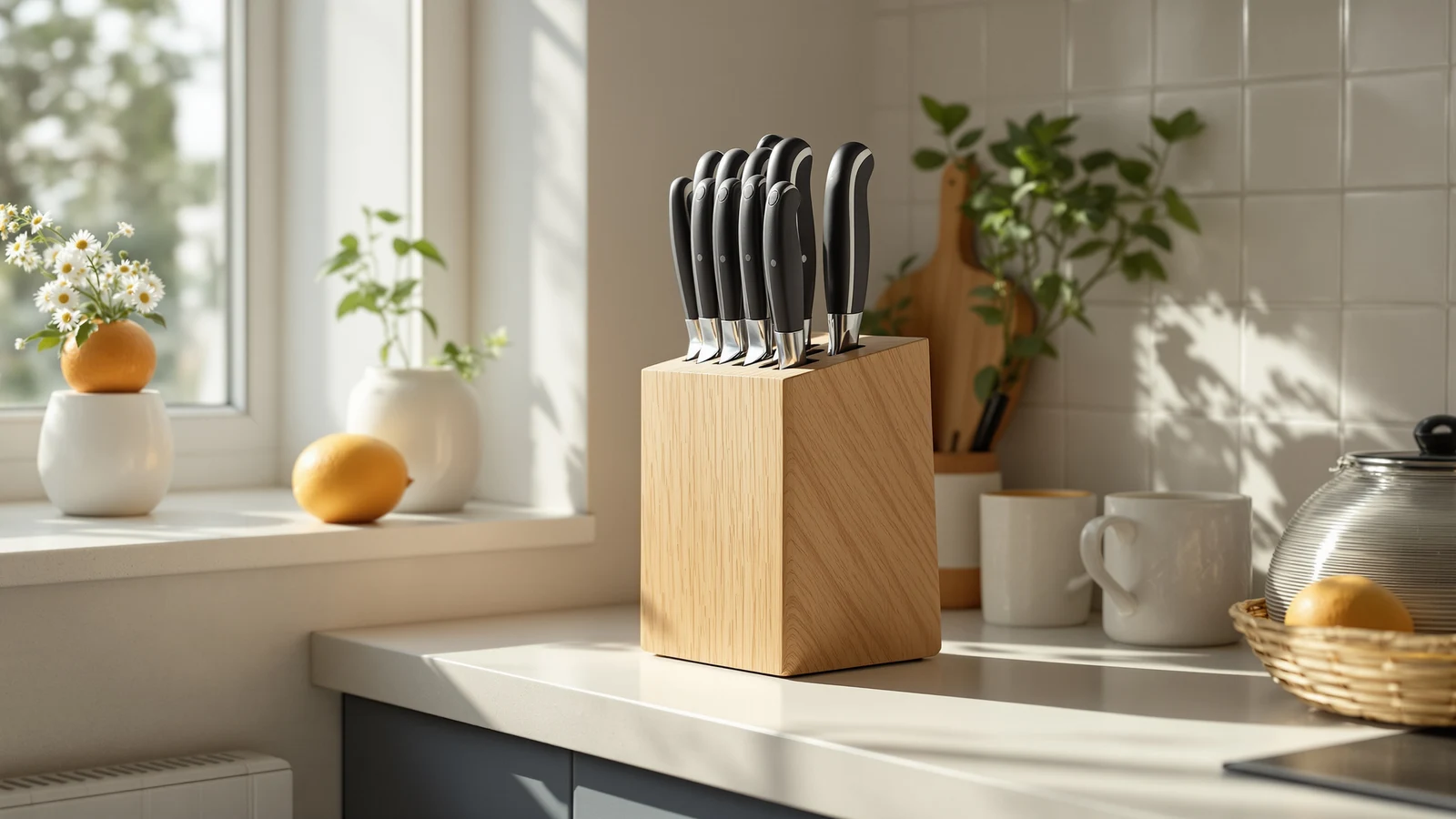
A first apartment kitchen is, more often than not, a small one — a run of counter that was never designed around a toaster, a coffee maker, a dish rack and a knife block all competing for the same eighteen inches. That is the real argument against a block, and it has nothing to do with the knives inside it. A wood block with a pinewood base, like the one included with the Amazon Basics and CAROTE sets, takes up a fixed footprint on the counter whether you use it daily or not, and in a studio or a one-bedroom, that footprint is not free.
The case for keeping the block anyway is that it is also the safest and most convenient place to store a knife you’ll use every day. Loose knives in a drawer roll against other utensils, dull faster against their own edges, and are a genuine hazard when you’re reaching into the drawer without looking. A block keeps the edge protected and the knife visible and ready, which for a set you’ll reach for constantly in a small kitchen is worth more than the counter inch it costs. All three sets in this guide ship with a block for exactly that reason — it is the default answer for a first kitchen, not an upsell.
The drawer alternative is real and sometimes the better fit: an in-drawer knife tray or a simple edge guard on each blade, stored flat in a drawer rather than upright on the counter. It suits a kitchen with almost no counter at all, or a household that would rather keep every visible surface clear. None of the three sets here include a drawer tray, so if that is the storage you actually want, treat it as a separate, inexpensive purchase rather than assuming one of these sets will cover it — we won’t claim a feature that isn’t in the listing. For most first apartments, though, the block that comes in the box is the simpler choice: one purchase, one footprint, and the knives are protected from day one.
Honest expectations
What you will replace first, and when
A starter set at this price is not sold as a lifetime purchase, and treating it as one is the fastest way to be disappointed by it. The pieces that go first are predictable and almost always the same across every budget block: the small paring knife, which does the most repetitive work on soft produce and dulls fastest because its edge is thinnest; and, in sets that include them, the steak knives, which tend to sit unused for months and then get asked to do a job — sawing through something frozen, opening packaging — they were never ground for.
What determines how soon any of that happens is mostly care, not the knife itself. Hand washing immediately after use, drying before storing, and keeping the blade out of the dishwasher will add years to a $25 set that would otherwise dull and pit within months. High-carbon stainless, which both the Amazon Basics and Astercook sets use, resists rust but is not immune to it, and a blade left wet in a dish rack overnight is the single most common way a cheap knife starts looking older than it is.
The realistic timeline for a starter set used daily in a first apartment is one to three years before the chef’s knife — the piece doing the most work — starts to feel genuinely dull rather than just due for a touch-up, and that is a fair trade for what it cost. Expect to resharpen more often than you would a forged set, expect the handle rivets to be the thing you check if a knife starts to feel loose, and expect that when something does wear out, it will be the paring knife or a steak knife, not the whole set. Budgeting for that outcome from the start is more useful than hoping to avoid it.
The picks
Three sets that equip a first kitchen honestly
01Best overall
Amazon Basics 14-Piece Knife Set
Best for a complete first kitchen at the lowest price
14 pieces·Full tang·High carbon stainless·Sharpener & pinewood block included
At $24.99, this is the set that makes the case for this entire guide. Amazon Basics states full tang construction and ergonomic handles directly in its listing, built from high carbon stainless steel, and ships with a sharpener built into the pinewood block and a complete 14-piece spread. It does not claim to be the knife you keep forever — it claims full tang, high carbon steel and a sharpener, and it delivers exactly those three things for less than the cost of a single mid-range chef’s knife sold alone.
The set to buy if this is genuinely your first kitchen and the budget has to stretch across a dozen other things this month too.
02Smallest footprint
Astercook 6-Piece Knife Set
Best for a tight counter and a short, focused knife list
6 pieces·High carbon stainless·Wood grain handle·Dishwasher safe, block included
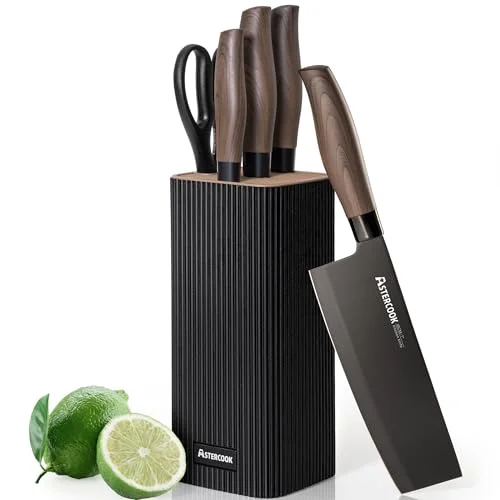
At $29.99, Astercook’s set skips the padding that makes a 14- or 16-piece box look generous and sticks to six pieces of high carbon stainless steel with a wood grain handle, housed in its own block. The listing states the set is dishwasher safe, which is a convenience worth having but not one we’d rely on daily — hand washing will keep any edge, including this one, sharp for longer. For a studio or a one-bedroom where counter space is the real constraint, a smaller block with fewer, sharper pieces is often the more honest fit than a bigger box with more filler.
The set to buy if your counter is the limiting factor, not your budget, and you want fewer pieces rather than more.
03Best if you want color
CAROTE 14-Piece Knife Set
Best for matching a kitchen you actually get to decorate
14 pieces·Rust-resistant·Wood block·Cream finish
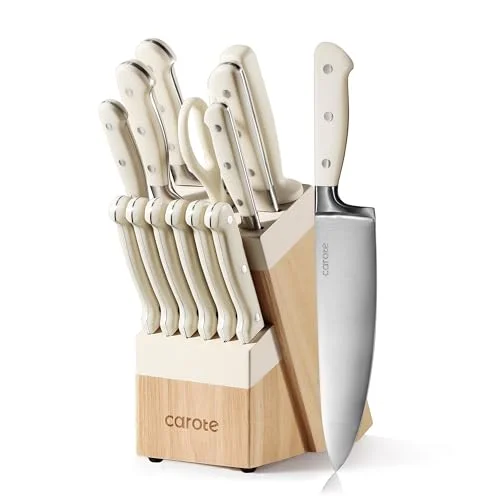
A first apartment is also, for a lot of people, the first kitchen they get to decorate themselves rather than inherit, and at $49.97 the CAROTE 14-piece set is the pick that treats that as a real consideration rather than an afterthought. It states rust-resistant construction and comes in a cream finish with a matching wood block, at roughly double the price of the Amazon Basics set for essentially the same 14-piece coverage. The premium here is cosmetic and in the finish, not in a construction claim we can independently verify beyond rust resistance — a fair trade if the kitchen is one you want to look a specific way.
The set to buy if you’re furnishing a kitchen you want to look intentional, not just functional, and $50 still fits the budget.
Side by side
The three, compared
| Set | Best for | Pieces | Construction | Price | Get it |
|---|
 Amazon Basics 14-Piece Amazon Basics 14-Piece |
Lowest price, complete kitchen |
14 |
Full tang, high carbon |
$24.99 |
Get it |
 Astercook 6-Piece Astercook 6-Piece |
Small counter, fewer pieces |
6 |
High carbon stainless |
$29.99 |
Get it |
 CAROTE 14-Piece CAROTE 14-Piece |
Finish and color match |
14 |
Rust-resistant |
$49.97 |
Get it |
Prices change. We refresh them, but Amazon is the authority at the moment you buy. See the full under-$100 roundup if your budget stretches past $50.
What comes next
Upgrading the chef’s knife before anything else
When a starter set does eventually need an upgrade, the instinct is to replace the whole thing at once — buy a new block, start over. That is the expensive way to do it, and it is not where the actual wear shows up first. The chef’s knife is the piece doing the overwhelming majority of the cutting in any kitchen, first apartment or not, which means it is also the piece whose dullness you’ll notice soonest and whose quality upgrade pays off fastest. The paring knife and the bread knife in any of the three sets above will likely still be perfectly serviceable long after the chef’s knife starts to feel like work.
That makes a single better chef’s knife the right first upgrade, not a second full set. A single forged or higher-carbon chef’s knife, bought on its own, can cost roughly the same as one of the complete starter sets above while delivering a noticeably better edge for the one task that matters most — and it slots into the block you already own, replacing just that one slot. If a sharper, longer-lasting edge specifically is the draw, a Japanese-style gyutou ground to a narrower angle is one direction to look; if what you actually want is to stop sharpening altogether, a set with a sharpener built into the block, like the one already in the Amazon Basics pick above, solves that without any upgrade at all.
The sequence that makes financial sense, in order: use the starter set as it comes; replace the chef’s knife alone once it genuinely stops performing, not on a schedule; keep the rest of the set, including the block, for as long as it holds an edge reasonably well. That is a cheaper and more honest path than buying a second complete set the first time one knife disappoints you.
Our method
How we picked — and what we can’t tell you
What we did
Specs, prices and published listings
We compared published specifications and current Amazon prices for starter kitchen knife sets under $50 sold in the US, then kept the sets whose listings state something checkable — full tang construction, the material, the piece count, or a specific finish — rather than relying on adjectives like “razor-sharp” that no listing can substantiate on its own.
What we didn’t
We don’t run a testing lab
We do not physically test these knives, we do not own them, and we do not publish invented scores or star ratings. We have no verified review data for these specific products, so we don’t paraphrase owner sentiment either. What we can do honestly is read every published specification and tell you plainly which claims are checkable and which are marketing.
FAQ
Common questions
How many knives do I actually need for a first apartment?
Three, in practice: an 8-inch chef’s knife for most cutting, a small paring knife for the jobs the chef’s knife is too big for, and a serrated bread knife, since a straight edge crushes a loaf rather than slicing it. A starter block set gives you those three plus extras you’ll use occasionally, bundled with a block and often a sharpener for one purchase instead of several.
Does full tang matter on a $25 knife set?
Yes, more than most other details at this price. The tang is the steel that extends into the handle; on a full-tang knife it runs the handle’s full length, usually riveted visibly in place, which improves balance and removes the glued seam that tends to fail first on a cheap knife. The Amazon Basics 14-piece set states full tang construction directly in its listing, which is unusual to find stated outright this far down in price.
Should I store the knives in a block if my counter is small?
A block is still usually the better default even in a small kitchen, because it protects the edge and keeps a daily-use knife visible and ready rather than loose in a drawer where it rolls against other utensils. If counter space is genuinely the limiting factor, a smaller set like the Astercook 6-piece, which ships in its own compact block, is a better fit than a 14-piece block on the same footprint.
What will wear out first on a starter set, and when?
Usually the paring knife, because its thin edge does repetitive work on soft produce and dulls fastest, followed by any steak knives that get pressed into jobs they weren’t ground for. With regular hand washing and immediate drying, a $25 to $50 starter set can reasonably last one to three years of daily use before the chef’s knife — the piece doing the most work — is worth replacing on its own.
Keep reading
Related on Best Knife Sets