Quick answer
The short version
Hand wash and dry every knife immediately after use, keep it out of the dishwasher entirely, store it in a block, on a magnetic strip, or in a dedicated in-drawer tray rather than loose among other utensils, hone the edge weekly with a honing rod, and have it properly sharpened on a whetstone or by a sharpening service about twice a year. Cut on wood or soft plastic, never on glass, stone or ceramic. Do that, and a set built on decent steel in the first place will still be sharp in five years. Skip any one of those five habits and the set you paid $150 for starts to feel like the one you paid $25 for, usually within eighteen months.
Before you start
What actually dulls a knife, and what doesn't
The real culprits
Impact, heat and the wrong surface
An edge is a few thousandths of an inch of steel folded to a point. It dulls from three things: knocking against something harder than itself (a plate, a sink, another knife in a drawer), the heat and detergent of a dishwasher cycle working on the alloy and the handle, and being drawn across a cutting surface harder than the blade. None of the three has anything to do with how often you use the knife to actually cut food — cutting a tomato is gentle; being left to rattle in a drawer is not.
What doesn't matter much
Frequency of use, within reason
A knife used daily and cared for properly will outlast a knife used once a month and tossed in a drawer. The steel itself — whether it's the high-carbon stainless in an entry set or the German or Japanese steel in a pricier one — is secondary to the handling. See our stamped vs forged comparison for how the two main blade-making methods differ in how they hold an edge, but the routine below applies to either one.
Step 1
The dishwasher, and exactly what it does to a blade
Three things happen to a knife in a dishwasher, and all three work against it at once. First, the detergent: dishwasher detergent is formulated to be abrasive and alkaline to cut through baked-on grease, and that same chemistry slowly etches and pits polished steel over repeated cycles — it's a visible dulling of the shine long before it's a measurable loss of edge. Second, the heat: a dishwasher's dry cycle runs well above the temperature a knife handle is built to tolerate indefinitely, and repeated heat cycling is what causes handle materials, especially wood or wood-composite scales, to shrink, crack or loosen from the tang over time. Third, and the one people underestimate most, is contact: a knife loaded into a rack knocks against plates, bowls and other cutlery through an entire wash-and-dry cycle, and every one of those impacts can roll or chip the edge in a way that's invisible until the knife starts catching instead of slicing.
High-carbon stainless steel, which is what most mid-range and budget sets including the under-$100 sets we've compared use, resists rust reasonably well on its own. That resistance is not the same as dishwasher safety. A set's product listing may not say "dishwasher safe" at all, and the honest reading of that silence is that the manufacturer isn't making a claim either way — treat it as hand-wash-only unless a listing explicitly states otherwise, and even then, hand washing is still the better habit for the handle and the edge alike.
The practical rule: if a knife set has a block, a sharpener slot, or any construction detail worth protecting, that is itself a signal the manufacturer expects it to be used carefully — and a dishwasher is the fastest way to undo whatever care went into the steel.
Step 2
Hand washing and drying: ten seconds per knife
The routine that actually protects a blade takes about as long to do as it took you to read this sentence, repeated once per knife. Rinse the blade under warm water, wipe both sides with a soft sponge or cloth and a small amount of dish soap, rinse again, and dry it immediately with a towel — blade first, moving away from the edge, never toward it. The entire sequence is roughly ten seconds per knife, and the step that matters most is the one people skip: drying immediately, rather than leaving the knife in a rack or by the sink to air dry.
Air drying leaves water sitting on the blade for minutes at a time, and that window is long enough for water spots, mineral deposits from hard water, and in some cases the beginning of surface rust to set in, even on stainless steel. High-carbon stainless resists corrosion; it does not prevent it indefinitely if moisture is left to sit. Drying immediately also means the knife goes back into its block, strip or drawer tray dry, rather than introducing moisture to wherever it's stored — which matters more than it sounds, since a damp knife sitting against a wooden block slot is a slower version of the same problem a dishwasher causes faster.
One habit worth adding: never leave a knife submerged in a sink full of soapy water, even briefly. A blade you can't see is a blade someone else in the kitchen can reach into without warning, and it's also more likely to knock against other submerged dishes exactly the way it would in a dishwasher rack.
Step 3
Storage: block, magnetic strip, drawer — in that order
How a knife is stored between uses matters almost as much as how it's washed, because storage determines whether the edge spends its idle time protected or knocking against other metal. The three common options protect the edge to different degrees, and the order below is also roughly the order of how much counter or wall space each one needs.
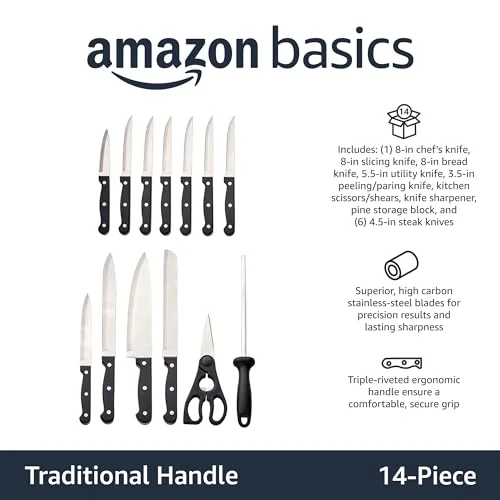
A block is the simplest option to get right: each slot holds one knife with the edge suspended and nothing touching it, which is why a block is still the standard that comes bundled with most sets, including the Amazon Basics 14-piece set, which ships with a pinewood block and a built-in sharpener in the same unit. The only failure mode with a block is putting the knife away wet, which turns the wood slot into a slow source of moisture against the blade.
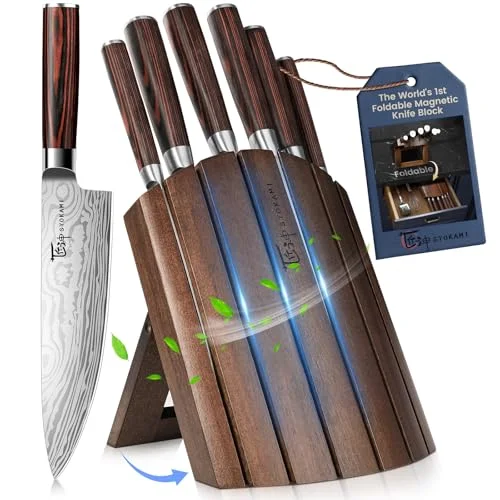
A magnetic strip or magnetic block holds the blade against a strip of magnets rather than inside a slot, and the main advantage is visibility and counter space — you can see every knife at a glance, and a wall-mounted strip uses no counter real estate at all. The SYOKAMI 2026 kitchen knife set ships with a foldable magnetic acacia wood block, which is a middle option: it keeps the block's suspended-edge protection but folds flatter than a traditional slotted block when counter space is tight. The trade-off with any magnetic storage is that the blade sits exposed rather than sheathed, so it's a better fit for a kitchen where the knives aren't near small children or where everyone in the house already handles blades carefully.
A drawer is the option to be most careful with, and it should come last, both in this list and in your preference. A knife loose in a drawer among other utensils is exactly the scenario that dulls an edge fastest — it slides, it's covered by other items being put away on top of it, and every one of those small contacts is a potential roll or chip. If a drawer is the only space available, use a knife-specific in-drawer tray with individual slots, sold separately from any set, rather than letting blades mix freely with spoons and spatulas. Never store a knife loose in a drawer with the edge unprotected; it is the single worst storage habit on this page and the easiest one to fix for the price of a $10 tray.
Step 4
Honing weekly, sharpening twice a year
These are two different jobs, and conflating them is the single most common mistake in knife care. Honing realigns a microscopically bent edge back into a straight line using a honing rod; it removes effectively no steel and takes about fifteen seconds per knife. Sharpening removes a thin layer of steel to create a new, genuinely sharp edge where the old one has actually worn down, using a whetstone, a pull-through sharpener, or a professional sharpening service. A knife that feels dull after heavy use has usually just had its edge bent slightly out of true, not worn away — which is why honing it first, before assuming it needs a full sharpening, solves the problem most of the time.
The twice-a-year sharpening schedule is a reasonable default for a knife used several times a week in a typical home kitchen; a knife used daily for heavy prep may need it more often, and one used occasionally may need it less. Either way, honing weekly and sharpening on a schedule — rather than waiting until a knife genuinely struggles to cut a tomato — keeps the edge in a narrow, manageable range instead of letting it fall off a cliff and requiring aggressive, steel-removing correction.
A knife set with a sharpener built into the block, like the Amazon Basics 14-piece set, gives the blade a quick touch-up every time it's drawn out and back in, which functions closer to honing than to true sharpening — it's a genuine convenience for people who would otherwise never touch a stone, but it is not a substitute for a proper sharpening on the twice-a-year schedule. If you want to understand this distinction in more depth, including how it compares with sharpening by hand, see our guide on whether a built-in sharpener is worth it. And if the edge angle itself is part of what you're optimizing for — a narrower angle bites more easily but needs more frequent attention — our Japanese-style knife set guide covers how angle and maintenance trade off against each other.
Step 5
Cutting boards: wood, plastic, and the ones that ruin edges
The surface a knife meets thousands of times a year matters as much as how it's washed or stored, because every single cut is a small amount of contact between the edge and whatever is underneath the food. Wood and soft plastic (polyethylene) are both "self-healing" to a degree — the fibers or the plastic compress and partially close back up after a cut rather than permanently scoring, which is gentle on an edge over years of use. Wood has the added benefit of being naturally resistant to bacterial growth due to its porous structure drawing moisture (and with it, microorganisms) away from the surface, though it needs regular oiling to avoid cracking and should never go in a dishwasher itself.
Glass, stone, marble and ceramic cutting boards are the ones that ruin edges, and they do it fast. These surfaces don't compress or give at all under the edge, so every cut is the blade grinding directly against a harder material than itself — the cutting-board equivalent of chopping on a plate. A knife used regularly on glass or stone will visibly dull within weeks regardless of how good the steel is or how carefully it's washed and stored otherwise. If a board looks decorative, has a hard glossy surface, or is marketed primarily on its appearance rather than its kindness to blades, treat it as a serving board or a backup, not a daily cutting surface.
Bamboo sits in between: it's harder than most wood and plastic, which makes it more dulling than either over time, even though it's often marketed alongside them as an eco-friendly wood alternative. It isn't a disaster to use occasionally, but if you're buying one board to use every day, standard hardwood or a soft plastic board will be kinder to any set, whether that's the full-tang Amazon Basics 14-piece set or something considerably more expensive.
Step 6
When a knife is past bringing back
Most dull knives are fixable with honing or sharpening, which is exactly why the two habits above matter so much — they prevent a knife from ever reaching the point described here. But a knife can cross from dull to genuinely done, and it's worth knowing the signs rather than sinking more time into a blade that won't hold an edge no matter how it's sharpened.
A chip or crack in the edge that's visible to the eye, rather than just a dull line, usually means a piece of the steel itself has broken away; a stone can round off the damage but can't replace the missing metal, so the knife often ends up with a visibly uneven edge even after sharpening. A blade that won't hold an edge for more than a day or two of normal use after a proper sharpening — as opposed to weeks or months — suggests the steel itself has been compromised, often by repeated dishwasher cycles or years of being stored wet, and no amount of honing fixes steel that has corroded or lost its temper. And a handle that's cracked, loose at the rivets, or separating from the tang is a safety issue before it's a sharpness issue: a blade can still cut food, but a knife that can shift or detach from its handle under pressure should be retired regardless of how good the edge still is.
None of this is a reason to assume a set needs replacing on any fixed timeline. A full-tang, properly cared-for knife from an entry-level set can easily outlast a forged, expensive one that's been run through a dishwasher for two years. The steel matters less than the habits above; replacing a knife is the last step, not an early one.
If you're starting from scratch
Sets that make this routine easier
01Built-in touch-up
Amazon Basics 14-Piece Knife Block Set
Best for a built-in sharpener and a block in one unit
14 pieces·Full tang·Sharpener included·Pinewood block
A pinewood block with an integrated sharpener means the storage step and a rough version of the honing step happen in the same motion of putting the knife away. It won't replace a proper twice-a-year sharpening, but it's a reasonable way to build the habit if you're starting from nothing.
02Space-saving storage
SYOKAMI Foldable Magnetic Knife Set
Best for magnetic storage without losing a slotted block entirely
Magnetic acacia wood block·Foldable·2026 model
The foldable magnetic acacia wood block keeps blades suspended rather than loose in a drawer, while taking up less flat counter space than a traditional block when folded down — useful if the storage step above is the one you're most likely to skip for lack of room.
03Worth the routine
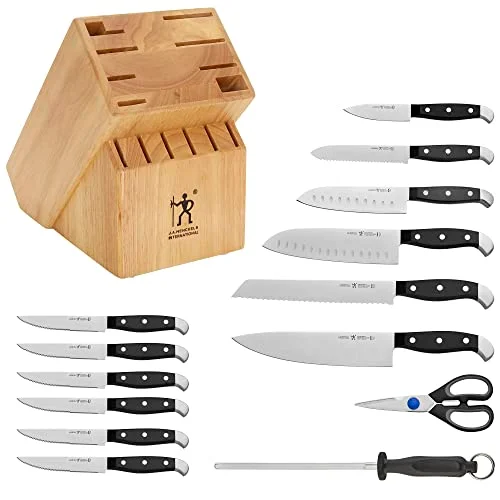
Henckels Statement 15-Piece Block Set
Best for German-engineered steel worth protecting properly
15 pieces·German engineered·Razor-sharp·Block included
At $149.95, this is the set in our lineup where skipping the dishwasher and keeping to a sharpening schedule pays off most — German-engineered steel that's cared for properly is the whole reason to spend more than $25 in the first place. See our full comparison in the under-$100 roundup for how it stacks up against cheaper alternatives.
Our method
How we researched this — and what we can't tell you
What we did
Manufacturer guidance and published specs
We compared manufacturer care instructions, published construction details — full tang, blade steel, block or sharpener design — and general, widely documented cutlery-maintenance practice around washing, honing and sharpening, then set that against the three products referenced on this page to make the routine concrete rather than abstract.
What we didn't
We don't run a testing lab
We do not physically test these knives, we do not own them, and we do not publish invented scores or star ratings. We have no verified review data for the products named here, so we don't paraphrase owner sentiment either. The care routine above reflects how these materials and designs are documented to behave, not a lab result from our own kitchen.
FAQ
Common questions
Is any knife set actually dishwasher safe?
Treat all of them as hand-wash-only unless a listing explicitly states dishwasher safety, and even then hand washing is still better for both the edge and the handle. Dishwasher detergent is abrasive and alkaline enough to etch polished steel over repeated cycles, the heat of the dry cycle stresses handle materials, and knives knock against other items in the rack in ways that chip or roll the edge. High-carbon stainless resists rust; it doesn't make a knife immune to any of that.
What's the actual difference between honing and sharpening?
Honing realigns a bent edge using a honing rod and removes almost no steel; it takes about fifteen seconds per knife and is worth doing weekly. Sharpening removes a thin layer of steel to create a genuinely new edge on a whetstone, pull-through sharpener or professional service, and is worth doing roughly twice a year for a knife used several times a week. A knife that feels dull after heavy use has usually just bent slightly out of true and needs honing first, not a full sharpening.
Which cutting board is actually best for keeping an edge?
Wood and soft plastic (polyethylene), because both compress slightly under the blade and partially close back up after a cut rather than permanently scoring. Glass, stone, marble and ceramic boards don't give at all, so every cut grinds the edge against a harder surface than itself, and they'll visibly dull a knife within weeks of regular use. Bamboo sits in between — harder than standard wood or plastic, so more dulling over time, even though it's often marketed as an eco-friendly alternative.
Block, magnetic strip, or drawer — does storage really matter that much?
Yes. A block or magnetic strip keeps the edge suspended with nothing touching it, which is the main reason either is safe for daily storage. A knife loose in a drawer among other utensils slides and gets knocked by whatever is put away on top of it, which is one of the fastest ways to dull or chip an edge outside of a dishwasher. If a drawer is the only option, use a knife-specific tray with individual slots rather than letting blades mix freely with other utensils.
Keep reading
Related on Best Knife Sets