What's actually happening
What does a built-in sharpener actually do to the edge?
Inside the slot sits a pair of abrasive wheels, crossed ceramic rods, or in a few designs a fixed carbide notch, set at a shallow angle on either side of where the blade passes through. Every time you slide the knife into its place in the block, the edge brushes against that abrasive for a fraction of a second, and a tiny amount of steel is removed from each side. Do that daily, and the edge is realigned and lightly refreshed before it has had the chance to go properly dull. Skip it for a month, and the edge drifts the way any working edge drifts — from use, from the cutting board, from the dishwasher if it ever ends up there.
The mechanism is passive and automatic, which is both the appeal and the ceiling. Nobody has to remember to do anything beyond putting the knife away, which is the one step in knife care that nobody skips. The imarku 14-Piece Japanese Gyutou set builds this into the block alongside its stated 15-degree-per-side edge, and the Ninja NeverDull 17-Piece set — the clue is in the name — is built around the same idea with an edge angle the brand describes as optimised for the mechanism. The McCook 15PC set states a built-in sharpener in its own listing title, the same basic premise at a different price point. In every case, the amount of steel removed per pass is small by design; it has to be, or the block would wear a knife down to nothing within a year.
What a fixed-angle slot cannot do is adapt to the knife. It sharpens at whatever angle the mechanism was built to, close to the angle the knife shipped with. Sharpen the same knife by hand at a different angle, and the two methods start fighting, each grinding against a slightly different edge than the one the other left behind.
Two different jobs
Honing against sharpening: two different jobs, often confused
Honing realigns an edge that has rolled slightly out of true from normal use — it does not remove meaningful steel, it just straightens what is already there, the way a honing steel does before you start cutting. Sharpening removes steel to create a new edge, because the old one has worn down or chipped past the point where realigning it does anything. A built-in sharpener sits closer to honing than to sharpening, even though manufacturers understandably call it a sharpener, because "touches up your edge" is a more sellable phrase than "delays the day you need a stone."
That distinction matters because of what it implies about frequency and expectation. A honing steel is meant to be used before nearly every cutting session and removes almost nothing. A whetstone is meant to be used every few weeks to months, depending on how hard the knife works, and removes a deliberate, visible amount of steel to form a fresh edge from scratch. A built-in sharpener lands in between: used constantly, like honing, but actually abrading the steel a little, like sharpening — just not nearly enough of it to reset an edge that has gone properly blunt. Ask it to take a genuinely dull knife and make it sharp again from a standing start, and the slot will keep doing its small pass with every draw while the knife keeps feeling about the same, because the mechanism was never sized for that job.
The honest audience
Who a built-in sharpener is actually for
It is for the person who will never otherwise sharpen a knife. That is not a criticism — it describes most home cooks, and it is a large enough group that three different manufacturers have built entire sets around solving exactly that problem. If buying a whetstone and setting aside fifteen minutes every couple of months sounds like something you will keep meaning to do and never actually do, a sharpener that works automatically every time you put the knife away is solving a real problem, not an imagined one. As the guide on how many knives you actually need gets into, most kitchens lean on two or three blades constantly, and keeping those few genuinely usable matters more than the size of the block they live in.
It is also for anyone sharing a kitchen with people who will not maintain a knife, however much the person who bought the set intends to: a block that sharpens on every put-away depends on nothing, which is precisely the point. It is a weaker case for someone who already owns a whetstone and knows how to use it. If that describes you, the mechanism is not doing nothing — it still realigns the edge between stone sessions — but it is not the reason to choose one set over another, and paying extra for it is paying for a feature you will barely notice using.
The limits
What a built-in sharpener cannot fix
It cannot repair a chipped edge. A chip is a small piece of steel missing from the blade, usually from hitting bone, a frozen surface, or the inside of a dishwasher rack, and fixing it means grinding the entire edge down past the depth of the chip — far more steel removal than a pass-through slot is built to do. Run a chipped knife through the block daily and the chip will still be there months later, lightly polished at the edges but structurally unchanged. Nor can it change the edge angle: the slot is set to one angle and will keep sharpening at that angle regardless of what the blade actually needs, so a knife reground steeper by a previous owner won't be corrected by a mechanism that only knows how to repeat itself.
It cannot rescue a blade that has gone through the dishwasher repeatedly, either. Detergent is abrasive and alkaline, and the heat and tumbling roll and dull an edge in ways that are about bulk wear, not a single damaged spot — generalized dulling a slot can slow but not reverse. None of this makes the mechanism a gimmick; it is a maintenance tool with a narrow job. Repair, regrinding and recovery need a different tool.
What you're paying for
How much of the price is the block
Across the three sets in this guide, the price spread makes the point on its own: $64.99 for the McCook 15-piece set, $169.99 for the imarku 14-Piece Japanese Gyutou set, and $370.00 for the Ninja NeverDull 17-Piece set. None of that difference comes from the sharpening mechanism alone being three or six times more capable — a built-in slot is a relatively simple piece of engineering wherever it appears. What changes between these prices is the steel, the construction behind the knives, the materials and fit of the block, and the brand doing the selling. Compare two sets purely on the strength of "it has a sharpener built in," and you are really comparing a feature that costs a small, fairly fixed amount to add, bolted onto knives and blocks that cost very different amounts to make.
That is worth separating out before buying on price alone, the same way the guide to kitchen knife sets under $100 argues for reading the construction details instead of the headline piece count. A $65 set with a built-in sharpener is not a budget version of a $370 set with the same feature; it is a different knife, at a different weight, with different steel, that happens to share one mechanism. The sharpener is the detail that gets the marketing attention because it is the differentiator from sets that do not have one. The knives underneath it are where most of the price actually lives. Imagine the same three sets with the sharpening slot removed entirely: the price gap between them would barely move, because the slot itself is a small, mass-producible part. The sharpener is the feature you notice daily. It is rarely the feature you are actually paying for.
The picks
Three sets with a sharpener built into the block
01Lowest entry price
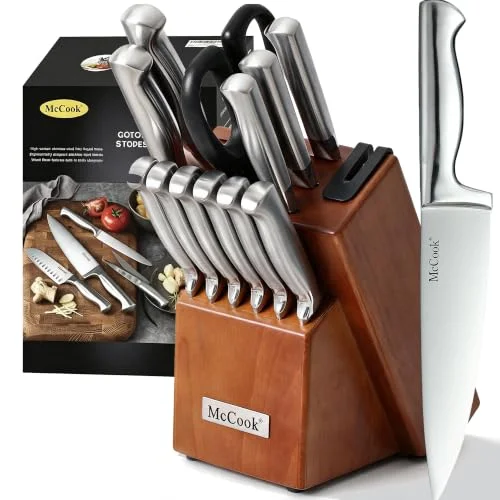
McCook Kitchen Knife Set 15PC Knife Block Set
Best for trying the mechanism without a large outlay
15 pieces·Built-in sharpener·Block included
McCook states a built-in sharpener directly in the set's title, at $64.99 — the lowest price of the three sets in this guide, and the one most likely to be a first experience with the mechanism rather than a considered upgrade from an existing set. It carries the same basic limitation as every slot sharpener here: it maintains an edge that is already in reasonable shape and does not substitute for sharpening a knife that has gone properly dull or taken a chip. For the price, it is a complete, entry-level way to find out whether the pass-through habit actually fits how you cook.
The set to buy if you want to find out whether a built-in sharpener changes your habits, before spending three or four times as much to find out.
02Best Japanese edge
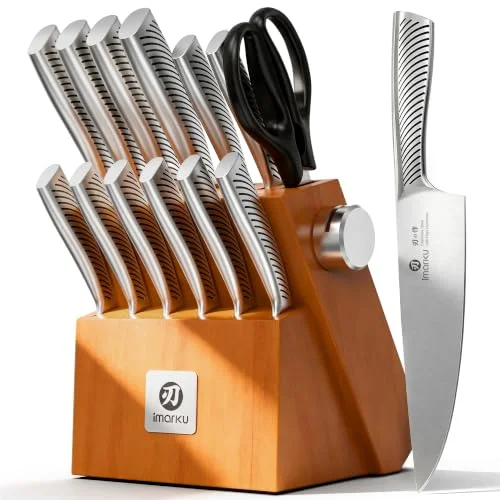
imarku 14-Piece Japanese Gyutou Stainless Steel Set
Best for a narrower edge that still gets touched up daily
14 pieces·8″ gyutou·15° per side·Built-in sharpener
A gyutou is the Japanese equivalent of a chef's knife, ground narrower than most German-style blades — imarku states 15 degrees per side against a typical 20 on a German edge, with a Rockwell hardness of 56 ± 2. A narrower edge bites more easily but is also less forgiving of bones and frozen food, which makes the built-in sharpener a genuinely useful counterweight: it keeps that finer edge realigned between the more careful hand-sharpening sessions a gyutou generally rewards. At $169.99 for an 8-inch gyutou plus the rest of the 14-piece set, it sits between the entry-level McCook set and the far pricier Ninja block. Readers comparing edge geometry across brands may also want the fuller rundown in the best Japanese-style knife sets.
Buy it if you want a sharper, narrower edge and are willing to treat the sharpener as upkeep, not a substitute for care.
03Built around the mechanism
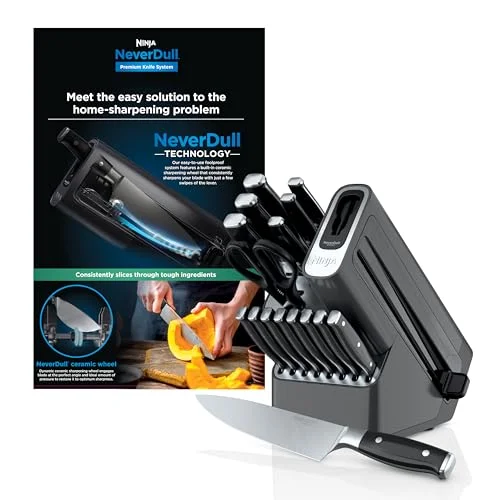
Ninja NeverDull 17-Pc Knife Block Set, K32017
Best for people who will truly never sharpen anything else
17 pieces·German stainless, stamped·Built-in sharpener·Balanced ergonomic handles
The name states the premise outright, and at $370.00 this is the most expensive set in the guide, as well as the one where the sharpening mechanism is clearly the product's whole identity rather than one feature among several. The blades are stamped German stainless with an edge angle the brand describes as optimised for the built-in mechanism, paired with ergonomic handles weighted for extended use. A large share of that price is the block and the engineering behind the sharpening slot itself, not a dramatic step up in the knives compared with the other two sets here.
Worth it only if you know, honestly, that you will never pick up a whetstone. If you already own one, this is an expensive way to buy a feature you will not use.
Side by side
The three, compared
| Set | Best for | Pieces | Sharpener | Price | Get it |
|---|
 McCook 15PC Set McCook 15PC Set |
Lowest entry price |
15 |
Built into the block |
$64.99 |
Get it |
 imarku Gyutou 14-Piece imarku Gyutou 14-Piece |
A Japanese edge, maintained daily |
14 |
15° per side, 56±2 HRC, built in |
$169.99 |
Get it |
 Ninja NeverDull 17-Piece Ninja NeverDull 17-Piece |
Never sharpening anything else |
17 |
German stainless, stamped, built in |
$370.00 |
Get it |
Prices change. We refresh them, but Amazon is the authority at the moment you buy. See the full six-set roundup for sets without a built-in sharpener too.
When to go further
When to buy a whetstone instead
Buy a whetstone when a built-in sharpener has clearly stopped being enough — when the knife drags through a tomato skin instead of slicing it, when you can feel a chip catch under your thumbnail, or when the blade has been reground or damaged in a way the slot was never built to correct. A stone lets you choose the angle and remove exactly as much steel as the edge needs. It takes longer to learn and longer to use, but it is the tool for repair, not just upkeep.
A whetstone and a built-in sharpener are not mutually exclusive. Someone who sharpens properly every few months can still own a set with a built-in sharpener and let the slot handle the in-between realignment; the mechanism does not undo careful stone work, it just keeps doing its small pass regardless. The scenario to avoid is paying extra specifically for the mechanism, as with the Ninja NeverDull set here, when you already have the habit and the stone to make it redundant.
Buy a whetstone, too, if cost-per-knife matters more to you than convenience. A decent whetstone is typically a one-time purchase under $40 that works on every knife in the house, including ones bought years apart from different brands with different edge angles — a fixed-angle block sharpener only ever serves the knives built for its own slot. For a household with knives from multiple sets, a stone is the more flexible long-term tool. Readers deciding between a stamped edge that is easy to touch up on a stone and a forged edge that holds its angle longer may also find the breakdown in stamped versus forged kitchen knives useful before choosing either path.
Our method
How we picked — and what we can't tell you
What we did
Specs, prices and published listings
We compared published specifications and current Amazon prices for kitchen knife sets that state a built-in sharpener as part of the block, then explained the mechanism using general, verifiable facts about how pull-through and fixed-angle sharpeners work — not claims a brand itself does not publish.
What we didn't
We don't run a testing lab
We do not physically test these knives, we do not own them, and we do not publish invented scores or star ratings. We have no verified review data for these specific products, so we don't paraphrase owner sentiment either. What we can do honestly is read every published specification, explain the general mechanics of the feature, and tell you plainly what it can and cannot do.
FAQ
Common questions
What does a built-in sharpener actually do to the blade?
It passes the edge across an abrasive wheel, ceramic rod or fixed notch at a set angle every time you slide the knife into the block, removing a small amount of steel and realigning the edge. Done daily, it keeps an edge that is already in reasonable shape from drifting dull. It is not sized to remove enough steel to reset an edge that has already gone properly blunt or chipped.
Is a built-in sharpener the same as honing?
Close, but not identical. Honing realigns an edge without removing meaningful steel, the way a honing steel does. A built-in sharpener does remove a small amount of steel on every pass, which puts it between honing and full sharpening — frequent like honing, but mildly abrasive like sharpening, without doing either job at full strength.
Can a built-in sharpener fix a chipped or damaged edge?
No. A chip means steel is missing from the blade, and fixing it means grinding the whole edge down past the depth of the chip, which is far more material removal than a pass-through slot is built to do. It also cannot change the edge angle or reverse general dulling from repeated dishwasher use. Those problems need a whetstone or professional sharpening.
When should I switch to a whetstone instead?
When the knife visibly struggles with something it used to cut cleanly, when you can feel a chip in the edge, or when you want to reset the angle rather than maintain the one the block assumes. A whetstone is also the better long-term choice for a household with knives from several different sets, since a fixed-angle block sharpener only serves the knives it was built for.
Keep reading
Related on Best Knife Sets