The number that isn’t a spec
The same number, three different boxes
“15-piece” sits in the title of three unrelated knife sets we looked at for this guide: the Astercook Knife Set 15 Piece German Steel Kitchen Knife Block Set at $59.99, the Cuisinart 15-Piece Knife Set with Block, Forged Triple Rivet (model C77WTR-15P) at $77.97, and the Cuisinart 15-Piece Stainless Steel Hollow Handle Block Set (model C77SS-15PK) at $59.99. Same digit, same word “piece,” three prices that span more than $35, and — once you read what each listing actually itemizes — three noticeably different boxes.
That isn’t a coincidence or a marketing trick specific to these three. “Piece count” is a single number standing in for a bundle of very different objects: full-size knives, steak knives, a sharpening tool, a pair of shears, and the block itself. None of those objects weigh the same in your actual cooking. A chef’s knife earns its place in the count every single day. A sixth steak knife earns its place twice a year, if that. Both count as “one piece” on the box. The number fifteen tells you the box is full. It does not tell you what’s in it, and — as the three sets in this guide show — the honest next step is always to open the listing and read the breakdown rather than compare two sets on the headline total alone.
This matters more at fifteen pieces specifically than it does at, say, three or four, because fifteen is large enough to hide real differences inside a number that looks identical on a search results page. Two shoppers comparing “15-piece knife set” listings side by side, scrolling past the title and the price, can walk away with two genuinely different kitchens. The rest of this guide is about what separates them, using these three real listings as the worked example, and ending with a method you can apply to any two sets in about ninety seconds.
Reading the fine print
Which brands publish the list — and which don’t
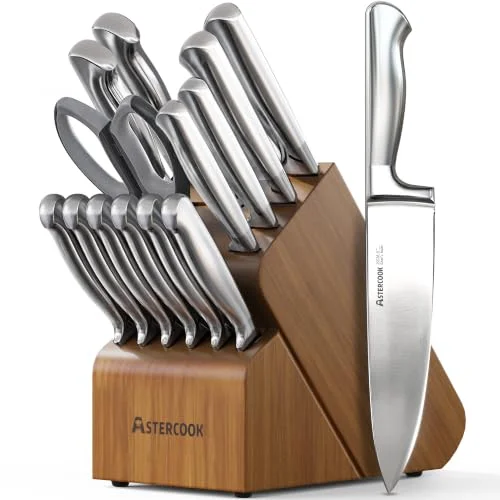
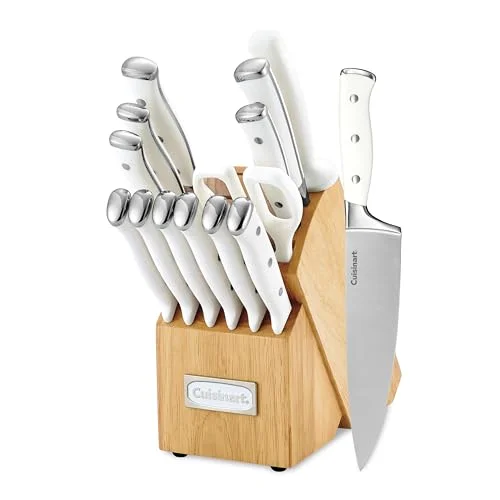
Two of the three listings here do the reader a real favor: they spell out, piece by piece, what’s in the box. Astercook’s bullet points state the set includes an 8-inch chef knife, an 8-inch bread knife, an 8-inch slicing knife, a 7-inch santoku knife, a 5-inch utility knife, a 3.5-inch paring knife, six steak knives, kitchen shears, and a wooden block with a built-in sharpener. The Cuisinart C77WTR-15P goes further still, naming exact lengths for eight distinct tools: an 8-inch chef knife, an 8-inch slicing knife, a 7-inch santoku knife, a 5.5-inch utility knife, a 3.5-inch paring knife, a 2.75-inch bird’s beak paring knife, six 4.5-inch steak knives, an 8-inch sharpening steel, all-purpose household shears, and a wooden block. Both of those are the kind of itemized breakdown that lets you judge the set against your actual cooking before you buy, not after the box arrives.
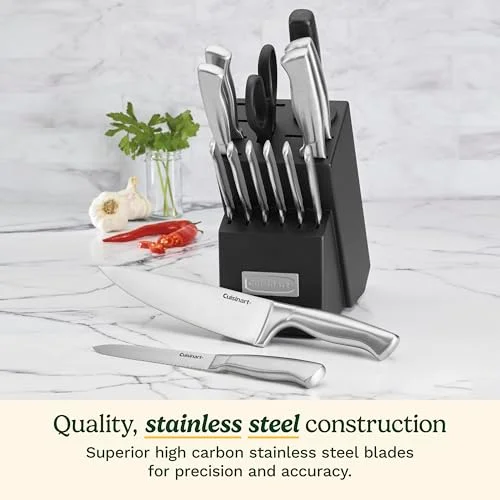
The third listing doesn’t do this. The Cuisinart C77SS-15PK — a different model from the same brand, at $59.99 — describes itself only in general terms: high-carbon stainless steel blades, a durable bolster, precision-tapered edges, an ergonomically designed handle. Nowhere in its published bullet points does it break down which fifteen objects make up the set. That’s a useful reminder on its own: publishing an itemized list isn’t a brand-level habit you can rely on once and assume forever. Cuisinart does it plainly on one 15-piece listing and not on another. The listing is the unit that matters, not the logo on the block.
If a listing you’re considering doesn’t itemize its piece count anywhere in the title, bullet points or product images, treat that the way you’d treat a food label with no ingredients — not necessarily a bad product, but one you can’t evaluate sight unseen. Before buying a set like the C77SS-15PK, scroll through every product image on the listing; manufacturers sometimes put the breakdown in an infographic image even when the bullet text skips it. If you can’t find the breakdown anywhere, the honest move is to ask the question directly in the Amazon Q&A section, or treat the piece count as a loose upper bound rather than a promise of fifteen specific, useful tools.
Doing the math yourself
Counting the block, the shears and the sharpener as pieces
Add up Astercook’s own itemized list and something doesn’t immediately balance. Six individual knives — chef, bread, slicing, santoku, utility, paring — plus six steak knives is twelve. Add the kitchen shears and you’re at thirteen. Add “a wooden block with a built-in sharpener” as one more object and you land at fourteen, one short of the fifteen on the box. The fifteenth piece only appears if you count the block and the built-in sharpener separately, as two pieces sharing one physical object, rather than as the single block Astercook’s own sentence describes. That’s not an accusation of dishonesty — it’s a genuinely common counting convention in this category — but it is exactly the kind of arithmetic a shopper has to do themselves if they want the number to make sense, because the listing states the parts and the total without walking you through how one becomes the other.
The Cuisinart C77WTR-15P doesn’t need that adjustment. Its own count runs clean: six individual knives (chef, slicing, santoku, utility, paring, bird’s beak paring) plus six steak knives is twelve, plus the 8-inch sharpening steel is thirteen, plus the household shears is fourteen, plus the wooden block is fifteen — fifteen separate physical objects, each counted once. The difference between the two listings isn’t that one is more honest than the other. It’s that a sharpener built into the block’s body is a different thing, physically, from a sharpening steel that sits in its own slot as a distinct tool, and that physical difference is exactly why the same arithmetic produces fourteen discrete objects in one set and fifteen in the other.
The practical rule worth taking from this: a block and a built-in sharpening slot are a convenience feature, not an extra knife, and whether a listing counts them as one piece or two tells you more about that listing’s counting convention than about how much cutlery you’re getting. Shears count as one tool whichever set you’re comparing — they’re genuinely a separate object, not a knife wearing a different name. The block is storage. The sharpener, built-in or separate, is maintenance. Before comparing two sets on their total, it’s worth doing the same subtraction we just did above: count only the knives you’d actually use, and treat the block, the sharpener and the shears as what they are — useful, but not knives, and not interchangeable with one.
If a built-in sharpener specifically is the detail driving your decision between two sets, it deserves its own look rather than a line item buried in a piece count — see our guide to knife sets with a built-in sharpener for what that feature does and doesn’t do for blade life.
Three listings, read closely
Three 15-piece sets, side by side
01Itemized, built-in sharpener
Astercook Knife Set 15 Piece German Steel Kitchen Knife Block Set
Six knives, six steak knives, shears and a block with a built-in sharpener
15 pieces·One-piece stainless steel·Anti-slip handle·Wooden block with built-in sharpener
Astercook’s own bullet points list an 8-inch chef knife, an 8-inch bread knife, an 8-inch slicing knife, a 7-inch santoku knife, a 5-inch utility knife, a 3.5-inch paring knife, six steak knives, kitchen shears, and a wooden block with a sharpener built into it, at $59.99 — the lowest of the three sets here. It’s the only one of the three that explicitly includes a bread knife, and the only one where the sharpener isn’t a separate tool. Whether its fifteenth “piece” is the block or the sharpening slot depends on which of the two you count separately, since the listing itself describes them as one combined object.
The set to read closely if a bread knife specifically is on your list — it’s the one listing of the three that states one is included.
02Itemized, specialty extras
Cuisinart C77WTR-15P Forged Triple Rivet, White
Seven knives, a sharpening steel, shears and a block — no bread knife
15 pieces·Forged, triple rivet·High-carbon stainless·Sharpening steel included
Cuisinart’s listing itemizes an 8-inch chef knife, an 8-inch slicing knife, a 7-inch santoku knife, a 5.5-inch utility knife, a 3.5-inch paring knife, a 2.75-inch bird’s beak paring knife, six 4.5-inch steak knives, an 8-inch sharpening steel, all-purpose household shears, and a wooden block, at $77.97. The bird’s beak paring knife — a small, curved blade built for peeling round produce — and the separate sharpening steel are the two tools that appear here and nowhere else in this guide. There is, notably, no bread knife on this list at all, despite the set sharing a piece count and a brand family with the Astercook set above.
The set to read closely if you want a dedicated sharpening steel rather than a built-in slot, or if a curved paring knife is a tool you’d actually reach for.
03No published breakdown
Cuisinart C77SS-15PK Hollow Handle Block Set
Fifteen pieces claimed, no itemized list published
15 pieces·High-carbon stainless·Hollow handle·Breakdown not itemized in listing
At $59.99, this is the middle-priced of the three sets in this guide, and the one where we can tell you the least. Its published bullet points describe the steel, the bolster and the handle in general terms — nothing about which fifteen specific tools are in the box. We won’t guess at a breakdown Cuisinart hasn’t published for this specific model, and we’d tell you to do the same: before buying, check every product image on the listing for an itemized graphic, and if you can’t find one, ask in the Amazon Q&A rather than assume it matches either of the other two sets above.
The listing that makes the case for this whole guide: the same number, a price in between the other two, and the least information to act on.
Side by side
The three, compared
| Set | Itemized list? | Pieces | Notable inclusion | Price | Get it |
|---|
 Astercook 15-Piece |
Yes, in bullet points |
15 |
Bread knife, built-in sharpener |
$59.99 |
Get it |
 Cuisinart C77WTR-15P |
Yes, with exact lengths |
15 |
Bird’s beak paring knife, sharpening steel |
$77.97 |
Get it |
 Cuisinart C77SS-15PK |
No breakdown published |
15 |
Hollow handle design (general specs only) |
$59.99 |
Get it |
Prices change. We refresh them, but Amazon is the authority at the moment you buy. If fifteen pieces is more than you need, see how many knives you actually need or our picks for a smaller starter kitchen.
What repeats, what doesn’t
The knives that appear in every set — and the ones that sit unused
Line up the two itemized lists from Astercook and the Cuisinart C77WTR-15P, and five things repeat exactly: a chef’s knife, a santoku knife, a utility knife, a paring knife, and a set of six steak knives. That overlap isn’t a coincidence — it’s close to the core list a kitchen actually uses, which is why almost every block set of this size, across almost any brand, builds around the same handful of blades. We can’t extend that comparison to the third set, the C77SS-15PK, because its listing doesn’t itemize what it includes; that gap is itself the clearest argument in this guide for reading the fine print before you buy, since without it there’s no way to know whether its fifteen pieces match this core list or diverge from it entirely.
What doesn’t repeat is just as informative. Astercook includes a bread knife; the Cuisinart C77WTR-15P doesn’t, despite being priced more than $30 higher and sharing the same “15-piece” headline. The Cuisinart includes a 2.75-inch bird’s beak paring knife — a small, hook-curved blade designed specifically for peeling and trimming round produce like potatoes or citrus — and a dedicated 8-inch sharpening steel; Astercook has neither, folding its sharpening function into the block instead. Each of those four items is a genuinely specialized tool solving one specific, narrower problem than the chef’s knife, the paring knife or the steak knives solve for most cooks on most days.
That specialization is exactly why some knives in a fifteen-piece set end up barely touched. A bird’s beak paring knife is purpose-built for a job — turning vegetables, peeling curved produce close to the skin — that most home cooks do rarely, if ever, compared with slicing, chopping and mincing with the chef’s knife. A sharpening steel only gets used by someone who already has the habit of steeling a blade before each use, a habit plenty of home cooks never build regardless of what’s in the block. None of this makes either tool a bad inclusion — it makes them occasion-use rather than everyday-use, the same category a sixth steak knife usually falls into once a set is more than two people deep. The honest way to read a fifteen-piece list isn’t to assume every piece earns equal counter time. It’s to sort the list in your head into “I’ll use this weekly” and “I’ll use this a few times a year,” and judge the price against the first group, not the full fifteen.
A fast, repeatable check
How to compare two sets properly in ninety seconds
You don’t need a spreadsheet to compare two knife sets fairly — you need about ninety seconds and the discipline to skip the headline number. Here’s the sequence that works on any two listings, not just the three in this guide:
1Find the itemized list
Scroll the bullet points first, then every product image. If you can’t find a piece-by-piece breakdown anywhere on the listing in about fifteen seconds, that’s itself a data point — treat the piece count as unverified rather than searching longer.
2Separate knives from everything else
Pull out the block, the shears and any sharpener or sharpening steel from the count. What’s left is the actual blade count — the number that should drive your comparison, not the number on the box.
3Count steak knives as one line, not six
Six steak knives read as six pieces on the label but function as one decision: do you need a matched steak knife set at all. Treat them as a single yes/no rather than letting them inflate the piece count in your head.
4Check for the knives you’d actually use weekly
Confirm a chef’s knife, a paring knife and — if you bake or eat much bread — a bread knife are on the list by name. These three cover most home cooking; everything else is a bonus, not a requirement.
Run that same sequence on both listings and you can tell, in under two minutes total, whether “15-piece” and “15-piece” mean the same purchase or two very different ones — which, as the three sets above show, they often don’t.
Our method
How we picked — and what we can’t tell you
What we did
Specs, prices and published listings
We compared the published titles, bullet points and current Amazon prices for three 15-piece kitchen knife sets sold in the US, reading each listing’s own itemized breakdown — where one exists — rather than inferring contents from the piece count or product photos alone.
What we didn’t
We don’t run a testing lab
We do not physically test these knives, we do not own them, and we do not publish invented scores or star ratings. We have no verified review data for these specific products, so we don’t paraphrase owner sentiment either. Where a listing doesn’t itemize its contents, we say so plainly instead of guessing.
FAQ
Common questions
Does a 15-piece knife set always include 15 knives?
No. In the sets we looked at, “15 pieces” includes the knives plus the block, a pair of shears, and either a built-in or separate sharpener. The Astercook set’s fifteen pieces break down to six individual knives, six steak knives, shears, and a block with a built-in sharpener; the Cuisinart C77WTR-15P’s fifteen break down to seven individual knives, six steak knives, a sharpening steel, shears, and a block. Neither is fifteen separate knives.
Why do two 15-piece sets from the same brand have different contents?
Because the piece count describes a total, not a fixed recipe, and different model lines from the same brand are built for different price points and buyers. Cuisinart’s C77WTR-15P itemizes its full contents in the listing; its C77SS-15PK, a separate model at a different price, does not publish a breakdown in its bullet points. Checking the specific listing, not the brand name, is the only reliable way to know what’s inside.
Should the block and the sharpener count as separate pieces?
It depends on how the manufacturer builds them. Where a sharpener is a distinct tool, like the sharpening steel in the Cuisinart C77WTR-15P, it reasonably counts as its own piece. Where the sharpener is built into the block itself, as in the Astercook set, counting it separately from the block is more of a counting convention than a description of a second physical object. Either way, neither the block nor the sharpener is a knife, and it’s worth setting both aside when you’re judging how much actual cutlery you’re getting for the price.
Which knives in a 15-piece set are most likely to go unused?
Specialty, occasion-use blades are the ones that tend to sit in the block: a sixth steak knife beyond what a household regularly needs, a bird’s beak paring knife built for a narrow peeling task, or a sharpening steel for a cook who doesn’t have a steeling habit. A chef’s knife, a paring knife, a utility knife and a bread knife — where included — see the most regular use in most home kitchens.
Keep reading
Related on Best Knife Sets