Where each style comes from
Two traditions, two priorities
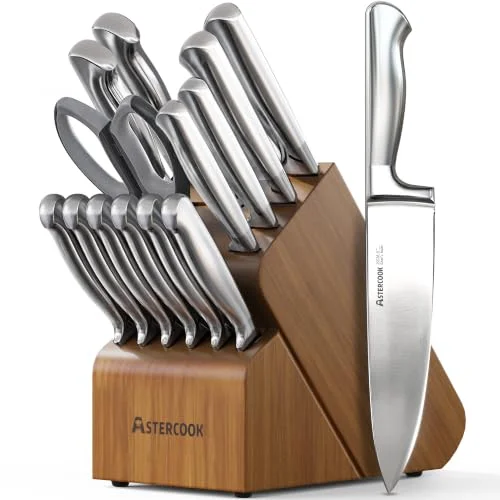
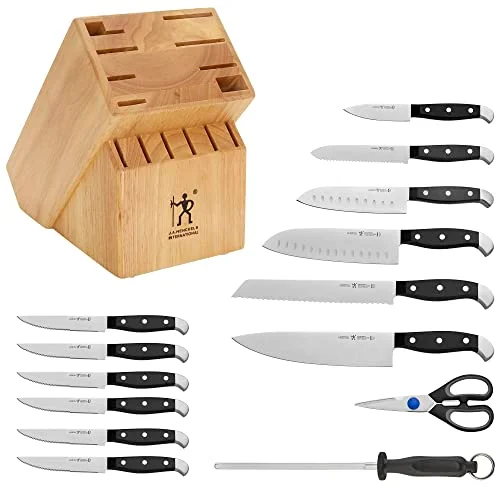
German knife-making grew up around a single job: give a home cook or a professional kitchen one blade family that can do almost everything, every day, without special handling. That is why a German-style block set is built for breadth. The Astercook 15-Piece German Steel set pairs an 8-inch chef knife with an 8-inch bread knife, an 8-inch slicer, a 7-inch santoku, a 5-inch utility knife, a 3.5-inch paring knife, six steak knives and kitchen shears — a one-piece stainless design with an anti-slip handle, all housed in a wooden block with a built-in sharpener, for $59.99. The Henckels Statement 15-Piece Block Set follows the same logic at a higher price point: German engineered, ultra-sharp out of the box, and marketed, bluntly, as “the last knife you’ll ever need to buy,” for $118.73. Both sets are priced and built around what a 15-piece knife set actually contains — a full roster for a household that cooks a wide range of American-style meals.
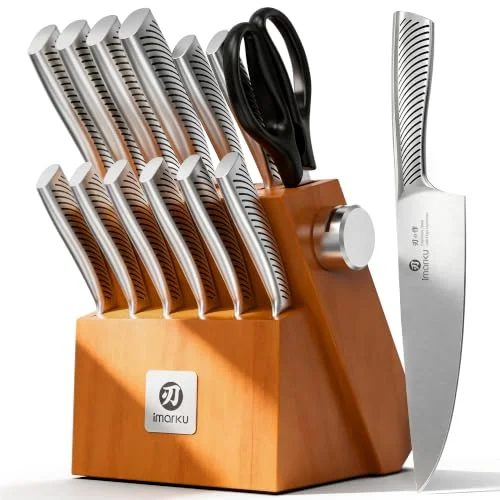
Japanese knife-making optimizes for something narrower and, in its own way, more demanding: the single cleanest cut a blade can make. A gyutou — the Japanese adaptation of the Western chef’s knife — is ground thinner and sharpened to a finer angle, which lets it glide through produce and protein with less resistance, at the cost of being less forgiving of bone, twisting or careless storage. The imarku 14-Piece Japanese Gyutou set reflects that priority directly: an 8-inch gyutou as its centerpiece, hand-sharpened blades, a mirror-polished finish, and a wooden block with its own built-in sharpener, for $129.99. It is one piece lighter than the two German sets and notably does not include steak knives — the tradition it comes from was never built around a steak-knife drawer in the first place, it was built around the chef’s knife doing the real work.
The number that explains everything else
Edge angle: 20 degrees against 15
Edge angle is the angle each side of the blade is ground to, measured from the centerline of the steel out to the cutting edge. A wider angle puts more metal behind the edge, which makes it sturdier and more tolerant of twisting, bone contact and the occasional glancing blow against a cutting board or a plate. A narrower angle removes more metal, which lets the edge bite into food with less force — and leaves less steel to absorb lateral stress, so the edge rolls or chips more easily if it is used carelessly. Neither Astercook nor Henckels publishes a specific edge angle for the sets compared here; what can be said honestly is the general convention their tradition sits in — Western double-bevel knives, built for a wide range of kitchen tasks including bone-in meat and frozen bread, are conventionally ground near 20 degrees per side.
imarku, by contrast, states its angle directly: the gyutou blades are hand-sharpened to a precise 15° angle per side. That five-degree difference sounds small on paper and is not small in the hand. It is the reason a well-kept Japanese-style edge slices a ripe tomato or a sheet of fish with almost no downward pressure, and it is also the reason that edge needs a gentler hand on a cutting board, and the kind of routine upkeep covered in how to keep a knife set sharp for years. A 20-degree edge forgives a bad habit. A 15-degree edge punishes it — and rewards good technique more than any German-style blade in this comparison can.
What a long prep session actually feels like
Weight, balance and the long prep session
The stereotype is that German knives are heavy and Japanese knives are light, and the three sets here complicate that stereotype in a useful way. Henckels specifically markets the Statement set as lightweight and effortless to use, built for minimal-effort cutting rather than for carrying momentum through tough cuts — a German name with a deliberately light hand. Astercook makes a similar case from the construction side: its one-piece stainless design pairs with an ergonomic, anti-slip handle meant to provide balanced control and reduce hand fatigue over a session of chopping, slicing and prepping. Neither German set here is marketed on heft. If raw weight and a thick bolster matter more to you than country of origin, that is a question of stamped versus forged construction within the German tradition, not a question this comparison answers on its own.
imarku approaches balance from a different angle: full-tang construction, where the steel runs the entire length of the handle, which the brand states is what gives the knife its balance and durability through repeated use. A full tang keeps the weight distributed evenly along the grip instead of concentrated at either end, which matters most during a long prep session — dicing a week’s worth of vegetables, breaking down a tray of chicken thighs, working through a big batch of herbs. All three sets here are, by their own listed features, built to be comfortable for exactly that kind of session. What differs is how each gets there: Henckels and Astercook lean on lightness and grip, imarku leans on full-tang balance paired with a thinner blade.
Steel, and what it forgives
Hardness, and what each one forgives
Rockwell hardness measures how resistant a blade’s steel is to deformation, and it sits at the center of the forgiveness question. Harder steel holds a sharp edge longer between sharpenings, but it is also more brittle — it is more likely to chip rather than bend when it meets something it shouldn’t, like a bone, a frozen crust or the bottom of a ceramic bowl. Softer steel dulls sooner, but a dull edge is easy to bring back on a stone or in a built-in sharpener slot, and it rarely chips outright. As a general rule, premium Japanese single-bevel blades are pushed toward the harder end of that scale, sometimes into the low-to-mid 60s on the Rockwell C scale, chasing the longest possible edge life at the cost of some brittleness.
imarku’s own published figure for this specific gyutou set is more moderate than that extreme: 56 ± 2 HRC, reached through repeated forging and low-temperature quenching. That number sits closer to the mid-50s range typical of general-purpose Western blades than to the hardest Japanese single-bevel steels — a deliberate trade, favoring a bit more day-to-day chip resistance over the absolute longest edge life. Neither Astercook nor Henckels publishes a Rockwell figure for the sets compared here, so we won’t assign one; what both brands do state is construction and finish — Astercook’s one-piece stainless build, Henckels’ description of itself as built to last over a long ownership period. A set with a built-in sharpener, like Astercook’s or imarku’s, is itself a tell about forgiveness: see whether a built-in sharpener is worth it for how that feature changes the maintenance math for either tradition.
The actual decision
What you cook, and which tradition suits it
If your week includes a bone-in roast, a frozen loaf of bread pulled straight from the freezer, a holiday turkey, or a table that wants steak knives at every place setting, the German tradition is built for exactly that list. Both the Astercook and Henckels sets ship with the pieces that list implies — bread knives, slicing knives, six steak knives between them — and a wider edge angle that tolerates the occasional rough contact those tasks involve. This is the tradition of the complete, do-everything kitchen set: one block, every knife a typical American kitchen reaches for, built to be used hard and sharpened occasionally rather than babied.
If your week looks more like fine dice on an onion, thin slices of raw fish, julienned vegetables for a stir-fry, or breaking down a chicken into clean, precise pieces rather than hacking through bone, the Japanese tradition is built for that instead. The imarku set drops the steak-knife drawer entirely and puts its money into the one blade that does that precision work — a thinner, narrower-ground gyutou that rewards a careful hand with cuts the German sets in this comparison were not designed to make quite as cleanly. For a deeper look at sets built entirely around that style, see our guide to the best Japanese-style knife sets. Most cooks, honestly, would be well served by either tradition for most of what they make in a week. The honest tell is what happens on the nights you cook the thing you cook least often — the frozen bread, or the raw fish — because that is where the edge angle and the hardness actually show up.
The picks
The picks, by tradition and by budget
01Best German value
Astercook 15-Piece German Steel Block Set
Best for a complete German-style kitchen at the lowest price here
15 pieces·German steel·One-piece stainless·Sharpener built into the block
At $59.99 this is the least expensive set in the comparison and still covers the full German-tradition roster: an 8-inch chef knife, bread knife and slicer, a 7-inch santoku, a utility knife, a paring knife, six steak knives and shears, all in a one-piece stainless build with an anti-slip handle meant to reduce hand fatigue. The wooden block’s built-in sharpener is the same convenience feature the Japanese set below also relies on — here it is paired with German-style breadth rather than a single precision blade.
The set to buy if you want every knife an American kitchen typically reaches for, in one block, without paying for a brand name.
02Best German name
Henckels Statement 15-Piece Block Set
Best for a trusted German name and a lighter blade
15 pieces·German engineered·Ultra-sharp·Lightweight, effortless cutting
Henckels is the name most American cooks already associate with the German tradition, and the Statement set at $118.73 is where that reputation becomes accessible. The brand states ultra-sharp, professional-level sharpness out of the box and markets the set on effortless, lightweight cutting rather than on heft — a German set built for ease of use through a long prep session, backed by a company with over a century behind it.
The set to buy if the German tradition’s breadth appeals to you, but you want the warranty and the name behind the steel.
03Best Japanese edge
imarku 14-Piece Japanese Gyutou Set
Best for a finer, narrower edge and precision prep
15° per side·56±2 Rockwell·Full tang·Sharpener built into the block
The imarku set is the clearest expression of the Japanese tradition in this comparison: an 8-inch gyutou hand-sharpened to a precise 15-degree angle per side, built through repeated forging and low-temperature quenching to a published 56 ± 2 Rockwell hardness, with full-tang construction for balance. At $129.99 it is the most expensive set here, and the price buys a narrower, sharper edge rather than a wider roster of knives — there are no steak knives in the box, because that was never the tradition’s job.
The set to buy if you cook the kind of food that rewards a thinner edge, and you are willing to treat it a little more carefully than a German blade.
Prices change. We refresh them, but Amazon is the authority at the moment you buy. If a block set is more furniture than you need, see the best knife sets without a block in either tradition.
Side by side
The three, compared
| Set | Best for | Tradition | Edge | Pieces | Price | Get it |
|---|
 Astercook 15-Piece |
German value |
German |
Not stated |
15 |
$59.99 |
Get it |
 Henckels Statement |
German name |
German |
Not stated |
15 |
$118.73 |
Get it |
 imarku Gyutou |
Japanese precision |
Japanese |
15° per side, 56±2 HRC |
14 |
$129.99 |
Get it |
Only imarku publishes a specific edge angle and hardness figure. We have not assigned either number to the Astercook or Henckels sets, because neither manufacturer states one.
Our method
How we compared — and what we can’t tell you
What we did
Published specs, prices and listed construction
We compared the published steel, edge angle, hardness figures, construction details and current Amazon prices for these three kitchen knife sets, then checked each manufacturer’s own claims against what the German and Japanese traditions generally optimize for. Where a listing states something checkable — a 15-degree edge angle, a 56 ± 2 Rockwell figure, full-tang construction — we treated that as the spec. Where a listing doesn’t state something, like a specific edge angle for the two German sets, we did not assume one anyway. Every set we track across the network sits in our guide index, updated as prices and listings change.
What we didn’t
We don’t run a testing lab
We do not physically test these knives, we do not own them, and we have no verified review data for these specific products, so we don’t paraphrase owner sentiment or publish star ratings either — inventing sentiment would be the same offense as inventing a score. What we can do honestly is explain what edge angle and hardness actually change about how a knife behaves, and let the published numbers, not a manufactured opinion, explain the difference between these two traditions. See how we handle affiliate links and picks for more on that policy.
FAQ
Common questions
Is a Japanese knife always sharper than a German knife?
Out of the box, a narrower edge angle like imarku’s published 15 degrees per side generally cuts with less resistance than a wider, conventional 20-degree double-bevel edge, which is the angle most German-style knives are ground to. “Sharper” in that sense is mostly a function of the angle and how recently the edge was honed, not a property that belongs to one country over another. A well-maintained German knife and a neglected Japanese one will not behave the way their traditions suggest.
Are Japanese knives always harder than German knives?
Not necessarily. Premium Japanese single-bevel blades are often pushed toward the harder end of the Rockwell scale, sometimes into the low-to-mid 60s, chasing the longest possible edge life. But imarku’s own published figure for the gyutou set compared here is 56 ± 2 HRC — a more moderate hardness that trades some edge life for better day-to-day chip resistance. Neither German set here publishes a Rockwell number at all, so a direct hardness comparison isn’t possible from the published specs alone.
Which tradition is more forgiving of a dishwasher or a frozen loaf of bread?
The German tradition, generally. A wider edge angle puts more steel behind the cutting edge, which tolerates lateral stress, bone contact and the kind of rough handling a crowded kitchen produces better than a narrower edge does. Both the Astercook and Henckels sets in this comparison include the bread knives and steak knives that roster implies. The imarku gyutou set is built for precision cuts on produce and protein, not for routine contact with bone or ice.
I don’t know which tradition fits how I cook — how do I decide?
Think about the meal you cook least carefully, not the one you cook most often. If your week regularly includes a bone-in roast, frozen bread, or a table that wants steak knives, the German tradition’s breadth and wider edge angle will serve you better. If your week leans toward fine dice, thin slices of fish, or precise vegetable prep, the Japanese tradition’s narrower, sharper edge is built for exactly that, provided you’re willing to treat the blade a little more carefully.
Keep reading
Related on Best Knife Sets