The basics
What the Rockwell scale actually measures
Rockwell hardness testing works by pressing a diamond-tipped indenter into a sample of steel under a fixed load, then measuring how deep the indenter sinks. A shallow indentation means the steel resisted the load well, which produces a high number; a deeper indentation means the steel gave way more easily, which produces a lower one. For kitchen knife steel specifically, the figure almost always refers to the Rockwell C scale — written as HRC — which was designed for harder materials and is the scale you will see on the handful of knife listings that bother to publish one. Most kitchen knives, across every price point and country of origin, land somewhere between the low 50s and low 60s on that scale.
It helps to be precise about what the number is not. Rockwell hardness is not a sharpness rating, and a higher HRC does not mean a knife arrives sharper out of the box. Sharpness is a function of edge geometry — how narrow an angle the blade is ground to — and how well that edge was finished at the factory. Hardness is a separate property: it describes how well the steel holds that geometry once you start using it. A soft knife ground to a narrow angle can arrive just as sharp as a hard one; the difference shows up a week later, in how much of that sharpness remains. That distinction matters most when you are weighing two knives with different stated edge angles, which is a large part of what separates German-style and Japanese-style blades — a comparison we cover in full in German vs Japanese Kitchen Knives.
The other reason the number matters is simpler: it is checkable. A listing that says "razor-sharp" or "professional-grade" is making a claim nobody can verify before buying. A listing that states "56 ± 2 HRC" is stating a specific, falsifiable figure that a buyer could, in principle, independently test. Most manufacturers never publish it, which is exactly why the ones that do are worth paying attention to — not because a published number guarantees a better knife, but because a manufacturer willing to commit to a specific figure in writing is behaving differently from one hiding behind an adjective.
The hard end
Harder steel: a longer-lasting edge, and a more brittle one
As Rockwell hardness climbs — into the high 50s and low 60s HRC — the steel becomes more resistant to the microscopic deformation that dulls a blade in everyday use. Every time a knife passes through food, the very edge of the steel is under lateral stress, and on a softer blade that stress gradually rolls the edge out of alignment, which is what dulling actually is at a microscopic level. Harder steel resists that rolling for longer, which is why it can hold a working edge through more prep sessions between sharpenings, and why it tolerates a narrower, more acute edge angle without that edge immediately folding over. This is part of why Japanese-style gyuto knives, which are typically ground to a narrower angle than a German chef's knife, are often paired with harder steel in the first place — the hardness is what makes the narrower angle viable. We go deeper on that pairing in The Best Japanese-Style Knife Sets.
The trade is brittleness. Hardness and toughness pull in opposite directions in steel metallurgy: a harder blade resists bending but has less give before it fails, and when it fails, it tends to fail suddenly rather than gracefully. In practice that means a harder knife is more likely to chip at the edge — a small visible notch rather than a rolled, dull line — when it meets something the softer blade would have simply bent away from: a bone, a frozen block of food, the edge of a ceramic plate, or a twisting motion against resistance rather than a clean push-through cut. A chip is also a different repair than ordinary dulling. Rolling can usually be corrected with a few passes on a honing rod or a fine stone; a chip has to be ground out entirely, which removes more steel and takes longer, a maintenance distinction we cover step by step in How to Keep a Knife Set Sharp for Years.
None of this makes harder steel the wrong choice. For a single cook who handles their own knives carefully, understands not to twist a blade against a jar lid or hack through a chicken thigh bone, and is willing to sharpen on a whetstone rather than a built-in slot, a harder edge rewards that care with longer stretches of genuinely sharp cutting. The question this guide keeps coming back to is who is actually holding the knife.
The soft end
Softer steel: faster dulling, and a much easier recovery
Steel in the low 50s HRC sits at the other end of the same trade. It dulls sooner in ordinary use, because the edge rolls more readily under the same lateral stress that a harder blade would shrug off for longer. If you compared two otherwise identical knives side by side across a week of normal prep, the softer one would need attention first. That is a genuine downside, and it is the reason enthusiast cooks often chase higher HRC figures.
What softer steel gives back is forgiveness, in two separate ways. The first is resistance to catastrophic failure: because the steel has more give before it fails, the same impact that chips a harder blade is more likely to just roll the edge of a softer one — an inconvenience rather than damage that requires grinding. A dropped knife, a twist against a stuck lid, an accidental strike on bone during a Thanksgiving carve, all land softer on more ductile steel. The second is how easy the damage is to undo. A rolled edge responds to a honing rod or a few light passes on a stone in a couple of minutes; it does not require removing much material, because there is nothing to grind out, only metal to straighten back into alignment. That is precisely the kind of touch-up a built-in sharpener slot is designed for, which is why sets that include one — covered in Knife Sets With a Built-In Sharpener: Worth It? — tend to pair well with steel in this range rather than with harder, chip-prone blades a few passes through a crude built-in slot would do little for.
The practical shorthand: softer steel asks for more frequent, smaller maintenance and gives back a wider margin for the kind of handling mistakes that happen in a real kitchen rather than a controlled one.
The sensible range
Why mid-fifties is the sensible place to be for a shared kitchen
Put the two trade-offs next to each other and a specific band falls out as the practical answer for most households: roughly 54 to 58 HRC, which is where both of the Rockwell figures published on this site's own product pages happen to land. That is not a coincidence so much as a reflection of where the category's better-specified sets actually cluster, because it is the range that balances holding an edge through a week of regular use against tolerating the kind of handling a knife gets when more than one person uses it.
"Shared kitchen" is doing real work in that sentence. A dedicated single-owner knife, used by someone who sharpens on a whetstone and handles the blade the same careful way every time, can justify chasing a harder, more specialized edge, because the one variable that causes most damage — inconsistent handling — is controlled for. A set that lives in a household with housemates, a partner who twists the blade against a cutting board instead of rocking it, kids learning to cook, or guests who have never held a chef's knife before, is going to meet more of the handling mistakes that a harder, more brittle edge punishes. Mid-fifties steel is the number that keeps a working edge through normal use while surviving the kind of occasional carelessness no household fully avoids. If that shared-use profile also describes a smaller space where the set itself has to earn its footprint, it is worth reading alongside The Best Knife Sets for a First Apartment, which covers the same forgiving end of the spec sheet from a different angle.
None of this is an argument that a higher number is a mistake. It is an argument for matching the steel to who is actually going to be holding it, and for treating a published figure in the mid-fifties as a feature worth noticing rather than a disappointment next to a flashier 60-plus claim elsewhere on the page.
Reading the listing
Which brands publish it, and what the silence says
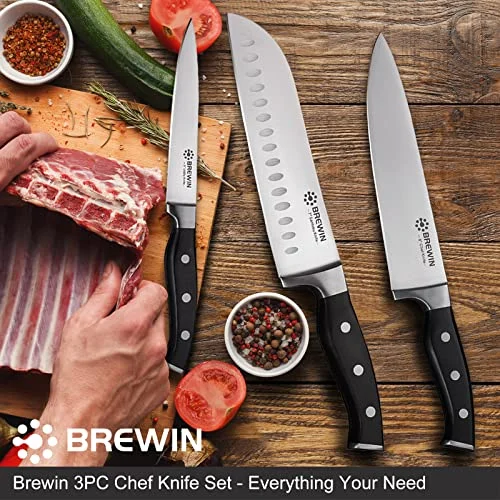
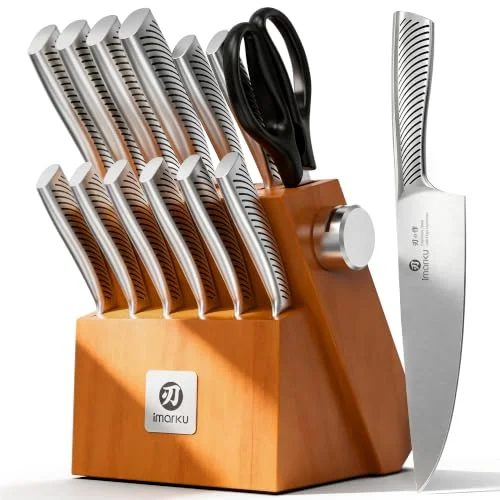
Of the sets we cover on this site, only a minority state a Rockwell figure anywhere in the listing, and the two that do both land exactly in the range the previous section argues for. Brewin states "56+ HRC" on its 3-piece chef knife set, and imarku states "56 ± 2 HRC" on its 14-piece Japanese gyutou set. Both numbers sit in the mid-fifties band, both are specific enough to be meaningfully wrong if they were invented, and both appear in writing on the product listing rather than in a review or a forum post repeating marketing copy.
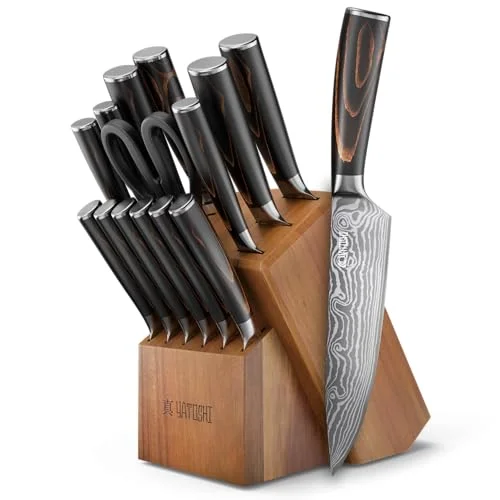
The Yatoshi 15-piece set is the instructive counterexample. Its listing states high-carbon stainless steel construction and an ergonomic handle, and — at $169.99 — it is the most expensive of the three sets discussed here. But nowhere in its published specifications does it state a Rockwell number, and we are not going to invent one to fill that gap. That silence is not proof of bad steel; high-carbon stainless as a category typically falls somewhere in a similar general range industry-wide, which is domain knowledge about the metal, not a claim about this specific knife. What the missing figure does mean is that a buyer cannot verify this particular set's hardness the way they can verify Brewin's or imarku's claim, and has to decide whether piece count — a question worth its own look at What Is Actually in a 15-Piece Knife Set? — and the other stated specs are enough to buy on without that one data point.
The broader pattern holds across the category: a published HRC figure is one of the cheapest, lowest-effort signals a manufacturer can give that it expects to be checked. It costs a brand nothing to add one line of text to a listing if the number is true, and a brand that has tested its steel and is confident in the result generally has no reason to withhold it. Its absence does not condemn a knife, but its presence is one fewer thing you have to take on faith, and in a category where "sharp" and "professional" are used on every listing regardless of merit, a specific number is worth noticing precisely because it is rare.
The picks
Three sets, read through their stated hardness
01Plainest published number
Brewin Professional 3-Piece Chef Knife Set
Best for a simple, stated 56+ HRC and nothing else to second-guess
56+ HRC·High carbon stainless·3 pieces·Gift box, no block
Brewin states "56+" on its listing for this chef, santoku and utility trio, which puts it squarely in the mid-fifties range this guide argues is the sensible default for a shared kitchen. There is no built-in sharpener and no block to maintain the steel's recovery advantage automatically, so the forgiveness this hardness buys you depends on actually honing the edge yourself from time to time. What the number removes is any guesswork about whether the steel leans toward the brittle end or the forgiving end — at 56+, it is stated to lean forgiving.
The set to buy if you want the mid-fifties range confirmed in writing and nothing else cluttering the decision.
02Harder edge, stated spec
imarku 14-Piece Japanese Gyutou (8")
Best for a narrower Japanese edge backed by a specific figure
56 ± 2 HRC·15° per side·14 pieces·Sharpener in the block
imarku publishes both halves of the pairing this guide describes: a stated 56 ± 2 HRC and a narrower 15-degree-per-side edge angle, which is the combination that makes a gyutou-style blade viable in the first place — the hardness is what lets the narrower angle hold rather than immediately rolling over. It still sits at the gentler end of mid-fifties rather than the 60-plus range some dedicated Japanese knives reach for, and the block's built-in sharpener gives that softer-leaning steel an easy way to recover between proper sharpenings.
The set to buy for a sharper, narrower edge without pushing into genuinely brittle territory.
03No stated figure
Yatoshi Professional 15-Piece Knife Set
Best for piece count and ergonomics, if a missing HRC figure doesn't bother you
High carbon stainless·Ergonomic handle·15 pieces·No Rockwell figure published
Yatoshi's listing states high-carbon stainless steel and an ergonomic handle across all 15 pieces, and at $169.99 it is priced above both other sets here. What it does not state, anywhere we could find, is a Rockwell number, so we are not assigning this set a position in the hardness spectrum the way we can for the other two. If where this steel actually falls between forgiving and brittle matters to your decision, check the current listing and product images yourself before buying rather than assuming a figure that isn't published.
The honest read: a strong piece count and stated materials, with one spec sheet gap you'll need to verify on the listing yourself.
Side by side
The three, by what they publish on hardness
| Set | Pieces | Rockwell, as published | Edge angle | Price | Get it |
|---|
 Brewin 3-Piece |
3 |
56+ HRC |
Not stated |
$28.21 |
Get it |
 imarku Gyutou 14-Piece |
14 |
56 ± 2 HRC |
15° per side |
$129.99 |
Get it |
 Yatoshi 15-Piece |
15 |
Not published |
Not stated |
$169.99 |
Get it |
Prices and listed specifications change. We refresh them, but the current Amazon listing is the authority at the moment you buy.
Our method
How we compared — and what we can't tell you
What we did
Published specs, current prices, general metallurgy
We compared the Rockwell figures, edge angles and construction details published directly on each product's Amazon listing against general, well-established facts about how Rockwell hardness testing works and what hardness trades against toughness in steel. Every specific figure attributed to a named product in this article — 56+ for Brewin, 56 ± 2 for imarku — comes from that product's own listing, not from a third-party estimate.
What we didn't
We don't run a testing lab
We do not physically test these knives, we do not own a Rockwell tester, and we do not publish invented hardness figures or scores out of ten for products that don't state one. Where a listing — like Yatoshi's — doesn't publish a Rockwell number, we say so plainly rather than estimating one, because a guessed figure dressed up as a spec is the same error as an invented star rating.
FAQ
Common questions
What is Rockwell hardness, in plain terms?
It is a measurement of how much a sample of steel resists a diamond-tipped indenter pressed into it under a fixed load. A shallower indentation means the steel resisted more, which produces a higher number on the Rockwell C scale (HRC) — the scale used for knife steel. Kitchen knives generally fall somewhere between the low 50s and low 60s HRC. It describes hardness, not sharpness; sharpness comes from edge geometry and how well that edge was finished.
Is harder steel always better for a kitchen knife?
No. Harder steel, generally in the high 50s to low 60s HRC, holds a working edge longer and tolerates a narrower, sharper grind, but it is also more brittle and more likely to chip when it meets a bone, frozen food, or a twisting motion. Softer steel in the low 50s dulls sooner but rolls rather than chips under the same stress, and rolling is far easier to fix with a quick hone. Which is "better" depends entirely on how carefully the knife will be handled.
What Rockwell hardness should I look for in a set for a shared kitchen?
Roughly 54 to 58 HRC — the mid-fifties range — is the sensible target for a set that more than one person will use. It holds an edge through normal weekly use while staying forgiving enough to survive the occasional mishandling that happens when a knife isn't used by just one careful owner. Both Brewin's "56+" and imarku's "56 ± 2" fall in this band.
Why doesn't every knife set publish a Rockwell number?
Because most listings don't volunteer specifications that can be independently checked, leaning instead on adjectives like "razor-sharp" or "professional-grade" that carry no verifiable meaning. Publishing a specific HRC figure costs a manufacturer nothing if the number is accurate, so a listing that states one is signaling confidence in a way a listing that doesn't simply isn't. An unpublished figure doesn't prove a bad knife — it just means that particular data point has to be taken on faith, or checked by other means before buying.
Keep reading
Related on Best Knife Sets