Edge type
Serrated or straight — and why most steak knives are serrated
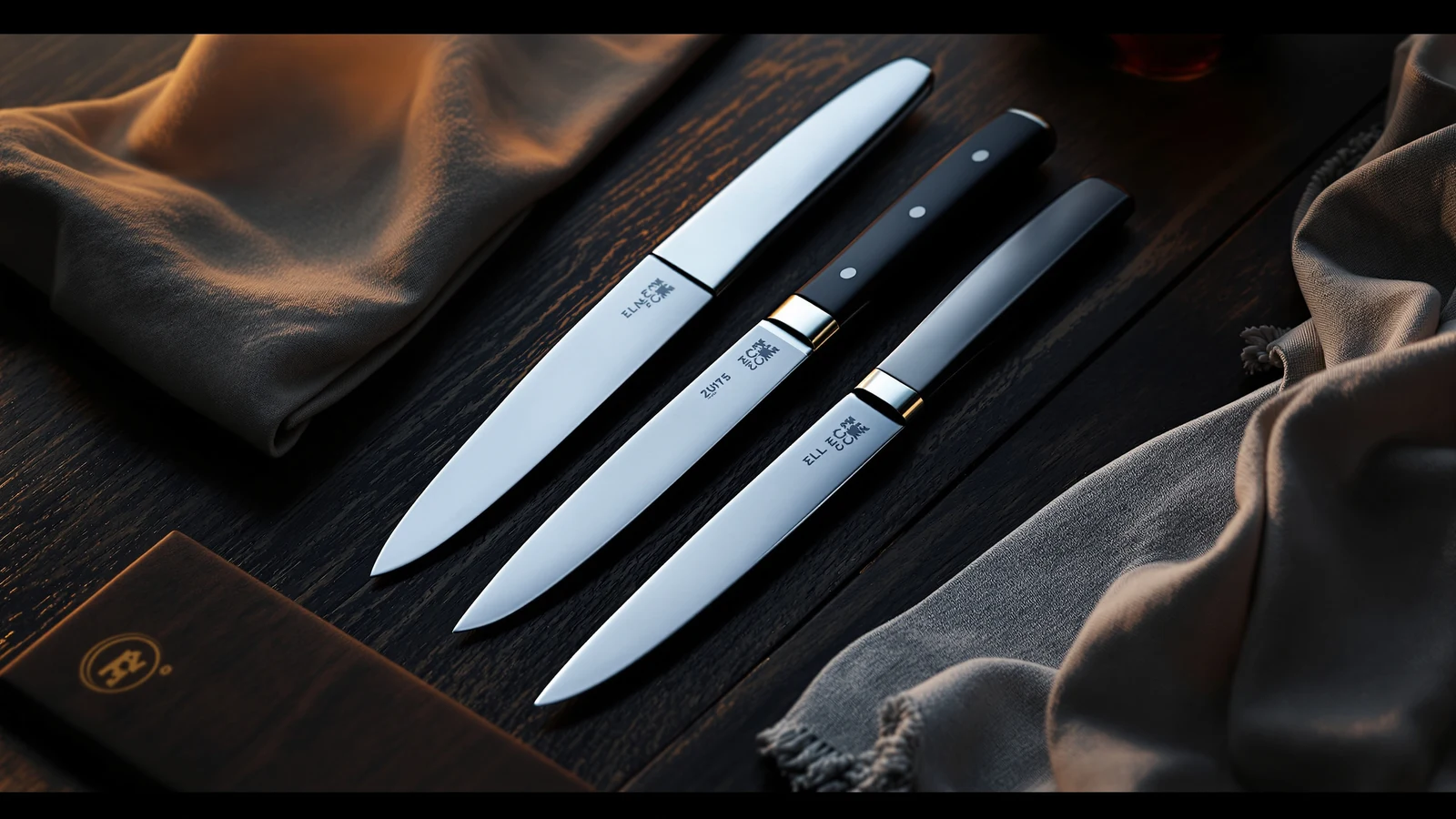
A serrated edge is a row of small teeth, each one acting like a tiny saw blade rather than a single continuous bevel. A straight edge is one unbroken bevel from heel to tip, the kind a chef’s knife carries. Steak knives default to serrated for a reason that has nothing to do with the steak and everything to do with the table: a serrated edge bites into a surface on contact and keeps cutting even when the blade has gone slightly dull, which matters enormously for a knife that is going to meet a porcelain plate several times a meal and get run through a dishwasher for years without ever seeing a sharpening stone. A straight edge dulls the same way a chef’s knife does, gradually and evenly, which sounds like an advantage until you remember that almost nobody sharpens their steak knives on purpose.
The trade is honest: a serrated edge cuts through a crusted sear or a cold refrigerated steak with less effort for longer, at the cost of a rougher cut surface and a tendency to tear rather than slice cleanly through something delicate. A straight edge gives a cleaner cut on a well-prepared, properly rested steak, but only for as long as it stays sharp, and in a block set that is rarely very long. That is why the serrated edge is the default across almost the entire category, including the steak knives bundled into the Farberware 15-Piece set and the Cuisinart 15-Piece Hollow Handle set in this guide — it is the edge that survives neglect, and most steak knives are neglected.
What’s in the block
What a block’s free steak knives usually are
Open the listing for almost any 14- or 15-piece knife block and the steak knives are the line item with the least detail attached. The Farberware 15-Piece set states its build plainly: high-carbon stainless steel blades with ergonomic stainless steel handles, and the six steak knives in the box share that same construction and the same stamped manufacturing process as the rest of the set. The Cuisinart 15-Piece Hollow Handle set, C77SS-15PK, states forged, triple-riveted construction with hollow handles across its line, and its six steak knives are built to the same specification as the chef’s and utility knives beside them in the block.
What both listings describe, without using the word, is a knife built to match the set’s aesthetic and price point rather than to be the best possible tool for cutting meat. That is not a criticism unique to these two sets — it is how the entire category is built. A steak knife is the fourteenth or fifteenth piece in a box sold on its chef’s knife and its block, and the manufacturing budget follows that order. The honest way to read any block listing is to treat the steak knives as a bonus that happens to work, not as the reason to buy the set.
When to upgrade
When the free ones genuinely matter — and when they don’t
For most dinners, the free steak knives in a block are enough, and replacing them is a solution to a problem you don’t have. Weeknight chicken, pasta, a sandwich at the table — a serrated edge that bites on contact does that job without complaint for years, dishwasher and all. The case for buying steak knives on their own, as a dedicated purchase rather than a block afterthought, comes down to three situations. The first is simply needing more place settings than your block provided: a set built for six comes with six steak knives, and a dinner party for eight means two guests are reaching for whatever is left in the drawer. The second is wanting a knife that matches the quality of the rest of your cutlery, rather than the lightest-built piece in the box, for the two or three nights a year you actually cook a good cut of meat. The third is wanting a straight edge specifically, which almost no block set offers, because a straight edge gives a cleaner cut on a well-rested, properly cooked steak and most people who care about that detail already know it.
Outside those three situations, upgrading is optional rather than necessary. A set like the Farberware 15-Piece or the Cuisinart 15-Piece Hollow Handle already includes six serrated steak knives built to the same standard as the rest of the block, and for a kitchen that eats steak occasionally rather than as a ritual, that is a complete answer. The honest signal that it’s time to buy separately is wanting a different count, a different edge, or simply a knife that feels like it was designed for the table rather than included because the box needed a fifteenth piece.
At the table
Table presence, weight and the handle
A steak knife is the one knife in the house that a guest holds and judges you by, which makes weight and handle material a bigger factor here than almost anywhere else in a kitchen drawer. The Farberware set uses stainless steel handles throughout, which reads clean and modern and matches a stainless block, but stainless handles can feel slick when wet or lightweight in the hand compared with a wood or polymer grip — a fair trade for a lower price and a matched, all-metal look across the set. The Cuisinart C77SS-15PK uses a hollow handle design, which Cuisinart states across its hollow-handle line as part of a lighter-weight, balanced grip intended to reduce hand fatigue during extended use; a hollow handle also tends to feel less substantial at the table than a solid one, which is a reasonable trade-off for everyday comfort rather than a flaw.
Neither listing publishes a knife-by-knife weight figure for the steak knives specifically, so we won’t assert one — what we can say is that the broader design language each manufacturer describes for its line carries through to the smaller pieces in the block. If table presence specifically matters to you — a dinner-party knife that feels substantial in a guest’s hand rather than light and stamped — check the specific handle material and weight on the listing for the individual steak knife, since a set’s general description doesn’t always break out that detail piece by piece.
The picks
Where to find decent steak knives without buying them separately
01Most complete box
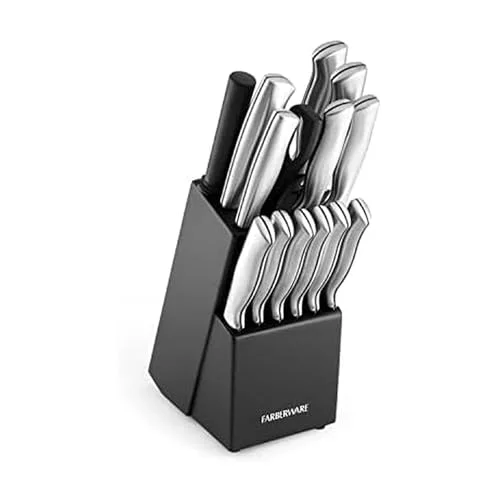
Farberware 15-Piece Kitchen Knife Set
Best for a complete kitchen that happens to include steak knives
15 pieces·High-carbon stainless·Sharpening tool & shears included·Wood block
Farberware’s 15-piece set states high-carbon stainless steel blades with a wood block, a built-in sharpening tool and all-purpose shears alongside its six steak knives, all with ergonomic stainless steel handles. The steak knives here are not a separate purchase to think about — they arrive already matched to the rest of the set, at a price that makes the whole box, sharpener and shears included, cost less than many standalone steak knife sets alone.
The set to buy if you want a complete kitchen, steak knives included, and don’t want to think about the knife drawer again.
02Smallest footprint
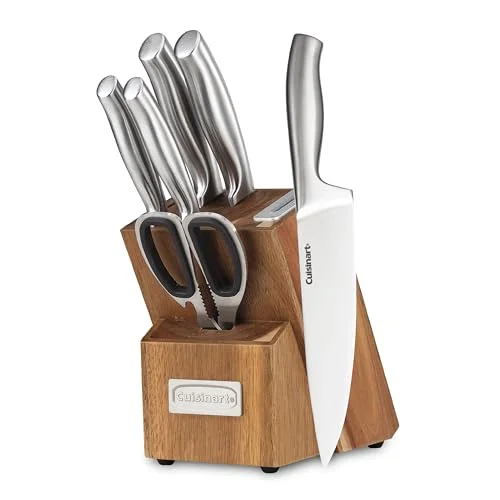
Cuisinart 7 Pc Stainless Steel Essentials Set
Best for a smaller block with a built-in sharpener
7 pieces·Stainless steel·Built-in sharpener·Compact block
Cuisinart’s 7-piece Essentials set states stainless steel construction with a built-in sharpener in the block, in a count small enough to suit a kitchen that doesn’t want fifteen pieces of anything. It is the pick for a smaller household or a second kitchen where the question isn’t how many steak knives come free, but whether the block takes up less counter space while still including a sharpening function the larger sets handle separately or not at all.
The set to buy if you want fewer pieces and a sharpener built into the block, not a bigger box.
03Forged, hollow handle
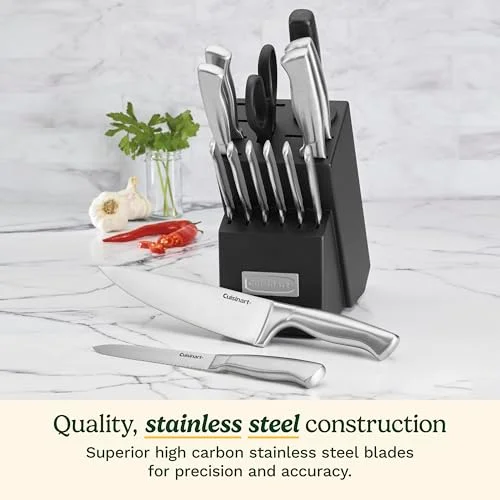
Cuisinart 15-Piece Hollow Handle Block Set
Best for forged steel and a lighter hollow-handle grip
15 pieces·Forged stainless steel·Hollow handles·Block included
The C77SS-15PK states forged stainless steel construction with hollow handles across the full 15-piece line, steak knives included, which puts a heavier, forged blade behind what is normally the lightest, least-considered piece in a block. The hollow handle design trades a little heft for a lighter, more balanced grip during extended use, which Cuisinart describes across its hollow-handle range rather than as a feature unique to the steak knives alone.
The set to buy if you want the steak knives built to the same forged standard as the chef’s knife beside them.
Side by side
The three, compared
| Set | Best for | Pieces | Construction | Price | Get it |
|---|
 Farberware 15-Piece |
Complete kitchen, steak knives included |
15 |
High-carbon stainless, stamped |
$35.18 |
Get it |
 Cuisinart 7 Pc Essentials |
Small block, built-in sharpener |
7 |
Stainless steel |
$59.95 |
Get it |
 Cuisinart C77SS-15PK |
Forged steel throughout, including steak knives |
15 |
Forged stainless, hollow handle |
$59.99 |
Get it |
Prices change. We refresh them, but Amazon is the authority at the moment you buy. See the full six-set roundup for sets built around the chef’s knife rather than the steak knives.
Care
Why a serrated steak knife cannot be sharpened the normal way
A straight edge is one continuous bevel, so running it across a whetstone or through a pull-through sharpener reshapes that whole bevel evenly, restoring the edge in one motion. A serrated edge is a row of individual scalloped teeth, each with its own small bevel ground on one side only, and a flat stone or a standard pull-through sharpener simply cannot reach into each scallop — it will grind the flat spine between the teeth and leave the actual cutting points untouched, or round them over and make the knife worse. Properly restoring a serrated edge requires a tapered rod or a specialized serrated sharpener worked into each individual scallop by hand, one tooth at a time, which is slow, fiddly, and not a skill most kitchens have reason to build for a knife that costs eight to fifteen dollars to replace.
That mismatch between the knife’s price and the effort required to maintain it is exactly why manufacturers build steak knives to be serrated and disposable rather than straight-edged and maintained. The practical guidance follows from the mechanics: don’t expect a standard knife sharpener to fix a dull steak knife, don’t force one through a pull-through sharpener built for straight edges, and when a serrated steak knife finally goes dull after years of dishwasher cycles, replacing the set is almost always more practical than sharpening it — which is also, not coincidentally, the outcome the category is built around.
Our method
How we picked — and what we can’t tell you
What we did
Specs, prices and published listings
We compared published specifications and current Amazon prices for knife block sets sold in the US that include steak knives, then narrowed the list to sets whose listings explicitly state something checkable — blade construction, handle material, piece count, or a built-in sharpener — rather than relying on adjectives like “razor-sharp” that no listing can substantiate on its own.
What we didn’t
We don’t run a testing lab
We do not physically test these knives, we do not own them, and we do not publish invented scores or star ratings. We have no verified review data for these specific products, so we don’t paraphrase owner sentiment either. What we can do honestly is read every published specification, compare them against each other, and tell you plainly which claims are checkable and which are marketing.
FAQ
Common questions
Why are almost all steak knives serrated?
A serrated edge is a row of small teeth that bite into a surface on contact and keep cutting even after the blade has dulled slightly, which suits a knife that meets a porcelain plate every meal and rarely sees a sharpening stone. A straight edge gives a cleaner cut but dulls the way a chef’s knife does, gradually and evenly — and almost nobody sharpens their steak knives on purpose. Serrated survives neglect better, which is why it is the category default, including in both the Farberware and Cuisinart sets in this guide.
Are the free steak knives in a block set actually any good?
For most dinners, yes. The Farberware 15-Piece set and the Cuisinart C77SS-15PK both build their six steak knives to the same construction standard as the rest of the block — high-carbon stainless and forged stainless respectively — rather than as a cut-rate afterthought. They become a real limitation only if you need more place settings than the set provides, want a straight edge specifically, or want a knife that matches a higher-end cutlery collection for the handful of nights a year you cook a serious cut of meat.
Can I sharpen a serrated steak knife at home?
Not with a standard stone or pull-through sharpener, which is built for a single continuous bevel and can’t reach into individual serrations without rounding them over or grinding the flat spine between the teeth instead of the actual edge. Properly restoring a serrated edge needs a tapered rod or a specialized serrated sharpener worked into each scallop by hand. Given how inexpensive most steak knives are, replacing a dull set is usually more practical than learning to sharpen one.
When should I buy steak knives separately instead of relying on the block?
Three situations stand out: needing more place settings than your block provides for larger dinners, wanting a straight edge rather than the serrated default, or wanting a knife that matches the quality of the rest of your cutlery for the occasions you cook a higher-end steak. Outside those cases, a block set like the Farberware 15-Piece or the Cuisinart C77SS-15PK already includes steak knives built to the same standard as the rest of the set.
Keep reading
Related on Best Knife Sets