First, the honest question
What makes a knife set a good gift, and not an obligation
Most gifts fail quietly. Nobody says anything, the thing goes in a drawer, and six months later it gets donated. A knife set fails loudly, because it sits on the counter being either used daily or resented every time it's in the way. That makes it a higher-stakes gift than it looks, and also a better one when it lands: unlike a gadget bought for a hobby the recipient may or may not keep up, a knife set serves a need that exists in every kitchen, every day, whether or not the person ever thinks about knives on their own.
The obligation version of this gift looks like a fifteen-piece block bought because it was the biggest box at the best discount. The gift version looks like something the recipient will actually reach for: a focused set if they already cook and already own clutter, a complete block if they are starting from nothing. Before buying anything, it's worth reading how many kitchen knives a person actually uses in a normal week, because that number — almost always three: a chef's knife, a paring knife, something serrated for bread — is a better guide to a good gift than any piece count printed on the box. A twenty-piece set is not twenty times more thoughtful than a three-piece one. It is just bigger.
The other test is durability of the gesture, not just the steel. A set that needs babying — hand wash only, never the dishwasher, sharpen it yourself on a stone you also have to buy — asks something of the recipient every time they use it. That is not disqualifying, but it is worth knowing before you give it, because a gift that quietly demands upkeep can start to feel like a chore with a bow on it. How to keep a set sharp for years is worth a few minutes before you buy, if only so you can mention the one or two things that matter — hand wash, dry it, store it in the block — when you hand it over. That single sentence turns a gift into a bit of guidance, which is usually what makes it land.
Presentation
The packaging question
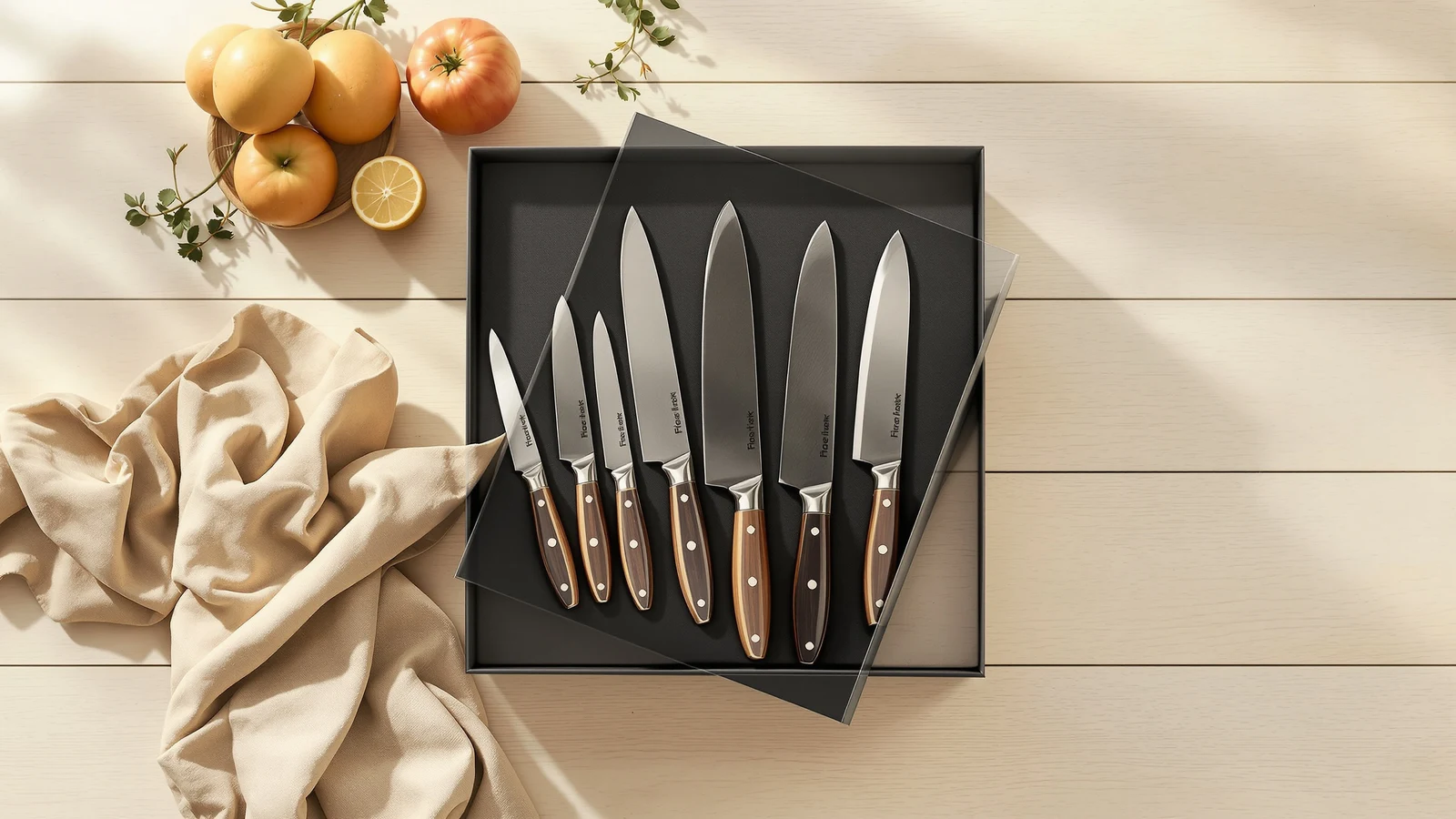
A knife set bought for your own kitchen can arrive in whatever cardboard the manufacturer uses. A knife set bought as a gift has to survive being unwrapped in front of someone, which changes what you should be shopping for. The three sets below solve this differently, and the difference is worth knowing before you buy. The Brewin 3-Piece set ships specifically with a gift box — its listing title says so outright, which means you are not improvising wrapping paper around a plain mailer bag the night before a birthday. The Martha Stewart Eastwalk 14-Piece set and the Henckels Statement 15-piece set both arrive in their own block, which is itself a piece of furniture rather than packaging: unwrap it once, and the unwrapping is also the setup. There's nothing to assemble and nothing extra to find room for afterward.
That matters more for a gift than it does for a routine purchase, because the unboxing is part of the moment. A set that turns up in an unmarked cardboard shipper, however good the knives inside are, reads as "I ordered a thing on the internet" rather than "I thought about what to give you." A set in its own gift box or finished wood block reads as the latter even before anyone touches a blade. If you're buying from Amazon close to the date you need it, it's also worth checking the listing for gift-wrap and gift-receipt options at checkout, and whether the seller ships in the manufacturer's branded packaging or in a plain outer box that hides it — the product photos and the "What's in the box" section usually show which you'll get.
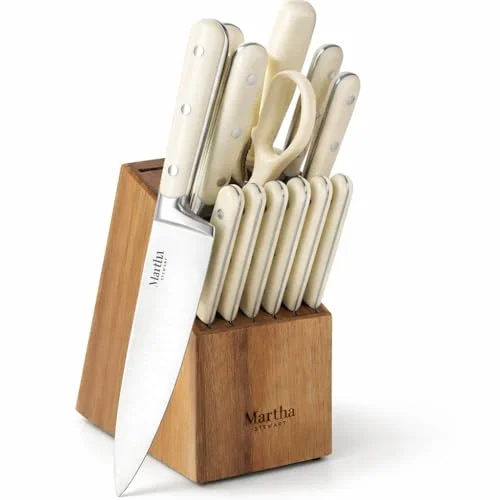
One more detail on packaging that doubles as a buying decision: a block set that arrives built and finished, like the acacia wood block behind the Martha Stewart Eastwalk set, is also the lower-effort option for the giver. There's no separate purchase of a knife block, no researching whether a blockless set fits their counter, no guessing about storage. The block comes with the gift, which means the gift arrives complete.
The hardest part
Buying for someone whose kitchen you haven't seen
The genuinely difficult version of this gift is for someone whose kitchen you've never stood in — a long-distance relative, a new partner's parents, a coworker in a gift exchange. You don't know if their counter has three feet of open space or six inches between the stove and the sink. You don't know if they already own a block they like, or a drawer full of mismatched knives they're quietly embarrassed by. You don't know if they're left-handed, though in fairness almost nothing about a straight kitchen knife actually depends on that the way, say, a pair of shears does.
The safest move in this situation is to buy toward the gap rather than toward abundance. If you know almost nothing about their kitchen except that it exists, a smaller, focused set like the first-apartment style of knife set is lower-risk than a large block: it asks less of their counter space, it duplicates less of what they might already own, and it's a smaller financial swing if it turns out to be the wrong call. A fifteen-piece block is a bigger, more generous-looking gift, but it is also a bigger gift to get wrong — six steak knives nobody asked for, a slot sized wrong for a block they already have, a footprint that doesn't fit a galley kitchen.
If you do know one thing about their kitchen — that they just moved, that they mentioned their knives are dull, that they cook often and ambitiously — let that one fact do the deciding instead of guessing at the rest. Someone just starting a kitchen from scratch is well served by a complete block, because it solves several problems in one purchase. Someone who already cooks seriously and complained about dull blades is usually better served by something more specific, even a single excellent knife, than by another full set duplicating knives they already own. When you truly have no information at all, a gift receipt or a note that says "exchange this for whatever actually fits your kitchen" is not a failure of thoughtfulness. It's an acknowledgment that you're guessing, said out loud instead of hidden.
A tradition worth knowing
The superstition about giving knives — and the coin
There's a widely held superstition, with versions across several cultures, that giving someone a knife as a gift is bad luck: the blade is said to symbolically "cut" the relationship between giver and recipient, whether that's a friendship, a marriage, or simply goodwill. Nobody claims this is literal, and plenty of people give and receive knife sets without a second thought. But it's common enough that some recipients will mention it, half-joking, the moment they open the box — and it's worth knowing the folk remedy before that happens rather than looking it up on your phone in front of them.
The traditional fix is a coin. The custom holds that if the recipient gives the giver a small coin in exchange for the knife — even a single cent, even symbolically handed back and forth — the gift becomes a purchase rather than a gift, and the superstition doesn't apply, because you can't "cut" a relationship with something you paid for. Some people tape a coin to the box. Some tuck one inside the gift box itself. Some just let the recipient hand them a penny back and call it settled. It costs nothing, takes ten seconds, and for a superstition this widespread, it is a genuinely easy piece of etiquette to have ready.
You don't have to believe any of it for it to be useful. The practical value of knowing the coin tradition is the same as knowing someone's food allergies before you cook for them: it removes a small, easily avoidable awkwardness from a moment that should just be a nice surprise. Tucking a coin into the box of the Brewin set, which already ships in its own gift box, takes exactly as long as finding a coin in your pocket.
The picks, by budget
Three sets worth giving, and who each one is for
01Under $60 · focused
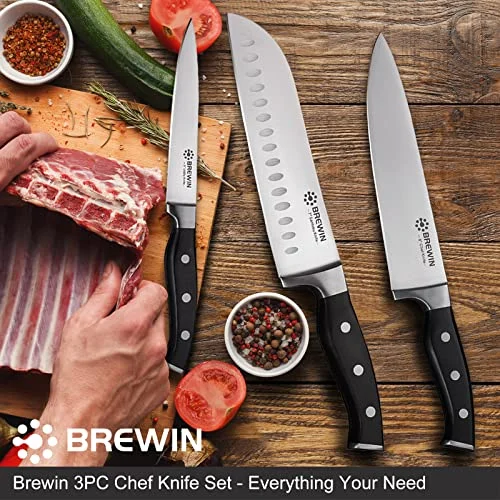
Brewin Professional 3-Piece Chef Knife Set
Best for someone who already has clutter, not a gap
3 pieces·High carbon stainless steel·Japanese-style cooking knife·Ships with a gift box
The listing describes this as a 3-piece chef knife set in high carbon stainless steel, styled as a Japanese cooking knife, and — unusually for this category — it says plainly that it ships with a gift box. That one detail does a lot of work for a present: you're not wrapping a plain mailer the night before, and you're not asking the recipient to find room for a block they didn't ask for. Three knives is also, per the research on how many knives people actually use, close to what most home cooks reach for anyway, which makes this a gift sized to real use rather than to shelf space in a store.
The set to give someone who already cooks and already owns a drawer full of things — it adds exactly what gets used, in a box built to be given.
02Under $60 · complete
MARTHA STEWART Eastwalk 14-Piece Knife Block Set
Best for a kitchen you know is starting from nothing
14 pieces·High carbon stainless steel·Triple-riveted handle·Acacia wood block, Linen White
This is the Knife Block Set variant of Martha Stewart's Eastwalk line: 14 pieces of high carbon stainless steel cutlery with a triple-riveted ABS handle, housed in an acacia wood block finished in linen white. Because it arrives already built into its own block, there's nothing to assemble and nowhere else the knives need to live — the gift is complete the moment it's unwrapped. At a higher price than the Brewin set, it's the version to choose when you know the recipient needs a starting kitchen rather than an addition to one; see what's typically inside a block this size before assuming every piece is a knife you'll reach for weekly.
The set to give a first apartment, a new house, or anyone who mentioned they don't really have proper knives yet.
03$118.73 · the occasion gift
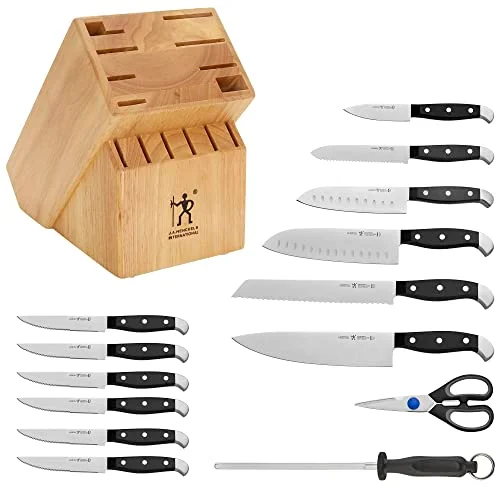
Henckels Statement 15 pc Knife Block Set
Best for a wedding, housewarming or milestone gift
15 pieces·German engineered·Block included
HENCKELS is a German cutlery name with a long history, and the Statement line is its listing marketed as "razor-sharp" and "German engineered" — language worth noting as the manufacturer's own description rather than a figure we can independently verify, in keeping with how we handle every claim on this page. What's checkable is the piece count and the block: fifteen pieces, housed and ready, at a price that reads as a real, considered gift rather than a token one. For a wedding registry gap, a housewarming, or a retirement from a decade of bad knives, the step up from the two sets above buys a recognizable name and a bigger box under the tree.
The set to give when the occasion calls for spending more than you would on yourself — a milestone, not a stocking stuffer.
Side by side
The three, compared
| Set | Best for | Pieces | Packaging | Price | Get it |
|---|
 Brewin 3-Piece |
A focused gift, someone who cooks |
3 |
Ships with a gift box |
$28.21 |
Get it |
 Martha Stewart Eastwalk 14-Piece |
A complete, starting-from-nothing kitchen |
14 |
Acacia wood block, Linen White |
$59.99 |
Get it |
 Henckels Statement 15-pc |
A milestone or occasion gift |
15 |
German-engineered block set |
$118.73 |
Get it |
Prices change. We refresh them, but Amazon is the authority at the moment you buy.
If you're still not sure
The safer alternative, if you're unsure
Not every gift needs to be a bet. If you genuinely don't know whether the person wants German-style weight or a lighter Japanese-style edge, whether they'd rather have a block on the counter or nothing at all, or whether they already own more knives than they need, the lower-risk move is to step down in commitment rather than up in piece count. A gift card specifically earmarked for knives, handed over with a note explaining why, keeps the thoughtfulness of the gesture without the risk of guessing wrong on steel, size or style. It's a less dramatic unwrapping than a block set, but it removes the two most common ways this particular gift goes wrong: duplicating something they already own, and buying more set than their kitchen has room for.
A near-equivalent middle ground is buying something adjacent to a knife set rather than the set itself — a cutting board, a honing rod, or a sharpener for knives they already have. These solve a real problem (a dull edge, nowhere to put a wet blade down) without requiring you to know anything about their kitchen's layout or their brand preferences, and they pair well with a gift receipt if you do decide to take the leap on an actual set. If you do go with gift cards or a receipt, say so plainly rather than apologizing for it. "I wasn't sure what would fit your kitchen, so you can pick" reads as consideration, not as an excuse for not trying.
If you want to take the leap anyway, the Brewin 3-piece set is the lowest-risk of the three sets above precisely because it's small: three knives duplicate less of what someone already owns than fourteen or fifteen pieces do, and it already ships in a box built for giving. When in doubt, smaller and more specific beats larger and more generic, both for the gift and for the gift receipt should it come to that.
Our method
How we picked — and what we can't tell you
What we did
Specs, prices and listing details
We compared published specifications, current Amazon prices and listing details — including how each set is packaged and whether a gift box or block is explicitly mentioned — for knife sets commonly bought as presents, then kept the three where the listing states something checkable about both the knives and the presentation, rather than relying on adjectives like "razor-sharp" that no listing can substantiate on its own.
What we didn't
We don't run a testing lab
We do not physically test these knives, we do not own them, and we do not publish invented scores or star ratings. We have no verified review data for these specific products, so we don't paraphrase owner sentiment either. What we can do honestly is read every published specification, compare them against each other, and tell you plainly which claims are checkable and which are marketing — the same standard we apply to every guide on this site.
FAQ
Common questions
Is it really bad luck to give someone a knife?
It's a widely held superstition, not a universal rule — the idea is that a blade symbolically "cuts" the relationship between giver and recipient. Plenty of people give and receive knife sets with no concern at all. The traditional remedy, if the recipient brings it up, is for them to hand you a small coin in exchange for the knife, which the custom treats as turning the gift into a purchase and voiding the superstition. It costs nothing and takes a few seconds.
What if I don't know what kind of kitchen the recipient has?
Buy toward the gap, not toward abundance. A smaller, focused set is lower-risk than a large block when you know little about their counter space or what they already own, because it asks less of their kitchen and duplicates less of their existing drawer. If you know nothing at all, a gift receipt or a note inviting them to exchange it is an honest, low-risk option rather than a weak one.
Should I buy a knife block or a smaller, focused set as a gift?
It depends on what you know about the recipient. A complete block, like the Martha Stewart Eastwalk 14-piece set, is the better gift for someone starting a kitchen from nothing, because it arrives as a finished, ready-to-use setup. A smaller set, like the Brewin 3-piece, suits someone who already cooks and already owns kitchen clutter — it adds exactly the knives most people actually use without duplicating what they have or crowding their counter.
What's the safest gift if I'm genuinely unsure what they'd like?
Step down in commitment rather than up in piece count. A gift card earmarked for knives, or an adjacent item like a cutting board or a sharpener for knives they already own, solves a real need without requiring you to guess at steel type, block size or style. Say plainly that you wanted them to be able to choose — that reads as thoughtful, not as an excuse.
Keep reading
Related on Best Knife Sets