Where it comes from
The color system was built for commercial kitchens, not yours
The six-color scheme most people half-remember — red for raw meat, yellow for raw poultry, green for produce, blue for seafood, brown for cooked proteins, white for dairy and bakery — was not designed as a consumer product feature. It grew out of commercial foodservice sanitation guidance, the kind written for kitchens that process hundreds of covers a night with a rotating staff who may not all speak the same language and may not all have worked a line before. Culinary schools teach it, chain restaurants mandate it, hospital kitchens are often required to document it, and health department inspectors check for it during a walkthrough. The colors are the visible layer of a system that also includes written protocol, scheduled retraining, and someone whose job includes confirming the system is being followed.
That context matters because it explains why the colors work there and why the mechanism does not automatically transfer to a home kitchen. In a commercial line, the color is a fast visual shortcut for people who are moving quickly, handling unfamiliar ingredients, and working stations they did not necessarily choose for themselves. The color removes a decision — "which knife touched the chicken" — at the exact moment a cook has no time to think about it. It is a workflow tool first, and a food-safety tool second, inseparable from the staffing and inspection that keep it honest.
A home kitchen has none of that structure, and it does not need it in the same way. Most households have one or two people cooking, both of whom know perfectly well which knife just touched the raw chicken, because they are the one holding it. What a consumer color-coded set imports is the visible half of the system — the handles, sometimes a small color key on the packaging — without the training manual, the rotating staff problem it was solving, or the inspector who would flag a red-handled knife left on a cutting board next to lettuce.
The honest split
What color-coding actually prevents — and what it can't touch
Strip away the marketing and the color system does one genuine thing well: it reduces the chance that the same blade gets used on raw protein and then, without a wash in between, on something eaten raw. That failure mode is real and common — slicing a chicken breast, then grabbing the same knife a minute later to quarter a tomato for the same plate, because it was the knife already in hand. A dedicated color for "raw meat" and a different one for "produce" gives a household a visual cue to stop and wash, the same cue it gives a line cook. If a family of color-coded knives actually gets used that way — one color consistently reserved for raw protein, washed before it touches anything else — that habit on its own lowers the odds of this specific mistake. That is a real, modest benefit, and it is the honest case for buying one of these sets.
What the colors cannot do is anything that depends on more than the blade. Bacteria on a knife do not care what color the handle is; a yellow-coded knife used correctly on raw chicken and then washed is safe, and a yellow-coded knife used on raw chicken and then wiped on a towel instead of washed is not safer than an all-black knife treated the same way. The color sorts the tool. It does not sanitize it, and it does not substitute for the wash between uses that remains the actual control. It also only governs the one item it is printed or molded onto: the knife. Everything else that touches raw protein during the same prep — the cutting board, the counter, the sponge, the cook's own hands, the faucet handle turned on with a still-contaminated grip — sits entirely outside the system a colored knife handle represents. A household that buys a 12-piece color-coded set and changes nothing else about how it washes hands or wipes counters has added a sorting cue, not a barrier.
There is also a quieter limitation worth naming: color coding assumes the cook still remembers, months after the set stops being novel, which color is assigned to which category. The honest comparison is not "color-coded knives versus no system," it is "color-coded knives versus the same vigilance you'd need anyway" — washing a knife between raw protein and anything else, regardless of handle color.
What's missing
Six colors, one cutting board: the missing half of the system
The commercial version of this system is not six colors of knife. It is six colors of knife paired with six matching colors of cutting board, usually hung on a labeled rack, with the expectation that the red knife only ever meets the red board. The board, not the blade, is where most of the actual contamination risk concentrates: a cutting board absorbs juices into its surface and knife-scoring over repeated use, and that surface stays in contact with food far longer per prep session than the blade itself does. A health inspector checking color discipline in a commercial kitchen is checking the boards as much as the knives, because a kitchen that color-codes its knives but still cuts everything on one board has solved roughly half the problem it set out to solve.
This is the detail a 10- to 12-piece color-coded knife set, bought on its own, cannot fix. None of the three sets in this guide ship with cutting boards — they are knife sets, full stop, and buying one does not give a household the second half of the commercial system. If a family cuts raw chicken with the yellow-handled knife and then slices a cucumber with the green-handled knife on the exact same wooden or plastic board that just had chicken juice on it, the color discipline on the knives themselves did essentially nothing, because the board carried the risk across to the next food regardless of which knife touched it second. The handle told the cook which tool was "for" which food category; it never touched the board, the counter underneath it, or the hands that moved both.
None of this is a reason to skip a color-coded knife set if the rest of the appeal still applies — a household already organized by color, with separate boards in place or purchased alongside, gets the complete version of the system these knives are modeled on. It is a reason to be precise about what a knife-only purchase buys: the smaller half of a two-part system, with the boards that complete it sold separately.
What lasts, what doesn't
Fading labels and blade guards that outlast the color
Not every "color-coded" set communicates its system the same durable way. Some mold the color all the way through the plastic handle, so the color is the material itself and does not wear off with use. Others rely more on a printed label or icon near the bolster, and printed finishes are the first thing repeated dishwasher cycles go after — detergent and sustained heat fade printed ink well before a molded-through handle color becomes hard to tell apart. A household leaning on printed text rather than handle color may find, a year in, that the part doing the most communicating has worn away while the knife is otherwise fine. That is a detail worth checking in a listing's photos before buying, and it is exactly the kind of claim covered in our look at what the "dishwasher safe" label actually means on a knife set — dishwasher-safe and dishwasher-friendly to its printed color key are two different promises.
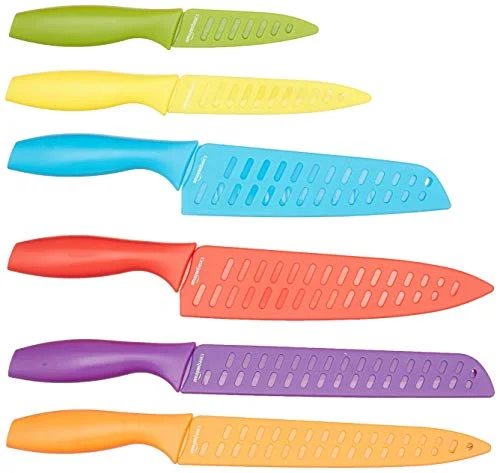
Blade guards are a related but separate detail, and one of the three sets here states them explicitly: the Amazon Basics 12-piece set lists six blade guards for its six knives. A blade guard outlasts the color system in a different sense — it protects the edge and whoever reaches into the drawer whether or not the household keeps using the color assignments at all. That is a genuine, checkable safety feature independent of the cross-contamination question this guide is about, and it is worth weighing on its own terms: a drawer of loose, unguarded colored knives is not safer to reach into than a drawer of loose uncolored ones, but a drawer of guarded colored knives is safer than either.
One thing we will not do is guess at handle construction we have not been told. None of the three listings referenced in this guide state full-tang construction, and we are not going to assume one way or the other on a detail the product data doesn't give us. If how the blade's steel is seated in the handle matters to your decision — and for a knife that will see years of dishwasher cycles, it reasonably might — read what "full tang" actually means on a knife set and check the specific listing's photos and bullet points before buying, rather than inferring construction from the color story alone.
The honest audience
Who this genuinely helps
Color-coded sets earn their keep fastest in households where more than one person cooks and prep happens out of sequence — one person starts the chicken, gets pulled away, and someone else picks up where they left off without necessarily knowing which knife was already in use. A shared visual cue removes a conversation that otherwise has to happen out loud every time. The same logic applies to a household teaching a new or young cook: "red knife only touches raw meat" is a rule that's easy to state and check at a glance, well before someone reasons through cross-contamination the way an adult cook eventually does on instinct.
It helps least for a single, attentive cook who already washes a knife between raw protein and anything else as a matter of course, and who already owns one good cutting board they're diligent about cleaning. For that person, the color is a label on a habit they've already built, not a replacement for one they're missing. If you're assembling a first kitchen or deciding what belongs in it at all, our broader guide to choosing a kitchen knife set walks through the decisions that matter more often than color — piece count, construction, and what you'll actually reach for. These sets also show up often as a practical, inexpensive choice for someone setting up a kitchen for the first time, which is worth knowing if you're shopping with that specific occasion in mind: see the best knife sets to give as a gift for how a color-coded set compares to the alternatives for that purpose. At the other end of the market, the best splurge-worthy knife sets make almost no mention of color at all — it is overwhelmingly a feature of the budget and mid-range tier of this category, not the premium one, which tells you something about who the manufacturers think wants it.
The picks
Three color-coded sets, and what each one actually ships with
01Full color set
Amazon Basics Color-Coded 12-Piece Knife Set
Best for a complete six-knife color assignment with guards included
12 pieces·6 knives, 6 blade guards·Dishwasher safe·Ergonomic handles, multicolor
This is the most complete color system of the three: six knives, each a different color, each with its own matching blade guard included in the box. The guards protect the edges in a drawer regardless of whether the color assignments get used as intended — a real safety benefit independent of the cross-contamination question. The listing states the set is dishwasher safe; whether the color stays as legible after years of cycles as the blade itself is worth checking in the product photos.
The set to buy if you want all six categories covered and guards on every blade from day one.
02Known brand
Cuisinart C55-01-12PCKS Advantage 12-Piece
Best for a recognizable name at the same price tier
12 pieces·Multi-colored handles·Advantage Cutlery line
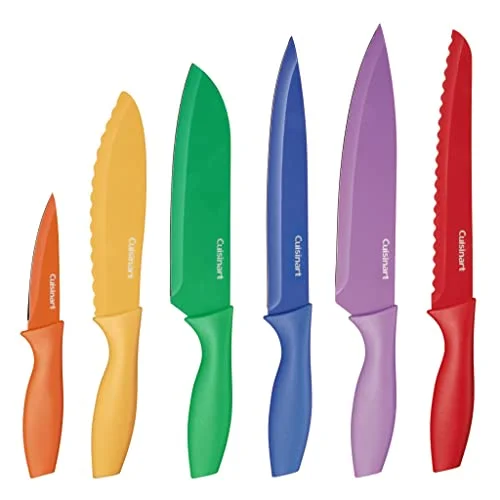
Cuisinart's Advantage line covers the same ground as the Amazon Basics set — a 12-piece multicolor block for the same budget shopper — with the difference being the name on the box. Our listing data doesn't state blade-guard inclusion or dishwasher status the way the Amazon Basics set does, so we're not asserting either here; check the current listing before assuming feature parity.
The set to buy if you'd rather have a recognized cutlery brand than the lowest price for the same color-coded idea.
03Color at the rivet
Cuisinart C77CR-10P ColorCore 10-Piece
Best if you want the color cue without a fully colored handle
10 pieces·Color rivet system·Stainless steel·Blade guards included
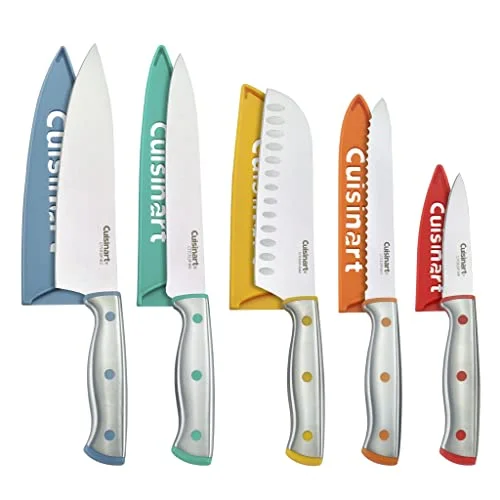
A different take on the same idea: instead of molding the whole handle in color, the ColorCore line puts color at the rivet, on an otherwise stainless-finished handle, with blade guards included. It's listed in a 3.9-inch size variant on Amazon — if a specific knife's length or role in the set matters to you, confirm it against the current listing, since that's the only size detail published for this product. The visual effect is more subdued than a fully colored handle.
The set to buy if you want the sorting cue without the handle looking like a toy block set.
Side by side
The three, compared
| Set | Best for | Pieces | Color system | Price | Get it |
|---|
 Amazon Basics 12-Piece |
Full set, guards included |
12 |
6 colored handles + 6 guards |
$13.67 |
Get it |
 Cuisinart Advantage 12-Piece |
Known brand, same tier |
12 |
Multicolor handles |
$19.51 |
Get it |
 Cuisinart ColorCore 10-Piece |
Subtler color cue |
10 |
Colored rivets + guards |
$24.95 |
Get it |
Prices change. We refresh them, but Amazon is the authority at the moment you buy. None of the three sets above include cutting boards — see how to choose a kitchen knife set for what else to weigh before buying any of them.
Our method
How we picked — and what we can't tell you
What we did
Specs, prices and public food-safety guidance
We compared published specifications and current Amazon prices for color-coded knife sets sold in the US, then checked each listing's stated contents — piece count, blade guards, dishwasher claims — against the box copy itself, not adjectives. The six-color commercial standard is widely documented public food-safety guidance, not a spec unique to any of these three products, and we've treated it that way throughout.
What we didn't
We don't run a testing lab
We do not physically test these knives, we do not own them, and we do not publish invented scores or star ratings. We have no verified review data for these products, so we don't paraphrase owner sentiment either. Where a listing doesn't state a spec — full tang, handle material, printed-versus-molded color — we've said so and pointed you to the listing instead of guessing.
FAQ
Common questions
Does color-coding alone stop cross-contamination?
No. Color-coding is a sorting cue, not a sanitizing step — it helps a cook remember which knife is assigned to which food category, but the knife still has to be washed between raw protein and anything eaten raw, exactly as it would without any color on the handle. Bacteria don't respond to handle color; only washing removes them.
Do I need color-coded cutting boards too?
If the goal is the complete version of the system commercial kitchens use, yes. The commercial standard pairs color-coded knives with matching color-coded boards, because the board holds food contact for longer and absorbs more into its surface than the blade does. None of the three knife sets in this guide include boards; buying the knives alone covers roughly half of what the full system is designed to do.
Are these color-coded knife sets dishwasher safe?
The Amazon Basics 12-piece set states it is dishwasher safe in its listing. We don't have that specific claim for the other two sets in this guide, so check the current listing before relying on it. Separately, repeated dishwasher cycles tend to fade a printed color label faster than a handle molded in color all the way through, which is worth checking in product photos if long-term legibility matters to you.
What does each color mean in the standard system?
The widely used commercial scheme assigns red to raw meat, yellow to raw poultry, green to produce, blue to seafood, brown to cooked proteins, and white to dairy and bakery items. That mapping is general food-safety guidance, not a spec unique to any one product; it's worth checking your specific set's packaging or insert for its own color key rather than assuming every colored knife set follows the six-color scheme exactly.
Keep reading
Related on Best Knife Sets