The premium, unpacked
What a higher price is actually buying here
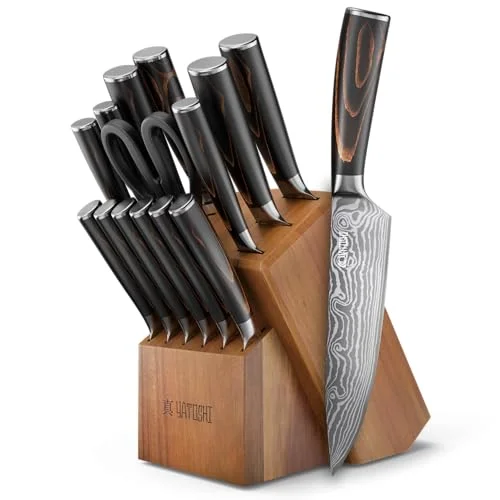
A fifty-dollar knife set and a five-hundred-dollar knife set both arrive in a box with a block and a stack of knives, and from across the kitchen they can look like the same product. They are not sold on the same claims, though, and that is the place to start. A budget listing sells you a piece count and a material name and leaves it there. A splurge-tier listing adds qualifiers — "professional," an explicit alloy class, an "ergonomic" handle, a named sharpening feature — because those words are what the extra money is nominally paying for. Some of that is substantive. The Yatoshi Professional Kitchen Knife Set states high-carbon stainless steel and an ergonomic handle specifically, at $169.99 for fifteen pieces, which is roughly four times the price of an entry-level fifteen-piece set using the same general steel category. The gap between those two listings is not in the raw material name; it is in everything the listing does not quantify — handle shaping, grind consistency, the finishing pass on the edge — none of which we can verify from a spec sheet, and none of which we will claim to have confirmed with a blade in hand.
Three things reliably move the price in this tier: a sharpening mechanism engineered into the block, which the Ninja NeverDull 17-Pc Knife Block Set builds around at $229.99; a larger total piece count, which the HOSHANHO 20PCS Knife Set leads with at $284.99; and the accumulation of smaller claims — ergonomic grips, a stated steel class, a named construction style — that individually cost little to manufacture but collectively signal "this is the premium listing." None of the three sets below publish a Rockwell hardness figure, a specific forging process, or an itemized breakdown of exactly which fifteen or seventeen or twenty pieces are knives versus everything else. That is not unusual for this price tier, but it means the honest answer to "what is this premium buying" is partly "a mechanism," partly "a bigger box," and partly "more confident copywriting." If you want the fuller framework for sorting those apart before you shop, our guide to choosing a kitchen knife set walks through the same six questions regardless of budget.
What tends to be real
Mechanisms and materials you can point to
A sharpening slot built into the block is a physical feature with a manufacturing cost. A stated steel class — high-carbon stainless, specifically — is a verifiable material claim, even without a hardness figure attached. A larger total piece count, taken at face value, is at minimum more metal and more plastic or wood in the box. These are the parts of a splurge-tier premium that correspond to something you can hold.
What tends to be marketing
Adjectives that cost nothing to print
"Professional," "ergonomic," and "ultra sharp" appear in listing titles at every price point, including the fifty-dollar tier, because they cost the seller nothing to type. They are not independently meaningless — an ergonomic handle may well fit a hand better — but they are not specifications, and a higher price does not make them one. Treat them as flavor text until the listing backs them with a number.
The box, not the blade
Piece count inflation: twenty pieces is not twenty knives
The clearest lever a manufacturer has for making a splurge-tier set look like more set for the money is the headline number on the box. The HOSHANHO 20PCS Knife Set leads with twenty pieces at $284.99, more than double the Yatoshi set's fifteen at just over a third of the price, and the arithmetic invites a reader to assume twenty pieces means roughly thirty percent more knife for close to three times the spend. That assumption is the thing to resist. A "20 Pieces Knife Set," as the listing itself titles it, almost never means twenty knives; in this category the total routinely bundles a cutting board, kitchen shears, a sharpening rod, and several steak knives in with the knives you will use for actual prep. We do not have an itemized, piece-by-piece breakdown published for the HOSHANHO set, the Yatoshi set, or the Ninja NeverDull set, and rather than guess at a split we have not verified, we are telling you plainly that the breakdown is the first thing to open the listing and check before the piece count moves your decision at all.
This is not a complaint specific to the splurge tier — it is the same inflation that shows up on fourteen-piece and sixteen-piece sets at a quarter of the price, just with more zeroes attached. The difference at this end of the market is that the inflated number is doing more work in the sales pitch, because "twenty pieces" is the headline reason the listing can ask for nearly $600. If you want a worked example of exactly how a mid-tier piece count typically breaks down into knives versus filler, we go through it line by line in what is actually in a 15-piece knife set, and the same logic scales upward: before the extra five pieces on a twenty-piece set justify an extra few hundred dollars, confirm they are blades you will reach for and not a second steak-knife set you already own six of.
The mechanism
The sharpener-in-the-block premium, quantified
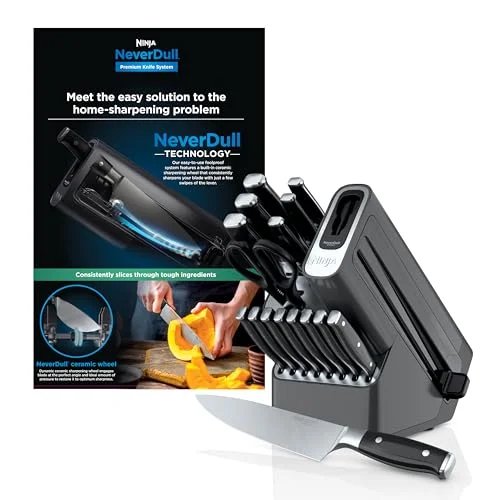
Of the three sets here, the Ninja NeverDull 17-Pc Knife Block Set is built specifically around a sharpener engineered into the block itself — it is the feature the product name leads with, and at $229.99 it is priced well above the Yatoshi set despite only two additional pieces. Dividing price by piece count makes the gap concrete rather than impressionistic: the Yatoshi set works out to roughly $13.33 per piece across its fifteen pieces, while the Ninja set works out to roughly $23.24 per piece across its seventeen. That is close to ten dollars more per piece, and two extra pieces alone do not plausibly account for a gap that size. The honest reading is that a meaningful share of that per-piece premium is paying for the sharpening mechanism and the brand behind it, not for additional steel — though we cannot cleanly separate how much of the difference is the mechanism versus the stainless grade versus the Ninja name itself, because none of those variables are isolated in the published listings.
What the mechanism buys in practical terms is also worth stating plainly: a sharpener built into the block touches up the edge a little every time the knife is drawn out and returned, which is a genuine convenience for anyone who would otherwise never sharpen a knife at all. It is not a substitute for a proper whetstone sharpening, and it will not rescue a badly damaged edge. If you already own a sharpening stone and use it, the built-in slot is a feature you are paying roughly ten dollars a piece for and will rarely touch. If you do not, and never will, it may be the single most-used feature in the entire box.
The alloy, not the adjective
High-carbon steel at this price versus at fifty dollars
The Yatoshi Professional Kitchen Knife Set states high-carbon stainless steel as a headline material at $169.99. That alloy class is not exclusive to this price tier — high-carbon stainless shows up on fifty-dollar sets in the same category, which is precisely why naming the steel alone does not explain a four-times price difference. What a listing at this tier does not typically publish, and none of our three sets here publish, is a Rockwell hardness figure that would let you compare the steel's actual hardness and edge retention against a cheaper set using nominally the same alloy name. Without that number, "high-carbon stainless" is a material category, not a performance claim, and we are not going to imply otherwise. If a Rockwell figure matters to your decision and you want to understand what the number actually measures and why a mid-fifties reading is the sensible range for a kitchen knife, our explainer on Rockwell hardness covers it in full — and it is worth reading before you assume a pricier listing automatically means harder, longer-lasting steel.
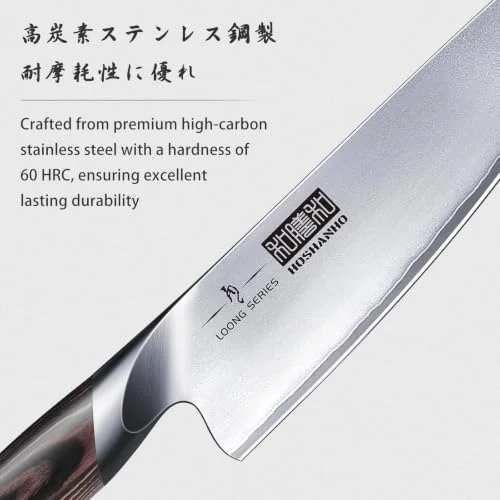
The HOSHANHO 20PCS Knife Set takes a different angle on the same steel story, describing itself as an "Ultra Sharp Japanese Kitchen Knife Set." Japanese-style blades are typically ground to a narrower edge angle than German-style blades, which can produce a sharper edge out of the box at the cost of being less forgiving against bones or frozen food — a real and meaningful distinction, but one about grind geometry and use case, not proof of superior steel. We do not have a published edge angle or hardness figure for the HOSHANHO set either, so the claim to take at face value is the style, not a specific performance number. For the fuller comparison between the two blade philosophies and which suits which kitchen, see our guide to German versus Japanese kitchen knives. What all of this adds up to: at every price point in this category, "high-carbon stainless" is closer to a baseline expectation than a premium feature. What you are actually paying extra for, when a hardness number is not on the label, is harder to pin down than the listing copy wants you to believe.
The picks
Three splurge-tier sets, and what each one earns its price with
01Entry to the splurge tier
Yatoshi Professional Kitchen Knife Set, 15 Pieces
Best for stepping up from a budget set without stepping all the way to $400
15 pieces·High carbon stainless steel·Ergonomic handle·$13.33 per piece
At $169.99, this is the most affordable of the three and the one that reads most like a direct upgrade on a budget set rather than a different category of product. It states high-carbon stainless steel and an ergonomic handle, both plausible and both unverified by us beyond the listing, and it holds the same fifteen-piece count as most entry-level sets — the money here is going into material and handle claims rather than a bigger box or a built-in mechanism. No Rockwell figure or itemized contents list is published, so the usual caveats apply: check the listing's own breakdown before assuming all fifteen pieces are blades you will use.
The set to buy if you want the splurge-tier material story without the splurge-tier price tag that comes with a sharpener or a bigger box.
02Best for the built-in sharpener
Ninja® NeverDull™ 17-Pc Knife Block Set, K32017
Best for anyone who will never sharpen a knife by hand
17 pieces·Built-in sharpener·Black finish·$23.24 per piece
The name is the feature: NeverDull is built around a sharpening mechanism in the block itself, and at $229.99 the price reflects that the mechanism, not the piece count, is the product. Against the Yatoshi set, two extra pieces do not account for the roughly ten-dollar-per-piece gap; a meaningful part of that premium is reasonably attributed to the sharpening slot and the Ninja name, even though the listings do not let us separate those two factors cleanly. If you already maintain your knives on a whetstone, this is the set where you are most likely paying for a feature you will not use.
Worth the premium specifically if you know you will never otherwise sharpen a knife. Skip it if you already own a stone.
03Top of the tier
HOSHANHO 20PCS Knife Set with Block
Best for a kitchen that genuinely wants the largest complete set
20 pieces·Japanese-style, ultra sharp·With block·$28.50 per piece
At $284.99, this is the most expensive set in our network's database and the one leaning hardest on piece count, with twenty pieces named directly in the title. It also markets a Japanese-style, "ultra sharp" edge, which points to a narrower grind angle than a typical German-style blade rather than to a superior steel — a real distinction in use, not a hardness claim we can verify. Before the twenty-piece count justifies this price over a fifteen-piece set at a third of the cost, open the listing and confirm how many of those twenty pieces are knives you would reach for weekly, because that breakdown is not itemized in the title.
The set to buy if you specifically want a Japanese-style edge and the largest total piece count on this page — and you have confirmed what the twenty pieces actually are.
Side by side
The three, compared
| Set | Best for | Pieces | Price | Price / piece | Sharpener | Get it |
|---|
 Yatoshi Professional 15-Piece |
Entry to the splurge tier |
15 |
$169.99 |
$13.33 |
Not built in |
Get it |
 Ninja NeverDull K32017 |
Never sharpening by hand |
17 |
$229.99 |
$23.24 |
Built into the block |
Get it |
 HOSHANHO 20PCS |
Largest total piece count |
20 |
$284.99 |
$28.50 |
Not stated |
Get it |
Prices change. We refresh them, but Amazon is the authority at the moment you buy. Price-per-piece is simple division against the listed total piece count, not a measure of how many pieces are knives you'll actually use.
The counter-argument
When the fifty-dollar set is still the smarter buy
Everything above assumes the splurge tier is the right place to be shopping, and for a serious home cook who uses a full set weekly, it often is. But the honest counter-case deserves equal space. None of the three sets here publish a Rockwell hardness figure that would prove the steel actually holds an edge longer than a budget set using the same high-carbon stainless alloy name. None publish an itemized contents list that confirms the extra pieces over a standard fourteen- or fifteen-piece set are knives rather than steak knives, shears, or a cutting board you may already own. And the built-in sharpener on the Ninja set, the single most concrete mechanism-based premium in this entire tier, is worth nothing to a cook who already sharpens on a stone. Strip those three uncertainties out and what is left paying for the jump from fifty dollars to two, four, or six hundred is largely handle ergonomics, brand confidence, and box size — real, but not always worth the multiple.
The calculus tips hardest toward the cheaper set in a few specific situations: a first kitchen where the knives will take abuse before technique catches up, a household that will not maintain the steel regardless of how good it is, or simply a cook who, honestly assessed, reaches for the same three knives every week and would rather spend the difference elsewhere. If that describes your kitchen, our guide to the best knife sets for a first apartment is built around exactly that calculus, and it is worth reading before a twenty-piece, $570 set outbids a fourteen-piece set that will do the same weekly jobs for a fraction of the price. The splurge tier earns its price when the mechanism or the material claim is one you will actually use. It does not earn it by default, and the piece count on the box is the last thing that should decide it.
Our method
How we picked — and what we can't tell you
What we did
Specs, prices and per-piece arithmetic
We compared published specifications and current Amazon prices for kitchen knife sets sitting well above the budget tier, then divided price by stated piece count for each to make the per-piece premium concrete rather than impressionistic. We looked specifically for checkable claims — a named steel class, a named mechanism, a stated piece count — and treated adjectives without a number behind them as marketing, regardless of price tier.
What we didn't
We don't run a fake testing lab
We do not physically test these knives, we do not own them, and we do not publish invented hardness figures or scores where the manufacturer has not published one itself. We have no verified review data for these specific products, so we are not paraphrasing owner sentiment either. What we can do honestly is read every published specification, run the arithmetic the listing itself invites, and say plainly where a claim stops being checkable.
FAQ
Common questions
Is a $400 or $570 knife set actually better than a $50 one?
It can be, but not automatically. The concrete, verifiable upgrades in this tier are a sharpening mechanism built into the block and, sometimes, a larger genuine piece count. Beyond those, claims like "professional" or "ultra sharp" are not specifications, and none of the three sets in this guide publish a Rockwell hardness figure that would prove the steel itself outperforms a cheaper set using the same high-carbon stainless alloy name. The price buys real things; it does not automatically buy proportionally better steel.
What does a built-in sharpener actually do, and is it worth the premium?
A sharpener built into the knife block touches up the edge each time the knife is drawn out and returned to its slot. It is a real convenience for anyone who would otherwise never sharpen a knife, and on the Ninja NeverDull set it accounts for a meaningful share of a roughly ten-dollar-per-piece premium over a similar set without one. If you already maintain your knives on a whetstone, the mechanism adds little; if you do not, it may be the most-used feature you own.
Does a twenty-piece set actually give you more usable knives than a fifteen-piece set?
Not necessarily. A "20 Pieces Knife Set" title bundles everything in the box into one number, and in this category that routinely includes a cutting board, kitchen shears, a sharpening rod, and steak knives alongside the knives you will use for daily prep. None of the three sets in this guide publish an itemized breakdown, so the honest step before the piece count justifies the price is to open the listing and check exactly what the extra pieces are.
Is high-carbon stainless steel always the same quality, no matter the price?
The alloy name alone does not tell you that. High-carbon stainless appears on sets at every price point in this category, including far cheaper ones, which is why naming the steel does not by itself explain a large price difference. What would actually distinguish the steel's performance — a Rockwell hardness figure, a specific forging or heat-treatment process — is not published for any of the three sets we compared here, so we are not claiming the pricier steel is proven harder or longer-lasting than a budget set's.
Keep reading
Related on Best Knife Sets
- The best knife sets to give as a giftIf the splurge is for someone else rather than your own kitchen, the criteria that matter shift — see what makes a set a good present instead of a resented one.
- The best knife sets without a blockNone of the three sets above skip the block. If counter space is the constraint rather than price, this is the shortlist built around that trade-off.
- The best steak knife setsSteak knives are one of the pieces most likely to be padding out a "20-piece" count. Here's when buying them separately actually makes sense.
- How to choose a kitchen knife setThe six questions that matter at any budget, in the order that matters — piece count is deliberately not the first one.
- Browse every guide on the siteThe full library of comparisons and buying guides, updated as prices change.