The basic part
What “tang” means, before “full” enters the sentence
Every fixed-blade kitchen knife has a tang: the portion of the blade's steel that continues past the cutting edge and disappears into the handle. It is not a separate part bolted on afterward — it is the same bar of steel that was shaped into the blade, simply extended further back. What differs between a $24 set and a $300 one is how far that steel goes, and how it is attached to whatever wraps around it.
A full tang runs the entire length of the handle, edge to butt, usually sandwiched between two handle scales (the slabs of wood, plastic or composite that form the grip) and pinned through with visible rivets. A partial tang stops short — sometimes halfway, sometimes just an inch or two past the bolster — and the rest of the handle is molded plastic with nothing structural inside it. A rat-tail tang goes further still: a thin rod of steel, often narrower than the spine of the blade, pushed into a hollow handle and held with glue or a single pin. Rat-tail construction is common on the cheapest stamped blanks sold loose, rarely on sets that bother to publish a construction claim at all, because there is nothing flattering to say about it.
The three sets we looked at for this guide sit at different points on that spectrum of what gets stated outright. The Amazon Basics 14-Piece set and the Astercook 14-Piece set both put the words full tang directly in their listing titles. The Cuisinart C77WTR-15P states something else — forged, triple-rivet construction — which is a different claim, and worth separating from a full-tang claim rather than assuming they mean the same thing. More on that below. None of this is a reason to distrust a set that doesn't use the phrase; it's a reason to read what it actually says instead of what you'd expect it to say. The same habit is worth applying to Rockwell hardness figures, which get thrown around with similar looseness.
Reading the handle
How to see it without a spec sheet: look at the rivets
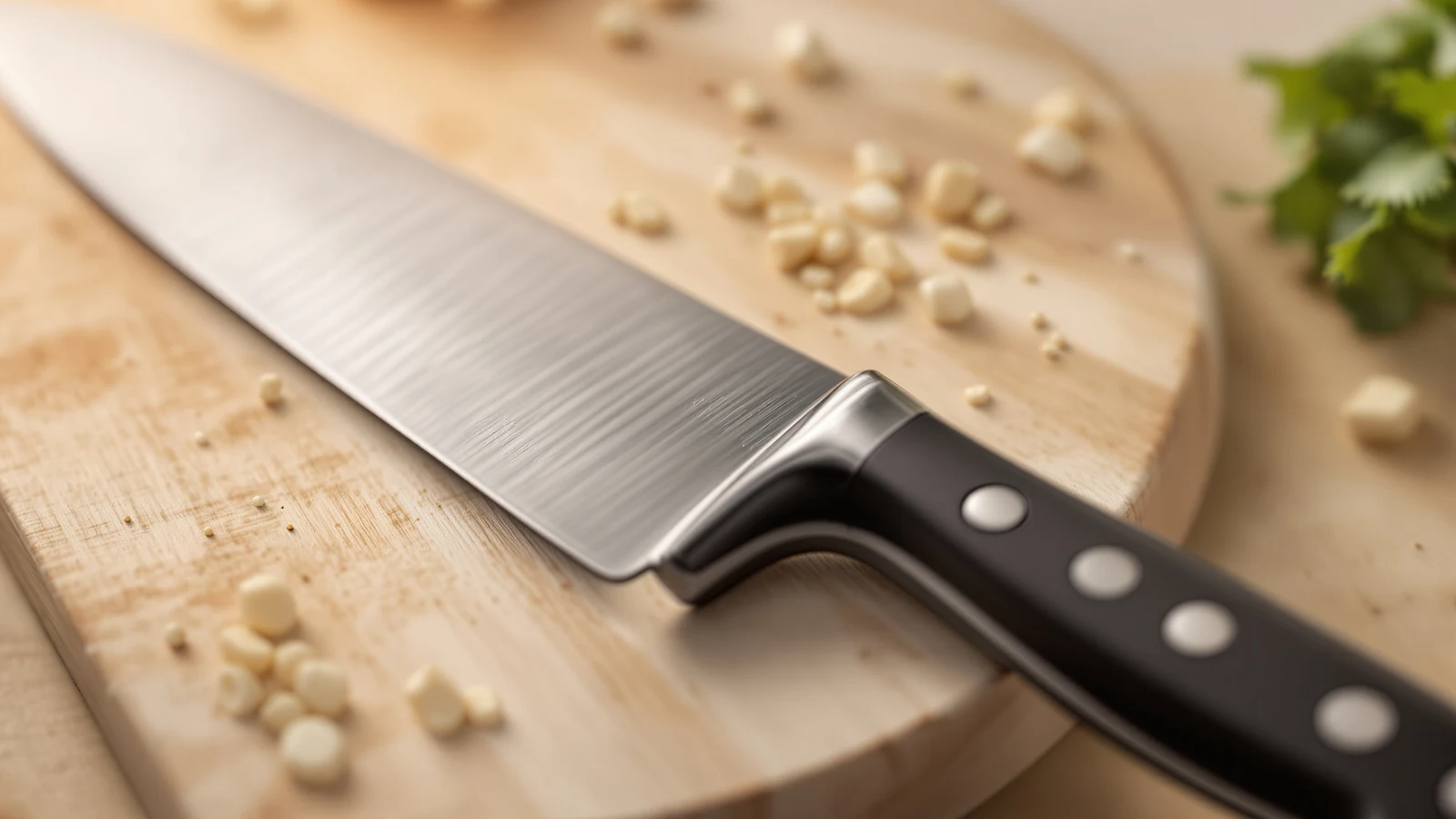
You don't need a listing to tell you whether a knife is full tang. You need two things you can check from a single product photo: a visible metal line, and rivets with somewhere real to bite into.
Look at the top edge of the handle, where it meets the spine of the blade, and at the bottom edge near the butt. On a full-tang knife, a thin strip of steel is visible running along both edges — the handle scales are riveted to either side of it, so the metal shows at the seam. On a partial or rat-tail tang, that strip disappears a few inches in; the rest of the handle is a smooth, uninterrupted curve of plastic with no metal line at all, because there's no steel underneath it to show.
The rivets themselves are the second tell, and they're the more reliable one, because a manufacturer can polish a handle to hide the seam line but can't fake a rivet into existing where there's nothing behind it. A full tang gives you solid steel to drill through and pin, so sets built this way typically show two or three rivets spaced along the handle — often described in listings as “triple riveted.” A hollow partial-tang handle has nothing back there to rivet into past the first inch or two, so manufacturers either skip visible rivets entirely or use a single decorative pin near the bolster that isn't doing structural work. If you see multiple evenly spaced rivets running the visible length of a dark wood or composite handle, you are almost certainly looking at full tang construction, whether or not the word ever appears in the title.
This is also where handle style matters. Traditional Japanese-style handles — the round or octagonal wa-handle you'll see discussed in our German vs Japanese knife comparison — are built differently on purpose, with the tang typically shorter and no rivets at all, because the handle is friction-fit and meant to be replaceable. That isn't a defect; it's a different construction tradition solving the same problem a different way. The rivet check above applies specifically to the Western-style handles on the block sets in this guide, not to every knife shape you'll encounter.
In the hand
Balance: what the extra steel in the handle actually changes
A full tang doesn't make a knife sharper. The edge is ground the same way regardless of what's happening six inches back in the handle. What it changes is where the knife's weight sits, and that has a real effect on how the knife feels through an hour of prep.
Steel is denser than the wood, plastic or composite that makes up the rest of a handle. Extend that steel the full length of the grip and you've moved real mass back toward your palm, closer to the pivot point of your wrist. The practical result is a knife that feels more balanced front-to-back rather than nose-heavy — the blade doesn't drag the handle forward the way it does on a partial-tang knife, where all the weight is concentrated in the steel up front and the handle is comparatively hollow and light. For a chef's knife doing a rocking chop through a pile of onions, that balance reduces the amount of wrist effort needed to keep the tip controlled, because less force is required to counteract the blade pulling downward.
It isn't automatically the preference everyone wants. Some cooks like a lighter, more nose-forward knife for fast, shallow cuts, which is part of why plenty of perfectly good knives are sold with partial tangs and nobody treats it as a flaw worth apologizing for. The honest way to frame it: full tang shifts the balance point toward the handle and adds overall weight, and whether that's an improvement depends on how you hold and move a knife, not on some universal standard of correctness. It's one of several construction trade-offs worth weighing alongside the questions in our buying guide, where piece count is deliberately not one of the four things that decide a purchase.
Where it stops mattering
Where full tang matters least: the paring knife
Everything above is most relevant to the knife doing the heaviest work in the block — usually the 8-inch chef's knife, sometimes a santoku. It matters considerably less on a 3- to 4-inch paring knife, and it's worth knowing why before you let a partial-tang parer talk you out of an otherwise good set.
A paring knife does light, close work: peeling, trimming, hulling a strawberry, deveining a shrimp. There's no rocking chop, no working through a butternut squash, no leverage against bone. The forces involved are small, the blade is short, and the knife spends most of its life pinched between thumb and first two fingers rather than gripped with a full hand around the handle. Balance still exists on a small knife, but the stakes are much lower — a slightly nose-heavy 4-inch blade is a minor annoyance, where the same imbalance on an 8-inch chef's knife is something you feel in your wrist after twenty minutes of prep.
This is also why a partial tang on a paring knife is rarely a sign that a manufacturer skimped specifically on that piece. Smaller handles have less room for a long tang and multiple rivets in the first place, and the knife simply doesn't need the reinforcement the way a workhorse blade does. If you're building or buying toward a minimal set rather than a full block — which is exactly the approach covered in our guide to knife sets without a block — full tang is the detail worth prioritizing on the chef's knife and worth deprioritizing on the parer.
Reading between the rivets
Sets that have the construction, and don't print the words
The flip side of a loosely used phrase is a listing that under-claims. The Cuisinart C77WTR-15P in this guide states forged construction with a triple rivet, in high-carbon stainless, for $77.97. What its title does not say, anywhere, is “full tang.”
That omission is worth reading carefully rather than assuming the worst. Forging a blade from a single bar of steel and then triple-riveting the handle to it is, in practice, the harder construction method to pull off with anything less than a full tang — there's limited reason to drill three rivet holes into a handle if there's only an inch of steel back there to catch them. The triple-rivet detail is the same visual tell described above: real structural rivets, evenly spaced, generally mean real steel underneath. But a strong inference from a listing photo is not the same thing as a manufacturer's written claim, and the rule for this site is the rule we'd want applied to us — if the spec isn't published, we don't assert it on the manufacturer's behalf. We can tell you what the construction method and rivet pattern suggest. We can't print “full tang” next to a product that doesn't use those words itself.
The practical move, if full tang specifically is the deciding factor for you and not just a nice-to-have: open the Cuisinart listing, look at the product photos for the rivet-and-seam pattern described above, and check the Q&A section, where buyers sometimes ask the construction question directly and get an answer the title copy never gave them. The same logic applies to our note in "Dishwasher Safe" Knife Sets: What the Label Actually Means — a label tells you what the manufacturer chose to print, not the complete list of what's true about the product underneath it.
The picks
Three sets, three ways of stating the same construction detail
01Stated outright, lowest price
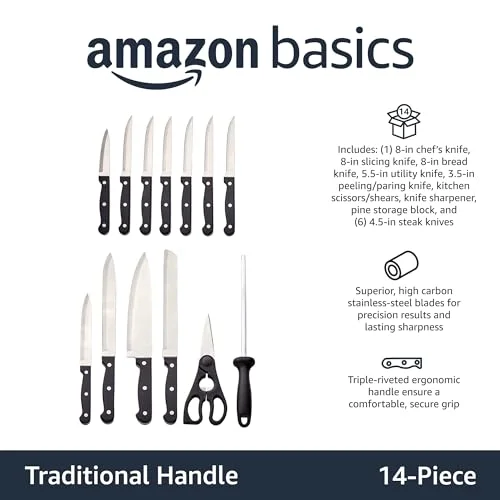
Amazon Basics 14-Piece Knife Block Set
Best for full tang at the lowest price here
14 pieces·High carbon stainless·Full tang construction·Sharpener & pinewood block included
The listing title states full tang construction directly, alongside ergonomic handles and high-carbon stainless steel, with a sharpener and a pinewood block included for $22.28. There's no ambiguity to read around here: the manufacturer put the claim in writing on the cheapest set in this comparison, which is itself the point — full tang is a labor cost, not a materials cost, and it doesn't require a large budget to include it.
The set to buy if full tang matters to you and the rest of your budget needs to go elsewhere.
02Stated, larger set
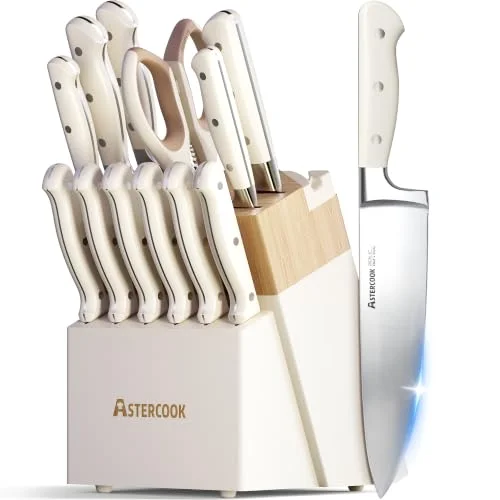
Astercook 14-Piece Knife Set with Block
Best for full tang in a larger-handled set
14 pieces·Full tang stainless steel·Anti-slip ergonomic handle·Large size/variant
Astercook's listing also states full tang stainless steel construction outright, paired with an anti-slip ergonomic handle and a built-in sharpener, for $47.48. The listing lists this as the Large size/variant — that's the only size detail published for this set, so if a specific handle or blade dimension matters to your decision, check the listing rather than assume a particular measurement. The listing also markets the set as dishwasher safe; our separate look at what that label actually protects against is worth reading before you rely on the dishwasher rather than hand-washing, since heat and detergent are harder on a handle's rivets and seams than on the blade's edge.
The set to buy if you want full tang confirmed in writing and a bit more set for roughly double the Amazon Basics price.
03Implied, not stated
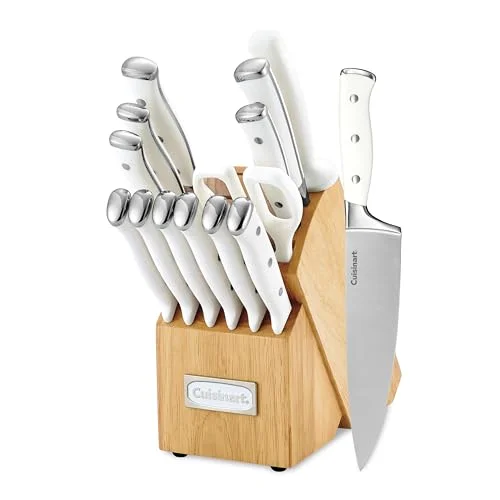
Cuisinart C77WTR-15P Forged Triple Rivet
Best for the rivet pattern that usually means full tang, without the words to confirm it
15 pieces·Forged, triple rivet·High carbon stainless·No full-tang claim stated
Forged blades with a published triple-rivet pattern, in high-carbon stainless, for $77.97. As covered above, that combination of forging and three structural rivets is the visual signature of full tang construction — but the listing title never uses the phrase, so we're treating it here as a strong inference from the construction method and photos, not a confirmed spec. If full tang is the deciding factor rather than a nice-to-have, verify it on the listing images or Q&A before buying.
The set to buy for forged steel and a known name, if you're comfortable reading the rivets yourself rather than reading the word.
Side by side
The three, compared on this one detail
| Set | Pieces | Full-tang claim | Construction | Price | Get it |
|---|
 Amazon Basics 14-Piece |
14 |
Stated in title |
High carbon stainless |
$22.28 |
Get it |
 Astercook 14-Piece |
14 |
Stated in title |
Full tang stainless steel |
$47.48 |
Get it |
 Cuisinart C77WTR-15P |
15 |
Not stated (triple rivet implies it) |
Forged, high carbon stainless |
$77.97 |
Get it |
Prices change. We refresh them, but Amazon is the authority at the moment you buy. See our full buying guide for the other factors worth weighing alongside construction.
Our method
How we checked — and what we can't tell you
What we did
Listing titles, photos and rivet patterns
We compared the published construction claims, current Amazon prices and listing photos for the kitchen knife sets in our catalogue, looking specifically at whether “full tang” appears as a stated claim versus a reasonable inference from forging method and visible rivet pattern. We kept that distinction explicit throughout rather than treating the two as interchangeable.
What we didn't
We don't run a fake testing lab
We do not physically test these knives, we do not own them, and we have no verified review data to paraphrase as owner sentiment. Like every guide on this site, we don't run a fake testing lab or publish invented scores. What we can do honestly is read every published construction claim, compare it against what the listing photos actually show, and tell you plainly which is which.
FAQ
Common questions
What does "full tang" actually mean?
The tang is the part of a knife blade's steel that continues past the edge and into the handle. On a full-tang knife, that steel runs the entire length of the handle, usually sandwiched between two handle scales and held in place with visible rivets. On a partial or rat-tail tang, the steel stops well short of the butt, and the rest of the handle is hollow plastic or composite with nothing structural inside it.
How can I tell if a knife is full tang without reading the spec sheet?
Look at a product photo of the handle. On a full-tang knife, a thin line of steel is visible along the top and bottom edge of the handle, and you'll usually see two or three rivets spaced along its length with real steel to bite into. A smooth, uninterrupted handle with no visible metal line, or with only a single decorative pin near the bolster, is almost always partial tang, whatever the surrounding copy claims.
Does a paring knife need to be full tang?
Not really. A paring knife does light, close work with little leverage involved, so the balance and reinforcement benefits of a full tang matter far less than they do on an 8-inch chef's knife doing a rocking chop. Smaller handles also have less physical room for a long tang and multiple rivets. A partial tang on a paring knife is rarely a sign the rest of the set was built cheaply.
Why would a set have full-tang construction and not say so in the listing?
Manufacturers publish the claims they choose to publish, and a listing's silence on a detail isn't proof the detail is absent. Forged blades with a published triple-rivet pattern, for example, are hard to build with anything less than a full tang, because there needs to be real steel behind each rivet. That's a strong inference from the construction method and photos, not a confirmed spec, so if full tang matters specifically to your decision, check the listing images or Q&A rather than assume either way.
Keep reading
Related on Best Knife Sets