The claim
What “dishwasher safe” is actually certifying
When a listing prints “dishwasher safe” on a stainless steel knife, it is making a narrower promise than it sounds like. It is saying the blade and, usually, the handle will survive repeated exposure to hot water, detergent and a heated dry cycle without rusting, warping, discoloring or coming apart at the joint. That is a durability and corrosion claim about the bulk materials. It is not a claim about sharpness, and it is not a claim about how the knife will look or cut after two hundred cycles sitting against forks and ceramic plates. Manufacturers add the phrase because the alternative — a knife that rusts or a handle that cracks after a single run through the machine — is the kind of failure that generates refund requests and one-star reviews about something that has nothing to do with how the knife cuts.
For a knife that is already stainless steel, the claim is in large part restating a property the metal already has. Stainless resists rust because of the chromium in the alloy, with or without a dishwasher cycle involved. “Dishwasher safe” on a stainless blade is closer to a reassurance than a new piece of engineering: it tells a nervous buyer that the manufacturer has tested the specific combination of this blade, this coating and this handle against a real cycle, rather than leaving them to assume. That reassurance is worth something. It is just not the thing most people read into the phrase when they see it printed next to a picture of a knife block.
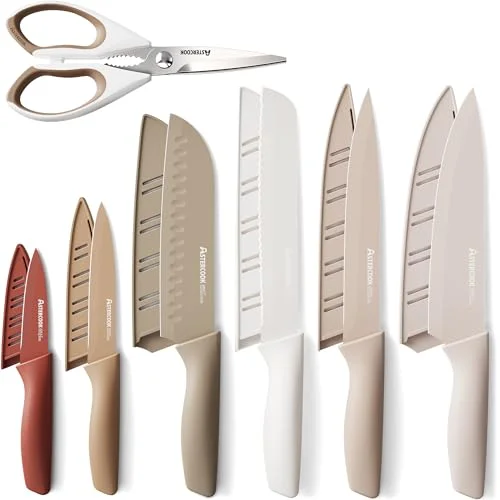
The Astercook 13-Piece set (ASIN B0D9B96TBX, $18.98) makes this distinction for you without meaning to. Its listing title pairs “Healthy Anti-Rust Coating” directly with “Dishwasher Safe” in the same breath, which is the manufacturer telling you plainly what the dishwasher claim is actually about on this set: rust resistance from the coating, not edge performance. Reading a listing title in that order — what is the dishwasher-safe claim actually sitting next to? — is one of the simpler habits worth carrying into any knife set purchase, dishwasher question or not.
What the label skips
Heat, detergent and the edge: the part the label skips
A dishwasher cycle runs hotter than a sink of handwash water, usually somewhere in the range of 130 to 170 degrees Fahrenheit, and it holds the blade in that environment, wet, for the better part of an hour including a heated dry phase. Dishwasher detergent is formulated to be alkaline and mildly abrasive on purpose, because its job is to break down baked-on grease and food residue without anyone scrubbing. Neither of those facts is a secret, and neither of them is specifically what dulls a blade. Kitchen knife steel does not meaningfully soften at dishwasher temperatures; the heat required to anneal a hardened edge is far beyond anything a home appliance produces. The detergent is mild enough on steel itself that it will not grind down an edge through chemistry alone.
What actually dulls an edge in a dishwasher is almost entirely mechanical, not thermal or chemical. A knife loaded into a rack moves. It is jostled by the spray arm, it knocks against forks, ceramic, other blades and the rack tines themselves, over and over, for the length of the cycle. The edge of a knife is the thinnest, most fragile part of the whole tool — a few thousandths of an inch of steel tapering to a point — and it is exactly that thin apex that rolls, micro-chips or flattens slightly every time it strikes something harder than itself. None of the three Astercook listings we cover here publish a Rockwell hardness figure, which means none of them is committing in writing to how well the edge resists that kind of contact; see our explainer on what a Rockwell number actually tells you for why that figure, when a listing provides it, is the more useful spec to chase than “dishwasher safe” if edge retention is what you actually care about.
None of this means the dishwasher is secretly dangerous in some exotic way. It means the damage a blade takes in a dishwasher is the same kind of damage it would take being tossed loose into a drawer with other utensils — repeated contact with hard objects — just concentrated into one long, unsupervised cycle instead of a hundred small moments. A “dishwasher safe” label has nothing to say about that contact, because it was never measuring it.
The more common casualty
Handles: the more common dishwasher casualty
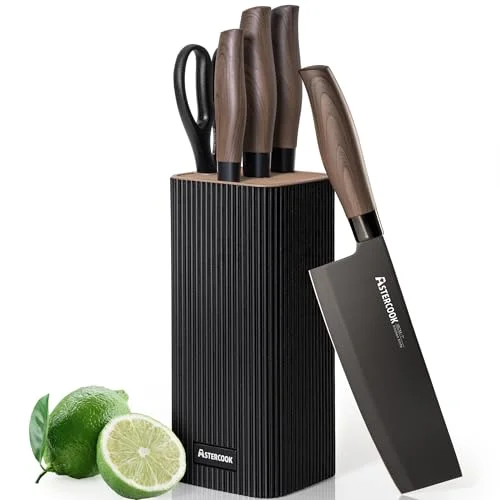
Ask a knife to survive a dishwasher and the blade is usually fine. The handle is where the failures actually happen, because handles are where manufacturers mix materials, bond joints and finishes that water, heat and repeated cycles are specifically hard on. The Astercook 6-Piece Knife Set with Block (ASIN B0G8HTRKQG, $18.98) states a “Wood Grain Handle” in its title alongside “Dishwasher Safe.” Read that phrase carefully: it says wood grain, not wood. That could describe a composite or resin handle finished with a wood-grain pattern, which would tolerate a dishwasher cycle about as well as any molded handle does. It could also describe a wood-polymer composite bonded over a tang, where the glue line is the actual point of failure under repeated heat-and-moisture exposure. The listing does not specify which, and we will not assert a material it doesn't state. If the distinction matters to you, check the listing photos and material callouts before trusting that handle to the top rack.
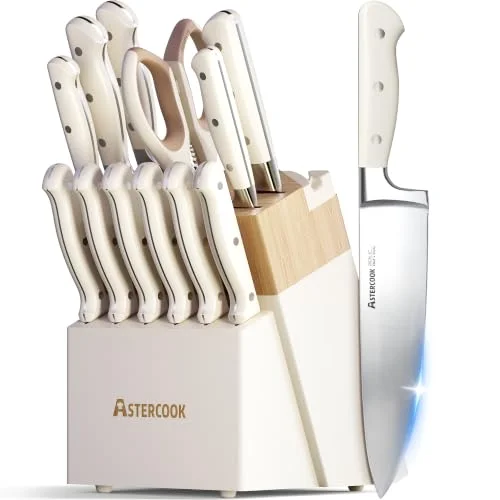
The Astercook 14-Piece Knife Set with Block (ASIN B0DYP3J5BW, $47.48) takes a different approach: it states full tang construction paired with an “Anti-Slip Ergonomic Handle.” Full tang means the blade's steel runs the entire length of the handle rather than stopping at a stub, which removes one of the common failure points on cheaper knives — a handle that is only glued or pinned onto a short tang has more places for water to work its way in and loosen the bond over repeated cycles. A full-tang knife still has a handle material that can degrade on its own terms, but it at least isn't relying on a short internal joint to hold the whole assembly together. Read more about what full tang buys you, and what a published piece count does and doesn't tell you about what's actually in the box.
The Astercook 13-Piece set doesn't specify a handle material at all. Its listing focuses on the anti-rust coating and the six blade guards included with the set — plastic sleeves that slide over each blade for storage and transport, which is a different design entirely from a block. If you're weighing a guard-and-sleeve set like this one against a block set, our guide to knife sets without a block covers the tradeoff in more detail; a block keeps a set together and visible on the counter, guards keep it flat in a drawer, and neither format tells you anything about how the handles underneath will hold up to repeated washing.
Two separate problems
Rust versus dulling: two different kinds of damage
It's worth separating these two failure modes completely, because a listing that is honest about one says nothing about the other. Rust is a chemical reaction: iron in the steel oxidizing when it's exposed to water and air over time. Stainless steel resists this because of its chromium content, which forms a passive, self-healing oxide layer on the surface — but “stainless” is a resistance, not an immunity. Lower-grade stainless, or a blade left wet and in contact with another reactive metal for an extended period, can still develop pitting or surface rust, which is exactly the failure an “anti-rust coating” claim like the one on the Astercook 13-Piece set is specifically addressing.
Dulling is a completely different mechanism: it's the mechanical rounding, chipping or flattening of the edge's geometry from contact with harder surfaces, as covered above. It has nothing to do with chemistry and nothing to do with water. A blade can be perfectly rust-free and still be duller than it was a month ago, because rust resistance and edge retention are governed by entirely different properties of the steel and entirely different kinds of exposure. A manufacturer can make a completely truthful “dishwasher safe” claim about rust while saying nothing at all about dulling, and that is precisely what's happening across all three Astercook listings here: none of the three pairs its dishwasher claim with any statement about edge retention, hardness or sharpening frequency.
The six blade guards included with the 13-Piece set are a useful illustration of the same point from the other direction. Guards protect fingers from an exposed edge and protect the edge itself from banging against other hard objects in a drawer — a mechanical protection, aimed at the same kind of contact damage a dishwasher cycle causes. They have nothing to do with rust. A set can ship with rust protection built into the coating and dulling protection built into the guards, and the two features are solving two unrelated problems that happen to show up in the same box. If you're shopping across price tiers and want to see how far a published spec sheet can go before the claims thin out, our guide to splurge-tier sets is a useful contrast: at that price, forged construction and a stated Rockwell figure are common, and most of those listings still don't recommend the dishwasher for the blade, regardless of rust resistance.
The three in this catalogue
The picks, and how we would still wash them
01Rust-coated, guard set
Astercook 13-Piece Knife Set
Best for the clearest rust-resistance claim
13 pieces·Anti-rust coating·6 blade guards·Stainless steel
This is the listing that states its dishwasher claim most transparently, because it pairs “Dishwasher Safe” directly with “Healthy Anti-Rust Coating” in the same title — the manufacturer isn't implying an edge claim, it's naming the coating that's actually doing the dishwasher-related work. The six included blade guards are the detail worth noting for anyone who skips the dishwasher question entirely and stores knives loose in a drawer instead; they protect the edge from the same kind of contact damage a dishwasher cycle causes, just in a different location.
How we'd wash it: the coating makes the dishwasher a reasonable option for rust. We'd still hand-dry it immediately after the cycle rather than leaving it to sit wet in the rack, and keep the guards on whenever it's not in use.
02Lowest price, block
Astercook 6-Piece Knife Set with Block
Best for a compact block, with a handle detail to check first
6 pieces·High carbon stainless·Wood grain handle·Block included
The smallest and least expensive of the three sets, built around high carbon stainless blades described as ultra sharp, in a black block. The detail that stands out is the handle: the listing states “wood grain,” not “wood,” and doesn't specify the underlying material. That ambiguity is worth resolving before you decide how hard to lean on the dishwasher for this one — a composite finished to look like wood grain and an actual wood-polymer handle age very differently under repeated heat and moisture.
How we'd wash it: hand wash the handles until the listing or photos confirm what “wood grain” is made of. The blades themselves, being high carbon stainless, are the less risky part of this set in a dishwasher.
03Full tang, most complete
Astercook 14-Piece Knife Set with Block
Best for full tang construction and a built-in sharpener
14 pieces·Full tang·Anti-slip ergonomic handle·Sharpener included
The most expensive and most completely specified of the three, at $47.48. Full tang construction is stated outright, which removes the glued-joint failure point that shorter tangs rely on, and the anti-slip ergonomic handle is purpose-built rather than a repurposed wood-grain finish. A sharpener is included in the block, which is useful for the edge wear that the dishwasher claim never addressed in the first place — a built-in sharpener touches up the mechanical rounding a blade picks up from any contact, dishwasher or drawer.
How we'd wash it: of the three, this is the set we'd be most comfortable running through the dishwasher occasionally on construction grounds alone. We'd still hand wash and dry the knives you reach for daily, and let the built-in sharpener do its job between washes either way.
Side by side
The three, compared on what their labels actually state
| Set | Pieces | Dishwasher-related claim | Handle | Price | Get it |
|---|
 Astercook 13-Piece |
13 |
Anti-rust coating + dishwasher safe |
Not specified |
$18.98 |
Get it |
 Astercook 6-Piece with Block |
6 |
Dishwasher safe (material not specified) |
Wood grain (material unstated) |
$18.98 |
Get it |
 Astercook 14-Piece with Block |
14 |
Dishwasher safe + full tang stated |
Anti-slip ergonomic |
$47.48 |
Get it |
Prices change. We refresh them, but Amazon is the authority at the moment you buy. None of the three listings publishes a Rockwell hardness figure, so edge-retention comparisons between them aren't possible from the published specs alone.
In defense of the label
When the label is doing real work
None of the above means “dishwasher safe” is a hollow phrase. It's doing real, honest work against a specific worst case: a knife that genuinely can't handle a dishwasher cycle. Carbon steel knives, which are prized for how easily they sharpen but lack the chromium content of stainless, can flash-rust within a single wash cycle if left wet, developing visible orange spots in under an hour. Knives with true wooden handles — not a wood-grain finish on a composite, but actual wood scales — will swell, crack or loosen at the rivets over repeated exposure to heat and moisture, sometimes after only a handful of cycles. Against either of those outcomes, “dishwasher safe” on a stainless-bladed set with a purpose-built handle is a real, meaningful difference, and it's the difference the label is actually built to communicate.
The honest way to read the phrase, across all three Astercook sets and any other listing that carries it, is “this will survive being in there,” not “this is the optimal way to clean it.” Surviving and thriving are different bars. A knife that comes out of two hundred dishwasher cycles without a spot of rust can still be noticeably duller than one of the same design hand-washed and dried immediately after every use, for the mechanical reasons covered earlier in this guide. That gap matters more on a knife ground to a narrower edge angle, which is part of why edge geometry is worth understanding on its own terms — see our comparison of German and Japanese edge angles for how a thinner, more acute edge is both sharper out of the box and more vulnerable to exactly the kind of rack-and-tine contact a dishwasher cycle produces.
If the dishwasher is simply more convenient for you than hand washing, and rust is the failure you're most worried about, a genuinely dishwasher-safe stainless set with a stated handle material will deliver on that promise. If a long-lasting edge is the priority, the dishwasher claim isn't the spec to anchor the decision on at all — it never was.
Our method
How we researched this — and what we can't tell you
What we did
Read the listings, not just the headline claim
We read the full listing title and published bullet points for every set in this catalogue that carries the words “dishwasher safe,” and noted exactly what other claim each one is paired with — anti-rust coating, full tang, a specific handle material or none of the above. We then compared those published claims against general, verifiable facts about dishwasher temperature ranges, detergent chemistry and how mechanical edge damage occurs, none of which is specific to these products and all of which is independently documented appliance and metallurgy information.
What we didn't
We don't run a testing lab
We did not run any of these sets through a dishwasher ourselves, we do not own them, and we have no verified owner review data for these specific listings to draw on, so we have not paraphrased any owner sentiment here. Edge retention and rust resistance are properties measured over months of real use and, for rust specifically, in accelerated corrosion testing — not something a single cycle or a short-term writeup could honestly demonstrate either way. What we can do is read every published claim carefully and tell you plainly which ones are checkable and which ones are adjectives.
FAQ
Common questions
Does "dishwasher safe" mean my knives won't need sharpening?
No. “Dishwasher safe” is a durability and corrosion claim about the blade and handle materials surviving heat, detergent and moisture without rusting, warping or coming apart. It says nothing about the edge, which dulls mechanically from contact with other hard objects in the rack — the same kind of contact that happens in a drawer, just concentrated into one long cycle. Any knife, dishwasher-safe or not, needs regular sharpening or a built-in sharpener to stay useful.
Why do some listings pair "dishwasher safe" with "anti-rust coating"?
Because that's usually the specific feature doing the dishwasher-related work. The Astercook 13-Piece set states both in the same title, which tells you the dishwasher claim is really about the coating resisting corrosion from repeated heat and detergent exposure, not about the steel's hardness or the edge's ability to stay sharp. Reading which claim a dishwasher-safe label is paired with tells you more than the phrase alone.
Is a "wood grain" handle actually safe in the dishwasher?
It depends on the material, which the listing doesn't always specify. “Wood grain” describes a visual finish, not necessarily a wood substrate — it could be a composite or resin molded to look like wood, which tolerates a dishwasher fine, or a wood-polymer handle bonded over the tang, where the glue joint is the weak point under repeated heat and moisture. The Astercook 6-Piece set states “wood grain handle” without specifying which, so we'd check the listing photos or hand wash it until that's confirmed.
Should I put any knife set in the dishwasher?
You can, for sets that explicitly state dishwasher-safe materials, without ruining them through rust or a cracked handle. But hand washing and drying immediately after use will keep an edge sharper for longer on any knife, because the edge wear a dishwasher causes is mechanical — from banging against other items in the rack — not something the dishwasher-safe label was ever designed to prevent.
Keep reading
Related on Best Knife Sets