First principles
What a block is actually protecting against
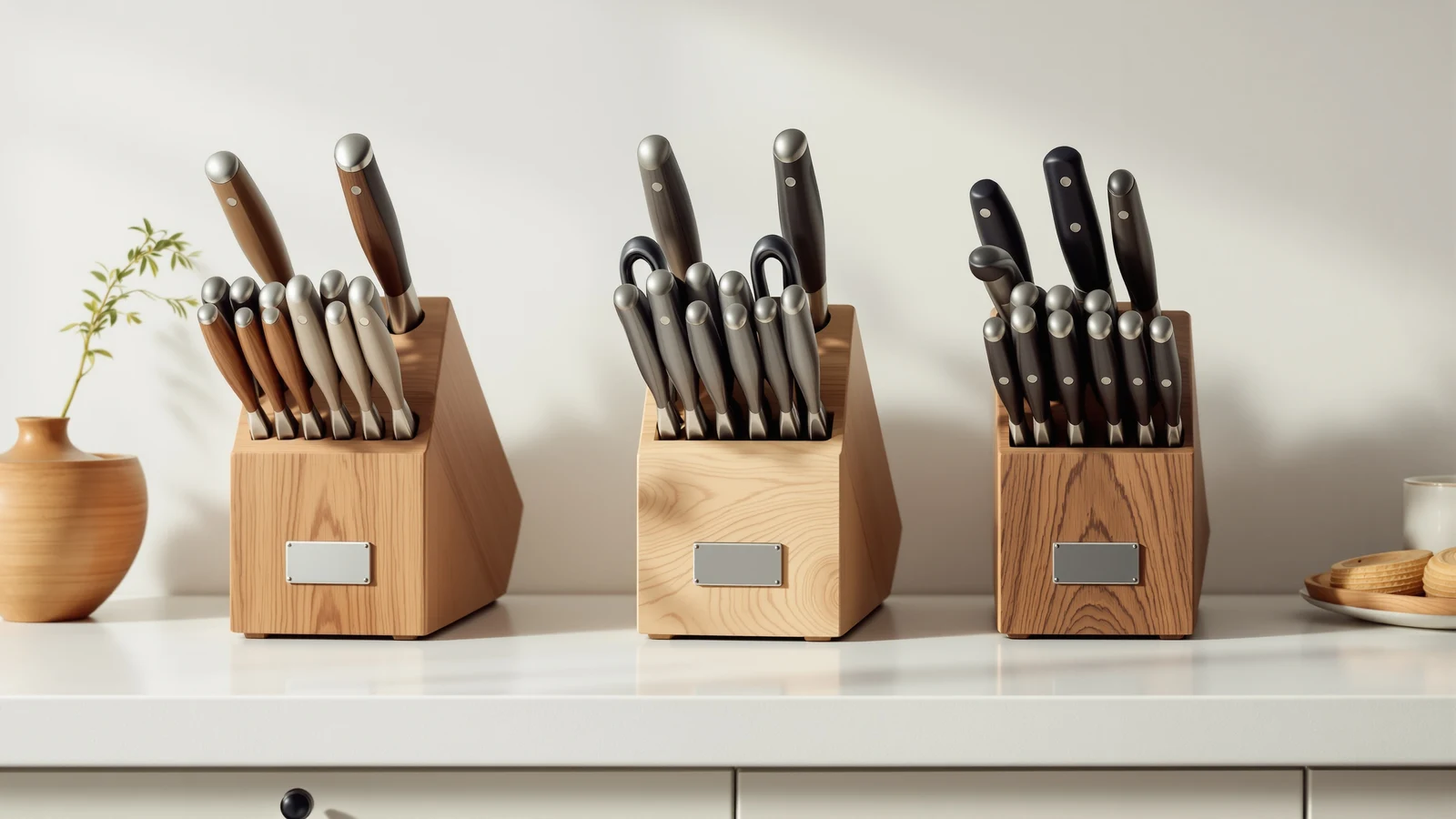
Leave a sharp knife loose in a drawer and two things happen to the edge, neither of them good. It knocks against the drawer sides, the cutlery tray and every other knife sharing the space — metal on metal, exactly the kind of contact that rolls or chips a fine edge. And it sits exposed, which is how a reach into a cluttered drawer turns into a cut. A block solves both problems the same way: each knife gets its own slot or its own strip of magnetic contact, isolated from the others, with the edge held away from anything hard enough to damage it.
That isolation is the entire point, and it is why the slot material matters more than it looks like it should. A slot that is too loose lets the blade rock and tap against the wood with every trip in and out of the block. A slot that is too tight forces you to wiggle the blade free, which is how an edge nicks the wood on the way out. The block is a protective system, and its material decides how well that system holds up over years rather than weeks. The same logic is why a full-tang handle matters on the knife itself — both are about what happens to the steel under ordinary, repeated contact.
None of the three materials in this guide are purely decorative. Acacia and pine are both solid wood, cut and finished to hold a slot shape; the foldable magnetic design in the SYOKAMI set skips slots altogether and holds each blade against a flat face instead. Each approach changes what you are trusting to protect the edge.
Wood density
Acacia versus pine: density, and what it means for the slots
Acacia and pine sit at opposite ends of the wood spectrum used in kitchen furniture. Acacia is a dense hardwood — the same general category of timber used for cutting boards and butcher blocks, chosen precisely because it resists dents and wear from repeated contact. Pine is a softwood: lighter, easier to mill into shape, and noticeably less expensive to source and manufacture, which is a large part of why it shows up in budget block sets. Neither is a defect. They are a trade-off between durability and price, and the sets in this guide land on opposite sides of it on purpose.
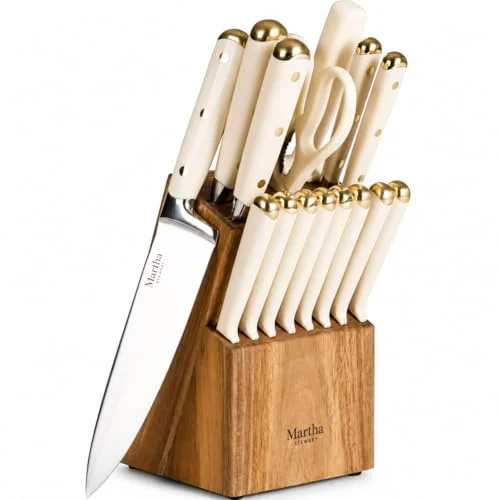
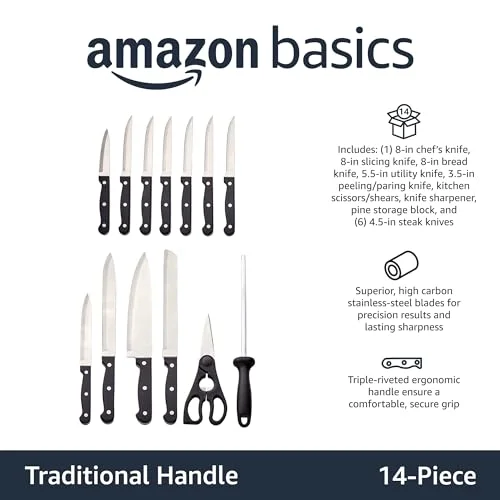
The Martha Stewart Lockton 16-piece set states an acacia wood block outright, finished in linen white and gold, at $68.39. A denser wood holds a cut slot's shape better over years of knives sliding in and out — it resists the slot walls wearing wider or splintering where a blade repeatedly makes contact on its way in. The Amazon Basics 14-piece set, at $22.28, states a pinewood block instead. That is not a hidden downgrade; it is printed in the listing title, exactly the kind of detail we want a set to publish rather than bury. Pine still does the core job — isolating each knife in its own slot — it simply does it with a softer material that shows wear sooner under the same daily use.
What this means in practice: a slot cut into acacia starts tighter and stays truer to its original shape for longer, because the wood itself resists compression and abrasion better. A slot cut into pine can loosen a little faster with heavy daily use. For a lighter-use kitchen, or a second set kept at a cabin or a first apartment, that difference is unlikely to matter inside any reasonable ownership window. For a primary kitchen knife block in daily heavy rotation, the denser wood is the one more likely to still feel snug in five years. Price tracks that difference closely in this catalogue: the acacia block costs more than three times the pine one, and part of what you are paying for is this durability margin, not just the finish.
A different mechanism
Magnetic blocks: the foldable design, and its real advantage
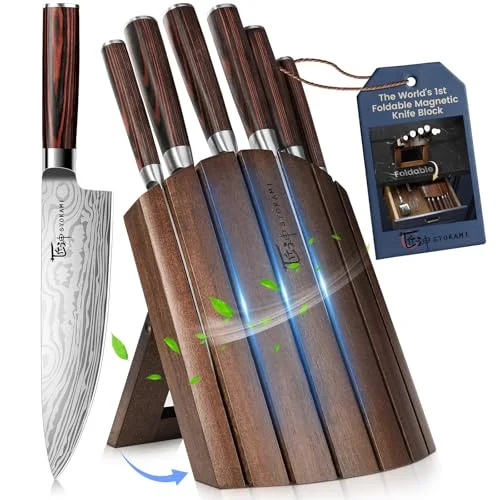
A magnetic block does not cut a slot for each blade at all. Instead, a strip of magnets runs behind a flat wood face, and each knife is held by the flat of its blade against that face rather than dropped into a channel. The SYOKAMI set in this catalogue pairs that mechanism with acacia wood and a foldable design, which changes the storage question from "which slot fits my knife" to "how flat can I make this when I am not using it."
The real advantage of that design is not magnetism for its own sake — it is what magnetic holding removes. A slotted block has a fixed number of fixed-size channels: buy a knife wider or longer than any slot was cut for, and it simply does not fit. A magnetic face has no such ceiling, because it is not shaped around any particular blade width. It is also easier to keep genuinely clean, because there is no narrow channel for crumbs, moisture or stray bits of food to collect in out of sight, the way they can at the bottom of a traditional slot. And because the SYOKAMI block folds, it addresses the complaint every slotted block shares — that it is a fixed block of furniture permanently claiming counter space — by collapsing down when the knives are stored elsewhere or when counter space is tight.
The honest trade-off is attention. A knife held by magnetic contact against a flat face is more exposed than one seated inside a slot on three sides; the edge faces outward rather than being enclosed. That is a different risk profile, not automatically a worse one — it rewards a kitchen where the block sits somewhere a hand will not brush past it carelessly. It also means the knife lifts straight off in one motion, with no slot to align with and no risk of scraping the edge against a wooden channel wall on the way out.
No piece count or blade list is published for the SYOKAMI set beyond the foldable magnetic acacia block itself, so we are not going to guess at what is included. If the exact number and sizing of knives in the box matters to you, check the current Amazon listing before buying rather than assuming it matches another set's contents.
Placement
Humidity, warping, and where not to put any of them
Solid wood moves with moisture, and both acacia and pine are solid wood, which means both can warp, crack or loosen at the joints if they sit somewhere humid for long enough. The slots that fit a knife snugly when the block is dry can tighten or loosen as the surrounding wood swells and shrinks with the season, and in a worst case a warped block no longer sits flat on the counter at all. This is not a flaw unique to the cheaper material, either — acacia resists wear from contact better than pine, but neither wood is immune to what humidity does to its grain over years.
In practice, the dish rack, the area directly behind the sink, and the counter next to the stove are all poor long-term homes for a wood block, for the same underlying reason: steady exposure to steam, splashes or standing moisture. The same caution extends to the dishwasher, for a different reason entirely — it is no accident that "dishwasher safe" claims on knife sets deserve a second look, and a wood block was never designed to survive a wash cycle's heat and detergent.
The magnetic design does not fully escape this problem. SYOKAMI's block is also acacia wood, just arranged around a magnet strip rather than cut into slots, so the same humidity caution applies to its wood face even though there are no channels to swell shut. What the magnetic design does avoid is one specific failure mode: a slot that tightens with humidity and starts gripping the blade too hard on the way out. With no slot to tighten, that problem simply does not exist for a magnetic block — though a warped wood base is still a warped wood base either way.
The practical rule, regardless of which of the three you own: keep the block on a dry stretch of counter, away from the sink and the stove's steam, and dry it immediately if it ever gets splashed. That single habit does more for a wood block's lifespan than any difference between acacia and pine.
The picks
Three block materials, and who each one actually suits
01Densest wood
Martha Stewart Knife Block Set, 16-Piece
Best for a block that stays snug under daily heavy use
16 pieces·Acacia wood block·Forged, full tang·Triple-riveted handles
The Lockton line states an acacia wood block, finished in linen white and gold, at $68.39. Acacia is the denser of the two solid woods in this guide, which is the reason to pick it over pine specifically for the block: it resists the slow widening and splintering that heavy daily use can cause at a slot's edges. The set itself is also forged and full tang, so you are not paying the acacia price purely for the furniture.
The set to buy if the block is going to see a knife pulled from it every single day for years.
02No slots at all
SYOKAMI Foldable Magnetic Acacia Wood Block
Best for avoiding slot wear and reclaiming counter space
Acacia wood·Magnetic, not slotted·Folds flat
The SYOKAMI set pairs acacia wood with a magnetic strip instead of cut slots, so there is no channel to widen, splinter or tighten with the seasons — the blade is held flat against the wood face by the magnet, and lifts straight off. The block also folds, which answers the complaint every fixed slotted block shares: that it permanently claims a strip of counter whether or not the knives are in use. At $71.98, the premium over the pine set is for the mechanism, not just the wood.
The set to buy if counter space is tight, or if you dislike the idea of a blade scraping a wooden channel on every trip in and out.
03Lightest budget
Amazon Basics 14-Piece Knife Set
Best for a complete, honestly specified block at the lowest price
14 pieces·Pinewood block·Full tang·Sharpener included
At $22.28, this set states a pinewood block plainly in its own listing title rather than leaving the material to be guessed at from photos. Pine is the softer, lighter wood of the two solid-wood blocks here, and it still does the core job of a block — keeping each knife isolated in its own slot — it will simply show wear at the slot edges sooner than acacia under the same heavy daily use. For a first kitchen, a second home, or a backup set, that trade-off is a reasonable one at a quarter of the acacia set's price.
The set to buy if the block is a convenience, not a decade-long commitment.
Side by side
The three, compared
| Set | Block material | Mechanism | Pieces | Price | Get it |
|---|
 Martha Stewart Lockton 16-Piece |
Acacia (dense hardwood) |
Slotted |
16 |
$68.39 |
Get it |
 SYOKAMI Foldable Magnetic |
Acacia (dense hardwood) |
Magnetic, foldable |
Not published |
$71.98 |
Get it |
 Amazon Basics 14-Piece |
Pine (softwood) |
Slotted |
14 |
$22.28 |
Get it |
Prices change. We refresh them, but Amazon is the authority at the moment you buy. For the full lineup across every budget, see the buying guide or the splurge-worthy sets if block mechanism matters less to you than steel.
The counter-argument
When a block is not the right answer at all
Everything above assumes you want a block, slotted or magnetic, sitting on the counter. For a lot of kitchens that is the right call — a block keeps knives visible, accessible and isolated from each other with zero daily thought required. But a block is also a fixed commitment of counter space and, for wood versions, an object that needs to stay dry and out of the dishwasher for its entire life. If your kitchen is short on counter space, or you already store knives safely some other way, none of that is a reason to buy one.
An in-drawer knife tray solves the isolation problem without claiming any counter real estate — each knife still gets its own slot, just horizontal instead of vertical, tucked inside a drawer you were already going to have. A wall-mounted magnetic strip solves it the way the SYOKAMI block does, minus the acacia base and the fold, for less money and even less footprint, though it trades away the block's countertop-stable feel for something more exposed and fixed to a wall. Either is a legitimate answer for a small kitchen, a rental, or a cook who simply does not want more furniture on the counter.
There is also a simpler question worth asking first: how many knives do you actually keep out and use daily? If it is three — a chef's knife, a paring knife, a bread knife — the piece count on a 14- or 16-piece block set includes a lot of steel you are not touching, and the block is mostly storing knives you reach for a handful of times a year. In that case, the better fix for cross-contact and chipped edges might not be any of the three materials in this guide; it might be fewer knives, stored in whatever smallest safe option fits your counter. A block only earns the space it takes up if you are using most of what it holds.
Our method
How we compared — and what we can't tell you
What we did
Materials, mechanism and general wood facts
We compared the published block material and mechanism for each set in this catalogue — acacia, pine, slotted or magnetic — against general, well-established facts about hardwood versus softwood density and how solid wood responds to moisture, rather than against any invented durability score. Where a set does not publish a piece count or dimension, we said so instead of guessing.
What we didn't
We don't run a testing lab
We did not physically test any of these blocks for wear, warping or magnet strength over time, we do not own them, and we do not publish invented scores or star ratings. We have no verified review data for these specific products, so we do not paraphrase owner sentiment either. What we can do honestly is read every published spec, set it against general material facts, and tell you plainly which claims are checkable and which are not.
FAQ
Common questions
Does a knife block's material actually affect how long my knives stay sharp?
Indirectly, yes. The block's job is to keep the edge away from other metal and from unnecessary contact, and a denser wood like acacia holds a slot's shape longer under daily use than a softer wood like pine, which means the blade keeps sitting cleanly in the slot rather than rocking against worn wood. The block does not sharpen or dull a knife on its own either way — that comes down to use, cutting surface and how often you sharpen — but a well-fitted slot reduces one more source of edge damage over years of ownership.
Why do some blocks use acacia and others use pine?
Cost and durability, mainly. Acacia is a denser hardwood that resists wear and holds a cut slot's shape better over years of heavy use, and it costs more to source and finish because of that density. Pine is a lighter softwood that is cheaper to mill into a block shape and still does the core job of isolating each knife, it simply shows wear at the slot edges sooner under the same amount of daily use. Neither choice is a defect; a manufacturer is choosing where on that price-versus-durability line to sit.
What's the real advantage of a magnetic block over slotted wood?
No fixed-size channel to outgrow, and nothing for crumbs or moisture to collect in out of sight. A magnetic block like SYOKAMI's holds the blade flat against a magnetized wood face instead of dropping it into a cut slot, so there is no channel to widen, splinter or tighten with humidity, and a wide or oddly shaped blade is not locked out the way it can be by a slot cut for a narrower knife. The foldable version also gives back counter space when the knives are stored elsewhere, which a fixed slotted block cannot do.
Where should I avoid putting a wood knife block in the kitchen?
Anywhere that sees regular steam, splashes or standing moisture: directly behind the sink, next to the stove, in the dish rack, or anywhere near the dishwasher's exhaust. Solid wood, whether acacia or pine, moves with moisture and can warp, crack or loosen at the joints if it sits somewhere humid for long enough. Keep the block on a dry stretch of counter and dry it immediately if it ever gets splashed; that single habit matters more to a wood block's lifespan than the difference between the two woods.
Keep reading
Related on Best Knife Sets