The language
The words every listing uses, and the data behind none of them
“Ultra-sharp” and “razor-sharp” are not technical terms. There is no body that certifies a blade as either one, no threshold of degrees or Rockwell hardness that a manufacturer crosses to earn the phrase, and no requirement that the claim survive a single use before the listing goes live. Compare that with a spec like “56±2 HRC” or “15° per side”: both are checkable, both come from a measurement, and both can be wrong in a way a reviewer or a competitor could call out. “Razor-sharp” cannot be wrong in that sense, because it was never a claim with a falsifiable floor. It is closer to “delicious” on a restaurant menu than to a nutrition label.
That does not make the phrase meaningless, exactly — it is usually true in the narrow sense that a brand-new blade, any brand-new blade, cuts better than the dull one it is replacing in your drawer. The Astercook 6-Piece set markets itself as “High Carbon Stainless Steel Ultra Sharp,” the Farberware 15-Piece set uses “Razor Sharp” in its own title, and the HOSHANHO 20-piece set calls itself “Ultra Sharp” as well. Three sets, three price points roughly fifteen times apart, and the identical adjective on all three. That spread alone is the tell: if the word correlated with an actual measurement of edge quality, it would not appear with equal confidence on a $18.98 six-piece set and a $284.99 twenty-piece set with no price-scaled claim attached to either.
None of this means the knives arrive dull. It means the word is not the information you think it is, and the information you actually want — the edge angle, the steel grade, the hardness number — sits elsewhere in the listing, if it is published at all. Below is what you can check instead, and what each of the three sets in this guide actually states.
Out of the box
What actually makes a new knife feel sharp out of the box
Every knife, regardless of price, ships with the sharpest edge it will ever have. That is simply how manufacturing works: the factory grinds the bevel, polishes it, and boxes the knife before it has cut anything. The feeling of sharpness you get on day one is a property of a fresh edge meeting a tomato skin or a sheet of paper for the first time, not necessarily a property of the steel underneath it. A $20 stamped blade and a $200 forged one can both feel shockingly sharp in the first week, because both received a factory edge and neither has yet met a cutting board, a dishwasher cycle or a drawer full of other utensils.
What separates them is not day one. It is what the edge does after a few dozen uses, and that comes down to two published details worth checking: the steel itself and the angle it was ground to. “High carbon stainless steel” — the material stated for both the Astercook and Farberware sets — describes a steel family capable of holding a good edge, but “high carbon stainless” covers a wide range of actual alloys and hardness levels, and neither listing publishes a specific grade or Rockwell figure. The HOSHANHO set markets itself as “Japanese” style, a tradition generally associated with narrower, harder-ground edges, but without a stated angle or hardness number from the listing itself, that too is a description of style rather than a verifiable spec.
The honest version of this section is short: none of the three products in this guide publish an edge angle in degrees or a Rockwell hardness figure. That is common in this category, not unusual to these three, and it is exactly the gap that “ultra-sharp” is standing in to fill. If a specific hardness or angle number matters to your decision, it is not available here and you would need to look elsewhere in the category for a listing that states one, or confirm directly with the seller before buying.
A check you can run
The paper-cut test, and why it is not nothing
You do not need a lab to learn something real about an edge. Hold a sheet of ordinary printer paper by one corner, unsupported, and draw the blade through it with light pressure and no sawing motion. A genuinely sharp edge slices a clean line through the sheet on the first pass. An edge that is merely adequate will tear, crumple the paper, or need two or three strokes to get through. This is sometimes called the paper-cut test, and it is a real, reproducible measure of edge quality at that moment — it just measures something narrower than “sharp” as a marketing word implies.
What it tells you: whether the edge in front of you, right now, is capable of a clean slicing cut with minimal pressure. That is useful information the day the knife arrives, and useful again six months later to see how much the edge has degraded. What it does not tell you: how long that edge will last under real kitchen use, how it holds up against bone or a frozen surface, or how it compares to a different knife's edge retention over a year of ordinary cooking. A thin, soft blade can pass the paper test beautifully on day one and lose that edge within weeks of regular use, while a harder, slightly less keen factory edge might test a notch worse on paper but hold its working sharpness for much longer.
The honest way to use it: as a same-day verification that what arrived in the box is not dull on delivery, and as a periodic check-in over the following months to see how fast the edge is actually degrading in your kitchen, with your cutting board, under your washing habits. It is not a way to compare the Astercook, Farberware and HOSHANHO sets against each other from a listing page — none of us have physically run the test on these specific units, and we are not claiming to have. It is a tool for you, once a set is in your kitchen, not a tool for choosing between listings before you buy.
Day one versus year one
Factory edge versus the edge after a year
The gap between how a knife set is marketed and how it performs mostly opens up after the first few weeks, which is exactly the period a listing's photography and adjectives cannot show you. A factory edge is ground by machine to a consistent angle across every unit that ships, polished to a mirror finish that catches light well in a product photo, and untouched by anything harder than the cardboard box it traveled in. A year of real use introduces variables no listing addresses: a cutting board that is glass instead of wood, a dishwasher cycle every few days instead of a hand wash, a drawer where the blade knocks against a can opener, a cook who twists the blade through a dense squash instead of rocking it.
None of the three products here publish any data about edge retention over time — no manufacturer in this category typically does, because it would require the kind of longitudinal lab testing that costs more than the knife set itself and that we are not able to perform or claim to have performed. What is publicly knowable, and worth stating plainly: high carbon stainless steel, the material named for the Astercook and Farberware sets, generally holds an edge longer than plain stainless but is more reactive to prolonged moisture exposure than fully stainless alternatives, which is a real reason to dry a blade immediately after washing rather than leave it on a rack. Dishwasher cycles are broadly understood to accelerate edge dulling across virtually all kitchen knife steels, regardless of brand or marketing language, because of the combination of heat, detergent alkalinity and contact with other items in the rack.
The practical upshot: the adjective on the box describes the day the knife left the factory. The condition of that same knife in twelve months depends far more on how it is stored, washed and used than on whether the listing said “ultra-sharp” or “razor-sharp.” Buying for the word buys you nothing that buying for the steel grade and the storage habits you are willing to maintain would not buy you just as well.
Price and language
Why price does not predict how a set is described
If sharpness-marketing scaled with price, you would expect the cheapest set in a category to undersell itself and the most expensive to lean hardest on the claim, or some consistent pattern either direction. That is not what happens here. The Astercook 6-Piece set, at $18.98, uses “Ultra Sharp” in its title. The Farberware 15-Piece set, at $35.18, uses “Razor Sharp” in its own title. The HOSHANHO 20-piece set, at $284.99 — roughly 15 times the price of the Astercook set and 8 times the Farberware set — also uses “Ultra Sharp” in its name. The adjective shows up at every price point this guide covers, with no visible correlation to what you are actually paying.
What does scale with price, at least directionally across this trio, is piece count and the claims around construction and origin rather than sharpness itself: six pieces for the Astercook, fifteen for the Farberware with an added sharpening tool and shears, twenty for the HOSHANHO with a Japanese-style positioning. The HOSHANHO's price is doing more work to justify piece count, included accessories and style positioning than it is doing to justify a sharper edge specifically — because, again, none of the three listings publish an edge-angle or hardness figure that would let you compare sharpness as a number rather than an adjective.
The lesson generalizes past these three products: in this category, “sharp” language is close to universal across the price range, which means it carries almost no signal about where a given set sits in that range. If you are trying to predict quality or value from a listing, the adjective is one of the least useful words on the page. The piece count, the stated material, and whether any construction detail is published in writing tell you far more about what you are actually paying for.
The picks
The picks, and what to check instead of the adjective
01Lowest entry price
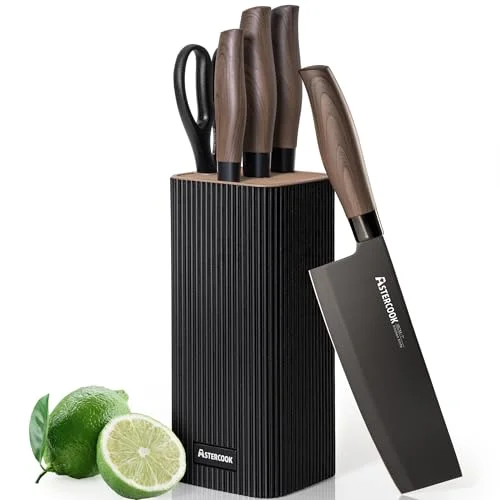
Astercook 6-Piece Knife Set with Block
Best for a minimal first set, checked on steel and piece count rather than the adjective
6 pieces·High carbon stainless·Wood grain handle·Dishwasher safe
The Astercook set markets itself with the words “Ultra Sharp” in its own title, the same phrase used by sets costing nearly twenty times as much, which is exactly the signal to set aside. What the listing states and what is worth checking instead: high carbon stainless steel construction, a wood grain handle, and dishwasher-safe blades, at $18.98 for six pieces with a block. No edge angle or hardness figure is published, so take the sharpness claim as the universal marketing language it is rather than a measured advantage over the other two sets here.
The set to buy if you want a small, complete kitchen knife set at the lowest price on this page — judge it on the steel and the block, not the word on the box.
02Most included for the price
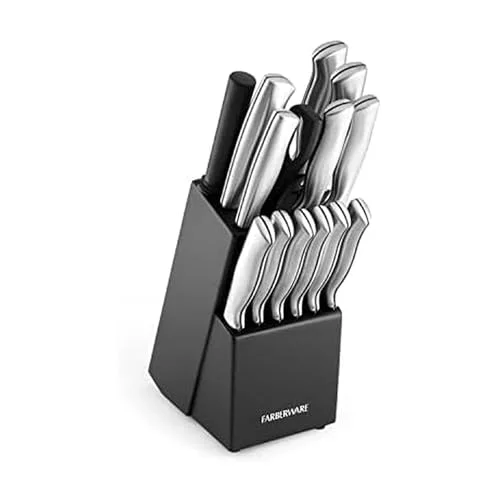
Farberware 15-Piece Knife Set with Block
Best for the most pieces per dollar, with the same caveat on the adjective
15 pieces·High carbon stainless·Sharpening tool & shears included·Ergonomic stainless handles
Farberware's own title states “Razor Sharp,” its version of the identical claim the Astercook set makes at a lower price and the HOSHANHO set makes at roughly eight times the price. What distinguishes this set on paper is the contents: fifteen pieces including steak knives, a built-in sharpening tool and all-purpose shears, in high carbon stainless with stainless steel handles, for $35.18. The sharpening tool included in the set is arguably more useful to long-term edge quality than any adjective on the box, since it gives you a way to maintain the edge yourself rather than relying on the factory grind alone.
The set to buy if you want the most pieces and a built-in way to maintain the edge, rather than trusting the factory edge to last on marketing alone.
03Japanese-style, premium tier
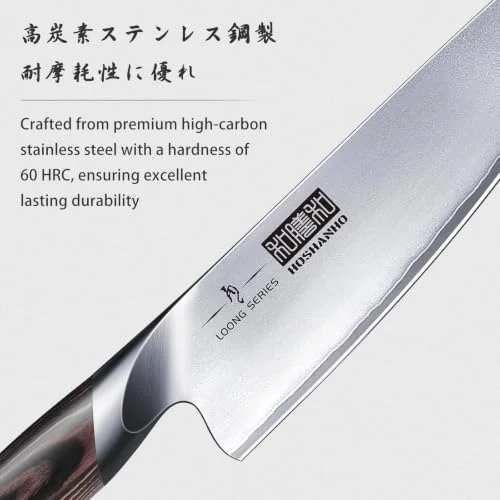
HOSHANHO 20-Piece Japanese-Style Knife Set with Block
Best if you want a larger Japanese-style set and are paying for piece count and positioning, not a measured edge
20 pieces·Japanese-style·Block included
At $284.99, the HOSHANHO set is priced well above both other sets in this guide, and it uses the identical “Ultra Sharp” phrase found on the $18.98 Astercook set. That is the clearest illustration in this entire category of the point this guide is making: the adjective tracks nothing about where a set sits in price or, as far as the listing states, in measured edge quality. What the price is buying, based on what is published, is piece count — twenty pieces against six or fifteen — and a Japanese-style positioning. No specific edge angle, steel grade or hardness figure is stated in the listing details available to us, so treat the premium as a reflection of included quantity and style framing rather than a verified sharpness advantage.
The set to buy if twenty pieces and Japanese-style knives are what you want — not because the word “ultra-sharp” means more here than it does on the $18.98 set.
Side by side
The three, compared
| Set | Best for | Pieces | Listed material | Price | Get it |
|---|
 Astercook 6-Piece |
Lowest entry price |
6 |
High carbon stainless |
$18.98 |
Get it |
 Farberware 15-Piece |
Most included, sharpener built in |
15 |
High carbon stainless |
$35.18 |
Get it |
 HOSHANHO 20-Piece |
Japanese-style, premium tier |
20 |
Not specified beyond style |
$284.99 |
Get it |
Prices change. We refresh them, but Amazon is the authority at the moment you buy. For sets in a specific budget range, see the best knife sets under $30 or the best sets between $100 and $200.
The checklist
What to check instead of the adjective, on any listing
Checkable
Facts a listing can state in writing
Steel type (high carbon stainless, Japanese-style, etc.), piece count with an itemized breakdown, whether a sharpener or sharpening tool is included, construction detail such as full tang, block material per our block material guide, and whether the set is stated as dishwasher safe. Each of these is something the manufacturer commits to in writing, which means it can be checked against the product you receive.
Not checkable from a listing
Words that describe a feeling, not a measurement
“Ultra-sharp,” “razor-sharp,” “professional-grade” and similar phrases describe an impression the brand wants you to have, not a number you can verify before buying. An edge angle in degrees or a Rockwell hardness figure would be checkable; an adjective is not. If a listing gives you the adjective without the number, treat the adjective as decoration and look for the number elsewhere on the page, or accept that it isn’t published for that product.
Our method
How we researched this — and what we can't tell you
What we did
Specs, prices and listing language
We compared published specifications, current Amazon prices and the exact marketing language used in the titles and bullet points of knife sets sold in this category in the US, looking specifically at how often sharpness-related adjectives appear versus how often a measurable spec — edge angle, steel grade, Rockwell hardness — accompanies them.
What we didn’t
We don’t run a testing lab
We do not physically test these knives, we do not own them, and we have not run the paper-cut test described in this guide on these specific units. We describe that test because it is a real, reproducible check you can run yourself at home, not because we are claiming results from running it. We have no verified review data for these products, so we do not paraphrase owner sentiment either — every claim above is anchored to a published spec, a price, or a general domain fact about steel and sharpening.
FAQ
Common questions
Does "ultra-sharp" or "razor-sharp" on a listing mean anything at all?
It means the brand wants you to associate the product with sharpness, but it is not a measured claim the way an edge angle in degrees or a Rockwell hardness figure would be. In this category the phrase appears on sets across the entire price range we looked at, from $18.98 to $284.99, with no visible correlation to price or to any published spec. Treat it as marketing language rather than a data point, and look for a stated angle, steel grade or hardness number if you want something checkable.
What is the paper-cut test, and can I trust it?
Hold a sheet of printer paper by one corner and draw the blade through with light pressure and no sawing motion. A genuinely sharp edge slices cleanly on the first pass; a duller edge tears or needs multiple strokes. It is a real, reproducible check of the edge in front of you at that moment, but it does not predict how long that edge will last under regular kitchen use, and it is not a way to compare different products from their listing pages before you own them.
Why does a $284.99 set use the same sharpness claim as a $18.98 set?
Because the claim is not tied to a measurement that would scale with price or quality. The HOSHANHO 20-piece set, the Astercook 6-piece set and the Farberware 15-piece set in this guide all use "ultra-sharp" or "razor-sharp" in their own titles despite spanning roughly a 15-to-1 price range. What the higher price in this trio is paying for, based on what is published, is piece count and style positioning, not a stated sharpness advantage.
What should I check instead of the sharpness claim before buying?
Look for an itemized piece count, the stated steel type, whether a sharpener or sharpening tool is included, construction details like full tang, and whether the set is stated as dishwasher safe. These are facts a manufacturer commits to in writing and that you can verify against the product you receive. An edge angle in degrees or a Rockwell hardness number would also be checkable, but very few listings in this category publish either.
Keep reading
Related on Best Knife Sets