The step up
What the under-$100 sets do not have
Our under-$30 guide and the sets that sit just below the $100 line share one pattern: a manufacturer usually gets to pick two of three things — forged construction, a confirmed full-tang handle, or a built-in sharpener — and leaves the third unstated. Below $100, those details tend to arrive one or two at a time, and a reader has to go looking for whichever one is missing. Cross the $100 line and that pattern breaks. All three sets in this guide publish a construction method, a full-tang claim, and a sharpening mechanism built into the block, with no detail quietly dropped to hit the price.
What actually changes, then, is not whether the basics are present — in this bracket they almost always are — but how much supporting detail a listing is willing to put in writing around those basics. The Henckels Statement set leans on a hundred years of brand history rather than a spec sheet. McCook publishes a Rockwell hardness figure and a named edge angle. imarku publishes both, plus a stated edge range and full-tang construction, and prices $4.76 to $73.50 higher than the other two for doing it. The gap between $100 and $200 is mostly a gap in how much a listing is willing to prove, not in whether the knife underneath is dramatically different steel.
Construction
"Precision-forged": what the claim is worth here
Two of the three sets in this bracket use the phrase "precision-forged" rather than the plainer "forged" used by sets closer to $100. McCook's listing states that "each precision-forged blade delivers clean, effortless cuts," and imarku's title leads with "Precision-Forged Gyutou Kitchen Knives." Forging itself means hammering a blade from a single bar of steel rather than cutting it from a sheet — that part of the claim is the same construction method covered in our full-tang explainer, and it is checkable the same way: by whether the listing states it plainly, which both of these do.
"Precision" is the word doing no verifiable work. Neither listing defines what precision-forging adds on top of forging — a tighter tolerance on blade thickness, a specific hammering process, a quality-control step — and neither publishes a number that would let a reader check the claim independently. That doesn't make it false; it makes it unconfirmable from the listing alone, which is the standard we hold every adjective to on this site. What is confirmable: McCook states the resulting steel at HRC 57±2 and a 15-degree edge angle, and imarku states a 10–15-degree edge, hand-honed, in high-carbon stainless. Those two figures are the part of "precision-forged" you can actually act on. The word in front of "forged" is marketing; the hardness number and the edge angle behind it are specification.
The Henckels Statement set, by contrast, doesn't claim forged construction of any kind here, precision or otherwise — its listing talks about sharpness and German engineering, not blade-making method. That's consistent with what we found comparing it elsewhere on this site: it's a stamped blade, and there's nothing dishonest about that. A stamped blade is lighter and easier to handle through a long prep session, and plenty of good knives are stamped. The point of calling out "precision-forged" here isn't to declare forged superior — it's that a reader paying $49.99 to $123.49 should know which of these three sets is actually making a forging claim, and which is selling you on heritage instead.
Maintenance
The sharpener mechanism here versus at fifty dollars
Both McCook and imarku build a sharpener into the knife block, and both listings describe it in confident, almost identical language: pull the blade through the slot on the way back in, and the edge gets touched up. McCook calls it a way to "never worry about sharpening again." imarku promises a few passes will "restore razor edges in seconds." Mechanically, this is the same pull-through sharpener design used in sets that cost a fraction of the price — an abrasive slot built into the block that the blade passes through, nothing more exotic than that.
What changes between a fifty-dollar set and these two is not the mechanism, it's the specificity of the copy wrapped around it. A budget listing will say "built-in sharpener" and stop there. McCook pairs the sharpener claim with a stated Rockwell hardness and a named edge angle, which at least tells you what the sharpener is maintaining. imarku goes a step further and frames the sharpener against a stated edge range rather than a generic promise. Neither extra layer of detail changes what the hardware physically does; a pull-through slot cannot reset a damaged edge, square off a chip, or change the grind angle the way a whetstone can, at any price. What the added detail buys you is a better idea of what you're starting from before you ever use the sharpener.
The practical takeaway carries over from every price tier we've covered: if you already own a whetstone and know how to use it, a built-in sharpener in this bracket is not a reason to spend more than a cheaper set with the same feature. If you don't, and you know you never will, paying for one with a published hardness figure at least tells you what level of steel you're keeping sharp.
The phrase
"German engineering," and what backs it up
The Henckels Statement set markets itself as "German Engineered," calling itself "the last knife you'll ever need to buy" and citing "over 100 years of mastery." HENCKELS is a real, long-standing German cutlery house, and that history is the part of the claim that's actually verifiable — the brand exists, it has made knives for a long time, and it puts a known name and warranty behind a $118.73 set. That's worth something a no-name listing can't offer: a company with a reputation to protect if the blades fail.
What "German engineered" does not tell you, and what the listing doesn't state, is where these specific blades are manufactured today, what steel alloy is used, or any hardness figure to compare against McCook's published 57±2 HRC or imarku's stated edge range. "Engineered" is a design-and-heritage word, not a materials spec, and treating it as one is the mistake worth avoiding. The set's own marketing leans entirely on sharpness ("professional-level") and brand history, not on a single checkable number about the steel itself — which puts it in an odd position in this bracket: priced closest to the floor of our $100–$200 range, but published with the fewest specifications of the three.
None of that makes the Henckels set a bad buy. A famous name with a century of history and a transparent return policy is a real form of assurance, just a different one from a Rockwell number. The honest way to use the phrase "German engineering" when comparing sets is as a heritage signal, not a specification — and to go looking for the actual steel figures elsewhere in the listing, or accept that for this particular set, they simply aren't published.
The picks
Three sets between $100 and $200, and what each one is actually selling
01The name you already know
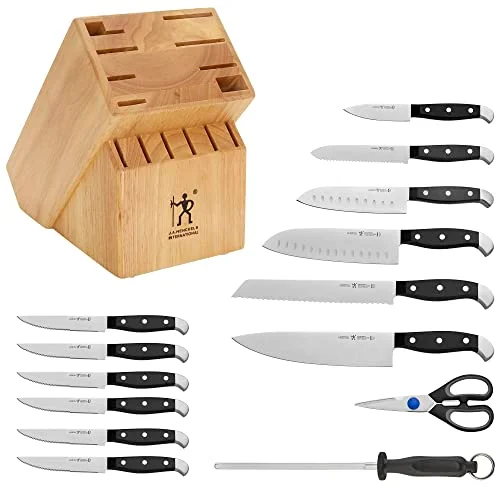
Henckels Statement 15-Piece Knife Block Set
Best for buying a brand's history, not a spec sheet
15 pieces·German engineered·No hardness figure published
HENCKELS is the accessible line of a German cutlery house with over a century behind it, and the Statement set sits at the floor of this bracket on that reputation alone. The listing markets "professional-level sharpness" and calls itself "the last knife you'll ever need to buy," which no knife is — any blade dulls, and whether this one is still good in five years depends on whether it's sharpened and kept out of the dishwasher. What you're actually buying at $118.73 is the HENCKELS name and warranty standing behind a set that doesn't publish a construction method or a hardness number the way its two neighbors here do.
The set to buy if a known German name and a lighter blade matter more to you than a published spec sheet.
02Most published specs for the money
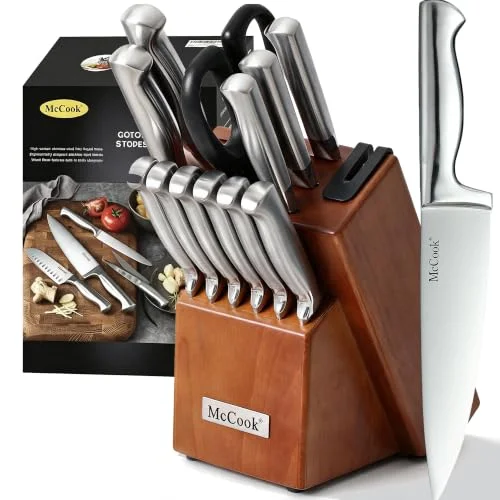
McCook 15-Piece Knife Block Set with Built-In Sharpener
Best for a stated hardness figure and a full contents list
15 pieces·HRC 57±2·15° edge·Built-in sharpener
At $49.99 — less than half what the Henckels set costs — McCook publishes the two numbers Henckels doesn't: a Rockwell hardness of 57±2 and a 15-degree edge angle, on precision-forged high-carbon stainless. The 15-piece contents are itemized down to the knife: an 8-inch chef's, an 8-inch slicer, a 5-inch santoku, two utility knives, a paring knife, six 4.5-inch steak knives, two pairs of kitchen shears, and a hardwood block with the sharpener built in. That's the most specific listing of the three, piece for piece and number for number.
The set to buy if you want a checkable hardness figure and a full accounting of what's in the box, for the same money as the brand-name alternative.
03The Japanese-style ceiling of this bracket
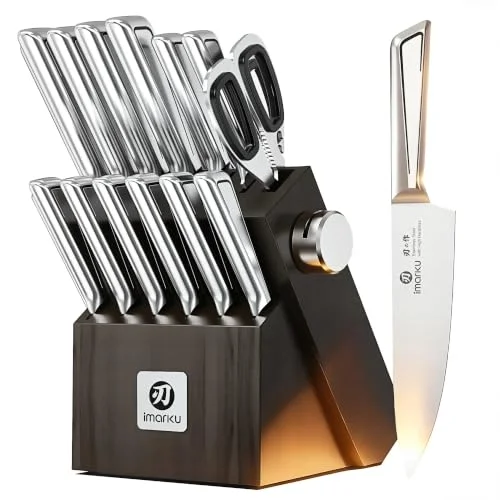
imarku Japanese High Carbon Stainless Steel Gyutou Knife Set
Best for a narrower edge and a stated full-tang handle
14 pieces·10–15° edge·Full-tang handle·Dishwasher safe
At $123.49 — the top of this bracket — imarku's gyutou set states the most on its own listing: precision-forged high-carbon stainless, hand-honed to a 10–15-degree edge, a full-tang handle for balance, a built-in sharpener, and dishwasher-safe construction. (Our dishwasher-safe explainer covers what that label actually promises and doesn't.) A gyutou is the Japanese equivalent of a chef's knife, and the narrower stated edge range — versus the roughly 20-degree edge typical of a German-style blade — is the real difference buyers are paying for here, not just a higher number on the price tag.
The set to buy if the gyutou profile and a narrower, stated edge range are what you actually want, and you're willing to spend up to the top of this bracket to get a full-tang claim in writing.
Side by side
The three, compared
| Set | Best for | Pieces | Construction | Sharpener | Price | Get it |
|---|
 Henckels Statement |
Brand name over spec sheet |
15 |
German engineered, no hardness published |
Not built in |
$118.73 |
Get it |
 McCook 15-Piece |
Most published specs |
15 |
Precision-forged, HRC 57±2, 15° edge |
Built into the block |
$49.99 |
Get it |
 imarku Gyutou 14-Piece |
Narrower Japanese-style edge |
14 |
Precision-forged, 10–15° edge, full tang |
Built into the block |
$123.49 |
Get it |
Prices change. We refresh them, but Amazon is the authority at the moment you buy. See our splurge-worthy picks if your budget stretches past $200, or the buying guide for how to weigh these details for your own kitchen.
The top of this bracket
Where $200 stops buying anything new
Line these three up by price and the jump from $49.99 to $123.49 does not buy a new category of knife. McCook, at $49.99, already publishes a hardness figure, a named edge angle and a full-tang-adjacent construction claim. imarku, at $123.49 — $73.50 more — publishes a hardness-adjacent edge range, a full-tang claim stated outright, and a narrower Japanese-style grind. That narrower edge and the gyutou profile are real differences and the main thing the extra money is actually paying for. What it is not paying for is a fundamentally different tier of steel: both sets describe high-carbon stainless, both are forged with the word "precision" attached, and neither publishes an alloy name, a carbon percentage, or a verified Rockwell figure beyond McCook's own self-reported number.
That's the pattern worth remembering before spending up to the ceiling of this bracket: between $100 and $200, you're mostly paying for a specific edge geometry and more detailed marketing copy, not a different grade of raw material. The genuinely different tier — named steel alloys, verified third-party hardness testing, single-bevel Japanese construction, lifetime warranties backed by a dedicated knife company rather than a general houseware brand — shows up above $200, which is where our splurge-worthy roundup picks up. If what you want is simply a sharper, narrower edge for a reasonable step up from a $49.99 set, imarku's gyutou is the honest way to get it inside this bracket. If you're hoping $123.49 buys meaningfully better steel than $49.99, on the published specs alone, it doesn't — it buys a different shape.
Our method
How we picked — and what we can't tell you
What we did
Specs, prices and published listings
We compared published specifications and current Amazon prices for kitchen knife sets sold in the US between $100 and $200, then read each listing for anything checkable — a Rockwell hardness figure, a named edge angle, a stated construction method, an itemized contents list — rather than taking brand adjectives like "precision-forged" or "German engineered" as specifications in themselves.
What we didn't
We don't run a testing lab
We do not physically test these knives, we do not own them, and we do not publish invented scores or star ratings. We have no verified review data for these specific products, so we don't paraphrase owner sentiment either. What we can do honestly is read every published specification, set them against each other, and tell you plainly which claims are backed by a number and which are an adjective doing the work a number should.
FAQ
Common questions
What does "German engineered" actually guarantee on a knife set?
It guarantees a brand's design heritage and, often, the warranty standing behind it — not a specific steel alloy or hardness figure. HENCKELS is a genuine German cutlery house with over a century of history, and that reputation is real and worth something. What the phrase doesn't tell you is where a specific set is manufactured today or how hard the steel is; for that, look for a published Rockwell number elsewhere in the listing, and if it isn't there, treat "German engineered" as a heritage claim rather than a spec.
Does "precision-forged" mean something different from plain "forged"?
Forging — hammering a blade from a single bar of steel rather than cutting it from a sheet — is the checkable part of the claim, and it's the same construction method whether a listing calls it "forged" or "precision-forged." Neither of the listings using "precision-forged" in this bracket defines what the extra word adds on top of forging, and neither publishes a number to verify it. Treat it as the same construction claim with a more expensive-sounding adjective in front of it, and look at the actual hardness figure or edge angle published alongside it instead.
Is the built-in sharpener at $49.99 to $123.49 better than the one in a $25 set?
Mechanically, no — it's the same pull-through sharpener design at every price point, an abrasive slot built into the block that the blade passes through on the way back in. What changes in this bracket is the detail published around it: McCook and imarku both pair the sharpener with a stated hardness figure or edge angle, so you at least know what level of steel is being maintained. The sharpener itself still can't reset a damaged edge or change the grind angle the way a whetstone can, at any price.
Does $123.49 buy meaningfully better steel than $49.99 in this bracket?
Not on the published specs alone. McCook, at $49.99, already states a Rockwell hardness and a named edge angle. imarku, at $123.49, states a narrower edge range and a full-tang claim, but both describe high-carbon stainless steel with no named alloy or third-party-verified hardness test. The $73.50 gap mostly buys a different edge geometry — the narrower, Japanese-style gyutou grind — not a different tier of raw material. Named alloys and verified testing tend to show up further above $200.
Keep reading
Related on Best Knife Sets