First principles
What a handle actually has to resist
A blade's only job is to stay sharp. A handle's job is harder to summarize, because it is doing three different things at once, under conditions that steel never has to deal with. It has to stay in your hand when your hand is wet — straight from the tap, or just after rinsing a cutting board. It has to stay in your hand when your hand is greasy, after breaking down a chicken thigh or trimming fat off a roast, which is a different failure mode from wet: wet is water finding the smoothest path off a surface, fat is a film that keeps the surface lubricated no matter how hard you grip. And it has to transmit pressure evenly from your palm and fingers into the blade, through a full stroke, without digging into your hand or rolling under load.
Most handle marketing addresses exactly one of those three. “Anti-slip” is almost always about the wet-hand case — a textured or contoured surface that gives water somewhere to go instead of sitting as a film under your palm. It says nothing about grease, which beads differently and clings to texture rather than running off it. “Full tang” and rivet count are about the third case, pressure transmission, because a handle with steel running its full length distributes force more evenly than a stub of steel buried in a block of molded plastic. None of the three sets in this guide claim to solve all three problems with one feature, and that is honest — no single handle design does.
The practical consequence: read a listing's handle claims as answers to a specific question, not a general promise. “Anti-slip” answers the wet-hand question. “Full tang” and rivets answer the pressure question. Neither one, on its own, tells you how the handle behaves when your hands are greasy, which for a lot of home cooking — butchering, oiling a roast, working with butter — is the condition that actually matters most.
Materials
ABS versus wood versus polymer, and why ABS wins the dishwasher
Three materials cover most kitchen knife handles sold today. Wood is the oldest: warm to hold, genuinely comfortable over a long prep session, and the one material that a dishwasher reliably ruins. Hot water and detergent swell wood fibers, repeated cycles dry them back out unevenly, and the result over months is a handle that cracks, loosens around its rivets, or warps enough that it no longer sits flush against the tang. Wood handles are not fragile in normal hand-washed use. They are specifically incompatible with a dishwasher's combination of heat, water and detergent, which is why a listing that pairs a wood-look handle with a dishwasher-safe claim deserves a second look at what the handle is actually made of.
ABS — acrylonitrile butadiene styrene, the same plastic family used in a lot of appliance housings and power tool casings — is the material that actually survives that cycle. It does not absorb water, does not swell or crack under repeated heat exposure, and can be molded directly around a knife's tang in one piece, which is part of why dishwasher-safe handles tend to be molded rather than built up from separate parts. “Polymer” on a listing is usually a less specific term for the same category — a synthetic resin molded around the tang — and functions the same way in practice: it survives the dishwasher, it doesn't absorb grease the way wood's open grain can, and it costs less to manufacture at scale than a riveted wood handle does.
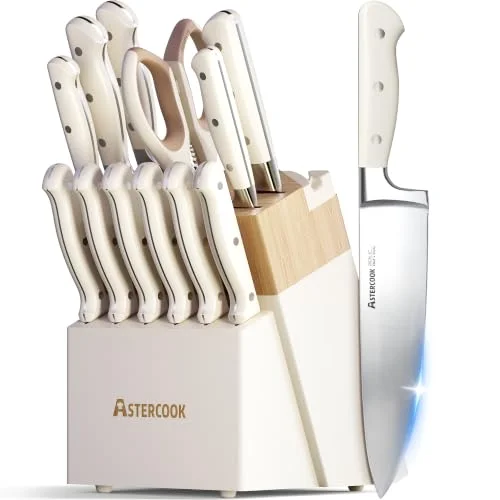
The Astercook 14-piece set in this guide states its handle is dishwasher-safe and anti-slip. The listing doesn't specify the exact synthetic resin, and we won't assert a spec it doesn't publish, but the combination of claims is the signature of a molded synthetic handle: wood simply cannot carry a dishwasher-safe claim honestly, which means the practical category is ABS or a comparable polymer, whatever Astercook's own material sheet calls it internally. That is a reasonable inference from what dishwasher-safe requires, not an invented spec.
None of this makes wood the wrong choice. A hand-washed wood handle, properly dried and never left to sit in a sink, can outlast a synthetic one and feels noticeably different in the hand — warmer, slightly textured by the grain, less slick when actually dry. The honest trade is convenience against feel: ABS and polymer handles trade some of that tactile warmth for a handle you can run through a dishwasher without a second thought, which for a lot of households is simply the correct trade.
Construction
Triple rivets, and what they are actually holding together
A rivet, on a kitchen knife, is doing one specific job: pinning the handle scales — the two slabs of material, usually wood or a wood-composite, bolted onto either face of the tang — permanently to the steel running through the middle. Three rivets instead of one or two spreads that clamping force across more points along the handle's length, which matters because a handle under load during a hard cut is being twisted and flexed, not just pulled straight. A single rivet near the bolster can hold a handle together for light work and still let it work loose, almost imperceptibly, after months of the twisting that comes with real use — chopping, not just slicing.
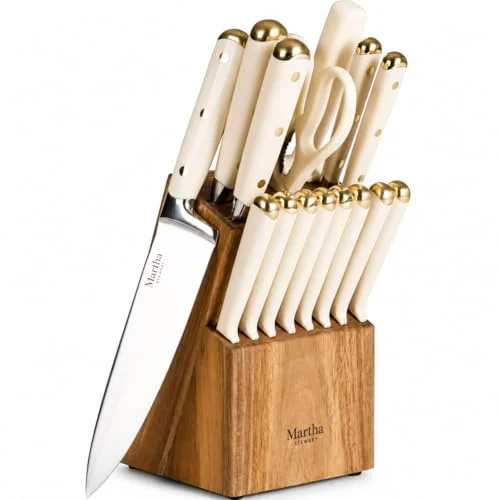
This is also why rivets are a specific tell about what kind of handle you're looking at. You rivet scales onto a tang. You do not rivet a handle that was injection-molded in one piece around the tang, because there is nothing to pin — the material is already continuous and fused to the steel. So “triple riveted” on a listing is functionally a material claim as much as a construction claim: it tells you the handle is built from separate scales clamped to the tang, which in practice means wood or a wood-composite material, not a molded synthetic. The Martha Stewart Lockton 16-piece set in this guide states triple-riveted handles alongside forged, full-tang blades, which is internally consistent — a forged full-tang blade is exactly the kind of knife that gets a traditional riveted handle, because the whole construction method, from the forging to the tang to the rivets, belongs to the same older, more labor-intensive school of knife-making that the Astercook's dishwasher-safe molded handle does not.
What triple rivets do not tell you is how comfortable the resulting shape is in your specific hand. Rivet count is a durability and construction signal, not a grip signal — a well-riveted handle can still be too thick, too thin, or too square-edged for a given hand size. It answers "will this handle stay together," not "will this handle feel good after twenty minutes of prep." Those are different questions, and a listing photo showing three rivets only answers the first one.
Marketing language
'Ergonomic' as a word with no agreed shape behind it
Here is the problem with “ergonomic handle” as a phrase: it describes an outcome — a handle shaped to fit how a hand holds it — without describing a shape. There is no single agreed-upon ergonomic profile for a kitchen knife handle the way there is, for instance, an agreed Rockwell hardness scale for steel. A bolster-heavy German-style handle, a slim Japanese wa-handle, and a contoured finger-grooved Western handle can each be marketed as ergonomic, and each one fits a different hand and a different grip style better than the others. “Ergonomic” on a listing is closer to “comfortable” than to a measurable spec — true in the sense that someone found it comfortable, not true in the sense that it is independently defined or verified for your hand.
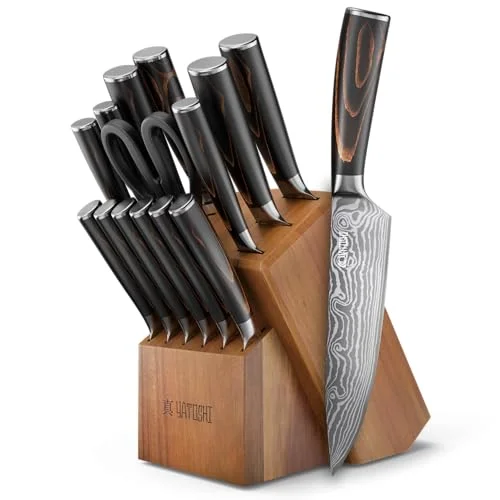
The Yatoshi Professional 15-piece set in this guide is a useful example of exactly this gap. Its listing states “ergonomic handle” and high-carbon stainless steel construction, at $169.99 — a price point where you might reasonably expect a published handle shape, grip diameter, or material spec to back up the claim. The listing doesn't provide one beyond the word itself, and we won't invent a profile it doesn't state. That isn't a mark against the knives' steel or construction, which the listing is specific about; it's simply a reminder that “ergonomic” at $200 is making exactly the same unverifiable promise that “ergonomic” makes on a $25 set. The price tells you about the steel and the finish. It does not tell you the word means something more precise at a higher tier.
None of this means ergonomic claims are dishonest. Most manufacturers genuinely did shape the handle with some hand in mind, often tested informally by their own design team. The issue is narrower: the word carries no external standard, so it functions as a claim of intent rather than a claim of fit. Treat it exactly that way — as a signal that someone designed the handle on purpose, not as a guarantee that the result fits your hand specifically.
Buying online
Checking grip without holding the knife first
Buying a knife set online means you cannot do the one thing that would actually answer the ergonomic question — pick it up. What you can do instead is read around the marketing word for the details a listing usually does include, even when it skips a formal grip spec. Handle length relative to blade length is one: a handle noticeably shorter than the blade it's attached to will feel front-heavy and cramped for anyone with larger hands, regardless of what the listing calls the shape. Weight, if the listing states it per knife or for the full set, is a second: a heavier full-tang knife sits differently in the hand than a light stamped one, and that difference matters more to grip comfort over a long session than the handle's cross-sectional shape does.
Construction method is a third, indirect signal, and it connects back to the earlier sections here. A triple-riveted wood-composite handle, like the Martha Stewart Lockton set's, tends to have a more traditional contoured profile with visible curvature, because that's the shape wood scales are typically carved into. A molded synthetic handle, like Astercook's dishwasher-safe anti-slip design, is more likely to have a textured or ridged grip pattern molded directly into the material, since that's cheaper to produce as part of the mold than a hand-shaped curve. Neither is objectively more ergonomic; they are simply different approaches to the same problem, and knowing which approach a given set uses tells you more about what to expect in your hand than the word “ergonomic” does on its own.
The most reliable check, when it's available, is a return policy rather than a spec sheet. If a set arrives and the handle genuinely doesn't suit your grip — too thick, too narrow, a ridge that lands wrong under your palm — a straightforward return is the only real-world test that substitutes for holding it in a store first. Read the return window before you buy a set specifically on the strength of an ergonomic claim, the same way you'd read the handle construction details: it's the detail that's actually checkable, where the adjective is not.
The picks
Three handles, three different answers to the same question
01Dishwasher-safe synthetic
Astercook 14-Piece Knife Set with Block
Best for a handle built to survive the dishwasher
14 pieces·Full tang stainless·Dishwasher safe·Anti-slip ergonomic handle
Astercook's listing states the handle is dishwasher-safe and anti-slip, which is the combination of claims that, as covered above, points to a molded synthetic build rather than wood — wood and dishwasher-safe don't coexist honestly on a listing. The set also states full tang stainless steel construction and includes a built-in sharpener. At $47.48, it's the set here built around convenience: a handle that doesn't need hand-washing babysitting, in a set sized for a working household kitchen rather than a showcase.
The set to buy if you want the handle question solved by not having to think about it — straight into the dishwasher, every time.
02Triple-riveted, traditional
Martha Stewart Knife Block Set, 16-Piece Lockton
Best for a traditional riveted handle you hand-wash
16 pieces·Forged, full tang·Triple-riveted handles·Acacia wood block
The Lockton line states triple-riveted handles alongside forged, full-tang blades — the traditional construction pairing covered above, where scales are clamped to the tang with visible rivets rather than molded around it. That construction method generally asks for hand-washing rather than a dishwasher cycle, the trade this guide's materials section lays out plainly: more tactile, more old-school, less convenient. At $68.39, housed in an acacia wood block finished in linen white and gold, it's the set here built around that older school of handle-making.
The set to buy if you'd rather hand-wash a handle that feels traditional than run a synthetic one through the dishwasher.
03The 'ergonomic' case study
Yatoshi Professional 15-Piece Knife Set
Best steel, least-specified handle claim
15 pieces·High carbon stainless·Ergonomic handle·Professional-tier price
Yatoshi's listing states high-carbon stainless steel and an ergonomic handle, at $169.99 — the highest price in this guide, and the set that illustrates the ergonomic-word problem most clearly. The steel claim is specific; the handle claim is the single word, with no profile, grip diameter or shape detail published alongside it. That isn't unusual at this price — as covered above, the word carries no agreed standard regardless of tier — but it's worth knowing before paying a premium specifically expecting a verified fit.
The set to buy for the steel claim it does publish. Don't buy it for the handle word alone; check the listing's return policy if grip fit matters to you.
Side by side
The three handles, compared
| Set | Handle claim | Pieces | Likely build | Price | Get it |
|---|
 Astercook 14-Piece |
Dishwasher safe, anti-slip |
14 |
Molded synthetic |
$47.48 |
Get it |
 Martha Stewart Lockton 16-Piece |
Triple-riveted |
16 |
Wood / wood-composite scales |
$68.39 |
Get it |
 Yatoshi Professional 15-Piece |
Ergonomic (unspecified shape) |
15 |
Not stated |
$169.99 |
Get it |
Prices change. We refresh them, but Amazon is the authority at the moment you buy. “Likely build” is our inference from the construction claims published on each listing, not a separately verified spec — see the knife block material guide for the same approach applied to blocks.
Our method
How we compared — and what we can't tell you
What we did
Published handle claims and material science
We compared the handle-specific claims published on each listing — dishwasher-safe, anti-slip, triple-riveted, ergonomic — against how those claims actually map to handle construction and material, using general, checkable facts about wood, ABS and polymer behavior under heat, water and repeated flexing. Where a listing states a construction detail, we report it. Where it doesn't, we say so rather than filling the gap, as with Yatoshi's unspecified handle shape.
What we didn't
We don't run a testing lab
We do not physically test these handles, we do not own these sets, and we do not publish invented grip scores or comfort ratings. We have no verified review data for these specific products, so we don't paraphrase owner sentiment either. What we can do honestly is read every published handle claim, set it against general material facts, and tell you plainly which claims are checkable and which are adjectives doing the work of a spec.
FAQ
Common questions
Is ABS handle plastic actually durable, or just dishwasher-convenient?
Both. ABS doesn't absorb water or swell the way wood does, so it survives the dishwasher's heat and detergent cycle after cycle without cracking or loosening. That same resistance to absorption also makes it durable in everyday use — it won't dry out, splinter or warp the way a neglected wood handle can. The trade isn't durability versus convenience; it's a different kind of durability (resisting moisture and heat) against a different kind of appeal (the tactile warmth and traditional look of wood).
Why do some knife handles have visible rivets and others don't?
Rivets pin two handle scales — slabs of wood or wood-composite — onto either side of the knife's tang. A handle that was instead molded in one piece around the tang, typically from ABS or a similar polymer, has nothing to pin, because the material is already fused to the steel. So visible rivets tell you the handle is built from separate scales clamped on, usually meaning a wood or wood-composite material rather than a molded synthetic one.
Does "ergonomic" on a knife listing mean anything I can verify?
Not reliably. There is no single agreed ergonomic profile for a kitchen knife handle the way there's an agreed Rockwell scale for steel hardness. "Ergonomic" signals that a manufacturer shaped the handle with some hand in mind, but it doesn't specify a grip diameter, profile or shape you can check against your own hand before buying. Treat it as a claim of design intent, not a guaranteed fit.
How can I judge grip comfort before buying a knife set online?
You can't fully replace holding it, but you can read around the adjective. Check handle length relative to blade length, any stated weight, and the construction method — triple-riveted wood-composite handles tend toward a traditional contoured shape, while molded synthetic handles tend toward a textured grip pattern molded into the material. If a listing offers a clear return window, that's the most practical real-world test available for an online purchase.
Keep reading
Related on Best Knife Sets