The set, in short
What this review is, and what it isn't
This is a single-product review of one set: the Ninja® NeverDull™ 17-Pc Knife Block Set with Built-in Sharpener, in black, model K32017, ASIN B09B7R3SY7, currently listed at $229.99. We don't own this set, we haven't drawn two hundred knives through its slot to see what happens on knife two hundred, and we don't run a testing lab that could tell you otherwise. What we can do honestly is read Ninja's own listing closely, set its claims against the general, checkable mechanics of how a pull-through sharpening slot works, and compare it against the two other sets in this catalogue that build the same kind of mechanism into a cheaper block.
The short version: at $229.99, this is the most expensive set we've reviewed, and nearly all of that premium over the rest of the catalogue is attached to one feature — the sharpening slot — rather than to a published edge angle or Rockwell hardness figure of its own. That's a different kind of pitch from the imarku gyutou set we reviewed separately, which prices its sharpener alongside a stated 15-degree edge and a 56 ± 2 hardness number. Here, the mechanism is the headline, and the rest of the set is built around supporting it.
At a glance
Ninja NeverDull 17-Piece Knife Block Set
0117 pieces
Ninja® NeverDull™ 17-Pc Knife Block Set, Built-in Sharpener, Black (K32017)
Best for buyers who specifically want the sharpening mechanism built in, not bolted on
17 pieces·German stainless, stamped·Built-in NeverDull sharpener·$229.99
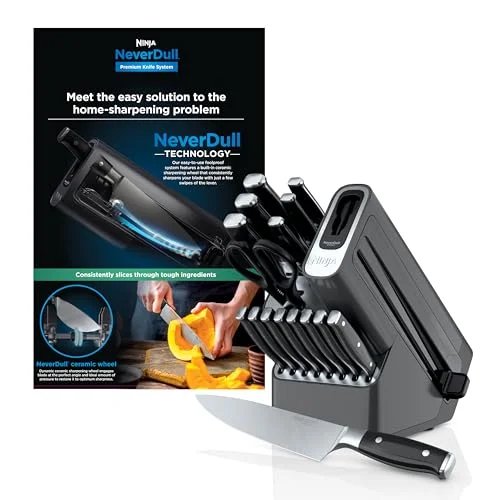
The listing's headline claim is the sharpening slot itself: every knife is drawn through the block's built-in mechanism on the way back in, so the edge is touched up as a byproduct of normal storage rather than a separate chore. The blades are stamped German stainless with an optimized edge angle, the handles are described as balanced and ergonomic, and the block, sharpener included, holds all 17 pieces in black.
A real mechanism, built into the furniture you already own — worth exactly what never having to think about sharpening is worth to you, at a price that assumes the answer is “a lot.”
What's actually in the block
17 pieces: what Ninja confirms, and what it doesn't itemize
The listing title commits to a specific total — 17 pieces — a black finish, and a model number, K32017, that ties the set to a specific SKU rather than a generic description. That is two more pieces than the HENCKELS 15-piece set we feature as our overall top pick, and three more than the imarku 14-piece gyutou set. What the listing does not do, in the published copy we have on file for this exact ASIN, is break that count down knife by knife the way Cuisinart's listings typically do — an 8-inch chef, a slicer, a utility knife, named one by one.
That gap matters a little less here than it did when we reviewed the 20-piece HOSHANHO set, because at least one of the 17 pieces is accounted for by name: the block's built-in sharpening slot, which counts toward a set's advertised total the same way shears or a blade guard do, without being a knife itself. We won't invent a piece-by-piece manifest for the remaining 16 pieces, because the manufacturer hasn't published one in the data we hold for this ASIN. If knowing exactly which knife shapes fill the block matters to your decision — whether you're getting a genuinely useful boning knife or another steak knife you already own six of — confirm the breakdown on the current Amazon listing images before buying. What we can confirm from the title and the general catalogue data for this set: 17 total pieces, a black finish, stamped German stainless blades with an optimized edge angle, balanced ergonomic handles, and a sharpening mechanism built into the block itself.
How it actually works
The NeverDull slot, mechanically explained
Strip away the brand name and the NeverDull slot is a specific implementation of a tool that already exists across this catalogue: a pull-through sharpener, built into the block instead of sold loose. A pull-through sharpener holds a pair of abrasive elements, usually angled wheels or crossed ceramic or carbide inserts, at a fixed geometry inside a slot. Drawing the blade through that slot, under light pressure, removes a small, consistent amount of steel along the edge at whatever angle the mechanism was built to. Do it once and the edge is touched up; do it every time the knife goes back into the block, and the edge theoretically never gets the chance to dull much in the first place, which is the entire premise behind the name.
What that mechanism cannot do, as a matter of how any fixed-angle pull-through sharpener works and not a knock on this specific brand, is adapt to the knife or reset serious damage. It removes metal the same way every time, at the angle it was built for. A light, consistent touch-up on a knife that's only mildly dulled from normal cutting is exactly what the mechanism is good at. A chip from a dropped blade, a rolled edge from a glass cutting board, or a knife that's been hand-sharpened at a different angle than the slot expects are all problems a pull-through slot handles poorly or not at all — for those, a whetstone or a professional sharpening service is still the right tool. Our comparison of pull-through sharpeners against honing steels covers this trade-off in more depth, including why a mechanism you walk past every day tends to actually get used, unlike a honing steel sitting loose in a drawer.
The other mechanical reality worth being honest about is wear. An abrasive sharpening slot removes a small amount of steel on every single pass, by design, which means repeated use narrows the blade slightly over its lifetime — the same trade every pull-through sharpener makes, built-in or not. On knife one, that's imperceptible. On knife two hundred, it's the accumulated cost of using the tool exactly as intended, every time, for years. Ninja's listing does not publish a figure for how much steel the mechanism removes per pass or how many passes the abrasive elements themselves are rated for before they need replacing, and we won't estimate one on its behalf. What we can say, as a matter of how these mechanisms work generally, is that the convenience and the wear are the same feature, not two separate ones.
The name on the block
Does a kitchen-appliance brand make a good knife brand?
Ninja built its name on countertop appliances — blenders, air fryers, pressure cookers — not on cutlery, and that's a genuinely different lineage from the houses that anchor the rest of this catalogue. HENCKELS and the German-engineered tier trade on more than a century of blade-making; imarku and the Japanese-style tier trade on a specific forging and edge-angle tradition. Ninja's credibility here isn't metallurgical heritage. It's mechanical engineering applied to a kitchen problem, which happens to be exactly the skillset a small-appliance brand already has in abundance: Ninja has spent years designing motors, blades and moving mechanisms for blenders and food processors, and a sharpening slot is, at its core, a small mechanical assembly rather than a forging process.
That reframes the right question. It isn't "can a blender company forge a better blade than a German or Japanese knife house" — nothing in this set's published listing claims that, and we won't credit it with a claim it doesn't make. The blades here are stamped German stainless with an optimized edge angle, which is a solid, unremarkable baseline shared with plenty of mid-tier sets in this catalogue, not a forged, hand-finished edge competing on steel alone. The actual question is whether a company whose core competency is mechanisms builds a more reliable mechanism than a knife company bolting a sharpener on as an afterthought. On that narrower question, a brand that already engineers moving parts for a living is a more plausible source of a well-built sharpening slot than a traditional cutlery house dabbling in one additional feature. Whether that reliability is worth a $229.99 price built almost entirely around it is a separate question, covered below.
Same mechanism, three prices
The NeverDull slot against McCook's and imarku's versions
This catalogue has three sets that build a sharpening slot into the block, and they make the comparison unusually direct. The McCook 15-piece set puts the same category of mechanism into a $62.99 block. The imarku 14-piece gyutou set puts it into a $169.99 block, paired with a published 15-degree edge angle and a 56 ± 2 Rockwell figure. The Ninja NeverDull 17-piece set puts the mechanism into a $229.99 block, more than six times McCook's price and well over double imarku's, without publishing an edge-angle or hardness figure of its own in the data we hold for this ASIN.
Mechanically, all three are doing the same basic thing: drawing a blade through a fixed-angle abrasive slot to maintain an edge between proper sharpenings. What separates them in writing is what each manufacturer chooses to publish. McCook's listing states a specific Rockwell figure alongside its sharpener, which is unusual at that price. Imarku pairs its sharpener with both an edge angle and a hardness number, which is why we reviewed it as a set that earns its price on checkable specifics. Ninja's listing, by contrast, leads with the mechanism's name and convenience — the drawer-the-blade-through, knife-after-knife premise — rather than a steel figure to hold it to. None of that tells you one slot cuts a better edge than another; a fixed-angle abrasive mechanism is a fixed-angle abrasive mechanism regardless of the name stamped on the block. It does tell you that if a published spec sheet is specifically what you're paying for, the $169.99 set gives you more of one than the $229.99 set does, and the $62.99 set gives you a Rockwell figure for a fraction of either price.
What the higher price plausibly buys instead is execution: a larger, 17-piece block with a dedicated model number, a brand built on mechanical consumer products rather than a single imported SKU, and, if Ninja's broader reputation for appliance engineering carries over, a sharpening mechanism built with the same attention as a blender blade assembly. That's a real, if less measurable, thing to pay for. It is a different purchase from paying for a published edge angle, and the two shouldn't be confused when the price gap between them is $230 or more.
The money
Build quality: where $229.99 shows up
At $229.99, this set sits well above every other sharpener block in this catalogue, and the published listing data gives a reasonably clear picture of where that money is going. The blades themselves are stamped, not forged — stamped German stainless with an optimized edge angle, the same basic construction method used across most sets in the $100–$200 range, not the heavier, bolstered construction of a forged blade. That means the price premium here is not primarily buying thicker, hand-forged steel the way a forged, full-tang set under $100 does with its construction method. It is buying the block: a 17-piece capacity, a dedicated sharpening mechanism engineered into the furniture rather than added as a slot borrowed from a cheaper design, balanced ergonomic handles, and a specific, numbered SKU from a brand with its own manufacturing and quality-control pipeline for mechanical kitchen products.
Put against the rest of the catalogue on a per-piece basis, $229.99 across 17 pieces works out to roughly $23.53 per piece, which lands below the $569.99 HOSHANHO 20-piece set's roughly $28.50 per piece but well above imarku's roughly $12.14 per piece for a set that publishes an edge angle and a hardness figure this one doesn't. The honest read is that this set's build quality is concentrated in the mechanism and the block rather than spread evenly across a published steel spec, a forging process, and an itemized contents list the way a few of the sets below $100 manage to combine. If the sharpening slot is the feature you're buying, the price is attached almost entirely to that one well-engineered moving part. If you're comparing blade steel alone, the published numbers elsewhere in this catalogue do more per dollar.
The decision
Who should buy this over a cheaper sharpener block
Imagine the alternative as a sharpener block priced around $125 — a tier that, in general, buys a mid-range build with the mechanism included but without a brand-name manufacturing pipeline behind it specifically for that mechanism, and usually without a block sized past 15 pieces. Choosing the $229.99 Ninja set over that kind of set makes sense if you've specifically decided that the mechanism's reliability and the block's capacity matter more than squeezing the lowest possible price out of the same basic feature, and if $270 or so genuinely doesn't move your budget. A 17-piece capacity, a dedicated model number, and a mechanism built by a company whose core business is kitchen mechanisms are all real, deliverable things, even without a published edge angle to quantify them.
It makes much less sense if what you actually want is a verifiably sharp, specifically engineered edge for the money. The imarku 14-piece gyutou set publishes both an edge angle and a Rockwell figure this listing doesn't, at under half the price, with the same basic sharpening convenience. If your honest habit is drawing a knife through a slot a handful of times a week and nothing more demanding than that, the $62.99 McCook set buys the same category of mechanism for a fraction of the cost. And if you're the kind of cook who already owns, or would actually use, a whetstone, none of the three sharpener blocks in this catalogue — this one included — are buying you anything a forged German-steel set without the mechanism wouldn't deliver for less.
Our method
How we researched this review
What we did
Read the listing, checked the mechanics
We read Ninja's published listing for this exact ASIN — the piece count, the construction, the price — and checked its sharpening mechanism against the general, verifiable mechanics of how any pull-through sharpener works, the same mechanics that apply to the McCook and imarku sets in this catalogue. Where the listing was specific, we repeated the specific figure. Where it wasn't, including edge angle and Rockwell hardness for this ASIN, we said so instead of filling the gap.
What we didn't
We don't run a testing lab
We do not physically test this knife set, we do not own it, and we have not drawn a single blade through its sharpening slot. We don't publish an invented score out of ten, and this listing carries no verified rating or review count for us to paraphrase, so we haven't attributed any opinions to owners. Edge retention and mechanism durability over hundreds of uses are measured in laboratories with repeated-cut machines, not by a writer's afternoon in a kitchen, and we're not pretending otherwise.
The bottom line
The verdict
At $229.99, the Ninja NeverDull 17-piece set is the most expensive sharpener block in this catalogue, and what it sells is a mechanism, not a metal: a sharpening slot built into the furniture by a company that engineers moving kitchen parts for a living, backing stamped German stainless blades with an optimized edge angle rather than a forged construction or a published hardness figure. That is a coherent, honest pitch on its own terms. A blender-and-air-fryer brand turning its mechanical know-how toward a sharpening slot is a more plausible source of a well-built mechanism than it would be a source of hand-forged steel, and the listing doesn't pretend otherwise.
What keeps this from being the obvious buy for every kitchen is the price attached to that one feature. The same basic mechanism, in general mechanical terms, shows up in a $169.99 set that also publishes a 15-degree edge angle and a 56 ± 2 Rockwell figure, and in a $62.99 set that publishes its own hardness number. Buy the Ninja set if the brand's manufacturing pipeline and the 17-piece capacity are specifically what you're paying for, and the gap over those two alternatives genuinely doesn't move your budget. Buy one of the cheaper sharpener blocks instead if what you want is the same mechanical convenience backed by a published steel spec, for less than half the price.
FAQ
Common questions
What's actually included in the Ninja NeverDull 17-piece set?
The listing confirms 17 total pieces, a black finish, stamped German stainless blades with an optimized edge angle, balanced ergonomic handles, and a block with a built-in sharpening slot, model K32017. It doesn't itemize the remaining pieces knife by knife in the data we have on file, so check the current Amazon listing images for the full breakdown if the exact mix of shapes matters to your decision.
How does the NeverDull sharpening slot actually work?
It's a pull-through sharpener built into the block: drawing the blade through a fixed-angle abrasive slot removes a small, consistent amount of steel along the edge, touching it up every time the knife is put away. It can't reset a chipped or badly rolled edge, and because it removes metal on every pass, repeated use narrows the blade slightly over its lifetime — the same trade any pull-through sharpener makes.
Is Ninja, a kitchen-appliance brand, a credible knife brand?
Not on blade-forging heritage, which it doesn't claim — the blades here are stamped German stainless, a standard mid-tier construction, not a forged or hand-finished edge. On the mechanism specifically, a company that already engineers moving parts for blenders and air fryers is a plausible source of a well-built sharpening slot, which is a narrower and more honest claim than competing on steel alone.
Is the Ninja NeverDull sharpener better than McCook's or imarku's built-in sharpener?
Mechanically, all three are the same category of fixed-angle pull-through sharpener, so one isn't inherently sharper than another. The difference is what each listing publishes: McCook and imarku both state a Rockwell hardness figure, and imarku adds a specific 15-degree edge angle, while Ninja's listing for this ASIN doesn't publish either figure, leaning instead on the mechanism's convenience and the block's capacity.
Keep reading
Related on Best Knife Sets