The set, in short
What this review is, and what it isn't
This is a single-product review of one set: the imarku 14-Piece Japanese Gyutou Stainless Steel Kitchen Knife Set, ASIN B0GQGJ4YF5, currently listed at $129.99. We don't own this set, we haven't run it through a week of dinners, and we don't run a testing lab that could tell you otherwise. What we can do honestly is read the manufacturer's own listing closely, set every claim against general, checkable facts about blade geometry, steel and construction, and tell you plainly which parts of the pitch are specific and verifiable and which parts are the kind of adjective any knife set could put on its box.
The short version: imarku publishes more than most sets at this price. A specific edge angle, a specific Rockwell hardness figure, and a specific heat-treatment process are all stated in the listing rather than implied. That's unusual, and it's the main reason this set is worth a dedicated review instead of a line in a roundup. It also means the set can be checked against its own claims more precisely than a listing that just says "razor-sharp" and leaves it there.
At a glance
imarku 14-Piece Japanese Gyutou Knife Set
018" gyutou
imarku 14-Piece Japanese Gyutou Stainless Steel Kitchen Knife Set
Best for a narrower, Japanese-style edge with the sharpening built in
14 pieces·15° per side·56±2 HRC·Built-in sharpener
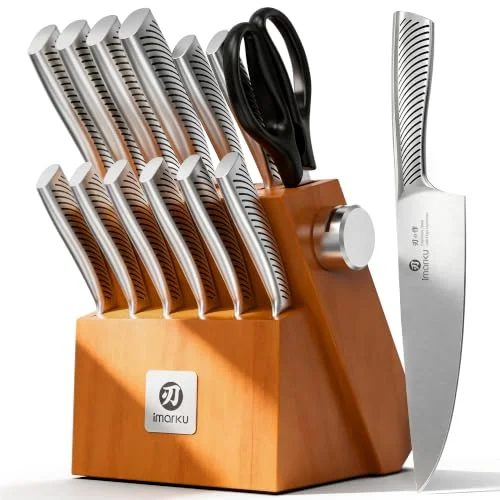
The listing states blades hand-sharpened to a precise 15-degree angle per side, repeated forging with low-temperature quenching to a Rockwell hardness of 56 ± 2, full-tang construction, a mirror-polished finish, and a wooden block with a built-in pull-through sharpener. The headline size is an 8-inch gyutou. What follows is a section-by-section look at what each of those claims is actually worth.
A real edge-angle figure and a real Rockwell figure, published and checkable — which is more than most sets in this price bracket offer in writing.
What's actually in the box
14 pieces: what imarku confirms, and what it doesn't itemize
The listing title commits to a specific number — 14 pieces — and a specific headline size, an 8-inch gyutou, the Japanese equivalent of a Western chef's knife and the piece the whole set is built around. What the listing does not do, at least in the published copy we have on file, is break that count down knife by knife the way some sets in this catalogue do. Cuisinart's listings typically spell out an 8-inch chef, a slicer, a santoku, a utility knife and a run of steak knives one by one. imarku's copy here leans on the gyutou, the sharpener and the construction claims instead, and doesn't walk through the remaining 12 or 13 pieces by name.
That's not the same as the set being vague about everything — the edge angle, the hardness and the sharpener are all specific — but it does mean we won't invent a piece-by-piece manifest the manufacturer hasn't published. If knowing exactly which knife shapes fill the other slots matters to your decision, confirm it on the current Amazon listing images before you buy, the same way we'd flag it for any block set that counts shears or blade guards toward its total. What we can confirm: 14 pieces, an 8-inch gyutou centerpiece, and a block that doubles as a sharpening station, covered below.
The geometry
The 15° edge, and how that compares with a German-style set
imarku's listing states its blades are hand-sharpened to a precise 15-degree angle per side. That's a specific figure, and it sits squarely inside the range Japanese-style gyutous are typically ground to, which runs narrower than the roughly 20 degrees per side common on Western, German-style double-bevel knives. A thinner edge angle means less steel meeting the food at the cutting line, which in practice means less downward force is needed to start a cut — the blade falls through a tomato skin or a stack of herbs rather than needing to be pushed through it.
The trade is the same one that applies to any narrow bevel, regardless of brand: less steel supporting the edge also means less tolerance for lateral stress. Twisting the blade, prying something apart, or cutting through bone or frozen food puts exactly the kind of sideways load on the edge that a 15-degree bevel handles worse than a thicker, more obtuse German-style grind. As a matter of blade geometry, not brand: a wider edge angle is the more forgiving choice around bones and frozen packaging, and a narrower one like this is the more precise choice for produce, fish and boneless cuts, provided it's used and cared for accordingly. For more on how stainless grades and heat treatment interact with edge angle, see our explainer on what "high carbon stainless steel" actually guarantees.
imarku pairs that edge angle with a second published figure: a Rockwell hardness of 56 ± 2 HRC, reached through repeated forging and low-temperature quenching. Mid-fifties Rockwell is a sensible, common range for a kitchen knife meant to be used daily — hard enough to hold the 15-degree edge for a reasonable stretch between touch-ups, soft enough to bring back without specialist equipment when it does dull. Publishing a specific hardness figure, rather than leaving it at "premium steel," is itself worth noting; it's a number a buyer could in principle check, which is more than most listings offer.
Upkeep
The built-in sharpener: does it keep up with daily use
The wooden block includes a built-in sharpener, and imarku's own framing for it is squarely aimed at beginners: draw the blade through the slot a few times and it restores what the listing calls the factory-sharp edge, with no separate stone, no separate tool, and no technique to learn. That's a real, specific feature, not a vague "easy to maintain" claim, and it addresses a genuine gap: most people who own a knife block never sharpen anything in it, and a slot that touches up the edge every time the knife goes back in the block is the single most effective way to keep a set usable for someone who will never own a whetstone.
What a built-in, pull-through sharpener cannot do is reset a damaged edge. It removes metal in a fixed, predetermined way, at a fixed angle, which is well suited to light, routine maintenance and poorly suited to fixing a chip or a badly rolled edge from a bad cutting-board habit or an accidental drop. For that, a whetstone or a professional sharpening service is still the right tool. It's also worth being careful about the angle match: a sharpener built for this block is presumably set close to the 15-degree edge the knives ship with, but a generic pull-through sharpener bought separately for a Western-style 20-degree edge would grind away more steel than necessary on a blade this narrow, gradually changing the geometry you bought the knife for. For a closer look at how slot sharpeners compare with honing steels, see our guide to pull-through sharpeners versus honing steels.
Whether it keeps up with daily use depends on what that means. For routine touch-ups between proper sharpenings, a built-in slot sharpener used every time the knife is put away is a reasonable, low-effort habit that should keep a working edge working. For a kitchen that uses these knives hard every day — heavy prep, bone-in cuts, careless storage — no pull-through sharpener is a substitute for an occasional pass on a whetstone.
In the hand
The handle: full tang is published; "non-slip" isn't, on this listing
Here is where we hold the line on not asserting a spec we don't have. The listing for this specific set states full-tang construction as part of its durability claim — the steel runs the length of the handle, which is the detail that gives a knife balance and keeps the handle from loosening over years of washing. That's confirmed, and it matters: a full-tang knife of this size should feel evenly weighted rather than blade-heavy or handle-heavy, and a full tang is one of the two or three construction details actually worth checking before buying any knife set.
What the published listing for this exact ASIN does not state, in the data we have on file, is an explicit non-slip grip texture or a wet-hands claim. Other imarku gyutou sets sold alongside this one make that claim directly in their own copy, which is exactly why we're being specific here rather than assuming every imarku listing says the same thing: this one doesn't, at least not in what's published. That doesn't mean the handle is slippery — many full-tang handles work fine wet without the manufacturer calling it out by name — it means we can't tell you from the listing alone. If a non-slip, wet-hands grip is specifically what you're shopping for, check the current listing photos before buying, rather than taking it for granted from the gyutou styling or the price point.
Quick reference
What imarku states for this set, and what it leaves out
Published, in writing
Specific and checkable
15-degree edge angle per side. Rockwell hardness of 56 ± 2 HRC via repeated forging and low-temperature quenching. Full-tang construction. Mirror-polished blade finish. A built-in pull-through sharpener in the wooden block. 14 pieces, headline size an 8-inch gyutou. Price of $129.99 as of our most recent check.
Not stated for this ASIN
What we won't assume
An itemized list of all 14 pieces by name. An explicit non-slip or wet-hands grip claim. Dishwasher-safe status. A star rating or review count — Amazon's product data for this listing carries none, so we're not citing owner sentiment we don't have. Any of these may be true; we simply don't have a published figure to repeat as fact.
The money
Where $129.99 shows up, and where it does not
At $129.99, this set sits above the entry-level block sets in this catalogue that run $25 to $30 for a stamped or basic full-tang build, and below the premium end where a dedicated sharpening mechanism or a long-established German name pushes the price past $300. The money here visibly goes into three things the listing is specific about: the forging and quenching process behind the 56 ± 2 Rockwell figure, the labor of hand-sharpening each blade to a 15-degree angle rather than leaving it at whatever a stamping die produces, and the built-in sharpening mechanism in the block, which is a moving part most cheaper sets skip entirely.
It does not visibly go into an itemized box of named pieces, a dishwasher-safe guarantee, or a documented review history — Amazon's listing data for this ASIN carries no rating and no review count, so there's no owner sentiment on file for us to pass along, and we won't invent any. It also, as covered above, doesn't publish a non-slip handle claim the way a comparable imarku line does. None of that makes $129.99 a bad price for what's confirmed; a published edge angle and a published hardness figure are genuinely uncommon at any price in this category. It does mean the set is priced on the strength of its blade geometry and steel treatment specifically, not on breadth of extras or itemized contents.
The decision
Who should buy this instead of a German 15-piece block
A German-style 15-piece block set, stamped or forged, is typically ground nearer 20 degrees per side, built for a wider range of jobs including bone-in cuts and frozen packaging, and sold on piece count. This imarku set makes the opposite trade: fewer named extras, one clearly specified edge geometry, and a sharpening mechanism built around maintaining that specific angle.
Choose this set over a German-style 15-piece block if the narrower edge is something you want on purpose: if most of your cutting is produce, fish, boneless meat and herbs rather than bone-in roasts or frozen blocks, and if you'd rather draw a knife through a built-in slot than own and learn a whetstone. Choose a German-style set instead if your kitchen regularly needs a tougher edge near bone or ice, if you want an itemized contents list spelled out knife by knife the way some comparable block sets in this catalogue publish, or if an explicit dishwasher-safe or non-slip-handle claim is a requirement rather than a nice-to-have. The two are built for different habits, not different quality tiers, and the honest version of this decision is about which habit matches your kitchen, not which set is objectively better.
Our method
How we researched this review
What we did
Read the listing, checked the math
We read imarku's published listing for this exact ASIN — the edge angle, the Rockwell figure, the construction method, the price — and checked each claim against general, verifiable facts about blade geometry, steel hardness and forging versus stamping. Where the listing was specific, we repeated the specific figure. Where it wasn't, we said so instead of filling the gap.
What we didn't
We don't run a testing lab
We do not physically test this knife set, we do not own it, and we have not used it for any period of time. We don't publish an invented score out of ten, and this listing carries no Amazon rating or review count for us to paraphrase, so we haven't attributed any opinions to owners. Edge retention and real-world durability are measured in laboratories with repeated-cut machines, not by a writer's afternoon in a kitchen, and we're not pretending otherwise.
The bottom line
The verdict
imarku's 14-piece gyutou set earns its place in this catalogue on the strength of two numbers most sets at this price never publish: a 15-degree edge angle per side and a 56 ± 2 Rockwell hardness figure, backed by full-tang construction and a sharpening slot built into the block itself. Those are specific, checkable claims, and at $129.99 they're the reason to consider this set over a vaguer "razor-sharp" listing at a similar price.
What keeps this from being an unqualified recommendation for every kitchen is exactly what the listing leaves unsaid: no itemized breakdown of the other 13 pieces, no non-slip handle claim on this specific ASIN, and no dishwasher-safe status or review history to check. Buy it for the edge geometry and the hardness figure, which are real and specific. Don't buy it expecting the itemized contents list or the wet-hands grip claim that some other sets — imarku's own included — make explicitly, because this listing doesn't make them for you.
FAQ
Common questions
What's actually included in the imarku 14-piece gyutou set?
The listing confirms 14 pieces built around an 8-inch gyutou and a wooden block with a built-in sharpener. It doesn't itemize the remaining pieces by name the way some comparable sets in this catalogue do, so if you need to know the exact mix of knife shapes before buying, check the current Amazon listing images for the full breakdown rather than assuming a specific lineup.
Is a 15-degree edge actually sharper than a German 20-degree edge?
It's thinner, which generally means less force is needed to start a cut, and that's often what "sharper" means in everyday use. It isn't automatically better in every situation: a narrower edge is also less tolerant of lateral stress from bone, frozen food or twisting cuts than a wider German-style bevel. Which one performs better depends on what you're cutting and how it's maintained, not the angle alone.
Is the built-in sharpener in the block actually useful day to day?
For routine maintenance, yes — drawing the blade through the slot each time it's put away is a low-effort habit that should keep a working edge working, which is exactly the problem it's designed to solve for people who'll never own a whetstone. It's a fixed-angle, pull-through mechanism, though, so it can't fully reset a chipped or badly rolled edge the way a proper sharpening stone can.
Does this set have a non-slip handle that's safe for wet hands?
The listing for this specific ASIN states full-tang construction, which affects balance, but it does not make an explicit non-slip or wet-hands grip claim in the data we have on file. Some other imarku gyutou lines do state that claim directly; this one doesn't, so if a non-slip wet-hands grip is a requirement for you, confirm it on the current listing photos before buying rather than assuming it carries over from a different imarku set.
Keep reading
Related on Best Knife Sets