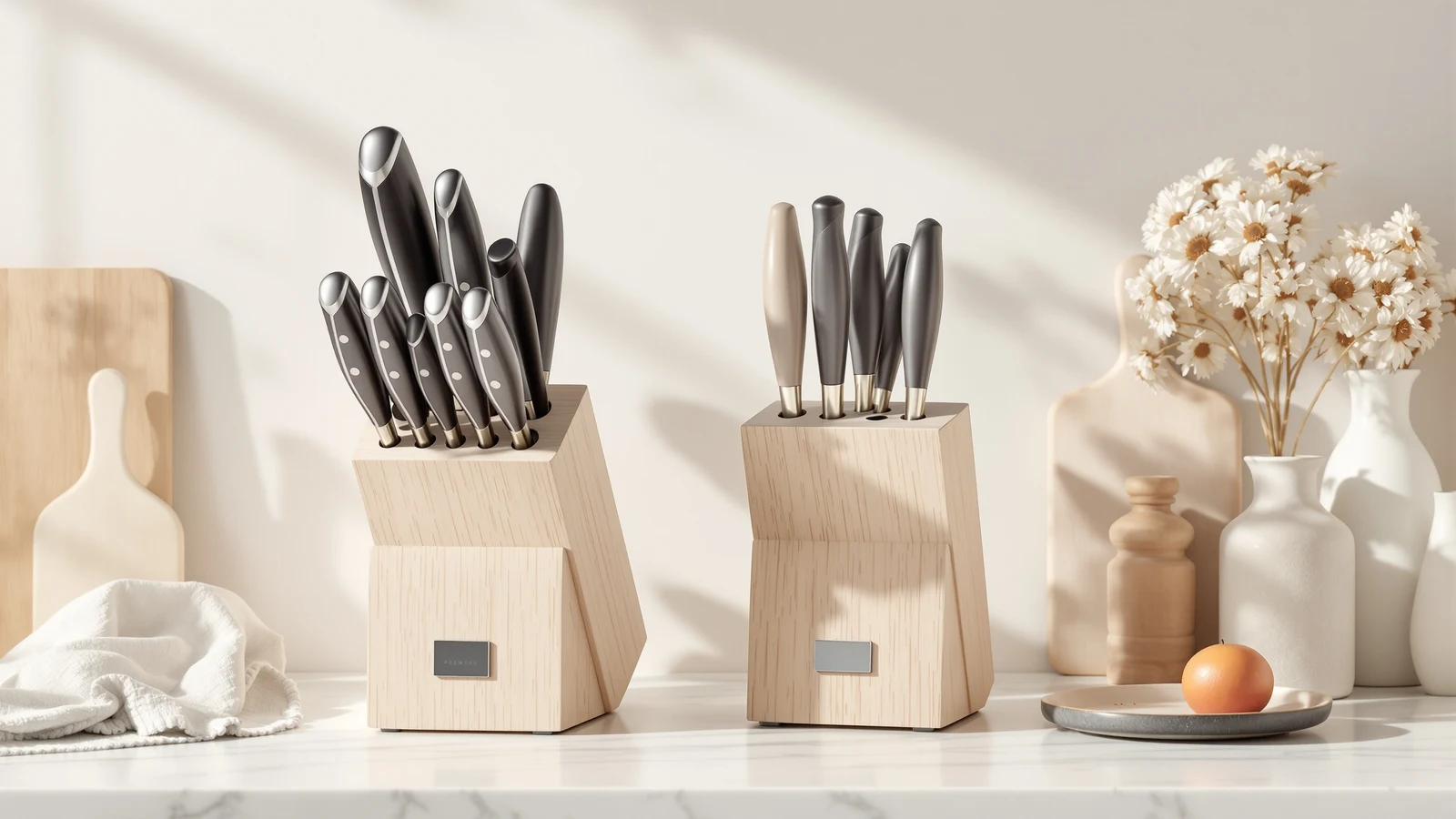
The two sets
Same wood, same rivets, two different product lines
Martha Stewart does not sell one knife block set with two piece counts — it sells two separate lines under the same name. The smaller one is called Eastwalk: 14 pieces, high-carbon stainless steel, an ABS handle that is triple riveted, an acacia wood block, finished in linen white, for $59.99. The larger one is called Lockton: 16 pieces, high-carbon stainless steel, forged full-tang chef’s knives, triple-riveted handles, an acacia wood block, finished in linen white and gold, for $68.39. Two more pieces and twenty dollars separate them on paper, and that is the headline most shoppers will see first.
What the piece count and the price don’t show you is sitting in the construction wording itself. Eastwalk’s listing names a handle material — ABS — and says nothing about full tang. Lockton’s listing says full tang but never names a handle material. Neither title is incomplete by accident; each brand line simply leads with the detail it wants you to notice. The rest of this guide works through what’s actually identical between the two, what the published wording says is different, and where neither listing gives us a number to compare at all. If you want to see how a different brand splits this same question across its own spec sheets, our Cuisinart knife sets compared guide runs the same exercise across four Cuisinart tiers instead of two.
What’s identical in writing
Steel, wood, rivets, brand
Both listings state “High Carbon Stainless Steel” as the blade material, both state an acacia wood block, and both state triple-riveted handles. All three of those claims appear in both titles, word for word, which means none of them is a reason to pay the extra twenty dollars — you get the identical stated steel, wood and rivet count either way.
What changes between the two
Piece count, price, one construction word, one color
Fourteen pieces versus sixteen. $59.99 versus $68.39. Lockton states “full tang”; Eastwalk doesn’t use that phrase and instead names its handle material as ABS. Eastwalk is linen white only; Lockton adds a gold accent. Four stated differences, and we won’t stretch any of them further than the words on the listing.
What's actually in the box
The two extra pieces in the 16-piece set: what we can and can't tell you
Fourteen pieces to sixteen is the first number most shoppers compare, and it’s tempting to read it as “two more knives.” Neither Martha Stewart listing itemizes its contents piece by piece the way some brands do — there is no bulleted breakdown of “8-inch chef’s knife, 5-inch utility, six steak knives” in the title or the specs we have for either set. That means we genuinely don’t know, from the data available to us, whether Lockton’s two extra pieces are two additional knives you’ll use every week, a pair of steak knives, a sharpening steel, or a set of shears that simply counts as a “piece” on the box without being a blade at all.
That distinction matters more than the number itself. Our guide to the extra pieces hiding in a knife block set walks through how shears, blade guards and sharpening slots routinely inflate a piece count across this entire category without adding a knife you’ll reach for — the same trap a bare “16 vs. 14” comparison sets here. Rather than guess which two items make up Lockton’s difference, the honest move is to open the live Amazon listing and check its product photos or bullet points for the exact breakdown before deciding the extra two pieces are worth the extra twenty dollars on their own.
What we can say with confidence is the floor: both sets build around the same core claim of high-carbon stainless steel blades in an acacia block, and the piece-count gap is the one difference neither listing explains in enough detail for us to assert what you’re actually getting more of. If piece-by-piece contents are the deciding factor for you, that single check is worth doing before you compare anything else on this page.
The blade material
High-carbon stainless steel across both: no difference there
Pull the exact phrase from both listings and they match: “High Carbon Stainless Steel” appears in the Eastwalk 14-piece title and in the Lockton 16-piece title, word for word. Neither listing in our data publishes a Rockwell hardness figure, an edge angle, or a stated grade number beyond that phrase, so we take both at the same level: a real, common blade material claim, and one detail short of the kind of number you could use to rank the two sets against each other on steel alone. Our guide to what “high carbon stainless steel” actually guarantees covers why the phrase on its own, without a published hardness figure, tells you less than it sounds like it does — and that applies equally to both Martha Stewart sets here, not just one of them.
Where the two listings actually diverge is construction language around the blade and handle, not the steel itself. Lockton’s title states “Forged Full Tang Chef Knives” — forged construction and a full-tang claim, meaning the steel is described as running the entire length of the handle, named outright. Eastwalk’s title instead names a handle material: “ABS Triple Riveted Forged Handle,” pairing forged construction with an ABS (plastic) handle shell. Both mention “forged” and both mention triple rivets. Only Lockton’s listing uses the words “full tang.” Eastwalk’s doesn’t use that phrase, and by this site’s rule we won’t assume it from the rivet count or the forged claim alone. Our guide to knife handle materials covers what full tang construction actually changes about balance and durability, and why a stated handle material like ABS and a stated full-tang claim aren’t the same kind of information — one tells you what the handle is made of, the other tells you how far the steel runs inside it.
The practical read: if full tang construction specifically is the deciding factor, Lockton states it and Eastwalk’s listing does not, which is a real difference worth the price gap to some buyers and irrelevant to others. The steel itself — the part most shoppers assume changes with price — is the one claim that stays exactly the same on both boxes.
Storage
Acacia wood block sizing between the two: what neither listing tells you
Both sets store their knives in an acacia wood block, stated outright in both titles, and acacia is a dense, closed-grain hardwood that holds up well to repeated knife insertion without splitting — a sensible, common choice across this category generally. What neither listing in our data publishes is the block’s actual footprint: no width, depth or height figure is given for the 14-slot Eastwalk block or the 16-slot Lockton block. It stands to reason that a block built to hold sixteen pieces needs more slots than one built for fourteen, and slots typically mean either a wider block or a deeper one, but “stands to reason” is not a published measurement, and we won’t invent one here.
If counter space is tight — a studio kitchen, a galley layout, a camper or an RV — the block’s physical size can matter more than its piece count. Our guide to the best knife sets for RVs, campers and small kitchens covers how to weigh a block’s actual footprint against how many knives you really need stored upright, which is exactly the check worth doing before assuming the 16-piece Lockton fits the same counter space as the 14-piece Eastwalk simply because both are described as “acacia wood.”
Neither listing states whether its block uses fixed, knife-shaped slots or the flexible, bristle-filled universal-slot design some brands use instead, so we won’t assume either design here. If that distinction affects how you’d store non-matching knives alongside the set, our universal knife blocks vs. fixed-slot blocks guide explains how to tell the two apart from listing photos before buying.
The one visible difference
Linen white and gold: the difference you can actually see
Set every spec aside and one difference needs no reading at all: Eastwalk’s block is finished in linen white, and Lockton’s block is finished in linen white and gold. The gold shows up as an accent against the same light wood tone and the same linen-colored surface, rather than a different wood or a different block shape. It is, as far as either listing tells us, purely a cosmetic choice — neither title ties the gold accent to a different steel, a different tang construction, or a different number of rivets. The $20 price gap is paying for the two extra pieces, the stated full-tang construction, and this finish together, not any one of the three alone.
That makes the color call a genuinely simple one compared to the construction questions above. If a plain linen-white block fits your kitchen better, Eastwalk gives you that finish at the lower price. If the gold accent reads as the more finished, higher-end look on your counter, Lockton is the only one of the two that offers it — bundled with the stated full-tang claim and the extra two pieces, whatever they turn out to be, rather than sold as a standalone upgrade.
The picks
The pick, and when the cheaper one is the smarter buy
01Full tang, stated
Martha Stewart Lockton 16-Piece Knife Block Set
Best if full tang construction and the gold accent both matter to you
16 pieces·Forged, full tang·Triple-riveted handles·Linen white & gold
The only one of the two whose listing states full-tang construction outright, paired with two more pieces than Eastwalk and the gold accent on the block. At $68.39 it is the pricier set, and the extra twenty dollars buys a stated construction detail you can’t confirm on the cheaper box, plus a finish Eastwalk doesn’t offer.
The set to buy if you want full tang confirmed in writing and the gold trim, and $20 more is inside your budget.
02Lower price, same steel
Martha Stewart Eastwalk 14-Piece Knife Block Set
Best for the same stated steel at a lower price
14 pieces·Forged, ABS handle·Triple-riveted handles·Linen white
Eastwalk states the identical “High Carbon Stainless Steel” claim as Lockton, the same acacia wood block, and the same triple-riveted construction — for twenty dollars less. What its listing doesn’t state is full tang; it names ABS as the handle material instead. If that specific confirmation isn’t the deciding factor for you, this is the same core product for less money.
The smarter buy when you don’t need full tang confirmed on paper and a plain linen-white block already suits your kitchen.
Side by side
Eastwalk vs. Lockton, compared
| Set | Best for | Pieces | Construction stated | Finish | Price | Get it |
|---|
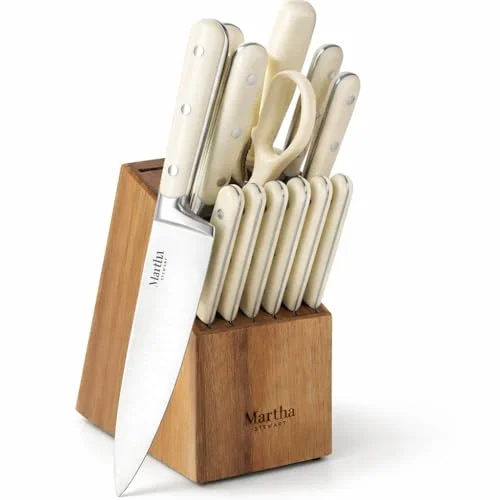 Eastwalk 14-Piece |
Same steel, lower price |
14 |
Forged, ABS handle |
Linen white |
$59.99 |
Get it |
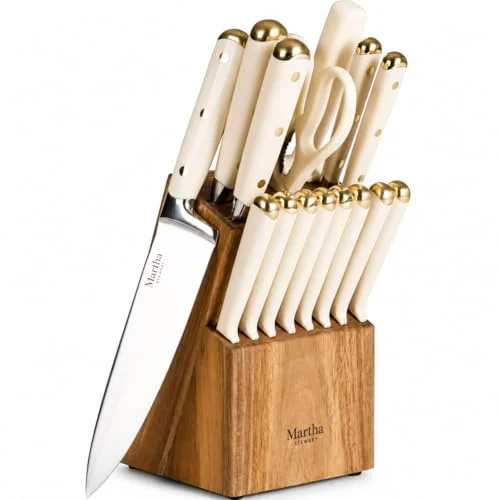 Lockton 16-Piece |
Full tang stated, gold accent |
16 |
Forged, full tang |
Linen white & gold |
$68.39 |
Get it |
Prices change. We refresh them, but Amazon is the authority at the moment you buy. See our Astercook knife sets compared guide for how a different brand splits the same tier question across three price points instead of two.
Our method
How we compared — and what we can't tell you
What we did
Two listings, read line by line
We compared the published listing titles, stated construction details and current Amazon prices for Martha Stewart’s Eastwalk 14-piece and Lockton 16-piece knife block sets, word for word, to see which claims both listings share and which appear on only one. Where a listing stated a spec — steel, wood, rivets, tang, finish — we took it at its word. Where a listing stayed silent, including on itemized contents and block dimensions for either set, we said so rather than borrowing a figure from the other listing.
What we didn't
We don't run a testing lab, and we don't invent sentiment
We do not physically test these knife sets, we do not own them, and we do not publish invented scores or star ratings. We have no verified review data for either listing, so we don’t paraphrase owner sentiment either — not “owners report,” not “reviewers note.” What we can do honestly is read every published word in both titles, set them side by side, and tell you plainly which differences are stated and which are assumptions you’d be making on the brand’s behalf.
FAQ
Common questions
What are the two extra pieces in the 16-piece Lockton set?
We don’t know from the data available to us. Neither the Eastwalk nor the Lockton listing itemizes its contents piece by piece, so the two extra items on the 16-piece set could be additional knives, a pair of steak knives, a sharpening steel, or shears — any of which commonly counts as a “piece” in this category without being a blade you’ll use weekly. Check the live Amazon listing’s photos or bullet points for the exact breakdown before assuming more pieces means more usable knives.
Is the steel actually different between the two sets?
No. Both listings state the identical phrase, “High Carbon Stainless Steel,” for the blade material. The stated construction difference is elsewhere: Lockton’s title says “full tang” outright, while Eastwalk’s title names its handle material as ABS instead and doesn’t use the words “full tang.” Neither listing publishes a Rockwell hardness figure for either set.
Does the 16-piece block actually take up more counter space than the 14-piece block?
Probably, but neither listing publishes exact block dimensions for either set, so we can’t confirm it with a number. A block built for sixteen slots is likely to need more width or depth than one built for fourteen, but if counter space is tight, check the live listing’s stated dimensions or product photos before buying rather than assuming the two blocks are interchangeable in footprint.
Should I buy the 14-piece Eastwalk or the 16-piece Lockton?
Buy Lockton if you want full-tang construction confirmed in writing and the linen white and gold finish, and the extra $20 is inside your budget. Buy Eastwalk if neither of those specifically matters to you — it states the identical high-carbon stainless steel, the same acacia wood block, and the same triple-riveted handles, for twenty dollars less and two fewer pieces of unknown composition.
Keep reading
Related on Best Knife Sets