The first mistake
Why a product photo tells you nothing about footprint
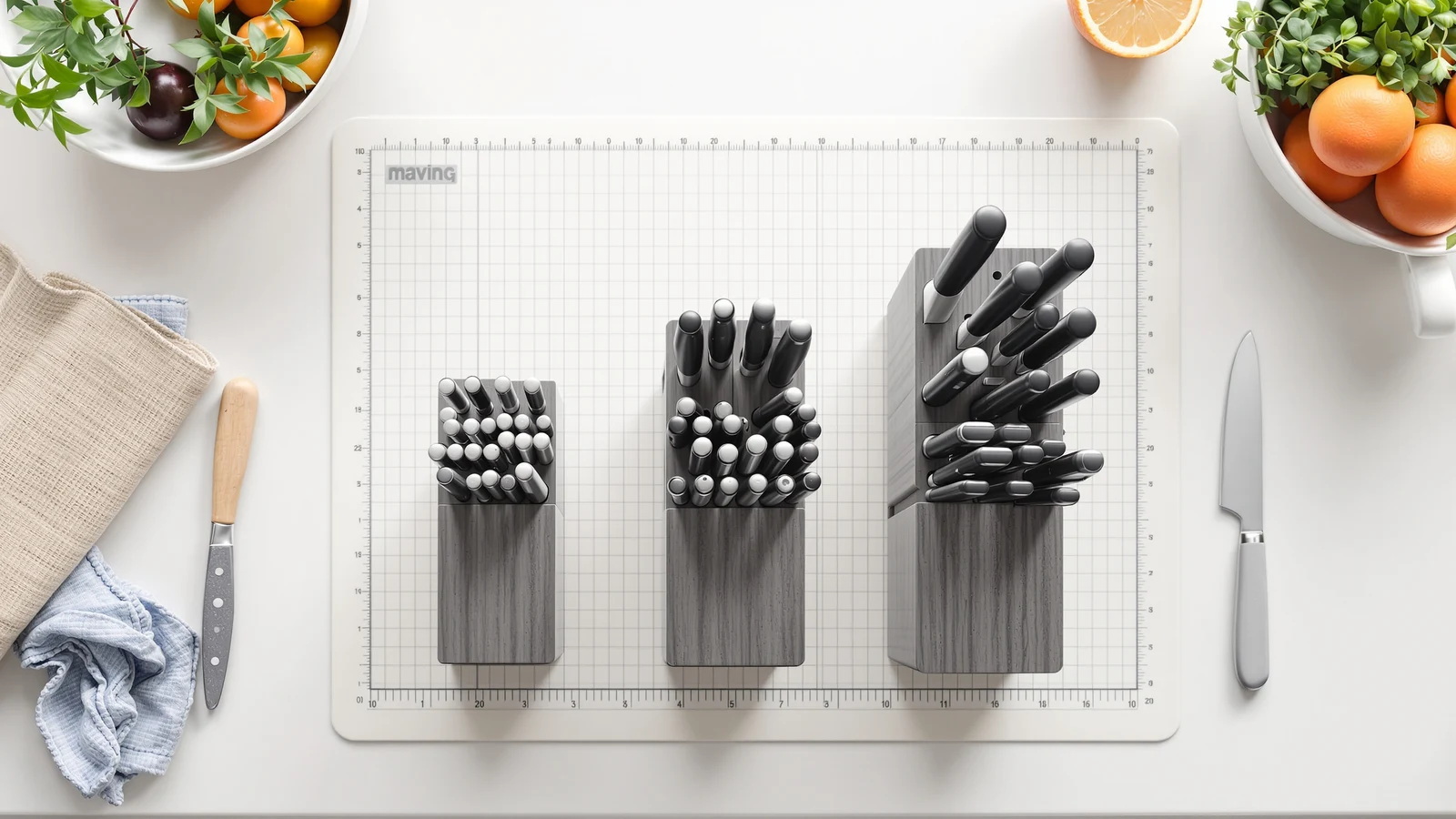
Every knife block listing on Amazon is photographed the same way: centered, lit evenly, and sitting alone on a counter with nothing beside it for scale. There is no coffee maker in the frame, no fruit bowl, no cutting board leaning against the backsplash — just the block, usually shot slightly from above and slightly to one side, an angle that compresses depth and makes a block that is genuinely 10 inches deep look closer to 7 or 8. Two blocks holding the same number of pieces can be staged to look nearly the same size in their respective photos even when one is meaningfully wider than the other, because nothing in either photo anchors it to a real-world measurement.
This is not a complaint about any one listing; it is simply how product photography works across the category, and it applies to all three sets named in this guide. The Amazon Basics 14-Piece set, the Astercook 15-Piece set and the HOSHANHO 20-Piece set are each shown on a clean counter with no surrounding objects, and none of the three listings states a block width or depth in inches anywhere in the title, bullet points or size field — only the piece count, and for the Astercook set, a size label of “Large,” which describes where that block sits in the brand’s own lineup rather than a number you could hold a tape measure to. If you want to know whether the HOSHANHO 20-piece set in particular will fit your layout, our full review of that set goes further into what the extra pieces actually are, but even there, the honest answer on footprint is the same: the listing doesn’t give you a number, so you have to go measure one yourself.
The piece count is the one figure every listing is required to be accurate about, because it is checkable against the photos and the box contents. Footprint is not checkable the same way from a listing page, which is exactly why it is the measurement most worth taking yourself before you order, not the one most worth trusting to a photo.
What to measure
The three measurements that matter: width, depth, and slot height
A knife block occupies space in three directions, and only one of them — width — is the number most shoppers think to check. The other two matter just as much and are checked far less often.
Side to side
Width
Width is the horizontal run of counter the block occupies left to right. Measure it at the counter surface, not at the widest point of a lid or sharpener housing that sits higher up, since that part won’t touch anything on the counter beside it but will still need head room if it overhangs a neighboring object like a toaster.
Front to back
Depth
Depth is the footprint from the wall or backsplash to the front edge of the block, and it is the number most often ignored, because photos rarely show a block from directly above. A deep block pushed too close to the counter’s front edge becomes something you bump with every pass through the kitchen.
Straight up
Slot height
Slot height is the clearance between the counter surface and the underside of the cabinet above it. The tallest knife handle in the set has to clear that gap when lifted straight up out of its slot, or you’ll be sliding the whole block forward every time you want the chef’s knife.
Of the three sets named in this guide, none publishes any of these three measurements directly. Cuisinart, for comparison, is one of the few brands in this category that publishes an itemized contents list for its sets — our comparison of four Cuisinart sets covers that habit in detail — but even an itemized contents list is not the same as a published block width, and most listings, including the three named here, give you neither. That absence is the reason this guide exists: the measurements that matter are the ones you have to take yourself.
The hidden variable
Small block, same piece count: how slot angle changes the footprint
Two blocks holding the identical number of knives do not need the identical footprint, because the slots inside them are not always arranged the same way. A block with straight, vertical slots lets each knife drop straight down and come straight back out, which can make the block narrower side to side but typically requires more depth or height to accommodate the full length of a blade entering at that angle. A block with angled, splayed slots — where the blade goes in on a diagonal — spreads the same slot count across a wider base instead, trading width for a shorter overall profile.
A built-in sharpener changes the math again, because it occupies one or more slot positions by itself rather than holding a knife. Our comparison of pull-through sharpeners and honing steels covers what that mechanism actually does to an edge; what matters here is simpler: a block with a sharpener built into the center column needs to be at least as wide as a block with the same knife count and no sharpener, because the sharpener slot is extra real estate the knife slots don’t get to use. The Ninja NeverDull 17-Piece set is a clear example of this trade elsewhere in our catalogue — the sharpener is a genuine feature, but it is not free counter space.
None of the three sets named in this guide publishes a slot-angle diagram or a block width, so we can’t tell you from the listing alone whether the Amazon Basics 14-Piece, the Astercook 15-Piece, or the HOSHANHO 20-Piece arranges its slots straight or splayed. What you can do is look at the listing photos taken from directly above, where most manufacturers do show the slot layout even when they don’t give a width in inches, and use that photo — not the piece count — to judge whether the block will run narrow or wide on your counter.
The high end
What a 20-piece block actually needs in linear counter inches
The simplest way to think about why a 20-piece block needs more counter than a 14-piece block is to add up the slots. Even at a conservative estimate of roughly three-quarters of an inch of wood per slot — enough to separate one blade from the next without the handles knocking together — twenty slots line up to about 15 inches of slot face before you count anything else. Add the solid wood walls on each side that keep the block rigid and keep knife tips from poking through the edge, and a realistic 18-to-20-slot block commonly runs toward two feet of counter, sometimes more once a built-in sharpener or a pair of kitchen shears claims an extra slot position of its own on top of the knife count.
A 14-piece block built around fewer slots and, in many cases, no separate shears compartment runs meaningfully narrower by the same logic — fewer slots, less wood, less width. That reasoning is general to how wooden blocks are built; it is not a published measurement for any specific set. None of the three sets named here — the Amazon Basics 14-Piece at $22.28, the Astercook 15-Piece at $59.99, or the HOSHANHO 20-Piece at $284.99 — lists a block width in inches on its Amazon page, so the honest number to work from is the reasoning above, not a figure lifted from a tape measure we don’t have. Before you clear two feet of counter for a 20-piece block on the strength of this guide’s general math, check the specific listing’s photos and any customer-submitted measurement photos in the Q&A section, which is often the only place an actual inch figure shows up for a given set.
Behind the block
Wall clearance behind the block, and why it matters
Depth alone isn’t the whole story, because a block measured flush against the wall in a showroom photo is not how most people actually use one. Pulling a long chef’s knife — typically around 8 inches of blade plus a handle — straight up and out of a slot usually means tilting it back slightly first, and a block pushed hard against a backsplash tile or a windowsill doesn’t leave room for that tilt. Leaving an inch or two of open air behind the block gives the handle somewhere to go without scraping tile or catching on a window ledge every time you reach for the knife you actually use most.
Side clearance matters for the same reason once a set includes kitchen shears. Several sets in this category build a shears compartment into the side of the block rather than the front face, which means the shears’ handles can stick out sideways rather than sitting flush — our piece on what the extra pieces hiding in a knife block set actually are goes into how shears, blade guards and sharpeners each change what a listing’s piece count really represents. A block with a side-mounted shears slot needs a little room on that side too, not just in front of it.
There is a quieter reason to leave a gap behind a wooden block specifically: a block pushed flush into a corner where condensation or splashback collects can trap moisture against the wood longer than a block with airflow on all sides, which is one more argument for treating “flush against the wall” as the measurement to avoid rather than the one to aim for.
By counter width
The picks, by counter width
01Narrow counter run
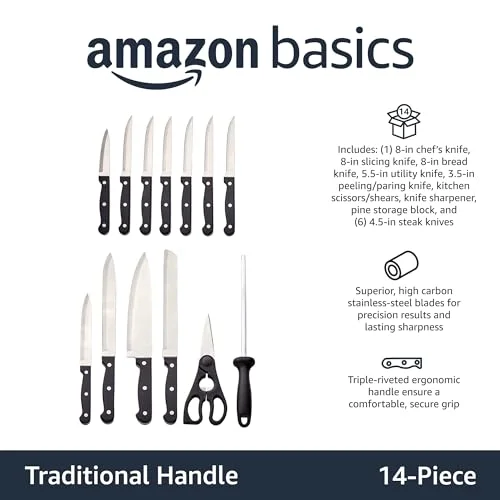
Amazon Basics 14-Piece Knife Set
Best for a narrow galley counter or a tight spot beside the stove
14 pieces·Full tang construction·Sharpener included·Pinewood block
The fewest slots of the three sets in this guide, which in practical terms means less wood and a shorter block, even without a published width. A 14-piece pinewood block with a built-in sharpener and ergonomic full-tang handles, at $22.28, is the shape most likely to clear a tight run of counter next to a stovetop or under a cabinet with limited headroom above it. Amazon doesn’t state a block width in inches anywhere on the listing, so treat the lower piece count as a useful proxy for a smaller footprint, not a guarantee, and measure your own run before ordering.
The set most likely to fit where you’ve only got a narrow strip of counter to give it.
02Mid-size counter
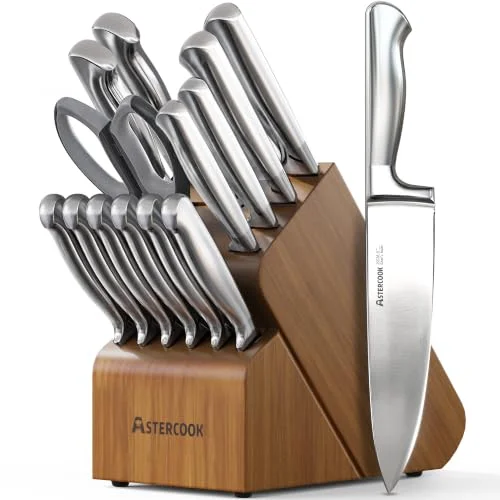
Astercook 15-Piece German Steel Knife Set
Best for a mid-size stretch between the sink and the stove
15 pieces·German steel·Size: Large·Knife block included
One more piece than the Amazon Basics set, and the listing’s own size label — “Large” — is the clearest signal Astercook gives that this block sits bigger than the brand’s smaller German-steel sets, even without a measurement attached to that word. Fifteen slots built to hold German steel pieces is a reasonable fit for the 24-to-30-inch stretch many apartment kitchens have free between the sink and the stove, at $59.99. But “Large” on an Amazon size field describes a product tier, not a tape-measure reading, so confirm the actual footprint in the listing photos or the Q&A section before committing a wide chunk of counter to it.
A reasonable middle ground if your free counter is more than a narrow strip but less than a dedicated two feet.
03Generous counter only
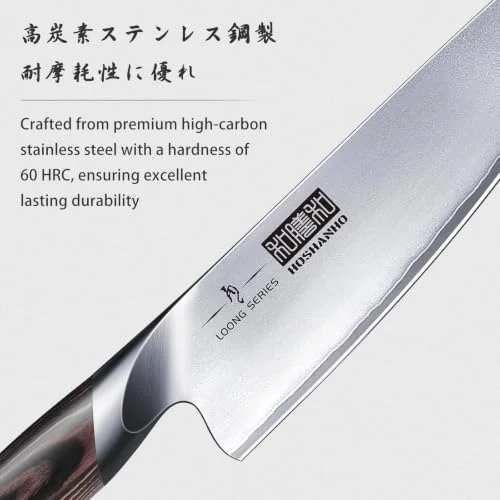
HOSHANHO 20-Piece Japanese Knife Set with Block
Best only if you have roughly two feet of counter to dedicate to it
20 pieces·Japanese knife set·Block included·Premium price tier
Twenty pieces is the largest count of any set named in this guide, and nothing about buying it makes sense on a counter that can’t spare roughly two feet of unbroken run — the reasoning laid out above, not a published HOSHANHO measurement, since the listing states the piece count and that a block is included and nothing about the block’s footprint. At $284.99 it is also the most expensive set named here by a wide margin, which makes it the one purchase on this page where measuring first and ordering second matters most: a block this size wedged into a space four inches too narrow stays a daily counter problem for years, not a one-time annoyance. Our full review of the HOSHANHO 20-piece set covers what the extra pieces actually are, which is worth reading before you decide whether you have the counter to match the price.
Measure the space before you spend $310 discovering it doesn’t fit.
Side by side
The three, by footprint tier
| Set | Counter tier | Pieces | What's confirmed | Price | Get it |
|---|
 Amazon Basics 14-Piece |
Narrow run |
14 |
Full tang, sharpener, pinewood block |
$22.28 |
Get it |
 Astercook 15-Piece |
Mid-size stretch |
15 |
German steel, size: Large, block included |
$59.99 |
Get it |
 HOSHANHO 20-Piece |
Generous run only |
20 |
Japanese knife set, block included |
$284.99 |
Get it |
None of the three listings publish a block width or depth in inches — the tiers above are built from piece count and size label, not a tape measure. See the full six-set roundup for sets across every piece count.
Before you order
Measuring your own counter before you order
Every number in this guide so far has been a general range built from how knife blocks are typically constructed, not a published spec for any one listing. The only measurement that actually matters is the one you take yourself, in your own kitchen, before you click buy. It takes about two minutes and needs nothing more than a tape measure.
- Clear the stretch of counter you intend to use and measure the open horizontal run in inches, from one fixed obstruction to the next. An outlet cover doesn’t count as an obstruction; the coffee maker or fruit bowl you have no intention of moving does.
- Measure depth from the wall or backsplash to the point on the counter where you want the front of the block to sit, then subtract at least an inch or two from that number so the block isn’t pushed flush against the wall — see the clearance section above for why.
- Open the cabinet door above that spot, if there is one, and measure straight down to the counter surface. That is your slot-height ceiling: the tallest knife handle in the set has to clear it when lifted straight up.
- Compare those three numbers against the listing’s own photos and customer Q&A, not against the general ranges in this guide, since none of the three sets named here publish an exact block width or depth. A ruler laid against a known reference object in a customer-submitted photo is often the closest thing to a real measurement you’ll find.
- Keep a spare box or a stack of books roughly the size you expect the block to be and set it in the actual spot for a day. It is a low-effort way to catch a footprint problem before the real block arrives and the return window starts ticking.
Our method
How we researched this — and what we can't tell you
What we did
Published listings and general construction facts
We compared the published listing details — piece count, size and variant labels, and current Amazon prices — for the three knife block sets named in this guide, and set them against general, well-established facts about how knife blocks are built: slot count, slot angle, and where a built-in sharpener or shears compartment sits all affect the footprint a block needs on a counter, independent of any one brand.
What we didn't
We don't run a testing lab
We do not physically test these knife blocks, we do not own them, and we did not measure any of the three with a tape measure, because none of the three listings publish a block width, depth or slot height, and we won’t invent a number a manufacturer hasn’t published. What we can do honestly is reason from the piece counts, size labels and well-known physical facts about how blocks are built, and tell you plainly which numbers are general estimates and which are confirmed specs.
FAQ
Common questions
How much counter space does a basic 14-piece knife block need?
There is no published figure for most 14-piece sets, including the Amazon Basics set named in this guide, but the general reasoning holds: fewer slots mean less wood, which generally means a shorter block than a 20-piece set built around the same slot spacing. Treat piece count as a useful proxy for size, not a guaranteed measurement, and confirm the actual footprint against your own counter before ordering.
Why don't knife block listings publish block dimensions?
Most Amazon listings in this category lead with piece count and price because those are the numbers shoppers compare first, and listing space is limited. Block width, depth and slot height are checkable facts a manufacturer could publish, but in practice they often aren't, which is why customer-submitted photos and Q&A sections are frequently the only place an actual inch figure appears for a given set.
Does a built-in sharpener make the block bigger?
Generally yes. A sharpener built into the block occupies a slot position of its own rather than holding a knife, which means a block with a built-in sharpener typically needs to be at least as wide as an equivalent block with the same knife count and no sharpener. The same logic applies to a built-in shears compartment.
How much wall clearance should I leave behind a knife block?
An inch or two is a reasonable minimum. Pulling a long knife straight up and out of a slot usually means tilting the handle back slightly, and a block pushed flush against a backsplash or windowsill doesn't leave room for that motion. A small gap also keeps the block from sitting directly against a corner where condensation or splashback can collect.
Keep reading
Related on Best Knife Sets