The set, in short
What this review is, and what it isn't
This is a single-product review of one listing: the Chicago Cutlery Insignia Triple Rivet Poly 18-Piece Kitchen Knife Block Set with Wooden Block & Built-In Sharpener, ASIN B08YMKNDNY, priced at $166.11. We don't own this set, we haven't drawn a blade through its sharpening slot, and we don't run a testing lab that could tell you how the edge holds up after months of weeknight dinners. What we can do honestly is read Chicago Cutlery's own listing closely, compare its stated price and features against the Henckels and Ninja sets already reviewed and compared on this site, and tell you plainly which claims the listing actually makes and which ones it leaves for you to assume.
The short version: at $166.11, this set is priced in the same band as the most expensive block we've covered, built around three stated features — triple-riveted handles, a wooden block and a built-in sharpener — rather than a published hardness figure, an edge angle, or even a stamped-versus-forged claim. Chicago Cutlery is leaning on its name and its piece count more than on a checkable steel spec, and that's a specific trade worth understanding before the price alone decides it for you.
At a glance
Chicago Cutlery Insignia 18-Piece Block Set
0118 pieces
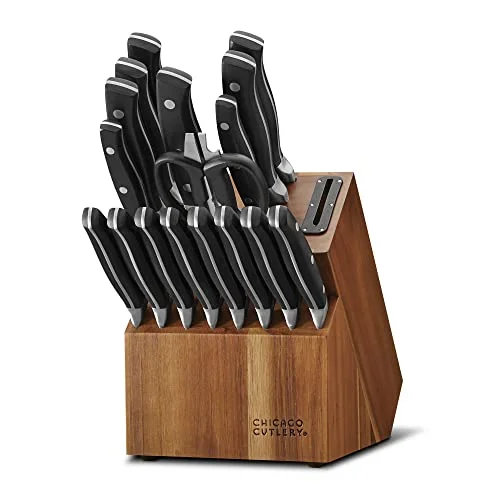
Chicago Cutlery Insignia Triple Rivet Poly (18-PC) Kitchen Knife Block Set
Best for buyers who want the largest piece count in this catalogue from a long-standing American name
18 pieces·Triple-riveted poly handles·Wooden block, built-in sharpener·$166.11
The listing's headline claims are a wooden storage block with a built-in sharpener, black ergonomic handles secured with triple rivets, and stainless steel blades the title describes simply as sharp and professional-grade. What the listing does not publish is a Rockwell hardness figure, a stated edge angle, a stamped-versus-forged claim, or a full-tang claim — none of which we'll assert on its behalf.
Eighteen pieces, a real wooden block and a genuine sharpening slot, sold on piece count and a long-standing name rather than on a published steel spec.
What's actually in the box
What's in the 18-piece block
Eighteen is the largest headline piece count of any set we've reviewed on this site, bigger than the Ninja NeverDull's 17 and well past the Henckels Statement's 15. What Chicago Cutlery's listing title does not do is itemize those 18 pieces the way some of the budget sharpener blocks in this catalogue do — there's no bullet-by-bullet breakdown of exactly how many are chef's knives, utility knives, steak knives or the block and sharpener counted as pieces in their own right. The title commits to a total; it doesn't commit to a list.
That matters because, as we've seen elsewhere in this catalogue, a "15-piece" set can mean seven knives and a shear, or eight knives and six steak knives, depending entirely on how the manufacturer counts. There is no reason to assume an 18-piece Chicago Cutlery block splits any differently, and we won't guess at a breakdown the listing doesn't give us. If the exact mix of knives versus steak knives versus block hardware matters to your decision, the listing's own bullet points and product photos are the place to check it, not an assumption carried over from a smaller set elsewhere on this page.
What is explicit in the title is the block material: wood, rather than the unspecified block material on sets like the Ninja NeverDull. A wooden block is also, by construction, bulkier on a counter than a slim in-drawer tray, and at 18 pieces this is not a small object. The listing doesn't publish its footprint, so we won't estimate one here — our guide to measuring a knife block before you buy walks through how to check a block's real footprint from listing photos before it arrives on your counter.
What's in your hand
Triple-riveted poly handles: what they're actually made of
The listing title specifies "Triple Rivet Poly" handles, finished in black and described as ergonomic. "Poly" is shorthand for a polymer handle material — a molded synthetic rather than wood, bone or a cast metal bolster — and triple rivet describes the fastening, not the material: three visible rivets running through the handle where it meets the blade's tang, the same construction style used on several of the Henckels sets we've compared and on Cuisinart's forged line elsewhere in this catalogue. Three rivets through a polymer handle is a genuinely sturdy, dishwasher-resistant way to build a handle; it is also a different material story from the solid wood or stainless-steel-and-rivet handles found on some premium sets.
What the listing does not state is how far the steel runs inside that polymer handle. Triple rivets are often, though not always, a sign that the tang runs the handle's full length — there generally isn't much structural point in triple-riveting a handle onto a short stub of steel. But "often" is not "confirmed," and Chicago Cutlery's listing never uses the words "full tang" the way some competing listings do explicitly. If a confirmed full-tang claim is the deciding factor for you, that's a detail to verify on the current listing photos rather than infer from the rivet count alone, the same caution worth applying to any set in this price range that doesn't spell the claim out in writing.
The practical read on "poly": it is a durable, grippable, and typically lighter handle material than wood or metal, and it's the same broad category used across a wide range of block sets at every price point in this catalogue. It is not, on its own, a sign of either a premium or a budget build — it's simply what the listing tells us is in your hand, stated plainly rather than described in marketing language that implies more than it confirms.
The feature every tier shares
The built-in sharpener, against the cheaper blocks
Chicago Cutlery's built-in sharpener sits in the same functional category as the sharpening slots we've covered at every price point in this catalogue: a fixed mechanism set into the block itself, so the knife picks up a touch-up pass simply by being put away. That's mechanically the same basic idea behind the Ninja NeverDull's sharpening slot at a similar price, and behind KitchenAid's Gourmet 15-piece set at barely a third of this price. The mechanism's core job — removing a small, consistent amount of steel on the way back into the block — doesn't change much from one listing to the next. What changes is what each manufacturer is willing to publish about it.
On that measure, Chicago Cutlery's listing is no more specific than the budget tier: no stated sharpening angle, no named abrasive material, no pass-count rating before the mechanism wears. That puts it on equal published footing with KitchenAid's $75.98 set and the sharpener-equipped McCook and Astercook sets we've compared elsewhere, none of which publish those details either. If a built-in sharpener is the entire reason you're shopping in this category, the mechanism here is not demonstrably better, on the facts each listing actually states, than one built into a block costing a third of the price.
What Chicago Cutlery's price is buying alongside the sharpener, then, is the wooden block itself, the larger 18-piece count, and the triple-riveted handle construction — not a more capable or more precisely specified sharpening slot. That's worth separating clearly before the $166.11 figure gets credited entirely to the one feature every tier in this catalogue already includes.
The name on the block
A heritage brand name: does it change the steel?
Chicago Cutlery is one of the older names in American kitchen cutlery, with a history that predates most of the direct-to-consumer knife brands sold on Amazon today, including the appliance-crossover names like KitchenAid that have only recently entered the knife-block category. That kind of longevity is a real, if narrow, form of credibility: a brand that has been making knives in the US for decades generally has an established customer-service and replacement-parts infrastructure behind it, the same practical advantage we've written about separately when looking at what knife-set warranties actually cover.
What a long-standing name does not automatically do is change the steel in the box you're buying today. Chicago Cutlery's listing title describes the blades only as "Sharp Stainless Steel" — it does not state a steel grade, a country of origin for the steel, a Rockwell hardness figure, or whether the blades are stamped or forged. That's a meaningfully less specific construction claim than Henckels' stamped, German-engineered Statement line or the forged, imported-steel claim on KitchenAid's Gourmet set. A heritage name is a statement about the company's history, not a substitute for a published steel spec, and we won't credit this listing with a construction claim it doesn't make just because the brand itself is an old one.
The honest framing: buy into Chicago Cutlery's history if a long-running American name and its customer-support track record matter to you. Don't buy into it expecting that history to have quietly upgraded the stainless steel beyond what the listing actually states, because nothing in the published listing says it has.
The number on the page
Where $166.11 lands against the Henckels and Ninja tiers
At $166.11, this set sits almost exactly where the Ninja NeverDull 17-Piece Block Set does at $229.99 — within $9 of each other, one piece apart, both with a sharpener built into the block. The practical difference between the two at that shared price point is what each listing is willing to state: Ninja's publishes a German stainless steel claim and an optimized edge angle for its blades, while Chicago Cutlery's stops at "Sharp Stainless Steel" without a country of origin, a grade, or an angle. Paying essentially the same money, you're getting one more piece from Chicago Cutlery and one more published construction detail from Ninja.
Against the Henckels Statement 15-Piece set at $118.73, Chicago Cutlery's $166.11 is a little under double the price, for three more pieces, a wooden block instead of none, and a built-in sharpener Henckels' Statement line doesn't include at that tier. Henckels, in turn, states its blades are stamped and German-engineered, a specific construction claim Chicago Cutlery's listing doesn't match at any price. The two sets aren't really competing on the same claim at all: Henckels is selling engineering heritage and a stated construction method at the lower price; Chicago Cutlery is selling piece count, a wooden block and a sharpener at the higher one.
Prices on all three listings move, sometimes by a few dollars and sometimes by more. The figures above are current price-check snapshots, not guarantees, and the sensible habit before buying any of the three is the same one that applies network-wide: confirm the live Amazon price before you check out, rather than treating any number printed in a review, including this one, as fixed.
The decision
Who should buy this instead of a 15-piece set at half the price
Picture the alternative as Henckels' 15-piece Statement set at $118.73 — a little over half of Chicago Cutlery's $166.11, with a stated stamped, German-engineered construction but no built-in sharpener and three fewer pieces. Choosing the Chicago Cutlery Insignia over that cheaper alternative makes sense if you specifically want a sharpener built into the block, if a wooden block matters to you more than an unspecified or no-block alternative, if the extra pieces genuinely get used in your kitchen rather than sitting untouched, and if you'd rather buy from a long-standing American cutlery name than a German engineering claim backed by a specific stamped-blade spec.
It makes far less sense if what you actually want is a checkable steel claim to hold the purchase to. Henckels' sheet states its blades are stamped; Chicago Cutlery's doesn't commit to stamped or forged at all. If a published construction method is the deciding factor, the cheaper Henckels set gives you more to verify for less money, even without a sharpener in the block. And if your honest habit is running a knife through a sharpening slot a few times a week and nothing more demanding, that mechanism performs the same basic job here as it does on a $75.98 KitchenAid block — which means a meaningful share of the extra $145 over Henckels is paying for piece count, the wooden block and the name, not a more capable edge or a sharper mechanism.
Our method
How we researched this review
What we did
Read the listing, compared it against sibling sets
We read Chicago Cutlery's published listing for this exact ASIN — the piece count, the stated construction details, the price — and set it against the published listings and prices for the Henckels and Ninja sets already reviewed and compared on this site. Where the listing was specific, we repeated the specific detail. Where it wasn't, including steel grade, Rockwell hardness, edge angle, and stamped-versus-forged construction, we said so instead of filling the gap.
What we didn't
We don't run a testing lab
We do not physically test this knife set, we do not own it, and we have not drawn a blade through its sharpening slot. We don't publish an invented score out of ten, and this listing carries no verified rating or review count for us to paraphrase, so we have not attributed any sentiment to owners. Edge retention over months of use is measured in laboratories with repeated-cut machines, not by a writer's afternoon in a kitchen, and we're not pretending otherwise.
The bottom line
The verdict
At $166.11, the Chicago Cutlery Insignia 18-Piece set is a large, triple-riveted, wooden-block set with a genuine built-in sharpener from one of the older names in American cutlery — and a listing that's notably light on checkable steel specifics for the price. It beats a cheaper 15-piece set on piece count, on having a built-in sharpener at all, and on a dedicated wooden block. It does not beat a cheaper set on anything the listing could actually prove about the steel itself, because the listing doesn't make that claim in the first place.
Buy this set if the piece count, the wooden block and a long-standing American name genuinely matter to you, and $166.11 doesn't move your budget. Buy Henckels' 15-piece Statement set instead if a stated, checkable construction method matters more than a sharpener and a bigger count, or the Ninja NeverDull instead if you want a similarly priced sharpener block that publishes more about its own steel. On the facts each listing actually states, Chicago Cutlery's premium over the Henckels tier is paying for pieces, wood and a name — not for a steel spec it never puts in writing.
FAQ
Common questions
What's actually included in the Chicago Cutlery Insignia 18-piece set?
The listing commits to 18 pieces total, built around triple-riveted black handles, stainless steel blades and a wooden storage block with a built-in sharpener. The title does not itemize the exact split between chef's knives, utility knives, steak knives and block hardware, so we won't guess at a breakdown it doesn't publish — check the listing's bullet points and photos for the precise contents before buying.
Are the triple-riveted poly handles full tang?
Not confirmed. "Poly" describes a polymer handle material, and three rivets usually suggest the steel tang runs a meaningful length into the handle, but the listing never uses the words "full tang" the way some competing sets do explicitly. If a confirmed full-tang claim matters to your decision, verify it on the current listing photos rather than inferring it from the rivet count alone.
How does the built-in sharpener compare to cheaper blocks?
Mechanically, it's the same category of fixed sharpening slot found on far cheaper sets like KitchenAid's $75.98 Gourmet block and on similarly priced sets like the Ninja NeverDull. None of these listings, Chicago Cutlery's included, publish a sharpening angle, abrasive material, or pass-count rating, so there's no published basis for calling one mechanically better than another.
Does the Chicago Cutlery name mean better steel?
Not on its own. Chicago Cutlery is one of the older names in American cutlery, which is a real but narrow form of credibility around customer service and brand longevity. The listing itself only describes the blades as "Sharp Stainless Steel," without a grade, origin, hardness figure, or a stamped-versus-forged claim, so the brand's age doesn't substitute for a published steel spec it doesn't state.
Keep reading
Related on Best Knife Sets