First principle
The pattern is a welding process, not a type of steel
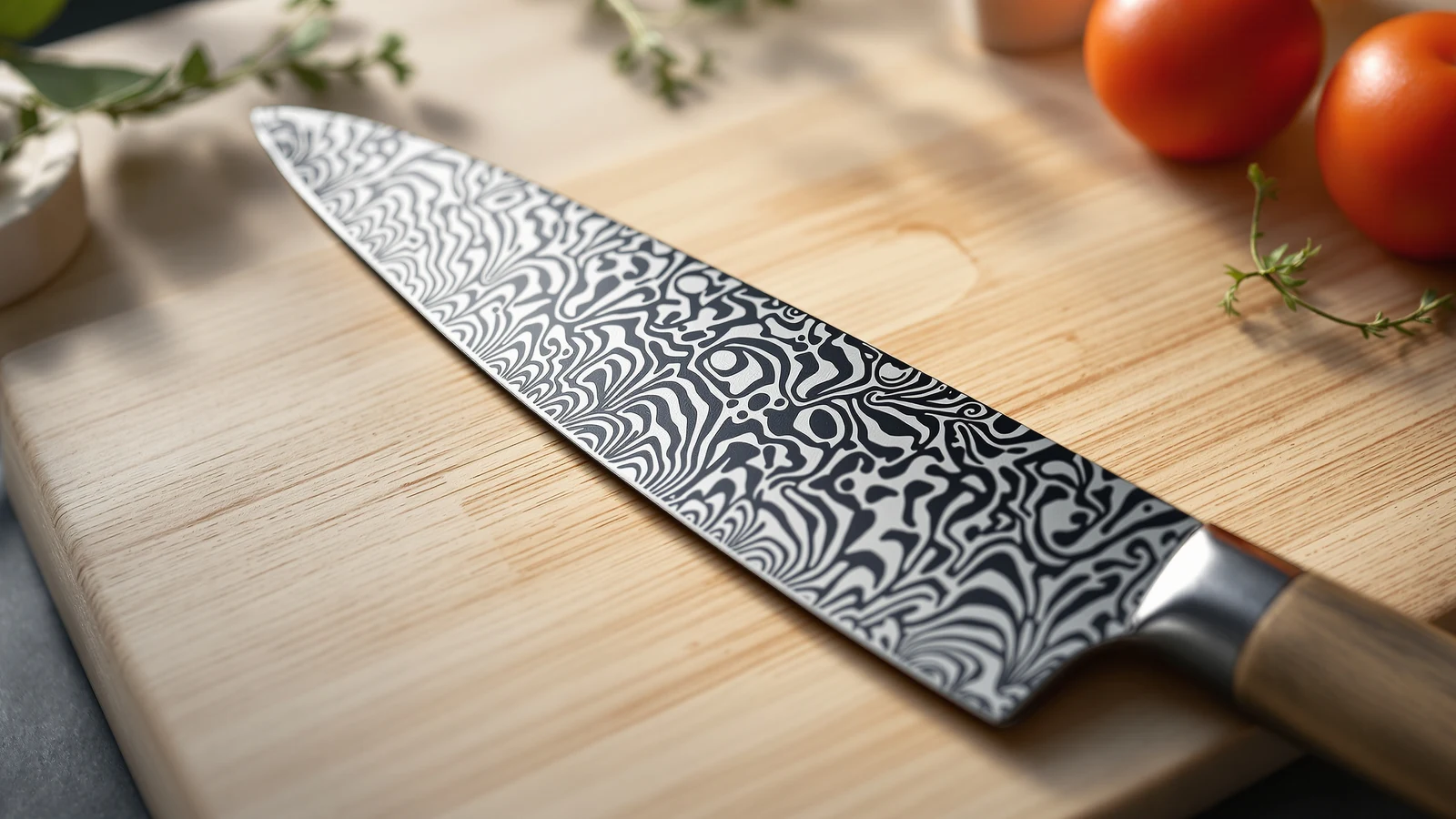
"Damascus" started as the name for a specific historical technique — blades forged from wootz crucible steel, a method largely lost by the 1800s. What every modern kitchen listing calls Damascus is a different process: pattern-welded, laminated steel. A smith stacks thin sheets of two or more steel alloys, forge-welds the stack under heat and pressure, then folds it back on itself repeatedly, doubling the number of layers each time. Once the blade is ground and polished, the maker etches the surface in a mild acid bath. The different alloys in the stack etch at different rates, and that differential etching is what produces the wavy, mottled lines buyers associate with the word Damascus. The pattern is a byproduct of how the metal was built, not an ingredient in it.
This is also why a layer count on its own tells you less than it sounds like it does. A listing that says "67-layer Damascus" is describing how many times the stack was folded and how fine the resulting pattern reads to the eye — more folds generally means a tighter, busier pattern. It is not a hardness figure, an edge-retention claim or a grade of steel. Two knives can both carry a 67-layer pattern and perform completely differently, because the layer count describes the outside of the sandwich, not what is sitting at its center.
That center is the actual question worth asking before the pattern convinces you of anything. A "Damascus knife" names a construction method applied around a core. What determines whether that knife is a good cutting tool is the same thing that determines it on a plain, unpatterned blade: the specific steel doing the cutting.
What's actually cutting
VG10 and other named cores: the part that actually determines the edge
VG10 is a Japanese high-carbon stainless steel developed by Takefu Special Steel, widely used across Japanese cutlery because it takes a fine edge and holds it well relative to softer stainless alloys. On a Damascus-patterned knife, VG10 (or whatever alloy the maker names) typically sits as the core, sandwiched between the softer, more corrosion-resistant layers that get folded and etched to produce the visible pattern. The outer layers protect the harder core from chipping and add some flexibility to the whole blade; the core is still the part doing the work at the edge. That construction — a named hard core wrapped in softer cladding — is standard practice across modern Damascus cutlery, Japanese and otherwise, and it is worth knowing before you read a listing as if "Damascus" alone were the spec.
Two of the three sets in this guide name their core steel outright. The 3-piece Japanese Chef Knife Set states a "VG10 Steel Core" under its 67-layer Damascus exterior, and the SENKEN 16-Piece Dynasty Collection states "Japanese VG10 Steel" in its own listing title. In both cases, VG10 is the checkable fact; the layer count and the pattern are the finish built around it. The Seido Master 17-Piece Damascus Knife Block Set is the instructive exception: its listing describes "Damascus steel kitchen knives" without naming a specific core alloy anywhere in the title. We won't guess what's inside that pattern on Seido's behalf — if the specific core steel matters to your decision, that is a detail to confirm on the current listing or product description before buying, not something the word Damascus settles for you on its own. The same gap shows up elsewhere in this category; the gyutou profile in our imarku 14-piece Japanese set is a useful comparison, because its listing leads with a published edge angle and Rockwell figure rather than a visual pattern — a different, equally checkable way of telling you what you're actually buying.
Doing the math
Why a 3-piece set can cost as much as a full block
Run the per-knife math on these three sets and the piece count stops explaining the price almost immediately. The 3-piece Japanese Chef Knife Set, VG10 core and all, runs $134.99 — about $56.66 per knife. The Seido Master 17-Piece Damascus Knife Block Set runs $296.65, or roughly $20.53 per piece once the block, the extra knives and the rest of the set are counted in. The SENKEN 16-Piece Dynasty Collection runs $585.65, about $43.06 per piece — nearly double Seido's per-piece price for one fewer item in the box. By piece count alone, SENKEN should be the cheaper-feeling set. It isn't, and the smallest set of the three, the 3-piece, actually carries the highest per-knife price of all three.
The reason is that laminating, folding and acid-etching a blade is labor priced per blade, not per box. A 3-piece set concentrates that labor cost across three knives, so each one reads expensive on its own. A larger block set spreads the same kind of labor across more pieces — and often pads the count further with lower-cost items like steak knives, a sharpening rod or kitchen scissors — which lowers the average even when the headline total looks bigger. Between Seido and SENKEN specifically, the gap is mostly what SENKEN states and Seido doesn't: a named VG10 core, "Sycamore Wood Handles," a bundled sharpening rod and scissors, and a "Dynasty Collection" presentation tier. None of that is dishonest, but it is a different thing from "one more knife," and it is why two 16-to-17-piece Damascus blocks can sit $340 apart.
It's also worth sizing this against premium sets outside the Damascus category entirely. Our review of the HOSHANHO 20-piece set, priced near $570 with no pattern-welded claim at all, makes the same point from the other direction: a large, expensive block set's price is driven by brand positioning and bundled accessories at least as much as by piece count, with or without a Damascus finish involved. And if the pattern simply isn't the priority, forged, full-tang construction without any lamination costs dramatically less — the sets compared in our Martha Stewart knife set comparison run well under $100 for forged blades and a block, precisely because none of that budget went toward folding and etching a pattern into the steel.
Day to day
Does a patterned blade need anything different?
The edge itself follows the core steel, not the pattern. Sharpening angle, frequency and the stone or rod you'd use are a function of whatever alloy is at the center — VG10 on two of these three sets — the same way they would be on a plain, unpatterned blade of the same steel. None of the three listings in this guide publish a Rockwell hardness figure, so we won't state one on their behalf; if a specific hardness number matters to you, check the current listing before assuming it. None of them describe a built-in sharpener in the block either, unlike the mechanism reviewed in our Ninja NeverDull set, so budget for a separate whetstone, rod or pull-through tool — our comparison of pull-through sharpeners versus honing steels covers which keeps an edge working without aggressively grinding into the show face of a patterned blade.
What is different is the surface itself. The visible pattern is not a coating; it is the blade's own metal, etched to different depths across the different alloys in the stack. That makes it a genuinely cosmetic concern in a way a plain polished blade doesn't have: an abrasive scouring pad, steel wool, or repeated dishwasher cycles can scrub down the contrast between layers over years, leaving the pattern fainter or streaky even if the edge underneath is perfectly fine. The underlying rule is the same one every knife in this category needs — hand wash, dry immediately, store in a block or sheath rather than loose in a drawer — it is simply more visible when ignored on a Damascus finish, because the thing that fades is the exact detail you paid the premium for.
What's in the price
Where the price is paying for the look alone
Presentation is a real line item in this category, and it's worth separating from the steel before you compare prices. The 3-piece Japanese Chef Knife Set is sold with an "Elegant Cooking Gifts Box" and an "Ocean-Blue Ergonomic Handle" — packaging and cosmetic finish that cost money to produce and are part of what $134.99 buys, independent of the VG10 core doing the actual cutting. The SENKEN set goes further, branding itself "The Dynasty Collection" and bundling a sharpening rod and kitchen scissors alongside sycamore wood handles. None of that is a misrepresentation — the listings state what's included — but it is packaging, branding and bundled accessories, not blade performance, and it belongs in a separate column when you're pricing a knife against its plainer competition.
There's a broader market pattern worth knowing even though it doesn't describe any of the three sets here specifically: some knives sold as "Damascus style" apply the wavy look by laser-etching or printing the pattern onto an otherwise plain, unlaminated blade, rather than folding and forging it from real layered steel. That's a purely cosmetic shortcut, and it doesn't carry the labor cost — or, arguably, the durability benefit of the softer cladding — that genuine pattern-welded construction does. We have not seen evidence either way on this specific point for the three sets reviewed here beyond what their own listings state, and we won't assume one way or the other on their behalf. The honest habit, for any Damascus knife, is checking the listing and product photos for language describing actual forged, folded or laminated construction, rather than letting the depth of the wavy lines alone stand in for that confirmation.
The picks
Three Damascus sets, and what their listings actually state
01Named core, smallest set
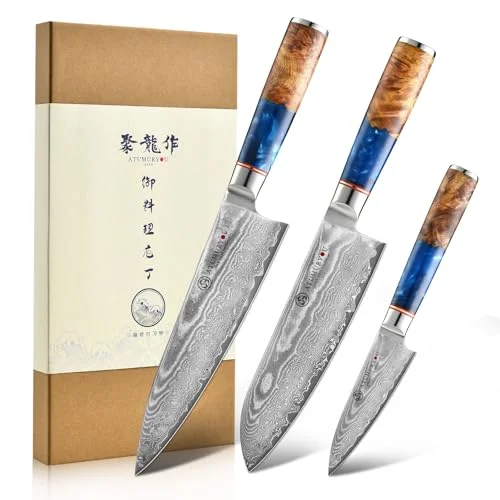
Japanese Chef Knife Set, 3 Pcs — 67-Layer Damascus, VG10 Steel Core
Best for a named core steel without a block
3 pieces·67-layer Damascus·VG10 steel core·7" · Ocean-blue handle
This is the set in this guide that states the most about what's actually cutting: a VG10 steel core underneath a 67-layer Damascus pattern, finished with an ocean-blue ergonomic handle and an "Elegant Cooking Gifts Box." At $134.99 for three knives, it works out to the highest per-knife price of the three sets compared here — the cost of concentrating pattern-welded labor and named-core steel across a small count, with none of it diluted by filler pieces.
The set to buy if you want a named core steel and a visible pattern on a short, specific blade lineup, and don't need a block.
02Lowest per-piece price
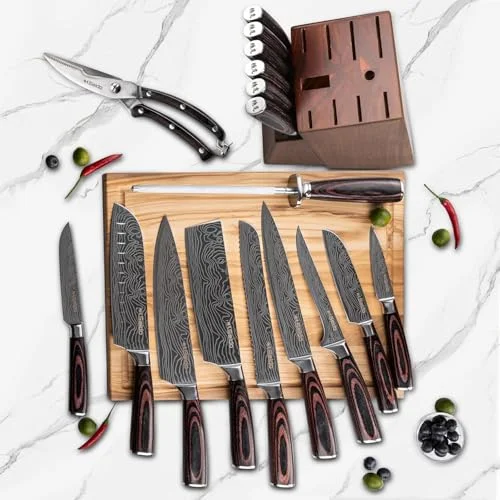
Seido Master 17-Piece Damascus Knife Block Set
Best for a full Damascus block without a stated core
17 pieces·Damascus steel·Acacia wood block·Sizes: 8" 8" 8" 7" 7" 5" 6" 3.5"
Seido's listing title describes "Damascus steel kitchen knives" and an acacia wood storage block, with a published size run across the eight knives in the set. It does not name a specific core alloy the way the other two sets here do — a gap worth checking on the current listing before buying if the steel underneath the pattern is the deciding factor for you. At $296.65 for 17 pieces, it is the lowest per-piece price of the three Damascus sets compared in this guide.
The set to buy for the pattern and a complete block at the lowest cost per piece here — just confirm the core steel on the listing yourself first.
03Named core, most bundled
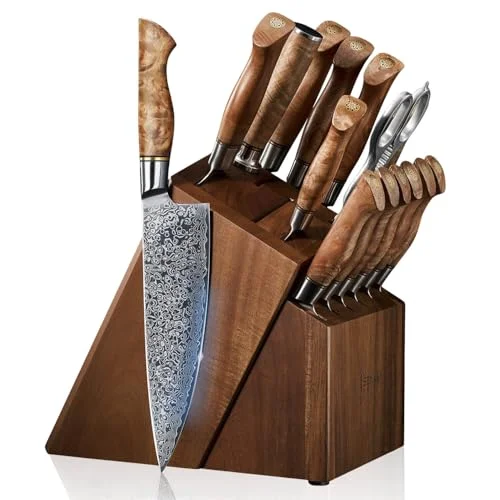
SENKEN 16-Piece Damascus Knife Block Set — The Dynasty Collection
Best for a named core plus bundled sharpening tools
16-piece block set·Japanese VG10 steel·Natural sycamore handles·Steak knives, scissors & sharpening rod included
SENKEN's "Dynasty Collection" states Japanese VG10 steel outright, paired with natural sycamore wood handles, and bundles steak knives, kitchen scissors and a sharpening rod into the 16-piece block. At $585.65, it is the most expensive set in this guide by a wide margin, and roughly double Seido's per-piece price for one fewer piece — the premium here is the named core plus the bundled accessories and branding, not a larger knife count.
The set to buy if a named core steel, included sharpening rod and a top-tier presentation box all matter to you, and price is not the deciding factor.
Side by side
The three, compared on what their listings state
| Set | Best for | Pieces | Named core | Price | Per piece | Get it |
|---|
 Japanese Chef 3-Piece |
Named core, no block |
3 |
VG10 |
$134.99 |
$56.66 |
Get it |
 Seido Master 17-Piece |
Lowest per-piece price |
17 |
Not stated |
$296.65 |
$20.53 |
Get it |
 SENKEN 16-Piece Dynasty |
Named core, most bundled |
16 |
VG10 |
$585.65 |
$43.06 |
Get it |
Per-piece prices are the listed total divided by the stated piece count, for comparison only. Prices change — confirm the current price on Amazon before buying. See our note on how much counter space a block actually needs before adding a 16- or 17-piece block to a small kitchen.
Before you buy
What to check on a listing before the word Damascus convinces you
01
Is a core steel actually named?
Look for a specific alloy — VG10 or another named steel — not just "high carbon steel" or the word Damascus standing alone. If no core is named, as with Seido's listing here, don't assume one.
02
Is the layer count tied to anything?
A number like "67-layer" describes pattern density from folding, not hardness or edge retention. Treat it as a cosmetic spec, not a performance one.
03
Does the listing describe forging, not just a finish?
Check for language or photos confirming folded, laminated construction, rather than assuming the depth of the pattern guarantees it wasn't etched or printed onto a plain blade.
04
Is the size and piece count itemized?
A "16-piece" or "17-piece" total can hide very different contents. Check the size/variant line for each knife, and see what a warranty on a premium set actually covers before paying for the top of this price range.
Our method
How we compared — and what we can't tell you
What we did
Listings, construction claims and current prices
We compared the published listing details and current Amazon prices for three Damascus-marketed knife sets in our catalogue, reading each title and description specifically for what it states about core steel, layer count, construction method and included pieces, rather than treating the word Damascus itself as a specification.
What we didn't
We don't run a testing lab
We do not physically test these knives, we do not own them, and we have not seen the Rockwell hardness figures or metallurgical reports for any of the three. We have no verified review data for these specific products, so we don't paraphrase owner sentiment either. Where a listing doesn't state a detail — a core alloy, a hardness number — we say so rather than inferring it from the pattern.
FAQ
Common questions
Is Damascus steel better than regular stainless steel?
Damascus isn't a steel type to compare against stainless — it's a construction method, pattern-welded layers folded and acid-etched to show a wavy finish. The question that actually determines cutting performance is what core steel sits underneath that pattern. A Damascus knife with a named core like VG10 performs according to that core steel's properties, not according to how many layers were folded around it.
What does the layer count, like "67-layer," actually tell me?
It describes how many times the steel stack was folded before the blade was ground and etched, which affects how fine and busy the visible pattern looks. It is not a hardness figure or an edge-retention claim. Two knives can carry the same layer count and perform very differently depending on the named core steel, if any, underneath.
Does a Damascus pattern need different care than a plain blade?
The edge itself follows the core steel's hardness and sharpening needs, the same as any plain blade. What's different is the visible pattern, which is etched into the metal itself rather than coated on — abrasive scouring pads, steel wool and repeated dishwasher cycles can dull or streak that contrast over years. Hand wash and dry immediately, the same rule every knife in this category needs, just with a more visible consequence if skipped.
Why does a smaller Damascus set sometimes cost more per knife than a full block?
Folding, laminating and acid-etching a blade is labor priced per knife, not per box. A small set concentrates that labor across fewer pieces, so each knife reads more expensive. A larger block set spreads the same kind of labor across more pieces, often padded further with lower-cost extras like steak knives or a sharpening rod, which lowers the average price per piece even when the total looks bigger.
Keep reading
Related on Best Knife Sets